
XJet Elevates Material Science with Nobel Laureate Professor Dan Shechtman Leading Scientific Advisory Board
XJet, a leading innovator in the additive manufacturing (AM) industry, today announced a significant strategic move designed to accelerate the evolution of 3D printing materials. Professor Dan Shechtman, the distinguished recipient of the 2011 Nobel Prize in Chemistry for his groundbreaking discovery of quasicrystals, has been appointed to spearhead XJet’s Scientific Advisory Board. This pivotal appointment underscores XJet’s unwavering commitment to pushing the boundaries of material science and application development within its patented NanoParticle Jetting (NPJ) technology ecosystem. Professor Shechtman’s profound expertise is set to guide XJet’s roadmap, driving advancements in both the fundamental understanding and practical implementation of cutting-edge materials for a diverse range of high-demand industries.
XJet has earned a formidable reputation in the additive manufacturing landscape through its unique NanoParticle Jetting (NPJ) technology. This proprietary process harnesses the precision of inkjet print heads to meticulously deposit ultra-thin layers of a liquid material, which is densely infused with either metal or ceramic nanoparticles. Unlike conventional 3D printing methods, NPJ offers unparalleled accuracy, smooth surface finishes, and the ability to produce parts with isotropic properties, making it an ideal solution for intricate and demanding applications. The versatility of XJet’s metal and ceramic solutions caters to a broad spectrum of industries, including but not limited to aerospace, where lightweight yet strong components are critical; automotive, for prototyping and specialized parts; medical, enabling the creation of custom implants and surgical tools; and various other sectors requiring high-performance, precision-engineered components.
The Strategic Importance of Materials in Advanced Additive Manufacturing
In the rapidly evolving landscape of 3D printing, an undeniable consensus is emerging: the next wave of transformative innovation will predominantly originate from advancements in materials science. Regardless of the underlying additive manufacturing technology, the industry’s progression hinges on the development of materials that offer superior performance characteristics, unlock new functionalities, and address existing limitations. This prediction is not merely speculative but is robustly supported by authoritative industry analyses, such as the Wohlers Report, a widely respected benchmark published annually, which consistently highlights material development as a key driver of growth and technological breakthrough in AM. The capability to print with novel alloys, advanced ceramics, or composite materials that exhibit enhanced strength-to-weight ratios, improved thermal properties, increased biocompatibility, or specific electrical conductivity is paramount to expanding the utility and applicability of 3D printing across industrial sectors.
It is within this critical context that Professor Dan Shechtman’s appointment becomes particularly impactful. His extensive and unparalleled knowledge of scientific challenges, coupled with a career defined by groundbreaking innovation, positions him perfectly to guide XJet’s pioneering efforts. He will play a crucial role in shaping the development of new applications, discovering and refining novel materials, and optimizing the methodologies for how these materials are precisely utilized within XJet’s NanoParticle Jetting (NPJ) technology. Professor Shechtman himself articulated his excitement for this role, stating: “I feel there’s still a huge untapped potential for pushing this technology, through the materials. XJet’s NPJ technology grabbed my heart, mind and imagination and is particularly intriguing to me. Because it jets a liquid, in tiny droplets, it allows for innovation to surpass the level of a single material and involve new mixtures and complex structures.” This insight encapsulates the core philosophy driving XJet’s material roadmap: to move beyond conventional limitations and explore the vast possibilities offered by multi-material capabilities and intricate structural designs.

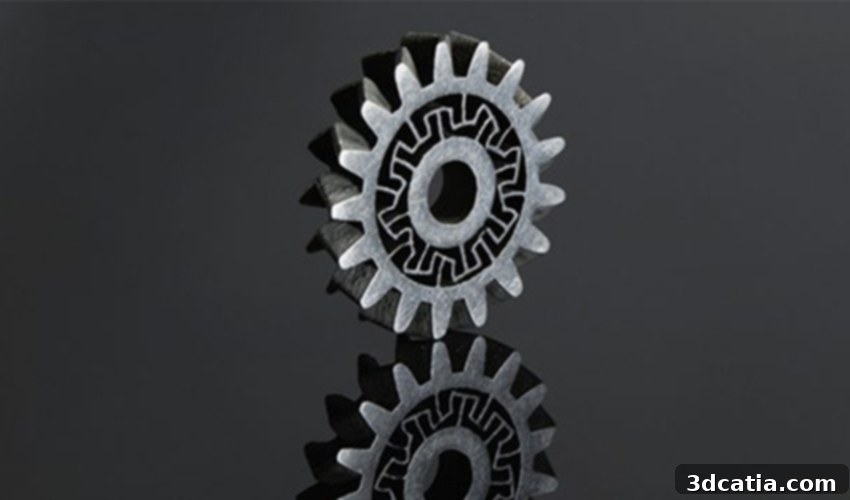
Close-up of XJet’s NanoParticle Jetting technology | Image via XJet
A Legacy of Disruptive Innovation: Professor Shechtman’s Journey with Quasicrystals
Professor Shechtman’s eminence in the field of material science is deeply rooted in his revolutionary understanding of the nature of matter. His monumental discovery of quasicrystals in 1982 fundamentally challenged established scientific dogma and sent ripples through the scientific community. Prior to his work, the prevailing consensus in crystallography dictated that atoms in solids were arranged in perfectly repeating patterns, a rule that had underpinned the field for centuries. Shechtman’s observation of a material with an atomic structure that was ordered but non-repeating – possessing symmetries previously thought impossible for crystals – was initially met with extreme skepticism and even strong denial from many of his peers. These established scientists were reluctant to reconsider their deeply ingrained conceptions of crystallography and the atomic structure of matter, leading to what he famously described as “years of loneliness” in the scientific wilderness.
It took immense determination, unwavering conviction, and persistent empirical evidence to gradually lead a paradigm shift in chemistry and physics. Over time, as more researchers independently verified his findings and began to appreciate the profound implications, the scientific community slowly embraced this breakthrough. The discovery blossomed into a thriving new branch of science, revealing new possibilities in material design and understanding. Eventually, this profound contribution to human knowledge was recognized with the ultimate scientific accolade: the Nobel Prize in Chemistry in 2011. Today, quasicrystals are no longer a theoretical curiosity but are found in a surprising array of practical applications, from enhancing the formation of incredibly durable steel alloys used in high-performance machinery to improving the non-stick properties of everyday frying pans, showcasing the vast potential of materials with previously unimaginable atomic arrangements. This legacy of challenging norms and forging new scientific frontiers makes Professor Shechtman an ideal leader for XJet’s advisory board, where innovation in materials is paramount.
Unlocking “Impossible” Manufacturing Challenges with NPJ and Expert Guidance
Discussing the expansive applications of NanoParticle Jetting, XJet CEO Hanan Gothait articulated the company’s ambitious vision: “My vision for NanoParticle Jetting technology is to solve ‘impossible’ manufacturing challenges.” This statement encapsulates XJet’s drive to tackle complex fabrication hurdles that conventional manufacturing methods, and even other AM technologies, struggle to overcome. These “impossible” challenges often involve the need for incredibly intricate geometries, exceptionally fine details, superior material properties, and high-volume consistency – all hallmarks of NPJ technology. Gothait emphasized the profound significance of the new appointment, stating: “This is fascinating and exactly why the appointment of Professor Shechtman to the XJet team is so momentous. His knowledge of materials and innovation is unrivalled, thus his unique perspective will be priceless to the business.” Indeed, Schechtman’s ability to envision and understand the potential of new material structures will be instrumental in transforming these challenging concepts into tangible realities through XJet’s innovative process.
One particularly significant area where NPJ has created groundbreaking opportunities is in ceramic 3D printing. For a long time, the segment of technical ceramics remained largely untapped by additive manufacturing due to inherent processing difficulties associated with these brittle yet high-performance materials. Traditional methods for ceramic fabrication are often slow, costly, and limited in geometric complexity. However, XJet’s NPJ technology has successfully enabled high-resolution 3D printing with technical ceramics, opening doors to industries previously unable to leverage the advantages of additive manufacturing for such components. This advancement allows for the creation of parts with exceptional physical properties, such as extremely high density – crucial for applications requiring wear resistance, high temperature stability, and chemical inertness. Beyond material properties, NPJ also delivers significant geometric advantages, including the unparalleled ability to form ultra-thin walls, achieve perfectly sharp edges, and produce incredibly smooth surfaces, along with other fine details, all with an impressive accuracy of 0.1mm. These capabilities are transformative for applications in electronics, medical devices, defense, and specialized industrial tooling, where precision and performance are non-negotiable.
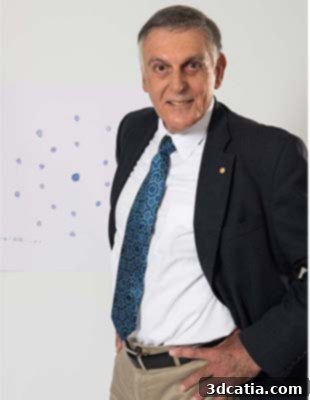
Professor Dan Shechtman
The Future of Advanced Additive Manufacturing: XJet’s Vision
The appointment of Professor Dan Shechtman is more than just a personnel change; it signifies XJet’s deep commitment to scientific rigor and an ambitious vision for the future of additive manufacturing. By bringing a Nobel laureate into a leadership role for its scientific advisory, XJet is strategically positioning itself at the forefront of material innovation, particularly in the realm of advanced ceramics and metals. This collaboration is expected to not only refine existing NPJ processes but also to explore entirely new material formulations and applications, potentially leading to breakthroughs that redefine what is possible with 3D printing. The synergy between Professor Shechtman’s theoretical insights into matter and XJet’s practical, high-precision manufacturing technology promises to accelerate the development of next-generation components, making significant impacts across critical global industries.
This move reinforces the understanding that while hardware and software are crucial, it is the materials that truly unlock the full potential of additive manufacturing. XJet, with Professor Shechtman’s guidance, is poised to lead this material-driven revolution, delivering solutions that are not just incrementally better but fundamentally transformative. The company’s focus on high-performance metals and ceramics through NPJ technology, now supercharged by world-class scientific leadership, sets a new benchmark for what industries can expect from 3D printed parts – components that offer unparalleled detail, superior mechanical properties, and the ability to solve previously intractable manufacturing challenges.
For those interested in delving deeper into XJet’s pioneering NanoParticle Jetting technology and its applications, you can find more information HERE.
What are your thoughts on Professor Dan Shechtman’s appointment to lead XJet’s Scientific Advisory Board and its implications for the future of 3D printing materials? Share your insights and join the conversation in a comment below or connect with us on our Facebook and Twitter pages! Don’t miss out on the latest news and innovations in additive manufacturing; sign up for our free weekly Newsletter, delivered straight to your inbox!