
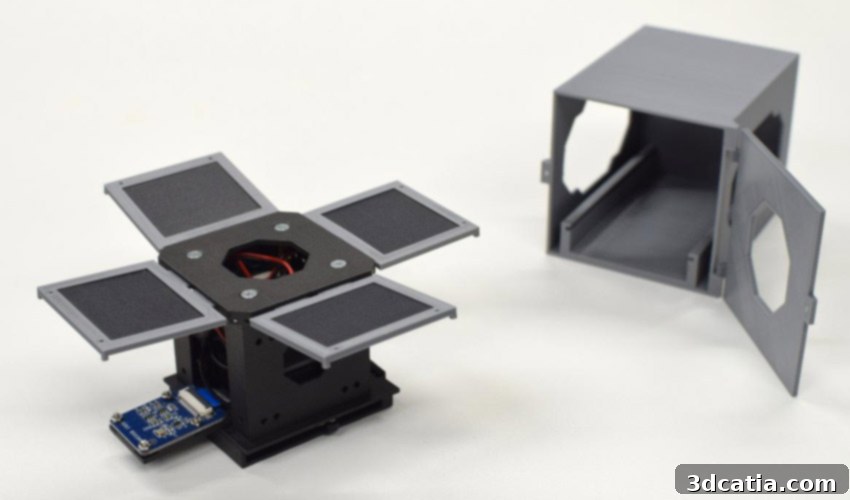
Mini-Cubes Pioneers 3D Printed Carbon Fiber Satellites for Space: The Discovery Project
In a significant stride towards revolutionizing space technology, Mini-Cubes, an innovative American company, is making waves with its pioneering approach to satellite design. Specializing in incredibly compact satellites known as PocketQubes, which measure a mere 5 cm on each side, Mini-Cubes offers a more accessible and cost-effective alternative to traditional, larger satellites. The groundbreaking aspect of their work lies in the integration of additive manufacturing – more commonly known as 3D printing – to develop their latest series of satellites, aptly named Discovery. These advanced devices are being 3D printed using an SLS (Selective Laser Sintering) machine, employing a cutting-edge carbon fiber composite material. This strategic choice ensures an unparalleled combination of high rigidity and remarkable lightness, crucial properties for any component destined for the harsh environment of space. According to Mini-Cubes, this marks a historic milestone as the first instance of such a material being utilized to 3D print satellites certified for space deployment, heralding a new era for aerospace manufacturing.
Mini-Cubes’ decision to embrace composite 3D printing for its production reflects a deep commitment to innovation and efficiency. Joe Latrell, the visionary CEO of Mini-Cubes, articulates the company’s ambitious philosophy: “For me, space is the next big frontier. Instead of seeing it as an impossible challenge, I see it as the source of saving the Earth.” This powerful statement underscores the dual purpose behind the Discovery satellite project. Beyond simply venturing into space, these compact marvels are specifically designed for a critical mission: to meticulously monitor natural resources across the Earth’s surface. This objective positions Mini-Cubes at the forefront of combining advanced manufacturing with environmental stewardship, leveraging the vast potential of orbital observation to address pressing global challenges.
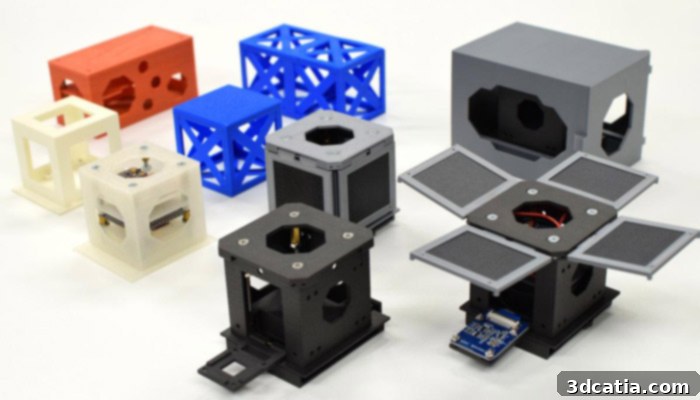
PocketQubes are very small satellites, opening new frontiers for space access. (Image credits: Mini-Cubes)
The Rise of PocketQubes: Democratizing Space Access
PocketQubes represent a significant paradigm shift in the aerospace industry, moving away from monolithic, expensive satellites towards miniature, modular, and more affordable alternatives. Their standardized 5x5x5 cm size allows for multiple units to be launched simultaneously as secondary payloads, drastically reducing launch costs and increasing deployment frequency. This “democratization of space” is vital for educational institutions, startups, and research entities that traditionally faced prohibitive barriers to entry. Mini-Cubes recognized this potential early on, focusing its expertise on developing these small form-factor satellites that, despite their size, are capable of performing complex tasks in orbit. The agility and relative simplicity of PocketQubes also enable faster design iterations and deployments, accelerating the pace of technological advancement in space applications. By focusing on these miniature platforms, Mini-Cubes is not just building satellites; it’s fostering a more inclusive and dynamic space ecosystem.
Discovery: Pioneering Earth Resource Monitoring from Orbit
The core mission of the Discovery satellites is rooted in a profound commitment to planetary health. As Joe Latrell highlighted, the endeavor is about “saving the Earth” by harnessing the unique vantage point of space. These tiny satellites are engineered to provide crucial data for monitoring the Earth’s natural resources, ranging from tracking deforestation and water body changes to observing agricultural health and climate patterns. The ability to deploy a constellation of these low-cost, high-performance satellites means more frequent and granular data collection, offering unprecedented insights into environmental dynamics. This capability can empower scientists, policymakers, and conservationists with the timely information needed to make informed decisions and implement effective strategies for resource management and environmental protection. The Discovery project, therefore, transcends mere technological novelty, positioning itself as a vital tool in the global effort towards sustainability.
The Manufacturing Process of Discovery: A Testament to Additive Manufacturing
The vision for the Discovery satellite necessitated integrating a sophisticated camera system into an incredibly confined space – an internal volume of just 50 x 50 x 50 mm. This proved to be a significant engineering challenge, pushing the boundaries of traditional manufacturing methods. To overcome these constraints, Mini-Cubes turned decisively to additive manufacturing. This technology offers unparalleled freedom in design, allowing for the creation of intricate internal geometries and optimized structures that would be impossible or prohibitively expensive with conventional techniques. 3D printing enables the development of more complex shapes, including integrated component housings and optimized weight distribution, all while keeping production costs manageable.
To ensure the highest quality for these space-bound components, Mini-Cubes partnered with CRP USA, a renowned 3D printing service provider with extensive experience in critical applications. The collaboration was essential in navigating the complexities of producing parts that meet rigorous aerospace standards. A pivotal decision then involved selecting a material robust enough to withstand the extreme conditions of a space launch and the vacuum of orbit, without compromising on lightness – a critical factor for minimizing launch costs. After comprehensive testing and evaluation, the two partners identified Windform XT 2.0 as the ideal solution. This advanced material is a carbon fiber reinforced polymer, engineered for exceptional mechanical properties under demanding conditions.
Engineering Excellence: The Material Science Behind Discovery
The selection of Windform XT 2.0 was not arbitrary; it was the culmination of meticulous research and testing. This high-performance composite material offers a unique blend of properties essential for satellite applications. Its carbon fiber reinforcement provides an outstanding strength-to-weight ratio, meaning the satellite can be incredibly durable while remaining exceptionally light – a paramount consideration for reducing fuel consumption and associated costs during launch. Furthermore, Windform XT 2.0 exhibits excellent thermal stability, allowing the satellites to endure the dramatic temperature fluctuations encountered in space, which can range from scorching direct sunlight to the extreme cold of orbital night. Its resistance to micro-cracking and material degradation under vacuum conditions and radiation exposure further solidified its position as the material of choice.
Joe Latrell elaborated on this crucial decision: “The combination of strength and ease of use made the material a natural choice for us. We knew we wanted to use additive manufacturing for Discovery but understood that it would be hard to find something that would work in the harsh environment of space. We discovered Windform® XT 2.0 and after looking at its properties, it was a simple choice.” This highlights the dual benefit of the material: its intrinsic physical properties meet the stringent demands of space, while its compatibility with SLS 3D printing facilitates complex design and rapid prototyping. The ability to print intricate, load-bearing structures with such a high-performance material signifies a monumental leap in the capabilities of small satellite manufacturing, directly contributing to the compact and robust design of the Discovery PocketQubes.
Rigorous Testing for Space-Readiness
Before any satellite can embark on its journey into space, it must undergo a battery of stringent tests to prove its resilience against the extreme forces and environments it will encounter. Mini-Cubes has developed and rigorously tested three prototypes of the Discovery satellite, subjecting them to conditions simulating launch and orbital operations. These tests included comprehensive load tests to ensure structural integrity under the immense G-forces of liftoff, and crucial temperature tests that push the limits of the material’s thermal stability. The company proudly reports that the 3D printed Discovery satellites have successfully withstood temperatures ranging from a scorching 50°C to a chilling -40°C, demonstrating their robustness in the face of orbital extremes. Further testing would typically involve vibration analysis to simulate rocket launch forces, as well as vacuum chamber tests to assess material outgassing and performance in the absence of an atmosphere. These rigorous validation processes are critical to guarantee the operational reliability and longevity of the satellites once deployed in orbit.
Looking ahead, Mini-Cubes is on track to send its inaugural Discovery device into orbit during the second quarter of 2021. This impending launch represents not just a company milestone, but a significant advancement for the broader aerospace community, showcasing the immense potential of additive manufacturing and advanced composite materials in creating the next generation of space hardware. The successful deployment and operation of these 3D printed PocketQubes will undoubtedly pave the way for more innovative and accessible space missions in the future. For those interested in learning more about this groundbreaking venture, additional information can be found on the official Mini-Cubes website HERE.
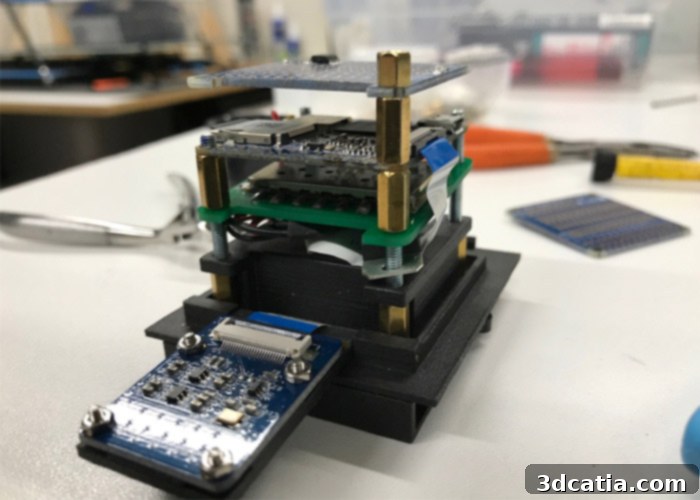
A detailed view inside one of the 3D printed Discovery prototypes, showcasing intricate component integration. (Image credits: Mini-Cubes)
The Future is Now: Expanding Horizons with Mini-Cubes and 3D Printing
The pioneering work by Mini-Cubes with its Discovery satellites underscores a transformative period in space technology. By leveraging additive manufacturing and advanced materials like Windform XT 2.0, the company is not only reducing the cost and complexity of satellite development but also accelerating the pace of innovation. This approach makes space more accessible to a wider array of users and applications, from environmental monitoring and telecommunications to scientific research and education. The ability to rapidly prototype, iterate, and produce highly durable, lightweight components in-house or through specialized partners like CRP USA drastically shortens development cycles, allowing for quicker responses to evolving technological needs and market demands. The success of the Discovery project could inspire a surge in similar ventures, fostering greater competition and innovation across the space sector. This ripple effect promises a future where constellations of small, smart satellites provide unprecedented global coverage and data, revolutionizing how we understand and interact with our planet and beyond.
What are your thoughts on Discovery, these innovative 3D printed satellites, and their potential impact on space exploration and environmental monitoring? We invite you to share your insights and comments below, or join the conversation on our Facebook and Twitter pages! Don’t miss out on the latest advancements in additive manufacturing; sign up for our free weekly Newsletter to get all the news straight to your inbox.