
Revolutionizing Electronics: MIT’s 3D Printing Breakthrough for High-Performance Solenoids and Beyond
The future of electronics manufacturing is being reshaped by groundbreaking advancements, and at the forefront of this innovation are researchers at the Massachusetts Institute of Technology (MIT). Their recent achievement in successfully 3D printing three-dimensional solenoids marks a monumental leap forward, promising to transform how we produce and utilize critical electronic components. Solenoids, fundamental to countless devices, are essentially electromagnets created by winding a coil of wire around a magnetic core. These indispensable components are vital for converting electrical energy into mechanical work, making them ubiquitous in modern technology. From life-saving medical equipment like advanced dialysis machines and sophisticated respirators to everyday household staples such as washing machines and dishwashers, solenoids perform crucial functions. Traditionally, the manufacturing of these intricate components has been a complex and often restrictive process, limiting design possibilities and efficiency.
The quest to develop fully 3D-manufactured electronic devices has long presented considerable engineering challenges. Integrating diverse materials with varying properties into a single, cohesive structure while maintaining high performance is a difficult task. However, the ongoing research spearheaded by MIT represents a significant progression towards more economical, sustainable, and less wasteful production techniques. These advancements are not confined to a single sector; their potential impact spans a multitude of industries, with intriguing applications even extending into the challenging environment of space exploration. This innovation offers a paradigm shift from traditional, multi-step assembly processes to integrated, additive manufacturing, paving the way for unprecedented design freedom and functional integration in electronics.

The Massachusetts Institute of Technology (MIT)
The Limitations of Conventional Manufacturing and the Rise of 3D Printed Electromagnets
Conventional manufacturing methods for solenoids typically involve a painstaking and complex assembly of various discrete materials. This often necessitates separate processes for creating the coil, the core, and the insulating layers, followed by their precise integration. Such an approach inherently introduces limitations on the size, shape, and overall design flexibility of the final parts. Miniaturization, for instance, becomes increasingly difficult and costly. Moreover, the need for multiple assembly steps increases the potential for manufacturing errors, material waste, and higher production times and costs. These challenges have long constrained innovation in the design of compact and high-performance electronic devices.
The emergence of 3D printing, however, offers a powerful solution for overcoming these traditional constraints. Its additive nature allows for the creation of intricate geometries and the seamless integration of different materials within a single manufacturing process. Recognizing this potential, MIT researchers, under the visionary leadership of Luis Fernando Velásquez-García, embarked on a mission to tackle the long-standing problems associated with material compatibility in integrated electronic components. Their innovative approach involved adapting their multi-material 3D printer to precisely superimpose three distinct materials into a single, cohesive structure. This specialized printer could deposit a dielectric material, which serves as an essential insulator; a conductive material, meticulously forming the electrical coil; and a soft magnetic material, making up the crucial core. This ingenious adaptation facilitated the direct production of compact, single-piece solenoids, entirely eliminating the complexities and potential for assembly errors inherent in multi-part manufacturing processes. This streamlined approach not only simplifies production but also opens up vast possibilities for custom designs and optimized performance.
Unprecedented Performance: The Power of 3D Printed Electromagnets
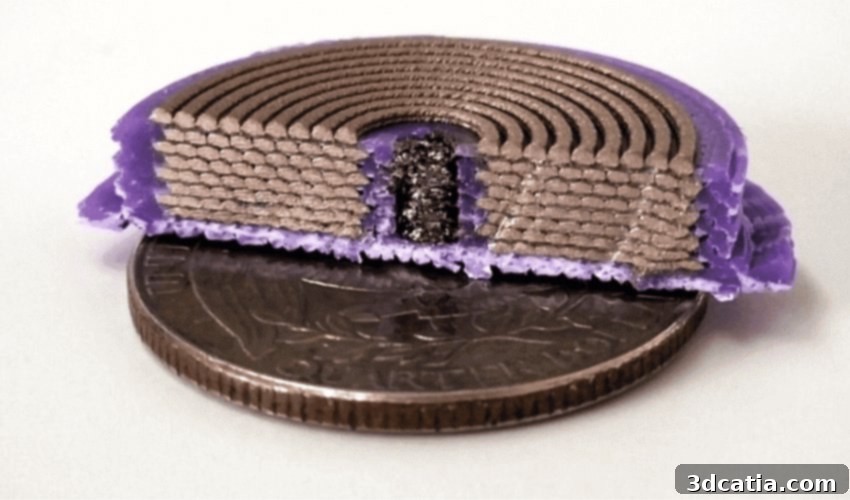
The experiments conducted by the MIT team yielded truly remarkable results, demonstrating the transformative capabilities of their 3D printing method. They successfully accomplished the printing of an electromagnet with an impressive eight winding layers, meticulously arranged in a spiral configuration. This intricate design, previously challenging or impossible with conventional methods, was achieved with precision through their adapted printer. This innovative modification to the printer’s capabilities allowed for the creation of solenoids that are not only significantly more compact but also exhibit substantially higher performance characteristics than their conventionally manufactured counterparts. The ability to precisely control the winding geometry and integrate multiple materials in a continuous process is a game-changer.
These groundbreaking results unequivocally showed the superior capabilities of 3D printed components. For instance, a 25 mm-diameter electromagnet produced using this advanced 3D printing technique demonstrated an extraordinary capacity to withstand twice the electric current compared to its traditionally manufactured equivalent. Furthermore, and perhaps even more impressively, it was capable of generating a magnetic field three times stronger. This dramatic improvement in performance metrics — higher current tolerance and increased magnetic field strength — translates directly into more powerful, more efficient, and potentially smaller electronic devices. Such enhancements can lead to breakthroughs in areas requiring high magnetic forces or precise control, opening doors for innovation across various fields, from compact robotics to advanced sensing technologies.

Solenoids are made by layering three materials: an insulator, a conductor for the coil, and a magnetic core.
Economic Advantages and Enhanced Accessibility
While the initial investment in custom equipment for this advanced 3D printing technology might seem substantial, the long-term economic advantages of using 3D printed electromagnets over conventional manufacturing methods are considerable and far-reaching. This advancement holds the potential to revolutionize manufacturing processes on a global scale. By transitioning from multi-step assembly to an integrated additive process, industries can significantly minimize material waste, reduce labor costs, and accelerate production cycles. The ability to print complex components on demand and with higher efficiency dramatically lowers the overall cost per unit in many applications, making high-performance electronics more accessible.
One of the most profound impacts of this technology is its potential to improve accessibility to essential medical equipment. Devices such as advanced dialysis machines, which rely heavily on precise solenoids for fluid control, could become more readily available and repairable, especially in remote or underserved areas. The ability to quickly and cost-effectively produce replacement parts or even entire sub-assemblies on-site means that critical medical services are no longer solely dependent on lengthy supply chains. This localized manufacturing capability can significantly enhance healthcare delivery, particularly in regions where traditional infrastructure is limited. Furthermore, the customized nature of 3D printing allows for tailor-made solutions for specific medical needs, driving innovation in personalized medicine.
Transforming Space Exploration: A Leap Towards Self-Sufficiency Beyond Earth
The potential benefits of 3D printing extend far beyond our planet, offering truly intriguing and transformative possibilities for space exploration. Current space missions are severely constrained by the sheer cost, weight, and time associated with transporting components from Earth. Every gram launched into space costs thousands of dollars, and the time it takes to deliver a replacement part to an orbiting station or a distant planetary base can stretch into months or even years. This often means that mission-critical equipment failures can lead to mission extensions, additional costs, or even complete mission termination.
With the capability to produce sophisticated replacement electronic components, like these high-performance solenoids, on demand directly in space or at an extraterrestrial base, this technology could fundamentally cut costs and eliminate significant time delays. Imagine a scenario where a vital component in a Martian rover or a lunar habitat fails. Instead of waiting years for a resupply mission, a digital file could be transmitted from Earth, and the part 3D printed within hours or days using locally sourced or already-present materials. This presents a truly sustainable solution, essential for enabling longer-duration space missions and fostering greater autonomy for astronauts. It shifts the paradigm from “take everything you might need” to “print everything you need, when you need it.” Luis Fernando Velásquez-García eloquently underscored these advantages, stating:
In addition to making electronics cheaper on Earth, this printing hardware could be particularly useful in space exploration. For example, instead of shipping replacement electronic parts to a base on Mars, which could take years and cost millions of dollars, one could send a signal containing files for the 3D printer. This approach not only reduces the immense logistical burden but also empowers future space outposts to become more self-sufficient, fostering a new era of exploratory missions.
Future Outlook and Broader Implications of Integrated 3D Electronics
The advancements made by MIT researchers are not just about printing better solenoids; they represent a significant step towards the broader vision of fully integrated 3D printed electronics. This technology hints at a future where complex electronic devices, complete with their active and passive components, can be manufactured as a single unit, layer by layer. This integrated approach minimizes interconnects, reduces device size, and enhances reliability. Imagine customized sensors, actuators, and even entire micro-robots fabricated on demand, tailored for specific tasks and environments. This level of functional integration and customization could unlock unprecedented capabilities in fields such as IoT (Internet of Things), wearable technology, advanced robotics, and personalized healthcare devices. The ability to embed intelligence and functionality directly into the structural components of a device opens up completely new avenues for design and innovation.
Furthermore, the techniques developed at MIT demonstrate the feasibility of combining disparate materials—insulators, conductors, and magnetic materials—with high precision. This multi-material printing capability is crucial for creating truly functional electronic systems. As material science continues to evolve, we can expect to see even more advanced materials compatible with 3D printing, including semiconductors, piezoelectrics, and optoelectronic compounds. This expansion will enable the fabrication of increasingly sophisticated and multi-functional electronic devices, pushing the boundaries of what is currently possible. The research paves the way for a manufacturing ecosystem where design complexity is no longer a barrier, and rapid prototyping of highly specialized electronic components becomes the norm, driving innovation at an accelerated pace.
What do you think of these innovative 3D printed solenoids and their potential impact on both Earth and space? We’d love to hear your thoughts! Let us know in a comment below or join the conversation on our LinkedIn, Facebook, and Twitter pages! Don’t forget to sign up for our free weekly newsletter here to receive the latest 3D printing news straight to your inbox! You can also find all our engaging videos and exclusive interviews on our YouTube channel.
*All Photo Credits: Massachusetts Institute of Technology (MIT)