
Weekly 3D Printing Innovations: Exploring the Latest in Additive Manufacturing Technology
Welcome back to our Sunday showcase of the most captivating and groundbreaking developments from the world of 3D printing! Each week, we scour the landscape of additive manufacturing to bring you insights into how this revolutionary technology is shaping our future. From scientific breakthroughs in medical prosthetics to the emerging complexities of 4D printing, and from confronting critical societal challenges posed by misuse to celebrating the artistic and practical applications in design and engineering, our curated selection of videos offers a comprehensive look at the diverse facets of 3D printing. Join us as we delve into these fascinating topics, offering a deeper understanding of the processes, implications, and potential of this rapidly evolving field. We hope you’ll enjoy this week’s collection and find inspiration in the endless possibilities that 3D printing continues to unveil.
Top 1: The Promise of 3D Printed Artificial Muscles and Advanced Bioprinting
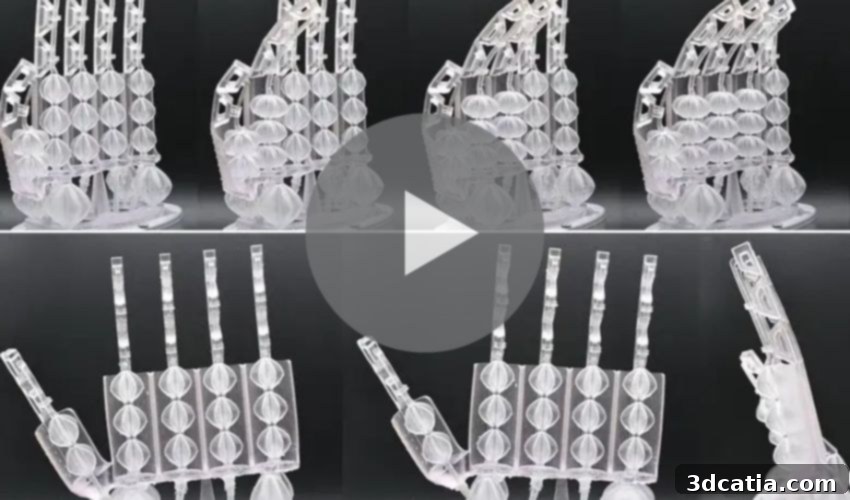
The field of medical science is continually pushing boundaries, and 3D printing stands at the forefront of some of the most exciting advancements. This week’s first video offers a remarkable glimpse into how scientists are leveraging additive manufacturing to mimic the intricate mechanics of human muscles. Corrado De Pascali, a dedicated PhD student at the Italian Institute of Technology in Genoa, along with his visionary colleagues, has achieved a significant milestone by developing a 3D-printed prototype of an artificial hand. This isn’t just any prosthetic; it represents a leap towards more functional and lifelike bionic limbs.
The team’s innovation lies in their creation of what they’ve aptly named “GeometRy-based Actuators that Contract and Elongate” (GRACE). This groundbreaking system employs a highly flexible resin, meticulously formulated to enable the printed structures to stretch and contract with a remarkable resemblance to natural human flesh and muscle tissue. The implications of such a technology are profound. Traditional prosthetics, while highly functional, often lack the nuanced flexibility and natural movement that human limbs possess. By engineering materials that can deform and recover dynamically, GRACE promises to deliver artificial hands that are not only more agile and adaptable but also offer a more natural aesthetic and feel for the user. This research paves the way for a new generation of prosthetics that could significantly enhance the quality of life for amputees, providing them with unprecedented dexterity and a sense of natural integration. This kind of bioprinting research highlights the incredible potential of 3D printing to revolutionize medical treatments and create solutions previously confined to science fiction.
Top 2: A Closer Look at the Dynamic World of 4D Printing Technologies
While 3D printing technologies continue to innovate at a rapid pace, a new dimension is emerging, promising to redefine the capabilities of additive manufacturing even further: 4D printing. This fascinating concept takes the foundational principles of 3D printing and introduces “time” as a critical fourth dimension. Imagine objects that aren’t static once printed but can transform, self-assemble, or change properties in response to environmental stimuli. This is the essence of 4D printing, and our second video offers an insightful exploration into this cutting-edge discovery.
At its core, 4D printing involves the use of “smart materials” or “shape-memory materials” that are specifically designed to react to external triggers such as heat, light, water, pH levels, or electrical currents. These materials, when printed into a specific geometry, are programmed to undergo a predetermined shape change or functional adaptation over time. For example, a 4D-printed object could be designed to expand when submerged in water, curl up when heated, or even self-repair minor damage. The potential applications are truly revolutionary and span multiple industries. In the medical field, we could see self-deploying stents that expand inside the body, or drug delivery systems that release medication based on physiological cues. For architecture and construction, 4D printing could lead to adaptive infrastructures that respond to changes in weather or environmental conditions, such as self-shading facades or structures that reinforce themselves. Soft robotics, smart textiles, and even space exploration could benefit from materials that can reconfigure themselves on demand. This technology represents a paradigm shift, moving from merely creating fixed objects to engineering dynamic, responsive systems that bridge the gap between inanimate objects and living organisms. Take a closer look at the interesting video below, in which the process and its boundless potential are explained in more detail!
Top 3: Addressing the Growing Problem of 3D Printed Ghost Guns
While additive manufacturing has ushered in an era of unprecedented benefits, fostering innovation across industries from healthcare to aerospace, it has also, unfortunately, presented new challenges. It seemed almost inevitable that some individuals would exploit these powerful new technologies for illicit purposes. One of the most alarming and rapidly growing concerns is the proliferation of 3D-printed guns, often referred to as “ghost guns.” These weapons, which can be manufactured at home using readily available 3D printers, pose a significant threat to public safety and law enforcement agencies worldwide. The following video vividly illustrates the gravity of this problem, showing a police operation where a man was apprehended for 3D printing his own firearms.
The danger of 3D-printed ghost guns stems from several critical factors. Firstly, they are often untraceable, as they typically lack serial numbers and can be made from materials that evade traditional metal detectors if primarily constructed from plastic. This makes it incredibly difficult for authorities to track their origins or link them to crimes. Secondly, the ease of access to 3D printing technology means that individuals with malicious intent can potentially create deadly weapons in the privacy of their homes, circumventing existing gun control laws and background checks. Law enforcement agencies, including international bodies like Europol, have expressed grave concerns over the increasing number of such weapons surfacing in criminal activities. The video serves as a stark reminder of the serious implications of unregulated access to weapon blueprints and the need for a balanced approach that promotes technological innovation while safeguarding society from its potential abuses. Addressing this challenge requires a multi-faceted approach involving legislative measures, public awareness, and ongoing collaboration between technology providers and law enforcement to prevent these sophisticated tools from falling into the wrong hands.
Top 4: Crafting Realism: A 3D Printed Authentic-Looking Cobra
Beyond the industrial and scientific applications, 3D printing technology also opens up a world of artistic expression, detailed craftsmanship, and educational tool creation. Our fourth video this week highlights the impressive capabilities of even desktop 3D printers in producing highly realistic and intricate objects. This captivating segment takes you through the step-by-step process of creating an authentic-looking, 3D-printed cobra. It’s a testament to how far consumer-grade 3D printers have come, allowing enthusiasts and professionals alike to bring complex digital designs into tangible reality.
The video provides a closer insight into the meticulous steps involved, from the initial digital sculpting and slicing of the model to the careful selection of materials and the final post-processing techniques that add incredible realism. Achieving an “authentic-looking” finish often involves not just precise printing but also skilled painting, texturing, and weathering to mimic the natural patterns and scales of a cobra. This demonstration beautifully illustrates what amazing yet simple things can be accomplished with a standard desktop 3D printer and a touch of creativity. It’s a prime example of how additive manufacturing democratizes creation, enabling hobbyists to craft intricate models for display, prop makers to produce highly detailed replicas for film or theater, and educators to create engaging, tactile learning aids for biology or art classes. The level of detail and lifelike quality achievable with modern 3D printing truly underscores its versatility as a tool for both functional prototyping and artistic endeavors.
Top 5: Precision Engineering with 3D Scanning a Motorbike
Complementing the transformative power of 3D printing is its equally innovative sibling: 3D scanning. This technology is rapidly revolutionizing how we capture, analyze, and interact with the physical world, extending its utility far beyond small objects to encompass large, complex structures like vehicles. This week’s final video showcases an impressive application of 3D scanning, demonstrating its use in meticulously capturing every detail of a motorbike. The ability to precisely scan and digitize objects of this scale offers a myriad of benefits, particularly within the automotive and mechanical engineering sectors.
For mechanics, engineers, and designers, 3D scanning a motorbike can open up new avenues for efficiency and accuracy. Once an object is scanned, a highly accurate digital model is created, allowing professionals to view the motorbike from virtually any angle on a screen. This eliminates the traditional constraints of needing physical access to the vehicle in a garage or workshop for every inspection or measurement. Such digital models are invaluable for reverse engineering parts that are no longer manufactured, custom designing aftermarket components, performing quality control checks, or even analyzing crash damage with unparalleled precision. Moreover, the digital twin created through 3D scanning facilitates collaborative work, enabling teams to share and discuss intricate details remotely. It streamlines prototyping, design iterations, and even the creation of personalized ergonomic adjustments for riders. The integration of 3D scanning into workflows transforms complex tasks into manageable digital processes, ultimately saving time, reducing costs, and enhancing the precision and innovation possible in vehicle design and maintenance.
What an incredible week it has been for 3D printing and additive manufacturing! From the intricate biomechanics of artificial muscles and the dynamic possibilities of 4D printing to the critical discussions around the misuse of technology and the boundless creativity in design and engineering, these videos underscore the multifaceted impact of this revolutionary field. The advancements continue to redefine industries, solve complex challenges, and inspire new forms of creation. We hope this comprehensive roundup has provided you with valuable insights into the exciting trajectory of 3D printing technology. The future of manufacturing is here, and it’s more dynamic and innovative than ever before.
What do you think of this week’s top 5 videos and the future of additive manufacturing? We’d love to hear your thoughts! Let us know in a comment below or join the conversation on our LinkedIn, Facebook, and Twitter pages! Don’t forget to sign up for our free weekly Newsletter here, to get the latest 3D printing news straight to your inbox! You can also find all our videos and much more exciting content on our YouTube channel. Stay tuned for more innovations and breakthroughs next Sunday!