
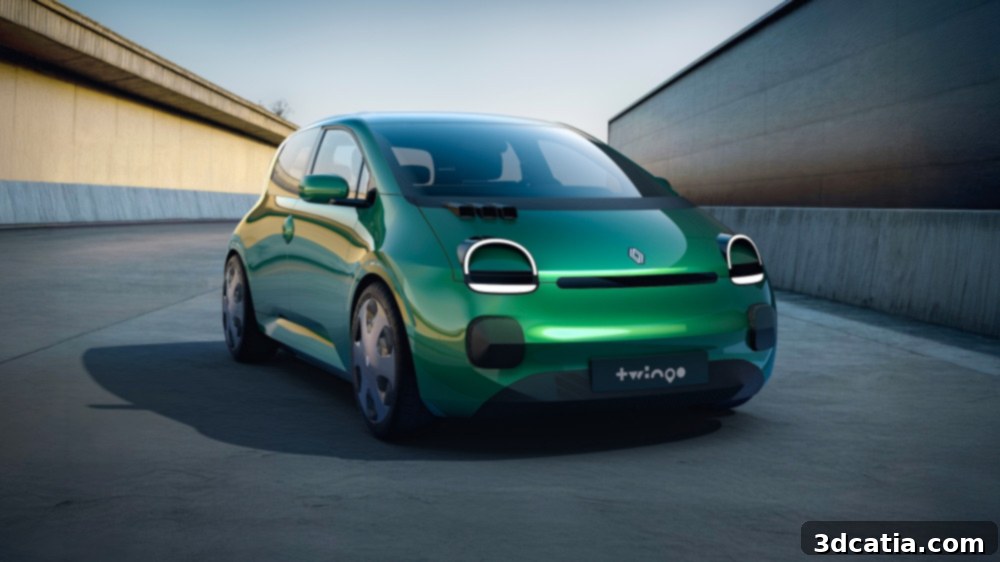
Renault Twingo E-Tech: Driving the Future with 3D Printing and Sustainable Electric Mobility
The automotive industry is in the midst of a profound transformation, with electric cars leading the charge towards a more sustainable future. Among the pioneering automakers driving this shift, Renault stands out with its ambitious “Renaulution” strategic plan. This comprehensive initiative aims not only to restore the company’s profitability but also to actively invent a new, environmentally conscious future for mobility. With a keen focus on environmental performance, Renault is committed to developing innovative vehicles that combine efficiency, cutting-edge technology, and responsible manufacturing practices. A shining example of this vision is the new TWINGO E-Tech prototype, a vehicle that encapsulates Renault’s dedication to sustainable urban transport and advanced design.
Unveiled to significant acclaim at the Mondial de l’Auto 2024 in Paris and subsequently at the Brussels Motor Show this January, the electric TWINGO E-Tech instantly captivated audiences. This modern iteration pays homage to the beloved historic Twingo model, reimagining its iconic charm with smart upgrades and contemporary flair. One of its most striking features, indicative of Renault’s forward-thinking approach, is the incorporation of sophisticated 3D-printed black bumpers. This innovative use of additive manufacturing not only enhances the vehicle’s aesthetics but also points to its advanced engineering. Set to be commercially available in 2026, the TWINGO E-Tech promises to make sustainable urban mobility accessible, targeting a competitive price point of less than €20,000, further cementing Renault’s commitment to broad accessibility for electric vehicles.
Renault’s Legacy in Electric Vehicle Innovation and the Renaulution Strategy
Renault’s journey into sustainability and electric mobility is not a recent endeavor. The company has a rich history of pioneering electric vehicle development, with its first electric prototype, the Renault NEXT, making its debut as early as 1995. This long-standing commitment underscores Renault’s proactive role in shaping the future of transportation. Over the decades, the brand has consistently specialized in technological innovation, continuously pushing the boundaries of what’s possible in automotive engineering. This dedication has culminated in the “Renaulution” plan, a strategic framework designed to propel Renault into a new era of electric and connected mobility.
As part of this ambitious strategy, Renault forged a crucial partnership with Ampere in 2022. This collaboration has been instrumental in the development of smarter electric vehicles, integrating cutting-edge software and advanced technological solutions. Through Ampere, Renault is accelerating its transition towards a fully electric future, ensuring that its vehicles are not just electric but also intelligent, efficient, and connected. The company’s current electric range boasts numerous sophisticated models, each designed to meet diverse consumer needs while upholding Renault’s stringent environmental performance standards. These include popular and highly anticipated models such as the Renault 5 E-Tech, Renault 4 E-Tech, Megane E-Tech, and Scenic E-Tech, each contributing to a comprehensive lineup that showcases Renault’s expertise and leadership in the electric vehicle market. The TWINGO E-Tech is poised to become an integral part of this impressive electric fleet, representing an affordable and stylish option for urban drivers.
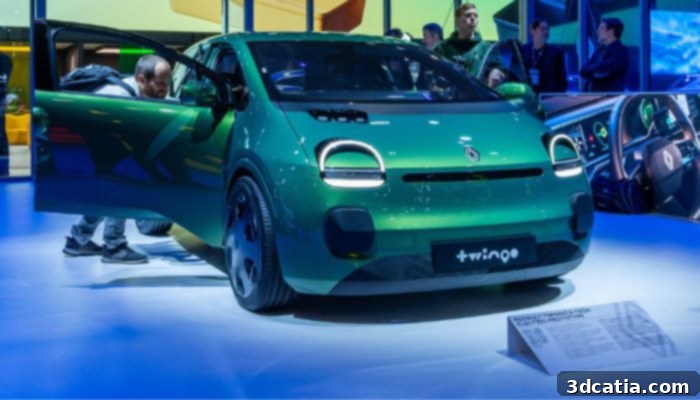
The prototype of the Twingo E-Tech was presented in Brussels this January. (Photo credit: Renault Group via Linkedin)
The TWINGO E-Tech: Designed for the Urban Landscape
The TWINGO E-Tech prototype is a testament to rapid innovation and focused design. Developed in an impressively short span of just two years, this vehicle was conceived with a singular purpose: to perfectly cater to the dynamic needs and unique challenges of city living. Its compact footprint makes it exceptionally agile and easy to maneuver through congested urban streets, while also simplifying parking in tight spaces. Despite its small exterior dimensions, the interior of the TWINGO E-Tech is remarkably spacious and versatile, a design feat achieved through clever engineering solutions such as sliding and folding seats. These adaptable seating arrangements allow for various configurations, maximizing cargo capacity or passenger comfort as required, making it ideal for everything from daily commutes to weekend errands.
Beyond its practical interior, the TWINGO E-Tech is packed with smart features designed to enhance the driving experience. The driver-centric cockpit includes two intuitive electric displays, providing essential information and entertainment at a glance. Modern LED headlights not only offer superior illumination but also contribute to the car’s distinctive and contemporary aesthetic. A thoughtfully designed front headrest incorporates a magnetic mount, offering a convenient and secure spot for mobile devices or other accessories. Furthermore, to optimize its performance and efficiency, an air intake is cleverly inserted into the front end of the car, a subtle yet significant detail that actively improves its aerodynamics, thereby contributing to increased range and reduced energy consumption. Every element of the TWINGO E-Tech has been meticulously considered to deliver a seamless, efficient, and enjoyable urban driving experience, demonstrating Renault’s dedication to creating vehicles that are both innovative and user-centric.
Revolutionizing Design: TWINGO E-Tech’s 3D Printed Prototype Bumpers
One of the most innovative aspects of the TWINGO E-Tech, and a clear indicator of Renault’s commitment to advanced manufacturing, lies in its 3D printed bumpers. While the initial version of the prototype, unveiled in Paris last October, did not yet feature these components, their subsequent integration highlights the dynamic and iterative nature of modern vehicle development. These protective devices were additively manufactured, leveraging the unparalleled design freedom offered by 3D printing to recreate intricate honeycomb structures. This choice of design is deeply rooted in the principles of biomimicry, an interdisciplinary approach that seeks sustainable solutions to human challenges by emulating nature’s time-tested patterns and strategies.
The hexagonal honeycomb structure adopted by Renault is not merely an aesthetic choice; it is a highly functional design inspired by the efficiency and strength found in biological systems, such as beehives. This particular geometry is a classic example of lattice structures, which are frequently realized with immense precision and complexity through 3D printing technologies. Lattices are invaluable in engineering because they allow for significant material reduction while maintaining or even enhancing structural integrity. By distributing stress evenly and offering exceptional energy absorption capabilities, these structures make components incredibly strong relative to their weight. For automotive applications, this translates directly into lighter vehicles, which in turn improves fuel efficiency (or extends battery range for EVs), enhances handling, and contributes to a safer vehicle through superior impact absorption. Renault’s adoption of this biomimetic, 3D-printed design for the TWINGO E-Tech’s bumpers showcases a sophisticated understanding of material science and additive manufacturing potential.
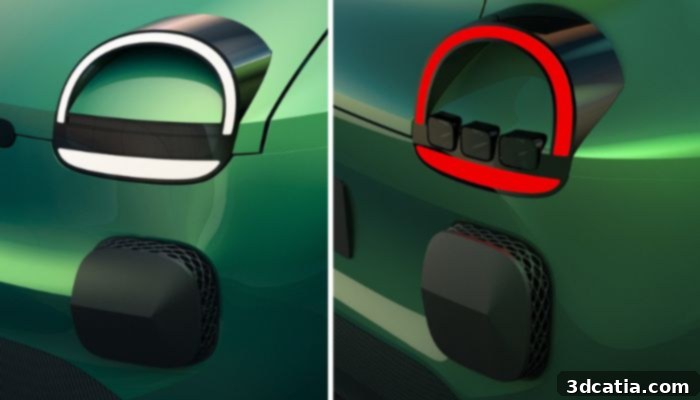
In these two photos, we can see both the front (left) and rear (right) bumpers, equipped with the characteristic honeycomb latticework, and the LED headlights with a modern design.
The Advantages of Additive Manufacturing for Automotive Components
By utilizing 3D printing for the TWINGO E-Tech’s bumpers, Renault has created components that are not only significantly lighter than conventionally manufactured counterparts but also possess optimal characteristics to respond effectively to potential external impacts. While the specific 3D printing technology employed by Renault for these bumpers has not been disclosed, industry standards suggest technologies like Selective Laser Sintering (SLS), Multi Jet Fusion (MJF), or Stereolithography (SLA) could be viable options, especially when producing complex geometries with engineering-grade polymers. These technologies offer high precision, excellent surface finish, and the ability to work with durable materials suitable for automotive applications.
The advantages of 3D printing in this context extend far beyond just lightweighting and impact resistance. Additive manufacturing offers unparalleled design freedom, allowing engineers to create intricate internal structures and external geometries that would be impossible or prohibitively expensive with traditional manufacturing methods. This facilitates rapid prototyping and iterative design improvements, significantly reducing development cycles. For Renault, this means faster innovation and the ability to bring advanced concepts to market more quickly. Furthermore, 3D printing can lead to localized production, reducing reliance on complex global supply chains and potentially lowering manufacturing costs for specialized parts or low-volume components.
Broader Implications: 3D Printing’s Growing Role in the Automotive Sector
Renault’s adoption of 3D printed bumpers for the TWINGO E-Tech prototype is a compelling example of a wider trend within the automotive industry. The question is not whether Renault will expand its use of 3D printing in the future, but rather how extensively. Indeed, Renault is not an isolated case; numerous other automakers are increasingly integrating additive manufacturing technologies across various stages of vehicle development and production. From concept design and rapid prototyping to the creation of tooling, jigs, and fixtures, and even the manufacturing of end-use production parts, 3D printing is proving its recognized value in the automotive sector.
Leading manufacturers worldwide are leveraging 3D printing to improve the performance of their vehicles in multiple ways. This includes producing lightweight components for enhanced fuel efficiency and range, creating custom parts for personalization and niche markets, and developing complex geometries that optimize aerodynamics or structural integrity. The technology also plays a crucial role in enabling faster iteration and customization, allowing car companies to respond more rapidly to market demands and evolving consumer preferences. As material science advances and 3D printing technologies become more robust and cost-effective, we can anticipate a significant expansion of additive manufacturing’s role in the production of mainstream vehicles, moving beyond prototypes and specialized parts into core vehicle components. This evolution is vital for driving innovation, enhancing sustainability, and delivering future-proof mobility solutions.
The TWINGO E-Tech stands as a beacon of Renault’s progressive vision, seamlessly blending iconic heritage with cutting-edge sustainable technology and advanced manufacturing techniques. Its 3D-printed bumpers are not just a design feature but a symbol of the automotive industry’s ongoing evolution towards more efficient, customizable, and environmentally responsible production methods. This compact electric vehicle is poised to make a significant impact on urban mobility, offering an accessible yet sophisticated solution for the modern city driver.
What do you think of the TWINGO E-Tech and Renault’s use of 3D printing? Share your thoughts in a comment below or join the conversation on our LinkedIn, Facebook, and Twitter pages! For more insights into how additive manufacturing is transforming the automotive sector, click here. Don’t forget to sign up for our free weekly Newsletter here to get the latest 3D printing news delivered straight to your inbox! You can also find all our compelling videos on our YouTube channel.
*All Photo Credits: Renault