
Unlocking Nature’s Secrets: How Biorobotics is Revolutionizing Bio-Inspired Engineering
Biorobotics stands at the fascinating intersection of biology and engineering, a specialized field dedicated to developing and studying robots that authentically mimic the intricate movements and behaviors of various animals. The core objective behind these advanced creations is not merely to replicate animal locomotion but to delve deeper into understanding the fundamental principles governing these biological systems. By gaining insights into how animals move, learn, and adapt, Biorobotics aims to harness this knowledge for the benefit and well-being of humanity, translating natural ingenuity into innovative technological solutions.
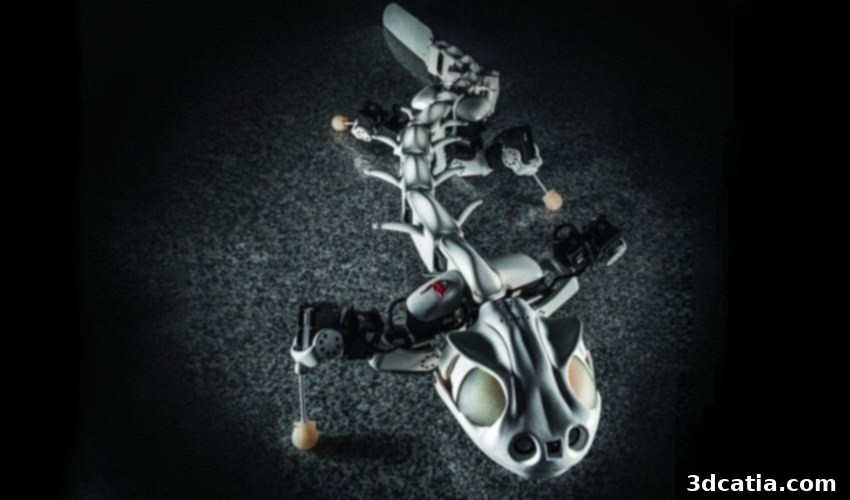
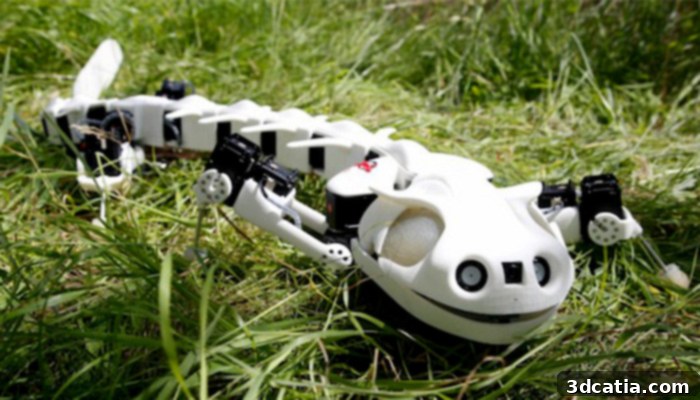
This pioneering laboratory, part of the prestigious Federal Polytechnic School of Lausanne (EPFL) in Switzerland, has already made significant contributions to the field. A notable example is the introduction of Pleurobot, a groundbreaking salamander robot unveiled some months ago. This remarkable biorobot demonstrated an unprecedented ability to swim with lifelike grace, a feat achieved through its meticulously designed bones and joints, all intricately manufactured using state-of-the-art 3D printing technology. Pleurobot not only showcases the potential of bio-inspired robotics but also serves as a powerful research tool for understanding the evolution of locomotion in early tetrapods.
More recently, the Biorobotics team collaborated with the BBC for their acclaimed documentary “Spy in the Wild,” creating an extraordinary robot in the form of a large crocodile. This sophisticated animatronic stealthily infiltrated natural habitats, providing researchers with invaluable, close-up information about the lives of these elusive animals without disturbing their natural routines. The success of such projects highlights the lab’s versatility and commitment to both scientific discovery and public education. This week, we had the distinct pleasure of speaking with Kamilo Melo, a leading Biorobotics Researcher at EPFL, who generously shared intricate details about the development processes behind some of their most renowned biorobots, offering a glimpse into the future of robotics.
3DN: Can you introduce yourself and tell us how the idea of Biorobotics came up?

Kamilo Melo
Hello, my name is Kamilo Melo, and I am a Postdoctoral Researcher at the Biorobotics Laboratory at EPFL in Lausanne, Switzerland. For me, Biorobotics represents a continuous and synergistic cycle. On one hand, we leverage advanced robotic systems as powerful tools to gain a deeper understanding of fundamental biological processes, particularly in deciphering complex questions about how animals move, adapt, and interact with their environments. This involves developing robots that can accurately replicate and even exaggerate certain animal movements, allowing us to isolate variables and test hypotheses in ways that are often impossible with living organisms.
Simultaneously, the discipline of biorobotics is dedicated to extracting and abstracting fundamental engineering principles directly from nature. By meticulously observing and analyzing the ingenious solutions developed by evolution over millions of years, we aim to design and create superior engineered machines. These bio-inspired robots are not only intended to push the boundaries of scientific inquiry but also to deliver tangible benefits and have a meaningful impact on society. This iterative process—from biological observation to robotic implementation and back to biological insight—forms the core philosophy and driving force of our work at Biorobotics.
3DN: What are the current projects of Biorobotics, and what uses do they have?
Our current research at Biorobotics is primarily focused on unraveling the many challenging problems associated with locomotion in animals. For instance, a significant portion of my work involves lamprey robots. Lampreys are ancient, primitive vertebrates, and studying their swimming mechanisms offers unique insights into the evolutionary development of vertebrate locomotion. Our lamprey robots help us to understand how these animals developed and evolved remarkably efficient swimming controllers. These controllers integrate not only complex neuronal circuits and neuro-muscular activity to generate basic swimming behaviors but also dynamically incorporate sensory information from their environment. Factors such as water flow and hydrodynamic pressure are crucial for the lamprey’s survival, and our research explores how this sensory feedback is integrated into their control systems to significantly enhance swimming robustness and adaptability.
In parallel, I am deeply involved in the highly accurate replication of salamanders and other animals exhibiting a sprawling posture within robotic systems. Salamanders, with their unique gait and amphibious capabilities, provide an excellent model for studying transitional locomotion. To achieve this fidelity, we conduct extensive studies on real salamanders, utilizing advanced imaging techniques like X-rays to precisely map how their bones and joints move during various activities. This data is then used to create scaled robotic replicas that accurately mirror and help us understand their intricate motions. Furthermore, this innovative technology extends beyond living creatures; we employ it to create exact replicas of fossilized animals. By bringing these ancient forms back to ‘life’ as biorobots, we can gain an unprecedented understanding of how creatures moved some 350 million years ago, shedding light on pivotal moments in evolutionary history. It’s worth noting that both the living salamander replicas and the fossilized animal biorobots extensively utilize advanced 3D printing technology for their construction.
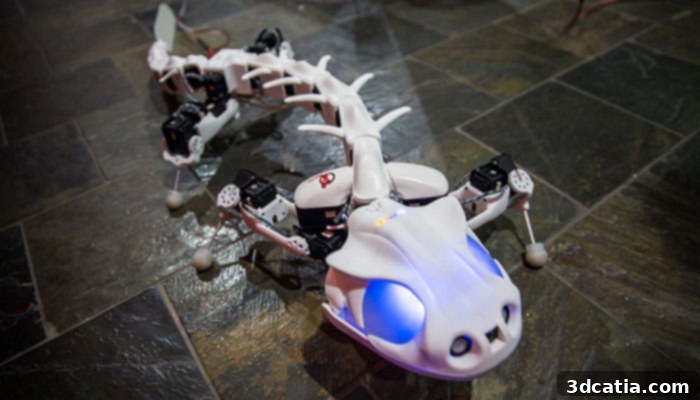
Pleurobot. Credits: Biorobotics
Drawing upon this comprehensive expertise in bio-inspired design and robust locomotion, we developed the impressive crocodile robot that was famously featured by the BBC in their wildlife documentary series, “Spy in the Wild,” filmed in the challenging environments of Africa. This particular biorobot was a true test of endurance, successfully operating for two weeks continuously under some of the most adverse natural conditions imaginable, including deep water, thick mud, and pervasive dust. Its unwavering performance served as a compelling demonstration of the robot’s exceptional robustness and resilience in extreme outdoor settings. The invaluable lessons gleaned from this field deployment, particularly regarding navigation and functionality in unpredictable terrains, are now being directly applied to the design of sprawling posture robots specifically engineered for disaster response scenarios. We envision these robots being capable of navigating through incredibly narrow passages, squeezing through small openings, and even swimming effectively through the debris and rubble of flooded disaster zones. Our ultimate aspiration is that this cutting-edge technology will one day play a crucial role in saving lives during humanitarian crises.
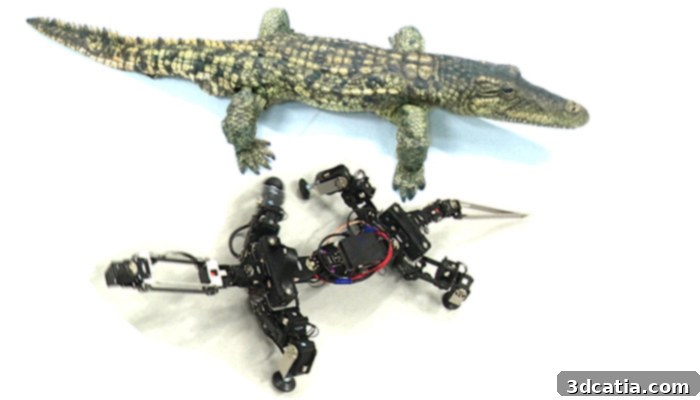
Biorobot crocodile used in the BBC documentary. Credits: Biorobotics
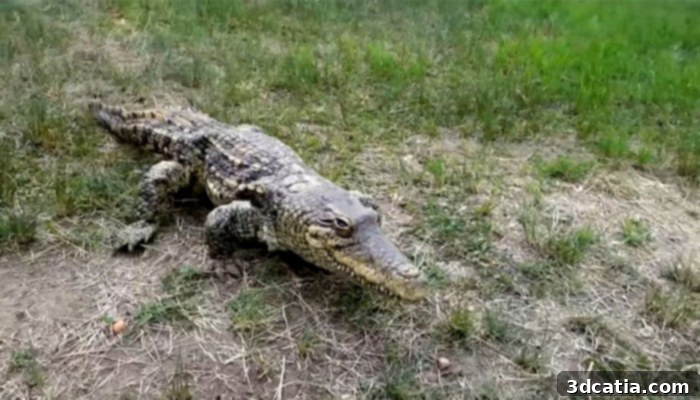
Credits: Biorobotics
3DN: In all your development, what’s the importance of 3D printing and what technologies do you use?
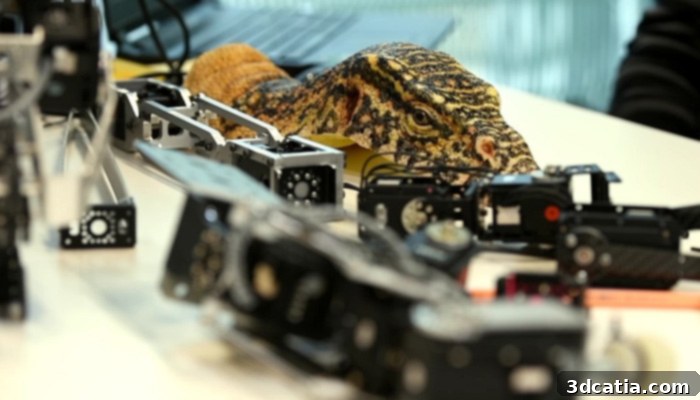
While it’s true that not every component of our sophisticated robots utilizes 3D printed parts, the role of 3D printing technology within the Biorobotics laboratory is undeniably profound and multifaceted. It has become an indispensable tool, significantly accelerating our development cycles and expanding our design capabilities in several key areas:
- **Rapid Prototyping Robot Design Concepts:** 3D printing allows us to quickly translate complex digital designs into physical prototypes. This rapid iteration capability is crucial for testing various design concepts for robot bodies, limbs, and joints, enabling us to identify optimal geometries and functional structures much faster than traditional manufacturing methods. This agility is vital when exploring novel bio-inspired locomotion mechanisms.
- **Creation of Testing Beds and Experimental Parts:** Beyond the robots themselves, 3D printing is immensely helpful in fabricating custom testing rigs, fixtures, and specialized parts for our experiments. These bespoke tools are essential for precisely measuring robot performance, analyzing sensor data, and understanding the mechanical properties of different components under various conditions.
- **Achieving the Desired Aesthetic and Branding:** The visual appearance of our robots, while secondary to functionality, is important for engagement and communication. 3D printing offers unparalleled freedom in creating intricate and organic shapes that closely resemble their biological counterparts. This distinct aesthetic not only enhances the perceived realism of our biorobots but also helps to establish a unique brand identity for our laboratory, differentiating our creations from other robotic research.
- **Quick Creation of Temporary Replacements:** During extensive experimental campaigns, parts can wear out or break. 3D printing provides an incredibly efficient solution for rapidly fabricating temporary replacement parts on demand. This minimizes downtime, allowing experiments to proceed with minimal interruption and ensuring the continuity of our research.
- **Molds for Soft Material Parts:** Many biological structures, such as muscle tissue or skin, are inherently soft and flexible. To replicate these properties in our robots, we often use soft materials like silicones. 3D printing is invaluable for creating highly detailed and complex molds into which these soft materials can be cast, allowing us to produce compliant parts that are integral to our biorobots’ lifelike movements.
In terms of specific technologies, we primarily utilize standard ABS (Acrylonitrile Butadiene Styrene) and Polyamide (Nylon) for additive manufacturing. For higher precision and strength, especially for intricate mechanical components, we extensively employ laser sintering techniques. These choices are driven by the need for materials that offer a balance of durability, flexibility, and the ability to produce fine details essential for our bio-inspired designs.
Credits: Biorobotics
3DN: What are the future projects of Biorobotics?
The future of Biorobotics is deeply rooted in the concept of the cycle I mentioned earlier, a continuous loop of learning and innovation. We are not content with merely solving the most challenging questions about how animals move; our ambition extends to learning as much as humanly possible from nature’s exquisite designs. The ultimate goal is to translate these profound biological insights into the development of new generations of robots, novel materials, and sophisticated behaviors. This comprehensive approach allows us to close the loop effectively, ensuring that our advancements not only push scientific boundaries but also deliver tangible value and positive impact to society.
Several key areas are currently of particular interest and form the cornerstone of our future research endeavors. One such area is **muscle-like actuation**. Current robotic actuators, while powerful, often lack the energy efficiency, compliance, and strength-to-weight ratio found in biological muscles. We aspire to develop superior and more powerful actuators that can achieve energy efficiencies comparable to animal muscles, thereby significantly reducing power consumption and extending operational times for robots. This would unlock capabilities currently unattainable with conventional rigid actuators.
Another critical focus is the continuous improvement of **material selection and fabrication techniques**. Nature provides an unparalleled masterclass in creating lightweight yet incredibly robust structures. Think of the intricate, yet resilient, design of animal bones, or the adaptability of various soft tissues and materials with finely tuned stiffness gradients. Our objective is to replicate these sophisticated material properties in our robotic designs. This involves exploring new composite materials, advanced polymers, and multi-material printing techniques that can mimic biological elasticity, strength, and damage tolerance. We firmly believe that advanced 3D fabrication technologies will play an instrumental role in achieving these ambitious material science goals, allowing us to print complex, multi-functional structures that closely resemble their natural inspirations.
Finally, a significant portion of our future work is dedicated to the **improvement of controllers**. These controllers can either be directly extracted and abstracted from natural biological systems or developed through rigorous, innovative engineered processes. The aim is to create control systems that are much faster in processing information and smoother in execution, enabling robots to solve complex interaction problems with their physical environment in real-time. This includes enhancing adaptability to unforeseen terrain, dynamic load changes, and unexpected obstacles, ultimately leading to more autonomous and versatile biorobots.
Credits: Biorobotics
3DN: Do you have any last words for our readers?
Building robots is an endlessly fascinating and incredibly rewarding world. The array of techniques available today for the fabrication of robotic components is vast and continually expanding, and without a doubt, 3D printing stands out as one of the most powerful and transformative among them. I strongly encourage anyone with an interest to delve into the exciting journey of robot creation, emphasizing the critical importance of thoughtfully integrating suitable materials, employing effective fabrication techniques, and meticulously designing for optimal actuation and control. The synergy of these elements is what truly brings a robot to life.
However, I also want to offer a crucial piece of advice: do not rely 100% on 3D printing for every single component. While exceptionally versatile, it can sometimes be an overkill, both in terms of optimizing robot performance and in managing project costs. The aesthetic appearance of a robot, while often captivating, is ultimately secondary to its core functionality. Therefore, I urge aspiring robot builders to prioritize functionality above all else. Strategically combine various fabrication techniques to leverage the strengths of each. For instance, 3D printing truly unleashes its full potential for creating specific, complex, or customized parts that would be difficult or impossible to manufacture otherwise. In contrast, simpler and more conventional fabrication techniques—such as merely adding a standard metal or carbon fiber rod for structural integrity—can often be a more robust, cost-effective, and practical solution for other components.
Embracing this hybrid approach, where you judiciously combine different fabrication methods, will invariably lead to designs that are not only more robust and durable but also more economical and, most importantly, highly functional. This intelligent integration of diverse engineering principles is the hallmark of truly well-designed and effective robotic systems, offering the best pathway to turning innovative ideas into practical realities.
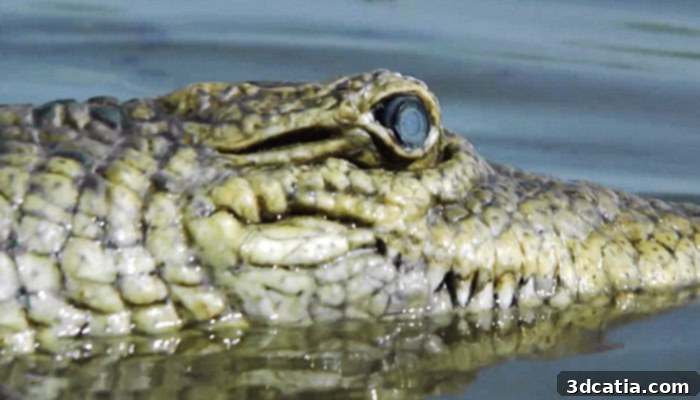
Biorobot created for documentary with integrated camera. Credits: Biorobotics
What are your thoughts on the groundbreaking biorobots developed by the Biorobotics laboratory and their insightful study of nature? We invite you to share your perspectives in a comment below or connect with us on our Facebook and Twitter pages! Don’t miss out on the latest advancements in 3D printing and bio-inspired robotics; be sure to sign up for our free weekly Newsletter, delivering all the essential news straight to your inbox!