
3D Printing’s Reality Check: Decoding the 2024 Market Trends and Future Opportunities in Additive Manufacturing
As 2023 drew to a close and 2024 began, the landscape of additive manufacturing (AM) found itself at a critical juncture. News outlets and industry analysts were quick to publish articles questioning the vitality of 3D printing, with headlines suggesting that the technology was either stagnating or had failed to meet its once-lofty expectations. This perception was often fueled by the increased financial pressures faced by publicly traded companies in the sector, alongside several high-profile failed mergers and acquisitions throughout the preceding year. Such developments naturally spark concern and lead to speculation about the health and trajectory of the entire industry. However, a deeper look beyond the sensational headlines reveals a more complex, and ultimately, more optimistic picture.
While acknowledging the inherent sensationalism that often accompanies industry critiques, it is undeniable that the past year presented considerable challenges for additive manufacturing. Many companies reported a reduction in printer sales across various segments, particularly in industrial solutions, which are typically high-value transactions. This downturn led to a series of layoffs, raising legitimate questions about market stability and future investment. Yet, these difficulties represent only a partial view of a dynamic and evolving sector. Amidst these challenges, there remains a substantial undercurrent of positive trends and opportunities within the industry. Dwelling solely on “doomsday” predictions, while understandable, distracts from the crucial work of addressing actual issues and harnessing the significant potential that still defines additive manufacturing. To gain a clearer understanding, let’s explore the current market conditions and identify proactive strategies the AM sector can implement to navigate these obstacles and foster sustainable growth.
The Sustained Momentum and Continued Growth of the Additive Manufacturing Market
Despite the narrative of a struggling industry, independent market analyses consistently affirm that the additive manufacturing market is not only growing but thriving in numerous aspects. While it is true that many manufacturers experienced a dip in sales for new printers, particularly in the industrial segment, this trend does not encapsulate the entire market. The growth narrative extends beyond just printer sales, encompassing materials, software, services, and the increasing adoption of AM technologies by end-users for production applications.
Leading market research firms continue to forecast substantial expansion for AM. For example, IDTechEX projects that the market will reach an impressive $49 billion valuation by 2034. Their analysis particularly highlights robust growth in hardware and material sales, indicating a strong foundation for the sector’s long-term prosperity. This positive trend is not isolated; it is echoed across multiple reports that delve into specific segments, such as polymer or metal 3D printing, each showing promising trajectories. Furthermore, even as some companies face restructuring, the 3D printing sector continues to see active recruitment, especially within innovative and rapidly expanding startups that are pioneering new applications and technologies.
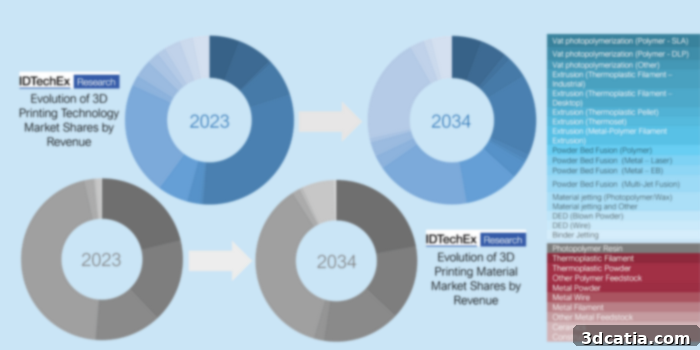
A report from IDTechEx, released in early 2024, shows where they expect to see growth in the AM market over the next 10 years (image credits: IDTechEx)
Evidence of this growth is also abundantly clear in the increasing adoption of additive manufacturing by prominent organizations across diverse industries. Over the past year, we have witnessed a continuous stream of announcements detailing how major original equipment manufacturers (OEMs) are integrating 3D printing into their operations. Industry giants such as Airbus and Boeing are leveraging AM for lightweight, complex aerospace components, enhancing fuel efficiency and performance. In the automotive sector, companies like Ferrari, Aston Martin, and Ford are utilizing 3D printing for rapid prototyping, customized parts, and even specialized tooling. Adidas continues to innovate with 3D-printed midsoles for athletic footwear, demonstrating AM’s potential for mass customization and performance enhancement. Beyond commercial entities, military organizations, particularly the American Navy, are increasingly showcasing their confidence in additive manufacturing technologies for on-demand parts, supply chain resilience, and field repairs. NASA, too, remains a significant adopter, utilizing 3D printing for critical applications, including rocket engine components and in-situ manufacturing for space exploration. While recent budget cuts at the Jet Propulsion Lab, which unfortunately led to layoffs affecting some 3D technology personnel, present a concerning, albeit isolated, development, it is still too early to determine its broader impact on the long-term adoption of innovative processes like AM within the space sector.
These widespread adoptions underscore the undeniable importance of the industrialization of additive manufacturing. Even as some reports suggest that industrial 3D printer shipments may have experienced a temporary dip, becoming less profitable than certain commercial or prosumer applications in the short term, the long-term value proposition of industrial AM remains robust. The rise of companies like Bambu Lab has highlighted consumers’ increasing concern with cost-effectiveness when purchasing new 3D printers, expanding the desktop and prosumer market significantly. While this segment forms a considerable part of the overall market, it is industrial applications — specifically, the creation of high-quality, industrial-grade parts for end-use production and mass customization — where 3D printing demonstrates its most significant staying power and long-term growth potential. The shift from primarily prototyping to full-scale manufacturing, enabled by advancements in materials, process reliability, and post-processing, positions industrial AM as a key driver for future expansion, addressing critical needs in efficiency, customization, and supply chain resilience.
A Pressing Need to Restructure Our Strategic Thinking
This brings us to a crucial point regarding the additive manufacturing sector’s strategic direction: the need for a critical re-evaluation of its priorities. Industry experts and thought leaders consistently highlighted last year that a significant challenge for AM is its pervasive “laser-focus on sales,” often pursued at the expense of all other considerations. While generating revenue and capitalizing on the heightened interest in 3D printing post-pandemic are undeniably important, a singular focus on merely selling machines without a clear, long-term value proposition for the end-user will ultimately hinder the industry’s sustainable growth. Such a short-term sales-driven strategy is insufficient if the sector genuinely aims to expand the adoption and impact of additive manufacturing on a global scale.
So, how can this crucial imbalance be addressed? To truly move beyond the transient “hype” cycles that have historically characterized 3D printing, the industry must fundamentally shift its approach. Instead of merely showcasing technological capabilities, it is imperative to focus on how AM technologies can effectively serve specific applications and solve real-world problems. This means engaging more effectively with individuals and organizations that are novices to these technologies, demonstrating tangible benefits rather than complex technical specifications. While AM is already well-established and critically important in sectors such as aerospace, medical, and automotive, its vast potential in numerous other industries remains largely untapped. To fully capitalize on this untapped potential, the focus must shift from developing technologies for their own sake to tailoring technologies to meet the precise requirements of specific applications. This ensures that the technology provides genuine, quantifiable value.

With organizations like NASA adopting 3D printing for things like rocket engines, it is clear it has its place. Now it is necessary to show the vast applications of the technologies (photo credits: NASA)
What does this strategic shift truly entail? In essence, it means redirecting significant research and development (R&D) efforts towards creating specialized processes and systems that are optimized for particular applications, moving away from a generic “one-size-fits-all” model. For instance, developing a 3D printer specifically for intricate medical implants with biocompatible materials requires a different approach than developing one for large-scale construction. This targeted R&D will lead to more efficient, reliable, and cost-effective solutions tailored to specific industry needs. Furthermore, educational initiatives should be reshaped to center around these concrete applications, vividly illustrating exactly what additive manufacturing can achieve. By presenting compelling case studies, demonstrating return on investment, and showcasing successful implementations in various sectors, the industry can effectively communicate its profound value to those outside the immediate AM ecosystem. This approach will not only help convince potential adopters of its significant benefits but also make the technology more accessible and understandable. If some perceive AM as overrated, it is often due to a lack of understanding of its true, practical value. It is the collective responsibility of the AM sector to bridge this knowledge gap and clearly demonstrate the transformative power of its technologies.
The Verdict: Resilience, Opportunities, and a Path Forward
In conclusion, the situation for 3D printing is far from as bleak as some headlines suggest. While the industry has certainly faced headwinds and some companies are navigating challenging periods, the underlying market fundamentals remain healthy. There are abundant opportunities for sustained growth and innovation within additive manufacturing. When one delves into the comprehensive market data, the resilience and potential of the sector become evident, even amidst the struggles of individual companies or specific market segments. The broader picture points towards a technology that is maturing, diversifying, and finding its footing in critical industrial applications.
It is crucial to recognize that boom and bust cycles are a natural, even inevitable, component of larger economic trends, impacting virtually all industries, including specialized sectors like additive manufacturing. Furthermore, while it is natural to maintain a focused perspective on our own industry, it is also important to acknowledge that many sectors, especially in technology, are currently grappling with significant global challenges. These include geopolitical conflicts, persistent supply chain disruptions, inflationary pressures, and broader economic uncertainties. Additive manufacturing does not exist in a vacuum; it is subject to these overarching macroeconomic forces, which contribute to temporary slowdowns or investment hesitancy.
Therefore, it is wise to embrace the reality that profitability will naturally fluctuate, with some periods being more prosperous than others. Rather than rushing to force additive manufacturing into becoming a multi-billion-dollar industry overnight, the focus should be on building a robust foundation. This involves prioritizing education and awareness, ensuring that an ever-increasing number of professionals and organizations are fully versed in the exact capabilities and strategic advantages of AM technologies. This deliberate, value-driven approach will, in turn, foster a more natural and sustainable adoption of additive manufacturing, even if the pace is slower than some might desire. As 2024 unfolds, it will undoubtedly be fascinating to observe the dynamics of the sector, marking the ups and downs that characterize its journey towards broader industrial integration and maturity.

Overall it seems clear that additive manufacturing will continue to grow, including industrial 3D printing, even if the market is experiencing difficulties
The views and opinions expressed in #3DOpinion are those of the authors and do not necessarily reflect the official policy or position of 3Dnatives. Any content provided by our authors are of their opinion and are not intended to malign any religion, ethnic group, club, organization, company, individual or anyone or anything.
What are your thoughts on the current state of additive manufacturing as we move through 2024? We invite you to share your insights in the comments section below or connect with us on our LinkedIn, Facebook, and Twitter pages! Don’t miss out on the latest 3D printing news—sign up for our free weekly newsletter here, delivered straight to your inbox! You can also explore all our video content on our YouTube channel.