
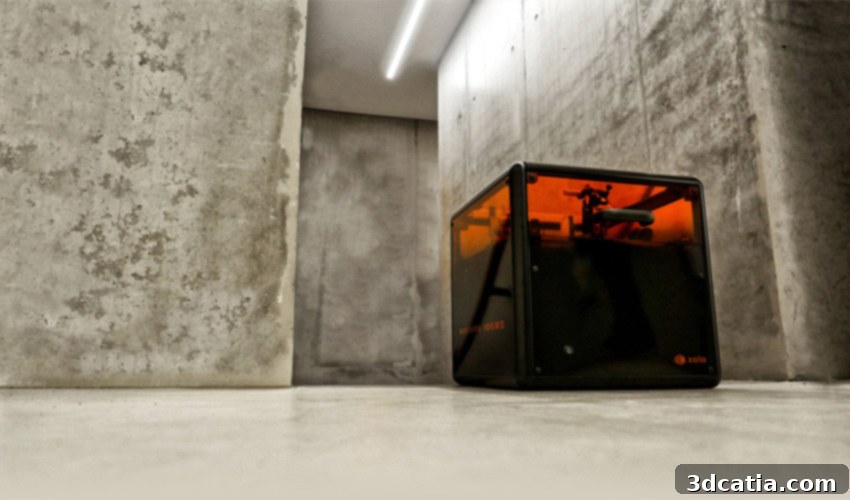
Xolo xube: Revolutionizing High-Speed Volumetric 3D Printing with Groundbreaking Xolography Technology
The landscape of additive manufacturing is constantly evolving, with innovations pushing the boundaries of speed, precision, and application. German startup Xolo is at the forefront of this evolution, having recently unveiled its revolutionary 3D printer, the xube. This cutting-edge machine introduces a paradigm shift in resin-based 3D printing, leveraging a proprietary method called Xolography, which is a sophisticated form of volumetric additive manufacturing. Unlike traditional stereolithography (SLA) processes that painstakingly build parts layer by layer, xube employs a radically faster approach. It’s engineered to construct intricate components of the smallest size in a mere 20 seconds, and even significantly larger structures in as little as 5 minutes. This unprecedented speed is not just an incremental improvement; it represents a fundamental rethinking of how photopolymer resin parts are fabricated, promising to unlock new possibilities across numerous industries.
At the core of xube’s remarkable performance lies its innovative technology: Volumetric 3D printing, specifically Xolography. While conventional SLA printers utilize a laser to selectively harden successive layers of liquid photopolymer resin, Xolography takes a completely different route. Instead of a tedious layer-by-layer approach, it projects a complex pattern of light into a vat filled with transparent resin from multiple angles simultaneously. This allows the entire object to form within the resin volume in a single, rapid process, dramatically cutting down production time. For now, xube is primarily positioned as a sophisticated research and development tool, designed to explore the full potential of this groundbreaking method. However, given the promising preliminary results and its inherent advantages, Xolo anticipates a swift transition towards commercialization, aiming to make this advanced volumetric 3D printing technology accessible to a wider audience in the near future.
Understanding the Potential of Volumetric 3D Printing: A New Manufacturing Frontier
Volumetric 3D printing, exemplified by Xolo’s Xolography, is poised to become a truly transformative manufacturing process due to its unparalleled speed and efficiency. The ability to create a complete part in a single, continuous process, rather than the iterative layer-by-layer methods prevalent today, fundamentally redefines production timelines and capabilities. This “part in one go” approach significantly reduces overall print times, diminishes the potential for layer-specific defects, and opens unprecedented avenues for truly rapid prototyping, on-demand manufacturing, and even scalable production. The core principle involves taking a 3D digital model and computationally translating it into a series of images or light patterns from various angles. These multi-angled projections are then simultaneously directed into a container filled with specialized photo-reactive resin. The light beams intersect at precise points within the resin, initiating photopolymerization exactly where the material needs to solidify, thereby forming the desired three-dimensional object almost instantaneously and in its entirety.
While the scientific concept of volumetric 3D printing has intrigued researchers and engineers for some time, its practical application has largely remained within academic and institutional laboratories. Numerous institutes, universities, and pioneering manufacturers are actively exploring its potential, but these efforts have primarily been confined to research and experimental projects, often limited by scale and commercial viability. Xolo’s ambitious goal is to bridge this critical gap, taking Xolography from the lab bench to industrial and professional applications. By developing the xube printer, Xolo aims to democratize this cutting-edge technology, offering a robust and reliable platform that can harness the inherent advantages of volumetric printing for real-world manufacturing challenges. The promise of Xolography extends beyond mere speed; it hints at unprecedented complexity, geometric freedom, and material integrity, given its ability to solidify entire volumes simultaneously and uniformly. This could be a game-changer for industries requiring both speed and high-fidelity detail.
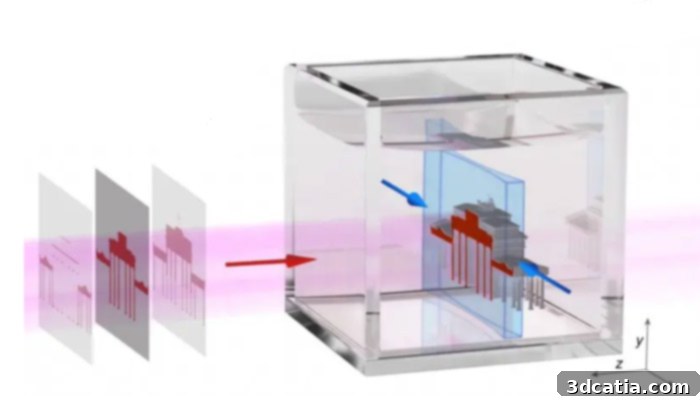
The Xolography process in action: Multi-angle light projections solidify resin volumetrically.
Unpacking the Innovation: How the Xube 3D Printer Works with Xolography
The sophisticated engineering behind Xolo’s xube printer is a testament to innovative material science and advanced optics. The German manufacturer has meticulously developed Xolography around the precise interaction of two distinct types of light energy with a specially formulated transparent photopolymer resin. This process doesn’t just project light; it orchestrates a precise, localized chemical reaction within the liquid volume. Specifically, the system projects what Xolo describes as “arcs” into the resin tank. These are not simple, static light beams but rather dynamically projected patterns, executed from multiple angles, ensuring comprehensive illumination and activation across the entire volume where the part is to be formed. This multi-directional projection is key to achieving a truly volumetric hardening process.
The mechanism unfolds in a carefully synchronized, two-step sequence. A first beam of light, tuned to a specific wavelength, is projected through the transparent resin. This initial light energy interacts with and selectively activates specific molecules embedded within the resin, known as two-color photoinitiators. These activated molecules are now primed for the next stage of the solidification process. Subsequently, a second, different light source is projected, typically at a different wavelength or intensity. Crucially, it is only at the precise points where the two-color photoinitiators have been activated by the first beam that the second light triggers the final photopolymerization process, causing the resin to solidify. This dual-beam activation strategy is the core of Xolography’s precision and volumetric capability. The intersection of these two light sources creates a highly localized hardening effect, allowing for the formation of the complex 3D geometry all at once, without the need for discrete layers. The projection system then rapidly moves or adjusts for subsequent activations if the object requires continuous scanning of the volume, and the entire process repeats or continues until the part is fully formed. Indeed, the “X” in Xolography elegantly symbolizes this ingenious intersection and synergistic interaction between the two distinct light sources, defining the exact voxel (volumetric pixel) where solidification occurs with exquisite control.
Xube’s Performance and Key Characteristics: Unmatched Speed, Precision, and Broad Applications
When evaluating the xube 3D printer, its specifications highlight a machine designed for specialized, high-performance applications where speed and detail are critical. The initial print volume remains somewhat constrained at 50 x 70 x 90 mm. While this might seem modest compared to some large-format resin 3D printers, it is not uncommon for novel, high-precision resin systems, especially in their early stages of development and commercialization. For volumetric printing, the focus is often on the internal complexity, material properties, and resolution achievable within a given volume, rather than brute external size. The true breakthrough, and Xolo’s core competitive advantage, lies squarely in the printing speed offered by Xolography, which is nothing short of revolutionary in the additive manufacturing landscape. According to Xolo, their xube system can astonishingly produce small, intricate parts in just 20 seconds. For larger, more substantial structures, the print time extends to a mere 5 minutes, a figure that truly disrupts traditional manufacturing paradigms.
To fully appreciate this capability, it’s crucial to draw a direct comparison with conventional resin 3D printers, such as those based on SLA or DLP technologies. A typical SLA or DLP printer, depending on the part’s size, geometric complexity, and desired resolution, often requires an hour, several hours, or even an entire day to complete a single part. This dramatic reduction in print time – from potentially many hours to mere minutes or even seconds – fundamentally transforms the economics and feasibility of rapid prototyping, batch production, and custom manufacturing. This unprecedented speed allows for incredibly aggressive iterative design cycles, enabling engineers and designers to test and refine concepts far more quickly and efficiently than ever before, accelerating product development. Furthermore, beyond raw speed, Xolography’s volumetric nature inherently lends itself to producing incredibly precise and smooth structures. Because the part forms simultaneously throughout the resin volume, it minimizes common issues like stair-stepping effects and anisotropic properties often seen in traditional layer-by-layer printing, resulting in exceptionally smooth surfaces, high-fidelity details, and superior mechanical integrity.
In terms of practical applications, the xube machine is ideally suited for scenarios where speed, precision, and intricate detail are paramount. Its capacity for rapid production makes it invaluable for urgent prototyping needs and on-demand fabrication in various professional fields. The high level of detail and smooth surface finish are particularly beneficial for medical and dental applications, such as the rapid creation of custom dental crowns, bridges, aligners, surgical guides, and patient-specific anatomical models for pre-operative planning. Beyond healthcare, its precision also finds a natural fit in design-centric industries, including intricate jewelry making, artistic installations requiring fine features, decorative components, and microfluidic devices where extremely fine channels and structures are critical. The potential extends to customized optical components, specialized industrial tooling, and even research in micro-robotics, where rapid iteration and high resolution are key drivers of innovation.
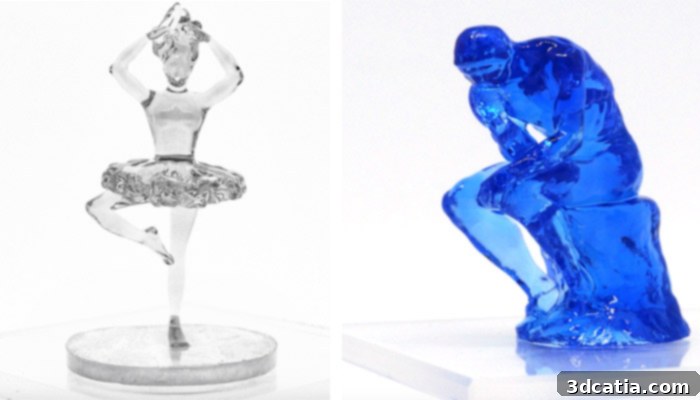
Examples of Xube 3D printed parts showcasing Xolo’s advanced Xolography capabilities and intricate detail | Photo Credits: Xolo
The Future is Volumetric: Xolo’s Vision and Market Impact
The anticipation surrounding the commercial launch of Xolo’s xube printer is palpable within the additive manufacturing community and beyond. While the exact timeline for its widespread availability remains to be formally confirmed, its eventual release would mark a truly significant milestone: xube would become one of the first volumetric 3D printers of its kind accessible to a broader market, moving beyond the confines of highly specialized research laboratories. This increased accessibility could catalyze a new wave of innovation across diverse industries, enabling companies of all sizes to leverage the benefits of ultra-fast, high-precision resin printing for their specific needs. Xolo’s vision is not just to introduce another new printer to the market, but to fundamentally shift expectations regarding the speed, efficiency, and capabilities of photopolymerization-based additive manufacturing as a whole.
The broader implications of widely available volumetric 3D printing are profound and far-reaching. It holds the immense promise of dramatically accelerating product development cycles, facilitating efficient on-demand manufacturing closer to the point of need, and enabling unprecedented levels of customization and personalization. Imagine being able to print highly detailed, patient-specific medical devices, complex industrial prototypes, or intricate consumer goods in minutes, rather than requiring hours or even days. This groundbreaking capability could revolutionize existing supply chains, significantly reduce material waste, and empower designers, engineers, and researchers with manufacturing tools that were previously unimaginable. As Xolo continues its dedicated development and optimization efforts, the xube stands as a beacon for the future of 3D printing—a future where speed, precision, and volumetric formation unlock an entirely new dimension of design freedom, manufacturing efficiency, and innovative product creation.
For those eager to delve deeper into this exciting technology and track Xolo’s progress, more detailed information and updates are available on the startup’s official website, which you can find HERE. We are keenly interested in your perspective: What are your thoughts on this innovative 3D printer and the immense potential of volumetric additive manufacturing? Share your insights and join the conversation in the comments section below, or connect with us and other enthusiasts on our Facebook and Twitter pages. Don’t miss out on the latest advancements and breakthroughs in 3D printing; sign up for our free weekly Newsletter here to receive cutting-edge news and insights directly in your inbox!