

Unlocking Design Efficiency: A Comprehensive Guide to Topology Optimization
The landscape of manufacturing is continually evolving, with additive manufacturing, commonly known as 3D printing, at its forefront. Unlike traditional subtractive methods that remove material from a larger block, additive manufacturing builds parts layer by layer, offering unprecedented design freedom. This revolutionary capability allows for the creation of components with incredibly complex geometries, which were once considered impossible or prohibitively expensive to produce. A pivotal technology enabling the full potential of additive manufacturing is topology optimization.
Topology optimization is a powerful numerical design method that allows engineers to determine the most efficient distribution of material within a defined design space, subject to specific mechanical loads and boundary conditions. Its primary goals are often twofold: to significantly reduce the total weight of a part while simultaneously maximizing its mechanical strength and performance. By leveraging advanced mathematical formulas and computational algorithms, this method intelligently identifies and retains only the material essential for structural integrity, leading to designs that are lighter, stronger, and more efficient than those conceived through conventional design processes.
Essentially, topology optimization streamlines the design process by identifying and eliminating superfluous material – the parts of a component that do not contribute meaningfully to its structural performance under applied stresses. This is achieved through dedicated software solutions that perform intricate analyses. Among the most recognized and widely used software packages in this field are Ansys Discovery, Tosca from Dassault Systèmes, Within Labs from Autodesk, Inspire from SolidThinking, Netfabb, and Simufact Additive. These tools empower designers to push the boundaries of innovation, creating highly optimized parts that meet rigorous performance criteria while consuming minimal material.
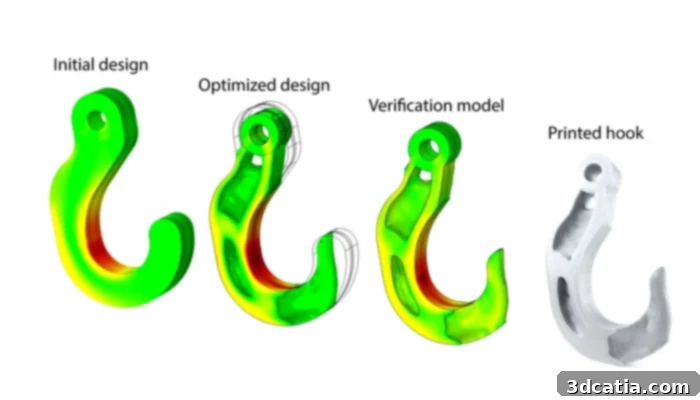
The design process via topology optimization
Topology Optimization: How Does It Work?
The operational logic behind topology optimization represents a paradigm shift from conventional numerical design workflows. In traditional design, engineers typically start with a pre-defined geometry—often based on previous designs or engineering intuition—and then apply loads to evaluate its weaknesses. This iterative process involves making design alterations, running simulations, and re-evaluating until the part meets the desired mechanical constraints. This can be a time-consuming and labor-intensive cycle, often leading to sub-optimal designs due to human bias or limitations in exploring complex design spaces.
With topology optimization, the approach is fundamentally different and more generative. Instead of starting with a finished design, engineers define a “design space” – a volumetric region where the part can exist – along with specific mechanical loads, boundary conditions (where the part is fixed or supported), and target performance objectives (e.g., minimize mass, maximize stiffness). These parameters serve as the input data. The software then takes on the role of a generative designer, proposing a new, optimized geometry by strategically distributing material within the defined design space. This generative approach significantly reduces the number of design iterations required, leading to a considerable reduction in both design and manufacturing lead times. It allows for the exploration of innovative and organic forms that would be exceedingly difficult, if not impossible, to achieve manually.
In practical terms, the process typically begins with either a rough 3D model of a new part or an existing part that needs optimization. The engineer then applies various loads and forces to this model – for instance, a specific pressure on fixing lugs or a twisting force on an arm. The topology optimization software, leveraging finite element analysis (FEA) principles, meticulously calculates how these forces propagate throughout the material. Based on these calculations, the software identifies regions within the design space where the material experiences minimal stress or is largely superfluous to the part’s structural integrity. These are the areas where material can be safely removed without compromising performance.
During this computational design stage, the software iteratively removes material from understressed regions, effectively carving out a more efficient structure. A draft of the future optimized part begins to emerge, often displaying organic, lattice-like, or cellular structures that are characteristic of lightweight, high-performance designs. Once the material distribution converges to an optimal state, the resulting rough geometry is then smoothed and refined through post-processing techniques to meet manufacturing tolerances and aesthetic requirements. The final geometry is not only structurally sound but also embodies the most efficient use of material possible, directly addressing key engineering objectives such as mass reduction, increased mechanical strength, or improved stiffness. This method is particularly synergistic with additive manufacturing, as 3D printing techniques can fabricate these complex, organic designs with relative ease, translating the theoretical benefits of topology optimization into tangible, physical components.
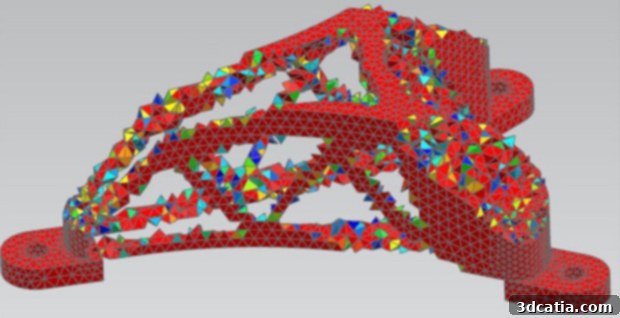
3D model after the removal of “unnecessary” material using the topology optimization method
Topology Optimization Software
The implementation of topology optimization relies heavily on specialized software, which can range from standalone applications to integrated modules within broader CAD (Computer-Aided Design) and CAE (Computer-Aided Engineering) platforms. While not all standard CAD software inherently offer these advanced generative design capabilities, the increasing demand for optimized, lightweight parts has led many developers to integrate or enhance such features. For designers aiming to produce truly optimal components, selecting a solution that incorporates robust topology optimization functionalities is a crucial decision, as it directly impacts the efficiency and quality of the design process.
Several pioneering companies have developed dedicated software for topology optimization. Altair is often credited as one of the pioneers in this field, having launched its very first OptiStruct solution many years ago, which later was complemented by Altair Inspire, known for its user-friendly interface and comprehensive capabilities. Other industry leaders like Ansys, Dassault Systèmes (with products such as Abaqus and Tosca), and Autodesk (with solutions like Fusion 360’s generative design features and Netfabb) have also developed powerful tools. Additionally, specialized software providers like nTopology offer unique approaches to generative design and complex lattice structures, further expanding the toolkit available to engineers. Furthermore, many mainstream CAD software programs like SolidWorks, PTC Creo, and Fusion 360 now include advanced features and modules that enable designers to perform topology optimization, making this technology more accessible to a wider user base.
Choosing the right topology optimization software is a critical strategic step for any engineering team. The ideal tool will not only provide robust algorithms for material distribution but also allow for precise definition of design constraints specific to the application. These constraints can include the intended manufacturing material (e.g., metals, polymers, composites), geometric properties (e.g., minimum feature size, symmetry requirements), and expected mechanical loads (e.g., static, dynamic, thermal). The software must be capable of analyzing various load cases, ranging from normal operational conditions to extreme scenarios, to ensure the part’s integrity under all foreseeable circumstances. Furthermore, it should enable the definition of non-design regions – areas that must remain untouched due to assembly requirements, existing interfaces, or specific functional needs. Effective software often integrates seamlessly with CAD for initial model preparation and with FEA for validation, providing a complete workflow from concept to optimized design.

Several software are available today
Who Uses Topology Optimization and for What Purpose?
Topology optimization has transcended its theoretical origins to become a practical, transformative tool across numerous industries, primarily driven by the imperative for enhanced performance, material efficiency, and cost reduction. Its applications are most prominent in sectors where weight and structural integrity are paramount concerns.
The **automotive industry**, for instance, has rapidly adopted topology optimization to address the pressing need for lighter vehicles. Lighter cars translate directly into improved fuel efficiency for internal combustion engines and extended range for electric vehicles, both of which are critical for meeting stringent environmental regulations and consumer demands. Material savings, particularly in high-volume series production, can lead to substantial cost reductions. Even a gain of a few grams per vehicle, when multiplied across millions of units, can represent tons of material saved annually. A notable example is the 3D printed chassis of the Light Rider motorcycle, which weighs an astonishing 6 kilograms thanks to an optimally distributed material structure. Another compelling case is a suspension part developed for Fiat Chrysler Automobiles, which consolidated over 12 different components into a single, optimized part. Designers reported a remarkable 36% weight reduction, showcasing the power of topology optimization in part consolidation and mass customization.
Similarly, the **aerospace industry** is arguably one of the most fervent adopters of topology optimization, driven by the direct correlation between aircraft weight and operational costs. A lighter aircraft consumes less fuel, leading to significant long-term savings for airlines and a reduced carbon footprint. Designer Andreas Bastian demonstrated this impact with his innovative aircraft seat designs, achieving a staggering 54% weight reduction per seat. This kind of weight saving, multiplied across hundreds of seats in a commercial airliner, translates into massive fuel consumption reductions over the aircraft’s lifespan. Beyond mere weight reduction, topology optimization empowers the aerospace sector to conceptualize and manufacture significantly more complex and intricate shapes. By leveraging additive manufacturing processes, the industry is freed from the traditional design constraints imposed by conventional manufacturing techniques like molding or machining, enabling the creation of highly integrated, functionally optimized components with internal structures that enhance performance and reliability.
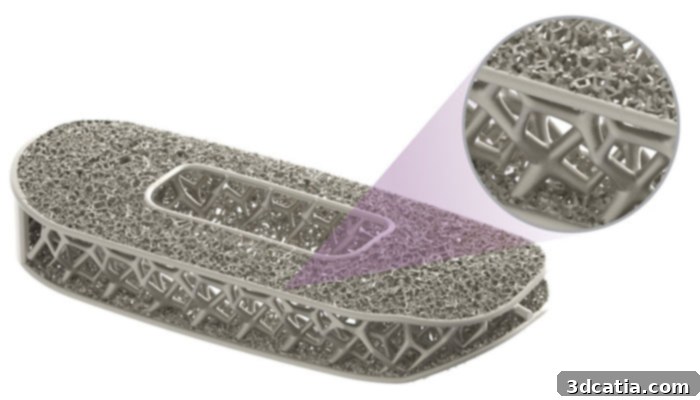
In the medical sector, topology optimization enables the design of more resistant implants | Image via Nuvasive
Finally, the **medical profession** is increasingly exploring topology optimization, particularly for the design and manufacture of patient-specific, custom-made implants. This design method offers unparalleled capabilities to mimic the complex porous structures and varying densities found in natural bone, thereby enhancing biocompatibility and promoting osseointegration – the direct structural and functional connection between living bone and the surface of a load-bearing artificial implant. By integrating intricate lattice structures and optimized internal geometries, implants can be designed to match the specific mechanical properties and anatomical contours of an individual patient, while simultaneously reducing the overall weight. Many topology-optimized implants have been shown to be as strong as, or even stronger than, traditionally designed counterparts, often with improved stiffness-to-weight ratios that contribute to better clinical outcomes and patient comfort. This personalized approach to medical device design represents a significant leap forward in healthcare, offering tailored solutions that were previously unimaginable.
In essence, topology optimization is not just a tool for making things lighter; it’s a fundamental shift in how engineers approach design. It’s about achieving optimal performance by intelligently placing material where it’s most effective, leading to stronger, more efficient, and often more innovative products across a diverse range of industries.
Have you ever noticed topology optimization being used around you? Let us know in a comment below or on our Facebook and Twitter pages! And remember to sign up for our free weekly Newsletter, to get all the latest news in 3D printing send straight to your inbox!