

Evolve Additive’s STEP Technology: Bridging the Gap Between 3D Printing and Injection Molding for Scalable ABS Production
The landscape of manufacturing is continually evolving, driven by innovations in materials and processes. A recent report by MarketsandMarkets underscores the significant growth trajectory of the polymer 3D printing market, projecting its value to skyrocket from an estimated $1.7 billion in 2023 to an impressive $4.4 billion by 2028. This expansion highlights a critical demand for advanced manufacturing solutions that can meet the increasing need for high-performance plastic components.
At the heart of many industrial applications is ABS (Acrylonitrile Butadiene Styrene), a widely used thermoplastic renowned for its exceptional properties. ABS stands out due to its superior impact resistance, excellent low-temperature performance, and lightweight nature. These characteristics make it an indispensable material across diverse sectors, finding extensive use in prototypes, appliance parts, automotive interiors, gears, valves, and various tools, where durability and reliability are paramount.
While injection molding remains the gold standard for producing large batches of ABS parts due to its efficiency and cost-effectiveness at scale, additive manufacturing, commonly known as 3D printing, has carved out its niche primarily in prototyping and small-run productions. However, a significant challenge arises for companies looking to scale their operations. As they transition from initial prototypes to higher volume production, many users encounter a bottleneck: the inability of traditional additive manufacturing processes to cost-effectively and rapidly scale to meet demand without compromising part quality or incurring prohibitive costs. This gap between rapid prototyping and volume manufacturing has long been a hurdle for businesses aiming to fully leverage the benefits of additive technologies.
It is precisely into this critical market segment that Evolve Additive Solutions introduces its groundbreaking Selective Thermoplastic Electrophotographic Process (STEP) technology. STEP positions itself as a revolutionary and viable alternative to conventional injection molding, specifically engineered to produce high-quality ABS parts at scale. This innovative approach promises to bridge the long-standing gap in manufacturing, offering a pathway for agile production that was previously unattainable with existing additive technologies. But how does STEP technology achieve this remarkable feat? Let’s delve deeper into its mechanics and advantages.
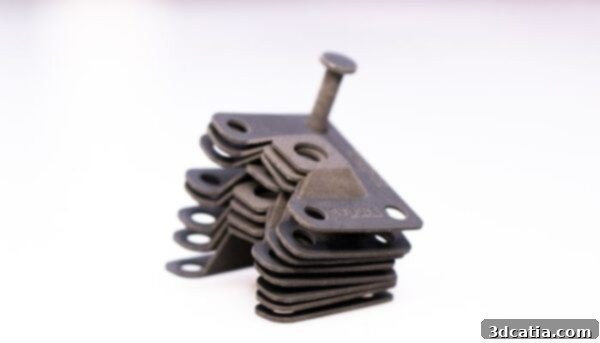
Set of ABS brackets 3D printed using STEP technology.
How Does STEP Technology Work to Produce Quality ABS Parts?
Evolve’s STEP technology is a novel addition to the additive manufacturing family, yet it distinguishes itself by not fitting neatly into any of the established categories outlined in the international standard ISO/ASTM 52900:2021, which defines additive manufacturing processes. This unique positioning is a testament to its innovative approach to 3D printing.
Fundamentally, STEP technology involves building parts layer by layer, similar to other additive processes. However, its core engine is derived from high-speed 2D digital printing principles, specifically leveraging electrophotography. This intricate process is structured in three distinct and highly coordinated steps:
- Imaging: In the initial phase, minuscule particles of the part material (such as ABS) and supporting materials are selectively deposited onto a rapidly moving belt. This deposition is precisely controlled using electrophotography, a technique that employs electrical charges to attract and transfer material particles, much like a conventional 2D laser printer creates images with toner. This enables high-resolution and intricate layer creation.
- Alignment: Once the material images are precisely laid down on the belt, they are carefully heated. This heating prepares the material for transfer to the build plate. The images are then accurately aligned and transferred from the moving belt onto the previous layer on the build plate, ensuring perfect registration for each subsequent layer.
- Fusing: The final and crucial step is fusing. Here, under the combined effect of meticulously controlled heat and pressure, the deposited material particles are seamlessly fused to the underlying build layer. Following fusion, the newly formed layer is rapidly cooled below its glass transition temperature, solidifying it and creating a robust, homogenous structure. This cyclical process of deposition, transfer, fusion, and cooling is repeated layer after layer, ultimately producing the complete 3D part with exceptional integrity.
As John Lees, vice president of engineering at Evolve Additive, eloquently puts it, “We’ve found a way to micronize engineering thermoplastics so that they behave like toner in a 2D printer.” This innovative approach is what truly sets STEP apart.
One of the most compelling aspects of STEP technology, and a key differentiator highlighted by Evolve, is its capability to produce fully dense parts. This is a critical advantage over many other additive processes which can sometimes result in parts with inherent porosity or voids. In STEP, the controlled application of pressure by a roller during the image transfer and fusing stage, combined with precise heat, ensures optimal adhesion and compaction of the material. This results in parts with material properties that closely mimic those produced by injection molding, including excellent mechanical strength, rigidity, and isotropic characteristics. Furthermore, the machine marketed by Evolve, the SVP™ (Scaled Volume Production), incorporates advanced intelligence. It continuously scans each layer after deposition to identify any minute variations in height or material distribution. This real-time feedback loop allows the system to compensate for these variations by precisely adjusting material deposition in subsequent layers, guaranteeing unparalleled dimensional accuracy and consistency. According to Evolve, this meticulous control ensures that STEP produces parts with superior mechanical properties and high accuracy, making them genuinely scalable for demanding applications.
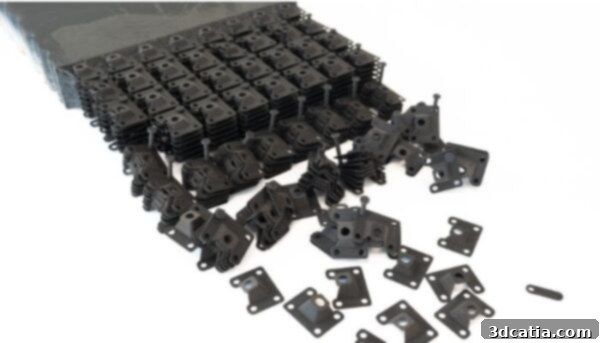
One SVP machine build unit includes 92 sets of brackets for a total of 736 brackets, printed in 6.5 hours.
Producing ABS Parts: Comparing STEP with Other Additive Technologies and Injection Molding
Having explored the intricate mechanics of STEP technology, let’s now delve into why it stands out from other additive manufacturing processes and why it presents a compelling alternative to injection molding for scalable ABS part production. The comparison spans several critical aspects, including material versatility, printing speed, part accuracy, and overall cost-effectiveness.
In terms of materials, STEP offers immediate practical advantages. The process currently supports two widely demanded types of ABS: a standard black and a versatile light gray. This choice caters to a broad spectrum of industrial requirements. Beyond ABS, STEP also demonstrates compatibility with Nylon PA-11, a high-performance polymer known for its superior elongation at break and elevated softening temperature, making it ideal for applications requiring flexibility and resilience in challenging thermal environments. This material flexibility opens up possibilities for diverse end-use parts.
When it comes to printing speed, STEP technology exhibits a significant advantage, particularly when compared to certain Powder Bed Fusion (PBF) additive technologies. PBF processes often necessitate the heating and cooling of the entire build volume for each print, leading to longer cycle times and extended periods required to switch between production runs. This inherent characteristic limits their throughput. In stark contrast, STEP’s electrophotographic approach allows for much more agile operation. The process can be efficiently stopped once a part is completed and extracted, enabling a new production run to commence almost immediately. This rapid turnaround time significantly boosts overall manufacturing throughput, making it highly attractive for environments demanding quick shifts in production lines or a continuous flow of different parts.
Delving into part accuracy and detail, STEP technology leverages its unique digital printing foundation to achieve impressive precision. The system is capable of producing layers as thin as 13 microns, utilizing finely controlled 22μm particles. This combination enables the creation of robust, high-resolution parts with exceptionally smooth surfaces, boasting a roughness (Ra) of typically 3-6μm. The underlying Kodak NexPress print engine, a core component of STEP, offers a resolution of 600 dots per inch (DPI), which translates to a precise pixel size of 40 microns. Because STEP is an electrophotographic process, it skillfully sidesteps the common thermal challenges that plague many other 3D printing processes, such as power density limits and thermal distortion. These issues often force compromises between print speed and resolution in traditional additive manufacturing. By overcoming these “historical” limitations, Evolve’s STEP aims to redefine the optimal balance between print speed and resolution, enabling manufacturers to achieve both rapid production and intricate detail without sacrificing one for the other.
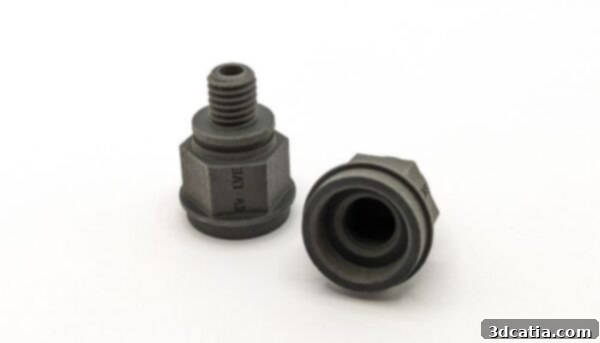
A fully dense ABS part can meet air or fluid handling requirements.
When benchmarked against the established efficiency of injection molding, STEP technology offers a compelling value proposition, particularly for certain production volumes. While it may not rival injection molding for ultra-high-volume serial production (millions of units), STEP consistently delivers ABS parts with equivalent mechanical properties and quality. This parity in part performance is a significant advantage for an additive manufacturing process, especially for small and medium-sized enterprises (SMEs) that are looking to scale their production without the substantial upfront investment in injection molds and specialized tooling. For SMEs, the cost and lead time associated with creating complex injection molds can be a major barrier to innovation and growth. STEP provides a flexible, on-demand manufacturing solution that bypasses these hurdles.
Given its relative speed and ability to produce quality parts, STEP technology effectively serves as an ideal bridge between the rapid iterations of prototyping and the demands of volume production. It allows companies to move from design to functional, end-use parts much faster than traditional methods. Moreover, from a cost perspective, STEP offers an accessible initial solution for SMEs that aspire to scale their manufacturing operations but are financially constrained from investing in costly injection molding technology and tooling. This makes advanced manufacturing capabilities more accessible, fostering innovation and competitiveness across a broader range of businesses.
3D Printing of ABS End-Use Parts for Serial Production
As previously highlighted, ABS components are vital across a multitude of industries and applications, celebrated for their robust material properties. Two sectors that particularly benefit from ABS and find STEP technology exceptionally valuable are irrigation systems and electrical components. Both of these fields frequently require the production of small, intricately detailed parts, often in medium-sized production runs rather than colossal volumes. In such scenarios, traditional injection molding often proves to be an economically less viable choice, especially when considering the significant additional costs associated with designing, manufacturing, and maintaining specialized molds.
For irrigation systems, STEP technology has been instrumental in creating a variety of critical components, including sprinkler valves, check valves, and pressure test manifolds. ABS is ideally suited for these applications due to its excellent chemical resistance to aqueous acids, alkalis, and concentrated hydrochloric and phosphoric acids, ensuring longevity and reliability in harsh environmental conditions. Crucially, STEP technology consistently delivers parts that possess essential characteristics required for fluid handling systems: full density, freedom from voids, and an absence of porosity problems. This ensures leak-proof performance and structural integrity, which are paramount in water management applications. The ability to produce complex internal geometries and fully functional moving parts like check-valves with a free-floating ball further demonstrates STEP’s advanced capabilities.
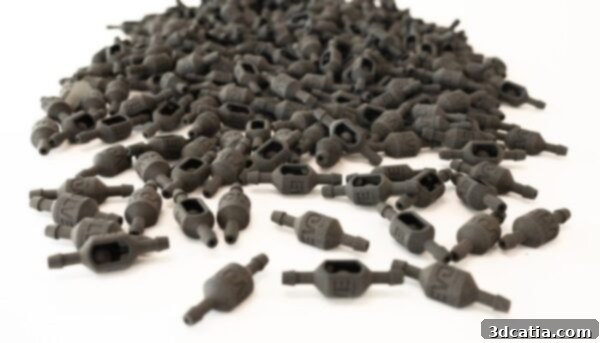
Check-valves with a free-floating ball inside, made by STEP process.
Another compelling use case for STEP technology in manufacturing ABS end-use parts is the production of electrical interconnect housings. In this domain, the combination of precision and speed offered by STEP is invaluable. For instance, an end-user was able to produce 195 parts in just under two hours, showcasing the technology’s rapid throughput. When scaled up with a standard three-shift rotation, this translates into an impressive output of more than 300,000 parts per year. The consistent quality and dimensional accuracy achieved with STEP are critical for electrical components, where tight tolerances and reliable performance are non-negotiable.
Ultimately, by adopting STEP technology for both prototyping and serial production in these diverse applications, users have significantly mitigated the risks traditionally associated with managing multiple production processes. This consolidation streamlines workflows, reduces lead times, and ensures consistent quality from the initial design phase all the way through to final production. Evolve Additive Solutions invites you to experience the transformative power of STEP technology firsthand. Discover its capabilities by requesting a free sample part HERE.
What are your thoughts on STEP technology’s potential for serial production of ABS end-parts? We encourage you to share your insights in a comment below or join the conversation on our LinkedIn, Facebook, and Twitter pages! Don’t forget to sign up for our free weekly newsletter here to receive the latest 3D printing news directly in your inbox! You can also explore all our videos on our YouTube channel.
*All Photo Credits: Evolve Additive Solutions