
Exploring the Future: Top 5 3D Printing Innovations Shaping Industries Today
Welcome to our weekly showcase of groundbreaking advancements in the world of 3D printing and additive manufacturing! This week, we delve into five exceptional videos that highlight how this revolutionary technology is not just evolving, but actively reshaping various sectors of our society. From transforming healthcare with personalized medical devices to pushing the boundaries of high-performance automotive parts, 3D printing continues to demonstrate its immense potential across diverse industries like medical, automotive, and even consumer goods. These innovations are not merely theoretical concepts; they are tangible solutions making a real difference in people’s lives and industrial processes worldwide. Join us as we explore cutting-edge applications, including a custom racecar steering wheel, advanced spinal implants, personalized footwear, and more. For an even deeper dive into the fascinating world of additive manufacturing, make sure to visit our extensive YouTube channel, where you’ll find a wealth of additional 3D printing content. We hope you enjoy this curated selection and gain valuable insights into the future of manufacturing!
Top 1: Revolutionizing Mobility with Custom 3D Printed Orthoses
Our first highlight takes us into the compassionate world of Andiamo, a pioneering company co-founded by Naveed & Samiya Parvez. Their inspiring journey began with a profound mission: to leverage advanced technology to fundamentally change the lives of children grappling with complex movement difficulties. Andiamo stands at the forefront of combining compassionate medical expertise with cutting-edge 3D printing technology, offering a beacon of hope for many families. The core of their innovation lies in their unparalleled ability to translate detailed 3D body data into highly customized medical devices. Specifically, they create bespoke orthoses – external body braces – tailored precisely to the unique anatomical needs of each child. Traditional methods for producing such devices often involve lengthy, uncomfortable, and imprecise casting processes, which can be particularly distressing for children with special needs. Andiamo’s approach, however, utilizes sophisticated 3D scanning and simulation techniques, dramatically improving both the accuracy of the fit and the speed of production. This digital workflow ensures that each orthosis provides optimal support, comfort, and functionality, which is paramount for children with sensitive conditions and long-term rehabilitation needs. By embracing additive manufacturing, Andiamo not only reduces the often-stressful lead times but also creates lighter, more breathable, and perfectly fitting devices. This significant enhancement in design and functionality contributes to a child’s improved mobility, greater independence, and overall quality of life. This level of personalization is truly transforming how children with disabilities interact with their environment, empowering them to move with greater ease and confidence.
Top 2: Advancing Spinal Care with Metal Additive Manufacturing
The second video spotlights a remarkable collaboration between NuVasive, a leading global medical technology company focused on spinal device manufacturing, and 3D Systems’ esteemed Customer Innovation Center. This partnership exemplifies how industrial additive manufacturing (AM) is breaking new ground in the medical field, particularly in the creation of highly advanced spinal devices. Metal additive manufacturing offers unparalleled capabilities for designing and producing implants with intricate geometries and tailored micro-structures that are often impossible to achieve with conventional manufacturing methods. NuVasive, backed by 3D Systems’ profound engineering expertise and extensive regulatory experience crucial for medical devices, is harnessing these capabilities to craft 3D printed spinal implants. These innovative devices boast a delicate balance of interconnected porosities, optimized stiffness, and superior imaging characteristics. The ability to control porosity at a micro-structural level is crucial for encouraging bone ingrowth (osseointegration), which is vital for long-term implant stability and seamless integration with the patient’s anatomy. Furthermore, tailoring the stiffness of an implant can significantly improve patient comfort by reducing stress shielding, a phenomenon where the implant takes too much load, potentially leading to bone degradation around the device. The enhanced imaging characteristics ensure that these devices are easily observable and distinguishable under various medical imaging techniques, allowing surgeons and clinicians to monitor their performance and integration effectively post-surgery. This revolutionary approach to implant design is set to transform spinal surgery, leading to improved patient outcomes, potentially faster recovery times, and ultimately, a higher quality of life for individuals suffering from debilitating spinal conditions. This partnership is not just about making parts; it’s about pushing the boundaries of what’s medically possible to enhance human well-being.
Top 3: The Future of Footwear: Hyper-Personalization with 3D Printing
Our third innovation comes from tech giant HP, which is stepping boldly into the footwear industry with its groundbreaking FitStation platform. This sophisticated 3D tech platform is a testament to the power of integrating artificial intelligence (AI), advanced engineering, and precise 3D printing to deliver truly custom footwear solutions. The FitStation experience begins with a comprehensive 3D foot scan, meticulously capturing every contour, dimension, and pressure point of the user’s foot. This highly accurate static data is then combined with dynamic gait analysis, which assesses how an individual walks or runs in motion, identifying nuances in pressure distribution, pronation, supination, and other biomechanical factors. By analyzing this rich and intricate dataset, the FitStation can generate designs for highly personalized 3D printed orthotic insoles. These insoles are manufactured using HP’s proprietary Multi Jet Fusion (MJF) process, renowned for its ability to produce complex, durable, and lightweight parts with remarkable speed and accuracy. The benefits of such custom insoles are manifold: they offer unparalleled comfort, optimized arch support, and enhanced performance, whether for everyday wear, high-intensity athletic activities, or specialized medical applications. For athletes, custom insoles can significantly reduce the risk of injury, improve biomechanical efficiency, and optimize energy transfer, potentially leading to better performance and endurance. For individuals with chronic foot conditions, discomfort, or specific orthopedic needs, these tailored insoles provide targeted support and cushioning, effectively alleviating pain and promoting healthier foot mechanics. HP’s FitStation represents a significant leap forward in consumer personalization, demonstrating how additive manufacturing can cater to individual needs on a mass scale, moving beyond one-size-fits-all solutions to truly bespoke products that enhance well-being, comfort, and athletic performance.
Top 4: Boosting Racecar Performance with Customized 3D Printed Parts
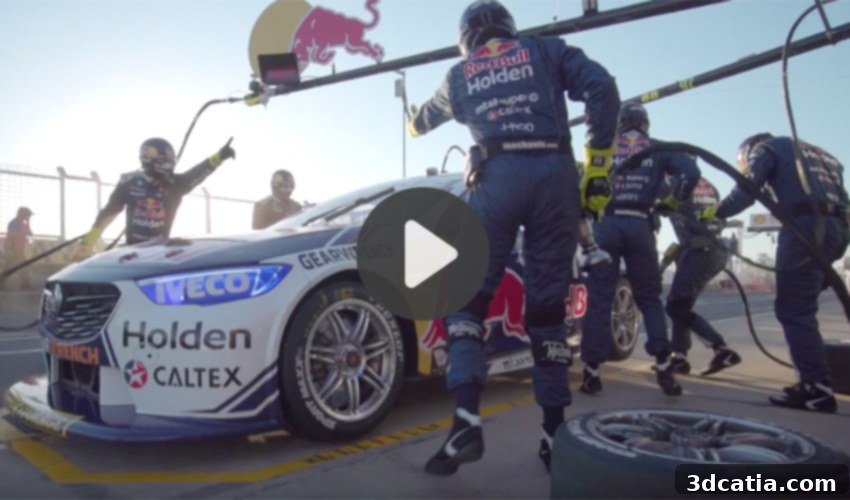
The fourth video accelerates us into the high-octane world of motorsports, where Triple Eight Race Engineering, a formidable force in V8 Supercars, is embracing 3D printing to gain an undeniable competitive edge. Partnering with EVOK3D and harnessing the unparalleled power of HP’s Multi Jet Fusion technology, Triple Eight is revolutionizing how critical race car parts, particularly elements for the intricate steering wheel, are designed and manufactured. In the demanding and relentless environment of professional racing, every gram of weight, every fraction of a second, and every minute ergonomic detail counts towards victory. Traditional manufacturing processes often entail long lead times, limiting the ability to rapidly iterate on designs or produce highly complex, optimized components. By integrating industrial 3D printing into their workflow, Triple Eight has drastically reduced these lead times, allowing for quicker design cycles, rapid prototyping, and faster implementation of improvements. This newfound agility is absolutely crucial for responding to dynamic track conditions, driver feedback, and evolving performance requirements throughout a racing season. More importantly, additive manufacturing enables the creation of parts with intricate geometries, lightweight internal lattice structures, and optimized contours that are simply not feasible with conventional machining or molding techniques. For a race car steering wheel, this means customizing grips, button layouts, paddle shifters, and internal components to perfectly fit a driver’s unique hand morphology and preferences. This optimizes ergonomics, improves weight distribution, and enhances the accessibility of crucial controls during high-speed maneuvers. The result is a steering wheel that is not only lighter and stronger but also ergonomically superior and perfectly integrated with the driver, directly contributing to increased driver comfort, precision control, and ultimately, enhanced race performance. This collaboration underscores how 3D printing is transforming motorsports by enabling unprecedented levels of customization, rapid design iteration, and performance optimization, driving the industry forward at incredible speed.
Top 5: MakerBot METHOD X: Bridging the Gap to Industrial-Grade 3D Printing
Our final spotlight shines on the MakerBot METHOD X, a professional desktop 3D printer that made a significant splash upon its launch at the beginning of August, captivating attention at industry events like the TCT Show in Birmingham. The METHOD X has been meticulously engineered to bridge the critical gap between traditional industrial 3D printers and more accessible desktop machines, offering capabilities typically reserved for much higher-priced systems. Its main selling point and a major differentiator in the crowded desktop market is its unique ability to reliably print with real ABS (Acrylonitrile Butadiene Styrene) material. Unlike many desktop 3D printers that often rely on modified ABS formulations to mitigate common printing challenges, the METHOD X is specifically designed to handle genuine, industrial-grade ABS. This distinction is paramount because real ABS boasts superior mechanical and thermal properties essential for functional prototyping and demanding applications. According to MakerBot’s rigorous testing, parts printed with real ABS on the METHOD X can withstand temperatures up to 15°C higher, are up to 26% more rigid, and up to 12% stronger than those made with modified ABS on other desktop printers. This enhanced durability, dimensional stability, and performance make it exceptionally suitable for more demanding applications, including functional prototypes, manufacturing tools, jigs, fixtures, and even certain end-use parts where strength, heat resistance, and long-term reliability are paramount. Furthermore, one of the biggest and most persistent challenges when printing ABS on desktop platforms without proper thermal control is warping or cracking of the printed object. The METHOD X ingeniously addresses this ubiquitous issue by incorporating a fully enclosed, actively heated build chamber. This controlled environment maintains a consistent, elevated internal temperature throughout the entire printing process, effectively preventing the typical warping and delamination that often plague ABS prints. This innovation ensures greater success rates, superior part accuracy, and consistent results. The MakerBot METHOD X therefore represents a significant step forward, making industrial-grade material capabilities and reliability accessible to a broader range of professionals, engineers, and designers, enabling them to produce stronger, more accurate, and more functional parts directly from their desks or office environments.
This week’s collection truly underscores the dynamic and transformative power of 3D printing across an incredibly diverse array of industries. From empowering children with greater mobility and revolutionizing spinal surgery, to enhancing athletic performance through personalized footwear and pushing the limits in motorsports, all the way to bringing industrial-grade materials to the desktop, additive manufacturing continues to innovate at an astonishing pace. These videos offer just a glimpse into the ongoing revolution that promises to redefine how we design, produce, and interact with the physical world, offering solutions that are more customized, efficient, and impactful than ever before. We hope this deep dive into these five incredible applications has sparked your imagination and highlighted the profound impact of this technology on our society and economy. What are your thoughts on this week’s top 5 innovations? We encourage you to drop a comment below or engage with us on our Facebook and Twitter pages! And to ensure you never miss out on the latest advancements, breaking news, and insightful analyses in the rapidly evolving 3D printing industry, be sure to sign up for our free weekly Newsletter, delivered straight to your inbox.