
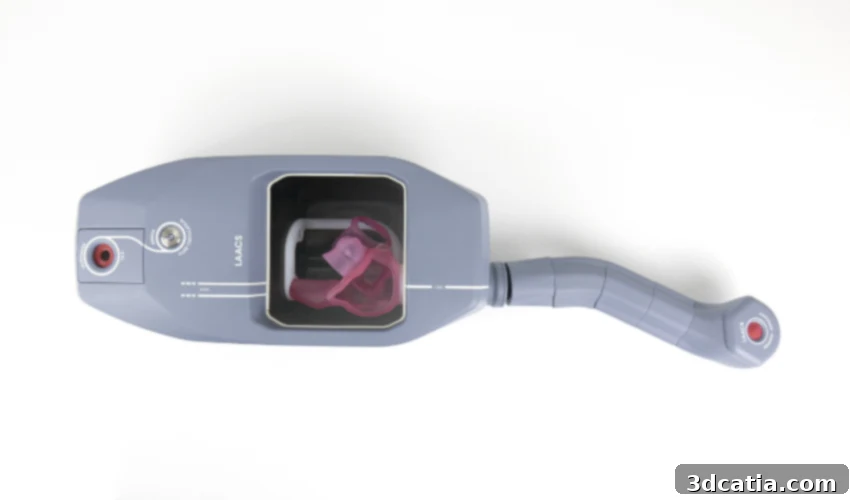
Revolutionizing Medical Training: Biomodex’s Advanced 3D Printed Transseptal Puncture Simulation Solution
The landscape of modern medicine is continually evolving, with 3D printing technology emerging as a pivotal tool, particularly in the realm of customized medical devices and advanced medical training. This innovative approach promises to redefine how medical professionals hone their skills, ensuring greater precision and safety in complex procedures. Leading this charge in medical simulation is Biomodex, a pioneering digital health company with offices in Boston and Paris. Biomodex has significantly expanded its product portfolio with cutting-edge 3D printed solutions tailored for neurovascular and cardiovascular patient-specific rehearsal and physician training. Their latest groundbreaking introduction is the new Transseptal Puncture Training Solution. This next-generation training system is ingeniously designed to be fully compatible with ultrasound imaging, meticulously simulating the authentic feel, friction, and haptic feedback of real heart tissues and blood vessels. This allows medical students and experienced physicians alike to practice and master the intricate transseptal puncture procedure in a highly realistic, risk-free environment.
The Expanding Horizons of 3D Printing in Healthcare and Medical Education
Over the past decade, advancements in 3D printing technologies have profoundly impacted numerous sectors, with the medical field experiencing some of the most transformative applications. This technology has proven its immense value not only in addressing immediate crises but also in fostering long-term improvements in patient care and physician proficiency. During the global COVID-19 pandemic, for instance, 3D printing became an indispensable resource for mitigating severe disruptions caused by supply chain breakdowns and widespread shortages. Dedicated manufacturers and a vibrant community of individual makers rapidly produced critical medical supplies, including Personal Protective Equipment (PPE), emergency ventilators, and even innovative 3D printed swabs for widespread testing. This agility and capacity for localized production showcased the technology’s critical role in healthcare resilience.
Beyond crisis response, 3D printing’s true power in medicine lies in its unparalleled ability to offer customization. This benefit is revolutionizing various product categories across medical and dental fields. Surgeons are increasingly leveraging 3D printing to create highly personalized implants, prosthetics, and surgical guides that precisely match individual patient anatomies. This level of personalization significantly enhances procedural accuracy, reduces recovery times, and improves long-term patient outcomes. The continuous innovation in biomedical materials further amplifies the dynamic possibilities within this field. Crucially, 3D printing is also transforming medical education and training, providing realistic, hands-on experiences that were previously unattainable. This is precisely where companies like Biomodex make their profound impact, bridging the gap between theoretical knowledge and practical expertise.
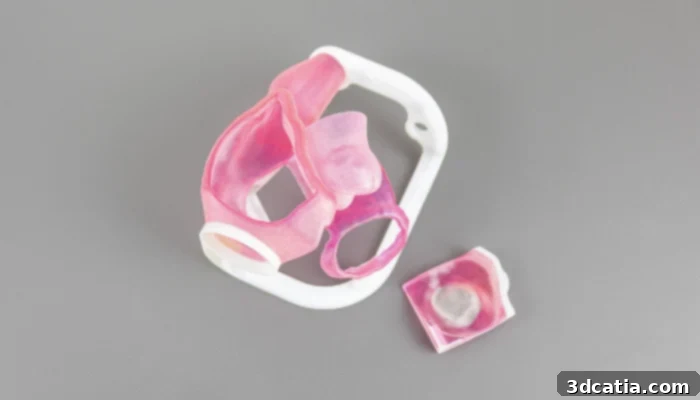
Biomodex’s Transseptal cartridge and septum (photo credits: Biomodex)
Biomodex: Pioneering Patient-Specific Rehearsal and Physician Training
Established in 2015, Biomodex set out with an ambitious vision: to develop sophisticated 3D printing-based solutions for complex medical training and case-specific surgical rehearsals. Their core mission revolves around utilizing their proprietary 3D printing technology to deliver an unparalleled, tailored tactile experience for physicians. By providing highly realistic simulations, Biomodex aims to fundamentally revolutionize pre-operative planning, thereby leading to safer medical procedures and significantly improved patient outcomes. The Transseptal Puncture Training Solution stands as the newest testament to their innovative spirit and commitment to advancing medical education.
According to Bill Perusek, Biomodex’s Vice President of U.S. Sales, the development of this specialized system was a direct response to a growing and critical need for enhanced training in this particular procedure. He elaborates, “The volume of TP procedures has been on the rise due to increasing incidences of atrial fibrillation and other structural heart disease. This surge underscores the urgent need for robust training methodologies. Our aim is to provide a modern and realistic training solution that can shorten the learning curve for these demanding procedures, and enable more physicians to advance their skills more quickly. By allowing repeatable, consequence-free practice, we empower clinicians to achieve competence and confidence faster, ultimately benefiting patient care.” This philosophy underscores Biomodex’s dedication to addressing real-world clinical challenges with advanced technological solutions.
An In-Depth Look at the New Biomodex 3D Printed Training Solution
The Transseptal Puncture procedure is a vital intervention that grants cardiologists and electrophysiologists access to the left atrium of the heart. This access is crucial for diagnosing and treating a wide array of cardiac conditions, including atrial fibrillation, structural heart defects, and various arrhythmias. The procedure itself is inherently complex, typically requiring sophisticated guidance from advanced cardiac imaging techniques such as transesophageal echocardiography (TEE) or intracardiac echocardiography (ICE) to ensure precise and safe navigation within the heart’s delicate structures. Mastery of this procedure demands not only extensive theoretical knowledge but also considerable practical skill and spatial awareness.
Biomodex’s innovative solution is meticulously engineered to provide an unparalleled training experience. Its design goes beyond merely simulating the visual aspects of the procedure; it focuses on replicating the tactile and acoustic properties essential for realistic practice. The system is designed not only to simulate the intricate anatomy of real heart tissues and blood vessels but also boasts full compatibility with advanced imaging technologies like TEE and ICE. This allows trainees to practice the procedure using the same guidance tools they would employ in a live clinical setting, thereby fostering more effective and comprehensive training while significantly reducing potential risks to actual patients. The training cartridges, which form the core of the system, are precisely 3D-printed using Biomodex’s proprietary INVIVOTECH and ECHOTECH technologies. INVIVOTECH is designed to mimic the exact mechanical behavior of cardiac tissue and blood vessels, delivering authentic feel, resistance, and haptic feedback as instruments pass through various anatomical layers. Concurrently, ECHOTECH ensures that the models possess targeted acoustic properties, making them respond realistically to ultrasound imaging and thus enabling physicians to train under conditions that closely mirror real-life scenarios. This dual technological approach creates an immersive and highly accurate simulation environment, empowering physicians to develop critical psychomotor skills, enhance hand-eye coordination, and refine decision-making processes without any patient involvement.
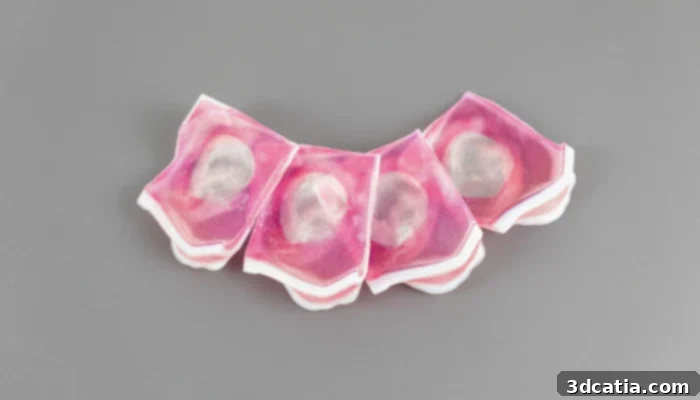
Disposable septums used for training (photo credits: Biomodex)
Expert Endorsement and the Future of Medical Training with 3D Printing
The significance of such advanced training solutions cannot be overstated, especially as new structural heart technologies continue to emerge. Dr. Juan F. Granada, President and CEO of the Cardiovascular Research Foundation, underscored this point, stating, “The successful adoption of emerging structural heart technologies necessitates that operators receive more specialized and rigorous training to further industry acceptance and integration. Biomodex’s latest solution offers an innovative and vastly superior alternative to traditional training methods. It uniquely enables physicians to gain invaluable experience by working on highly humanized models and utilizing clinically adopted imaging tools within a realistic cath-lab environment. This experiential learning approach is crucial for building competence and confidence.”
Dr. Granada further highlighted the indispensable role of 3D printing in the creation of these sophisticated training models, remarking, “Due to the fact that the training models are 3D-printed, we possess the incredible flexibility to adapt training scenarios to address more complex anatomies or specific technical challenges. This adaptability means that training can be precisely tailored to the individual needs of the physician or the unique complexities of a particular case, something impossible with cadaveric or animal models.” This capacity for customization is a game-changer, allowing for the simulation of rare anatomical variations or challenging procedural hurdles, ensuring that physicians are prepared for an extensive range of clinical situations. The integration of 3D printing into medical training promises a future where surgical preparation is highly personalized, incredibly realistic, and continuously adaptable. This approach will undoubtedly lead to enhanced physician proficiency, reduced procedural complications, and ultimately, superior patient care across the entire healthcare spectrum. We eagerly anticipate the ongoing innovations that 3D printing will bring to the medical field, transforming how future generations of healthcare professionals are educated and trained.
To delve deeper into the innovative Transseptal Puncture Training Solution or to learn more about Biomodex and their pioneering work in digital health, please visit their official website HERE. We invite your thoughts on this revolutionary training system. What do you think about the Transseptal Puncture Training Solution and its potential impact on medical education? Share your opinions in a comment below or join the conversation on our Facebook and Twitter pages! For the latest updates and breaking news in the world of 3D printing, sign up for our free weekly Newsletter here, delivered straight to your inbox!
*thumbnail photo credits: Biomodex