
Revolutionizing 3D Content Creation: An In-Depth Look at OpenAI’s Point-E System
Artificial Intelligence (AI) has seamlessly integrated itself into countless aspects of our daily lives, often operating behind the scenes without us even realizing its pervasive influence. From the moment we unlock our smartphones with facial recognition to receiving personalized product recommendations online, AI-powered software, designed to simulate human behavior and complex cognitive processes, is constantly at work. These sophisticated systems leverage advanced machine learning techniques and Deep Learning algorithms to analyze data, identify patterns, and provide solutions to intricate problems. Its applications span across diverse sectors, including personalized online shopping experiences, robust fraud prevention for financial transactions, and the ubiquitous convenience of voice assistants. The escalating prevalence of AI is hardly surprising, especially when considering the promising projections from a 2020 Statista study, which anticipated the global artificial intelligence software market to soar to an impressive $126 billion by 2025. This rapid expansion now opens exciting new frontiers, one of the most intriguing being the application of AI in the intricate process of 3D model generation. This is precisely the ambitious goal that OpenAI, a leading AI research organization, aims to achieve with its groundbreaking new system, Point-E.
While the concept of leveraging AI for 3D model creation isn’t entirely new, previous iterations often faced significant limitations, particularly regarding efficiency. For instance, tech giants like Google have already ventured into this space, offering services such as their DreamFusion tool, which facilitates the conversion of text into 3D models. However, the generation process using such tools could typically take several hours, presenting a considerable bottleneck for rapid prototyping and iterative design. It is against this backdrop that OpenAI, a company famously co-founded by influential entrepreneur Elon Musk, has introduced its innovative machine learning system, Point-E, to the market. What sets Point-E apart is its remarkable speed; according to OpenAI, this advanced system can drastically reduce the time required to generate 3D models from hours to mere minutes. This significant leap in efficiency marks a pivotal moment for industries reliant on 3D content, promising to accelerate workflows and democratize access to sophisticated 3D modeling capabilities.

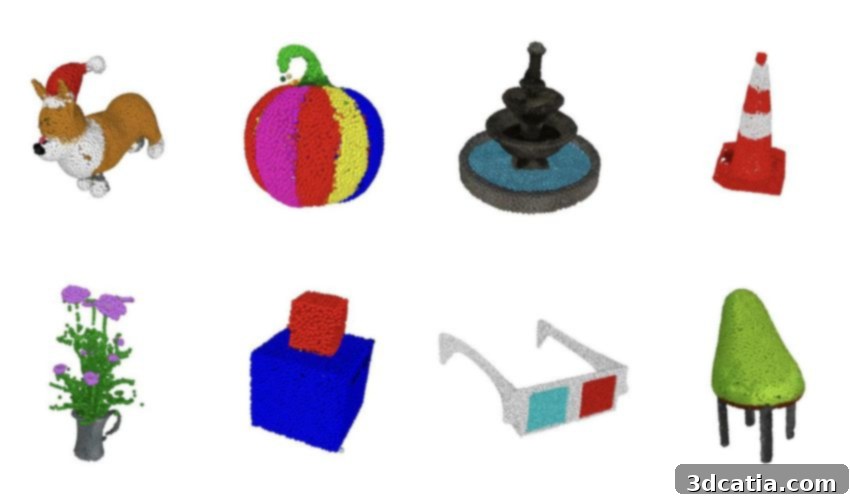
How 3D models are created from point clouds (photo credits: OpenAI)
How Point-E Revolutionizes 3D Model Generation with Efficiency
At the core of Point-E’s functionality lies its innovative approach to generating 3D objects through the creation of vast numbers of “point clouds.” A point cloud is essentially a collection of data points defined by their X, Y, and Z coordinates in a three-dimensional space. These points collectively represent the exterior surface of a 3D shape, capturing its overall form. The primary advantage of generating point clouds over traditional volumetric or mesh-based representations is their computational efficiency. Point clouds are relatively simple to produce quickly, as the AI needs only to predict the coordinates of individual points rather than defining complex geometric structures from the outset. This inherent speed is precisely why the ‘E’ in Point-E stands for ‘efficiency,’ reflecting the system’s ability to outperform other offerings on the market in terms of generation time. This speed advantage makes it an ideal tool for rapid concept visualization and initial prototyping, where quick iterations are more valuable than ultra-high fidelity in the early stages.
While the speed of point cloud generation is a significant benefit, it also comes with certain inherent disadvantages. A raw point cloud, by its nature, represents a discreet set of points and does not inherently contain information about the connectivity between these points or the surface topology of the object. This means that point clouds often struggle to capture the fine shape details, intricate textures, or smooth surfaces of an object accurately. For many advanced applications, such as realistic rendering, simulation, or manufacturing, a continuous surface representation is crucial. Recognizing this significant drawback, the developers at OpenAI implemented an ingenious solution: an additional AI system. This secondary AI is specifically trained to convert the generated point clouds into more traditional and usable mesh models. Meshes are a more comprehensive representation of a 3D object, composed of vertices (points), edges (lines connecting vertices), and faces (surfaces formed by edges). This structure allows for a much more detailed and topologically accurate definition of an object’s geometry, enabling better rendering, texturing, and physical interaction.
Even with the crucial step of converting point clouds to meshes, certain limitations persist. The fidelity and accuracy of the resulting mesh heavily depend on the density and quality of the initial point cloud. If the point cloud is sparse or contains inaccuracies, the generated mesh might still overlook subtle features or introduce imperfections, meaning the final shape might not always be represented in its absolute true sense. For instance, complex curvatures or very thin structures could still present challenges, requiring further refinement or manual intervention for high-precision applications. Despite these challenges, the two-stage process (point cloud generation followed by mesh conversion) offers a remarkable balance between speed and geometric detail, pushing the boundaries of what is possible in automated 3D content creation.
Understanding Point-E’s Text-to-3D and Image-to-3D Workflow
Beyond its core point cloud generation mechanism, Point-E distinguishes itself by offering versatile input methods, specifically text-to-3D and image-to-3D model generation. The text-to-3D workflow is particularly compelling. It typically begins with a user providing a textual description of the desired object – for example, “a red gear wheel with 20 teeth and a 5cm diameter.” Instead of directly generating a 3D model from this text, Point-E leverages a sophisticated intermediary step. Initially, a specialized text-to-image AI model, trained to understand and associate words with corresponding visual representations, generates a synthetic image based on the textual prompt. This image serves as a detailed visual blueprint. Subsequently, this rendered image is fed into Point-E’s image-to-3D component, which then interprets the 2D visual information to generate the 3D point cloud, and ultimately, the mesh model. This multi-stage approach, where text is first translated into a visual concept before being converted into a 3D form, helps the system to bridge the semantic gap between abstract language and concrete three-dimensional geometry, making the overall process more robust and effective.
The image-to-3D model, on the other hand, allows users to directly input a 2D image, from which the system generates a corresponding 3D object. This functionality is invaluable for creators who already have visual concepts or reference images they wish to transform into three-dimensional assets. By leveraging a system trained on massive datasets correlating 2D images with their 3D counterparts, Point-E can efficiently understand the structure and depth implied in a flat image and translate it into a point cloud. This direct image-to-3D conversion offers a powerful tool for artists, designers, and developers looking to quickly create 3D assets from existing visual media, significantly accelerating the ideation and production phases in various creative industries. Both text and image inputs underscore Point-E’s flexibility and potential to democratize 3D modeling for a broader audience, reducing the need for specialized 3D design software and expertise.
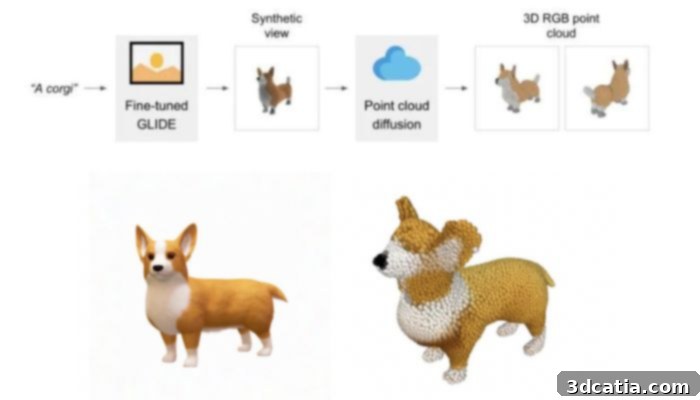
How to 3D Print a Corgi using Point-E (photo credits: OpenAI).
The Power of Data and Point-E’s Current State and Future Outlook
The impressive capabilities of Point-E, particularly its ability to generate diverse and detailed 3D models from simple prompts, are underpinned by an enormous database of models used for training. Like most advanced AI systems, Point-E relies on vast amounts of carefully curated data to learn the intricate relationships between text, images, and 3D geometries. This extensive dataset allows the AI to recognize patterns, understand semantic meanings, and extrapolate complex forms, enabling it to respond effectively to user prompts. OpenAI acknowledges that while this technology for generating 3D models represents a monumental leap forward, it is not yet “perfectly mature.” This candid assessment highlights that there are still areas for refinement, such as improving the fidelity of generated textures, enhancing topological consistency, and expanding the range of complex object types that can be reliably produced. However, the company strongly emphasizes that even in its current state, Point-E offers a significantly faster and more accessible approach to 3D model generation compared to previously existing techniques, paving the way for further advancements and wider adoption in the near future.
Real-World Applications and Future Potential of Point-E
The introduction of OpenAI’s Point-E system immediately sparks the imagination regarding a wide range of potential applications across numerous industries. The team behind Point-E explicitly highlights its particular suitability for the production of tangible, real-world objects, making it an excellent tool for 3D printing. The ability to quickly generate 3D models from text or images dramatically accelerates the prototyping phase, allowing designers and engineers to rapidly iterate on ideas and test physical concepts without extensive manual modeling. This speed is invaluable in sectors like product design, architecture, and manufacturing. Furthermore, OpenAI is convinced that Point-E will find a strong foothold in the dynamic gaming and animation sectors in the long run. Game developers and animators constantly require new 3D assets, and Point-E could significantly streamline the creation of environmental props, character prototypes, and various in-game objects, thereby reducing production timelines and costs. Beyond these immediate applications, Point-E holds immense promise for virtual reality (VR) and augmented reality (AR) content creation, educational tools for visualizing complex concepts, and even for individual creators and hobbyists looking to bring their imaginative ideas to life in three dimensions without the steep learning curve of traditional 3D software. To delve deeper into the innovative work and mission of OpenAI, please click HERE.
What are your thoughts on OpenAI’s revolutionary Point-E system and its potential impact on 3D content creation? We’d love to hear your insights and predictions! Share your comments below or engage with us on our Linkedin, Facebook, and Twitter pages! Don’t miss out on the latest advancements in 3D printing and AI; make sure to sign up for our free weekly Newsletter here to receive news straight to your inbox! You can also explore all our informative videos and tutorials on our YouTube channel.
*Cover Photo Credits: OpenAI