
Pioneering the Future: Europe’s First Industrial 3D Concrete Printing Facility Unveiled in Eindhoven
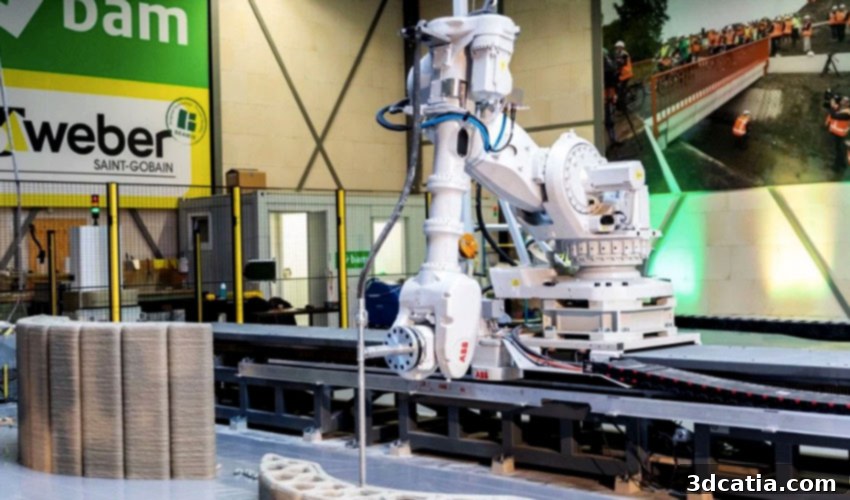
A monumental step forward for the construction industry unfolded on January 14th in Eindhoven, Holland, with the grand inauguration of Europe’s first industrial 3D concrete printing facility. This cutting-edge establishment marks a significant milestone in the adoption of additive manufacturing within the building sector, promising a revolutionary shift in how structures are designed and erected. The facility, a collaborative venture between construction giants Weber Beamix and BAM Infra, is set to become a crucible for innovation, focusing on the industrial production of 3D printed concrete elements for a diverse range of construction applications. Their primary objective is not merely to implement existing technology but to push the boundaries of what is currently possible, rigorously developing and refining 3D concrete printing to maximize its inherent benefits across various projects. The immediate impact of this new facility was evident on its opening day, as the very first order was announced: the ambitious task of printing four robust bicycle bridges destined for the province of North Holland, signaling a concrete (pun intended) start to its transformative mission.
The advent of 3D printing in construction introduces a paradigm shift, offering a multitude of advantages that resonate deeply with the industry’s evolving demands for efficiency, sustainability, and flexibility. These benefits are not merely theoretical but are being actively demonstrated and refined at the Eindhoven facility. Firstly, the technology significantly reduces material consumption. Unlike traditional casting methods that often require extensive formwork and lead to substantial waste, 3D concrete printing precisely deposits material layer by layer, only where it’s structurally needed. This optimized material usage translates directly into enhanced cost-efficiency, as less raw material is purchased and less waste needs to be disposed of. Moreover, this approach profoundly impacts the environmental footprint of construction. By minimizing material waste and often requiring fewer transportation logistics due to on-demand production or local manufacturing, 3D concrete printing contributes to a substantial reduction in CO2 emissions. The process itself is inherently more sustainable, aligning with global efforts to create greener building practices and reduce the environmental impact of urban development.
Bas Huysmans, the visionary Managing Director of Weber Beamix, encapsulates the profound optimism surrounding this technology. “I think 3D printing of concrete has a fantastic future,” he asserted, reflecting the long-term strategic outlook of the initiative. He further elaborated on the ultimate aspiration that drives their relentless pursuit of innovation: “For us, the ultimate goal is to be able to print a house on the construction site.” This statement underscores the ambition to transition from printing individual components within a controlled factory environment to deploying autonomous printing systems directly where construction takes place, heralding an era of unprecedented speed and efficiency in home building.
Project Milestone: Bringing 3D Printed Houses to Life
A cornerstone project for this pioneering facility is “Project Milestone,” an ambitious endeavor aimed at constructing the world’s first habitable 3D printed concrete houses for the city of Eindhoven. The facility will play a critical role in bringing these innovative homes to fruition, serving as the central hub where various structural elements of the houses will be 3D printed in modular chunks. These pre-fabricated components will then be transported to the designated construction sites for assembly, streamlining the building process and significantly reducing on-site labor and construction time. Marco Vonk of Weber Beamix detailed the project’s phased approach, explaining, “The first houses of Project Milestone will be printed in elements here and assembled on location.” This strategic decision allows the team to meticulously control the printing environment, ensuring optimal quality and precision for each component. However, the ultimate aspiration remains to overcome the current logistical and technical hurdles to achieve complete on-site printing. “We hope that the last of the five houses can be printed on location, but that’s still very difficult,” Vonk admitted.
The challenge of direct on-site printing primarily revolves around environmental control, a factor that is meticulously managed within the new facility. “Here it is always 18 degrees and we have constant humidity, but outside you can’t control that,” Vonk explained. The curing process of concrete is highly sensitive to external conditions; for instance, “if the temperature drops below 5 degrees, the concrete will not cure at all.” This environmental variability poses significant obstacles, impacting not only the structural integrity of the printed layers but also the speed and efficiency of the overall process. Researchers and engineers are actively exploring innovative material compositions and protective printing solutions to mitigate these external factors, recognizing that mastering on-site printing is crucial for unlocking the full potential of 3D concrete construction globally. The journey towards printing entire structures directly at their final destination is a complex one, yet it remains the ultimate and most transformative goal for the industry.
The Power of Collaboration: Uniting Industry and Academia
The establishment of this groundbreaking facility is a testament to the power of strategic collaboration, a synergistic alliance born from long-term vision and academic pioneering. Bas Huysmans, Managing Director of Weber Beamix, recounted the genesis of this partnership, revealing that his ambition to embark on concrete printing predated the market’s readiness. “I had always wanted to start printing in concrete but the market for it did not exist yet,” he reflected. It took nearly two decades for the opportune moment to arrive. The catalyst appeared when “someone from Eindhoven University of Technology knocked on the door and wanted to start a project to print concrete.” This pivotal moment ignited the collaborative spirit, as Huysmans recalled, “we were immediately enthusiastic.” This convergence of a seasoned industrial player with a long-held vision and an innovative academic institution eager to apply its research proved to be the fertile ground for this pioneering venture.
From its very inception, BAM Infra and Beamix have been deeply entrenched in the underlying research and development of this advanced technology. This close integration of industrial application and academic inquiry has forged a unique ecosystem where theoretical breakthroughs can be rapidly tested and commercialized. The aim is to cultivate what the partners refer to as a “healthy marriage between the university and construction industry.” This continuous feedback loop ensures that industrial needs drive research directions, while academic advancements provide cutting-edge solutions for real-world construction challenges. This collaborative model is fundamental to accelerating the pace of innovation, overcoming technical hurdles, and ensuring that 3D concrete printing evolves from a novel concept into a mainstream, sustainable construction method. The combined expertise of industry leaders in construction and material science, alongside leading academic research in additive manufacturing, creates an unparalleled environment for continuous improvement and groundbreaking discoveries.
Innovating the Future: Speed, Materials, and Design Freedom
Despite the current achievements, the partners are keenly aware that 3D concrete printing is still in its nascent stages, with immense potential for further refinement and innovation. Theo Salet, a distinguished professor at the Eindhoven University of Technology, eloquently articulated this vision for future development. “There is still a lot of room for improvement,” he observed, highlighting key areas for ongoing research and enhancement. One critical aspect is the printing speed, which Salet believes needs exponential advancement. “As you can see here, the speed of printing is far too slow, it should be ten times faster,” he stated, emphasizing the need for engineering breakthroughs that can dramatically increase output and efficiency, making the technology even more competitive against traditional methods.
Beyond speed, material science stands as another frontier for innovation. Professor Salet pointed out that “there is also much to gain in the materials.” This includes the development of diverse new types of concrete tailored for additive manufacturing, such as formulations that offer different aesthetic properties like various colors, allowing architects greater creative freedom. More importantly, research is focused on enhancing structural performance through advanced reinforcement techniques that can be integrated directly into the printing process, moving beyond conventional steel rebar. Furthermore, the development of lightweight concrete variants is crucial for reducing material load, simplifying transportation, and potentially enabling taller or more complex structures with reduced foundation requirements. These material advancements, coupled with increased printing speeds, will unlock unprecedented design possibilities, allowing for complex geometries, organic shapes, and customized architectural elements that are either impossible or prohibitively expensive to achieve with traditional construction techniques. The ongoing research ensures that 3D concrete printing remains a dynamic field, continually evolving to meet future demands for sustainable, efficient, and aesthetically compelling construction.
Beyond Eindhoven: The Global Impact of Additive Construction
While the Eindhoven facility stands as a beacon of innovation in Europe, its pioneering work resonates with a global movement towards advanced manufacturing in construction. The lessons learned and technologies developed here will undoubtedly influence similar initiatives worldwide. From reducing the carbon footprint of massive infrastructure projects to offering rapid, cost-effective solutions for affordable housing in developing regions, 3D concrete printing holds the promise of revolutionizing how we build our world. This technology offers unparalleled opportunities for customization, allowing for demand-driven designs that are both functional and aesthetically integrated into local environments. As research progresses in areas like robotic automation, artificial intelligence in design, and sustainable material composites, the potential applications for 3D printed concrete will only expand, driving a paradigm shift in urban planning and architectural innovation across continents.
Conclusion: Paving the Way for a Sustainable Built Environment
The inauguration of Europe’s first industrial 3D concrete printing facility in Eindhoven marks a significant turning point for the global construction industry. Through the strategic partnership of Weber Beamix, BAM Infra, and the Eindhoven University of Technology, this facility is not just a manufacturing plant but a vibrant hub for innovation, research, and development. By demonstrating the tangible benefits of 3D printing in terms of cost efficiency, time savings, material optimization, and environmental sustainability, it sets a new benchmark for future construction practices. From printing essential infrastructure like bicycle bridges to embarking on the ambitious Project Milestone for 3D printed houses, Eindhoven is at the forefront of shaping a more sustainable, efficient, and technologically advanced built environment. The journey ahead involves continuous innovation in printing speed, material science, and the ultimate goal of full on-site printing, but the foundation has been laid for a truly transformative era in construction.
Want to know more about 3D Printing, we also interviewed Sika, specialist in concrete 3D Printing.
What do you think of prospect of 3D printed houses on site? Let us know in a comment below or on our Facebook and Twitter pages! Don’t forget to sign up for our free weekly Newsletter, with all the latest news in 3D printing delivered straight to your inbox!