
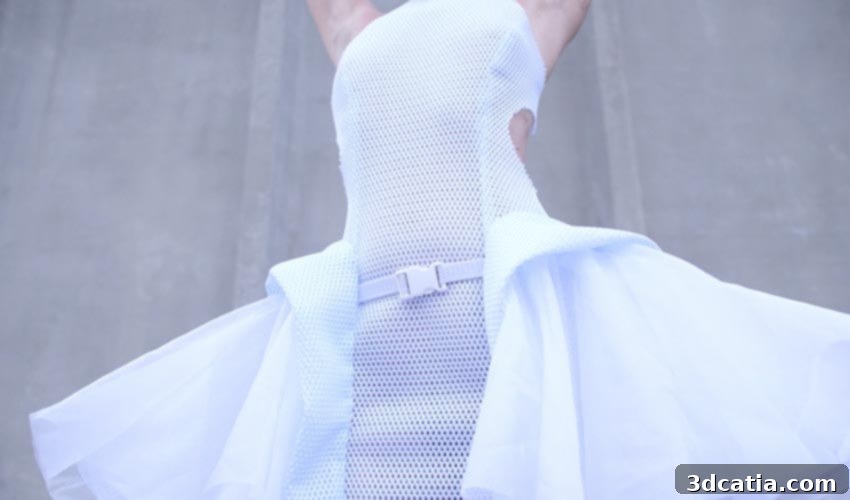
Anouk Wipprecht’s Proximity Dress: Redefining Personal Space with 3D Printed FashionTech
As we venture into a future where the lines between our physical and digital worlds increasingly blur, and electronics are seamlessly integrated into our daily lives, fundamental questions arise: What will our clothing look like, and how will it influence our interactions? How will we navigate social dynamics in a world under constant technological supervision? These thought-provoking inquiries are at the heart of Dutch high-tech fashion designer Anouk Wipprecht’s groundbreaking work. Recognized as a pioneer in the burgeoning field of FashionTech, Wipprecht seamlessly merges avant-garde fashion design with cutting-edge engineering, advanced science, and intuitive user experience principles to create garments that are not just worn, but interacted with. Her innovative approach seeks to explore and challenge our perceptions of personal space and social engagement in an increasingly connected era. Several years ago, Anouk captivated the world with her robotic Spider Dress, an interactive garment designed to react to its wearer’s personal space. Today, she presents an ingenious evolution of that pioneering concept: the Proximity Dress, a design that resonates profoundly with the contemporary context of social distancing and our evolving understanding of personal boundaries.
The Proximity Dress is a testament to the transformative power of additive manufacturing in fashion. Anouk Wipprecht leveraged advanced 3D printing technologies to design this extraordinary garment, which ingeniously creates dynamic physical barriers when it detects someone encroaching upon the wearer’s immediate surroundings. At its core, the dress integrates sophisticated sensors meticulously calibrated to perceive movement in the wearer’s proximity. Upon detecting such movement, the dress employs a remarkable robotic 3D printed hip mechanism, intricately built into its structure, alongside a resin 3D printed transparent collar that houses additional integrated sensors. These components work in concert to extend outwards, forming an automatic, reactive barrier. The intricate hip mechanisms, responsible for housing and articulating the servos that drive the mechanical hip parts, are precisely 3D printed using Selective Laser Sintering (SLS) technology. This choice of manufacturing method is crucial, allowing for complex geometries and robust components. The material selected for these critical structural parts is Nylon PA-11, specifically chosen for its exceptional durability, flexibility, and ability to endure significant mechanical stress, ensuring the dress’s responsiveness and longevity. In contrast, the transparent collar, a key aesthetic and functional element, is crafted from VeroClear material, known for its optical clarity and smooth finish. This part was expertly 3D printed using a state-of-the-art PolyJet machine from Stratasys, enabling the creation of intricate, transparent components with integrated sensor pathways, perfectly blending form and function to achieve Wipprecht’s vision of interactive, responsive fashion.
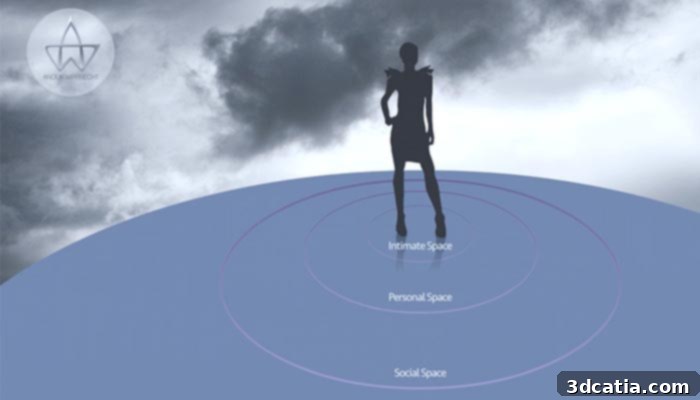
Anouk Wipprecht provides deeper insight into the philosophical underpinnings of her design: “Just like my previous robotic creations, the Spider Dress and the Smoke Dress, my designs are profoundly influenced by Edward T. Hall’s Proxemics Theory. This foundational theory meticulously delineates four distinct spaces around the human body—intimate, personal, social, and public—each characterized by specific distances and cultural norms. Historically, Hall employed rudimentary tools, such as a simple wooden stick, to quantify the invisible boundaries between individuals. However, since 2007, my research and design practice have been dedicated to translating these nuanced spatial concepts into the digital realm. This endeavor allows me to precisely measure and interact with the spaces between people, extending my sensing capabilities up to an impressive range of 25 feet. The Proximity Dress, therefore, is not merely a garment but an active interpretation of proxemic principles, bringing Hall’s sociological observations into the sphere of wearable technology and interactive fashion. It encourages us to consciously engage with and reflect upon the invisible bubbles we create around ourselves, especially in an age where physical interaction and personal space have taken on new significance.”
The integration of additive manufacturing into the world of fashion is not an entirely new phenomenon, yet it continues to push boundaries and inspire innovation. While initially embraced predominantly by high-end designers and haute couture houses for their avant-garde collections, we are gradually witnessing a shift towards exploring the technology’s potential for more accessible, high-street applications. Projects like Anouk Wipprecht’s Proximity Dress are exemplary in showcasing the immense design freedom and the ability to achieve unprecedented geometries that 3D printing offers. This technology transcends traditional textile limitations, allowing designers to imbue clothing with entirely new features and interactive capabilities previously unimaginable. Beyond merely unleashing the boundless creativity of designers and stylists, enabling them to realize complex forms and intricate details, 3D printing also heralds a new era of personalization. Wearers can experience garments tailored not just to their measurements, but to their specific preferences and needs, creating truly unique pieces. Furthermore, and perhaps most crucially in today’s environmentally conscious climate, 3D printing technologies hold significant promise in addressing one of the fashion industry’s most pressing challenges: waste reduction. By enabling on-demand production and precise material deposition, it minimizes excess material usage, making it an incredibly important factor to consider for the future of sustainable fashion. The potential for localized, customized production also reduces supply chain complexities and associated environmental impacts, paving the way for a more responsible and efficient manufacturing paradigm.
Expanding on the sustainability aspect, 3D printing offers a radical departure from conventional garment manufacturing processes, which are notoriously wasteful. Traditional cutting and sewing methods often leave behind significant scraps of fabric, contributing to mountains of textile waste annually. In contrast, 3D printing, especially technologies like Selective Laser Sintering (SLS) and PolyJet, are additive processes, meaning they build objects layer by layer, only using the precise amount of material required for the design. This “just-in-time” and “just-enough” material usage drastically reduces waste at the production stage. Moreover, the ability to create complex, multi-functional components in a single print further streamlines the manufacturing process, potentially reducing the need for multiple parts and assembly stages. The concept of on-demand manufacturing, facilitated by 3D printing, also plays a crucial role in curbing overproduction – a major issue in the fast fashion industry. Instead of mass-producing garments that may or may not sell, items can be printed as orders come in, minimizing unsold inventory and the environmental burden associated with its disposal. As material science advances, the development of recyclable and biodegradable 3D printing filaments will further amplify the environmental benefits, moving the fashion industry closer to a truly circular economy. This technological shift is not just about aesthetics or functionality; it’s about fundamentally reshaping the industry towards a more eco-conscious and resource-efficient future, making it an undeniable force for positive change.
Anouk Wipprecht’s Proximity Dress not only pushes the boundaries of fashion and technology but also serves as a poignant social commentary, prompting us to reconsider our interactions and our relationship with an increasingly connected world. It invites us to imagine a future where our clothing actively participates in defining our comfort zones and mediating our social engagements. This innovative garment exemplifies the incredible potential of FashionTech to integrate intelligence into everyday wear, creating pieces that are reactive, interactive, and deeply personal. What are your thoughts on this visionary 3D printed dress and its implications for the future of fashion and social interaction? We invite you to share your perspectives in a comment below or join the conversation on our Facebook and Twitter pages! Don’t forget to sign up for our free weekly Newsletter, ensuring you receive all the latest news, innovations, and insights in the dynamic world of 3D printing delivered straight to your inbox every week!