
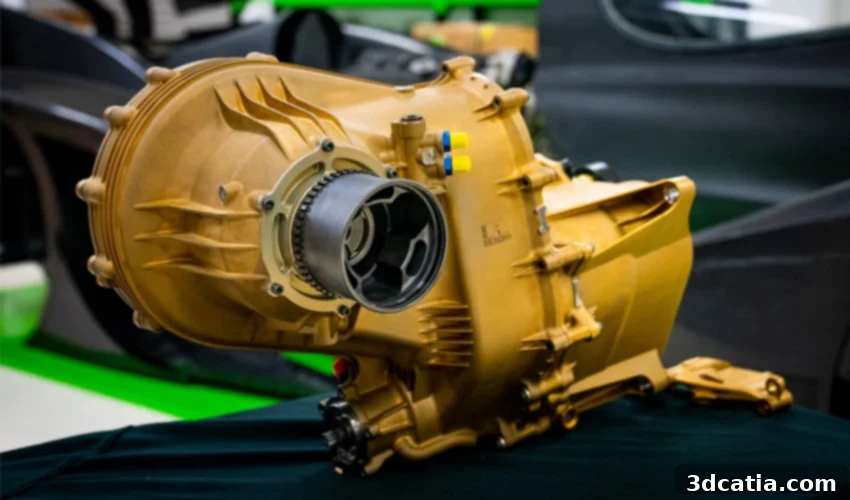
Rodin FZERO Hypercar: Revolutionizing Performance with Advanced Metal 3D Printing for a Tailor-Made Titanium Gearbox
In the relentless pursuit of ultimate performance and engineering excellence, New Zealand-based racing car manufacturer Rodin Cars is pushing the boundaries of automotive design by integrating cutting-edge metal additive manufacturing into the production of its highly anticipated hypercar, the Rodin FZERO. This revolutionary approach has enabled Rodin Cars to craft a bespoke sequential gearbox featuring a hydraulically operated differential – a component that embodies the pinnacle of strength, durability, and lightweight design. Utilizing the formidable capabilities of the 3D Systems DMP Factory 500 3D printer, Rodin Cars has successfully produced this intricate titanium component, which is remarkably more compact, significantly lighter, inherently stronger, and exceptionally durable than traditionally manufactured alternatives.
The automotive industry has long embraced additive manufacturing, initially leveraging its potential primarily for rapid prototyping. However, over the past few years, the role of 3D printing has undergone a transformative evolution. What was once a tool for conceptualization and iterative design is now firmly established as a robust method for producing high-quality finished parts and crucial spare components. This paradigm shift offers unprecedented flexibility to manufacturers worldwide, empowering them to overcome traditional manufacturing constraints. More specifically, additive manufacturing excels in its ability to facilitate the production of highly personalized, on-demand, and locally manufactured parts. This not only dramatically reduces lead times but also optimizes manufacturing costs for complex, low-volume components – factors that undoubtedly motivated Rodin Cars to invest in 3D Systems’ advanced machinery.
David Dicker, the visionary founder of Rodin Cars, eloquently articulates the profound impact of this technology on their development process: “3D printing allows us to design and create components otherwise unachievable using traditional methods of manufacturing. With the Rodin FZERO gearbox, we had specific criteria we wanted to meet in terms of weight and durability. Because of the size and quality required for such a large component, it was only possible to print it on 3D Systems’ DMP Factory 500 machine. We couldn’t source another AM supplier who was able to offer a similar solution for our needs — the print quality, volume capacity, testing facilities in Leuven, and continued technological support.” This statement underscores the critical role of specialized metal 3D printing in realizing the ambitious performance goals set for the Rodin FZERO, highlighting not just the technology itself, but the comprehensive ecosystem of support and expertise that 3D Systems provides.
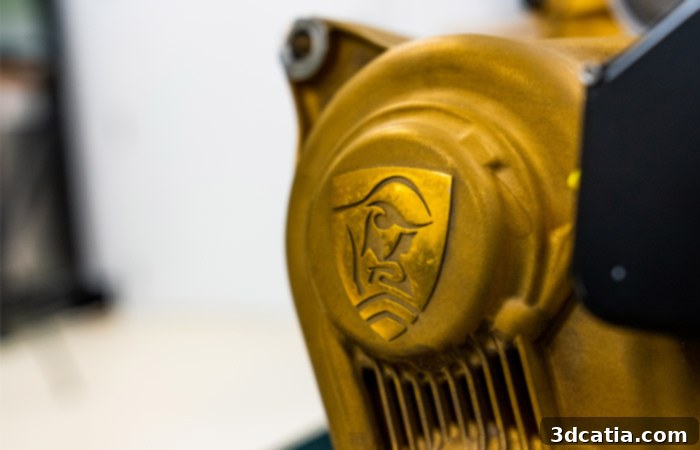
Thanks to advanced metal additive manufacturing, Rodin Cars has engineered a highly customized and compact titanium gearbox for its FZERO hypercar. (Photo Credit: Rodin Cars)
Rodin Cars: Forging Innovation with a Compact, 3D Printed Titanium Gearbox
Having successfully developed his initial racing car in 2019, David Dicker and the Rodin Cars team were determined to push the envelope even further in the design of their next-generation vehicle. The vision for the Rodin FZERO was not merely an evolution but a revolution, requiring components that defied conventional manufacturing limitations. After an intensive 18-month design phase, undertaken in close collaboration with the renowned British engineering company Ricardo, Rodin Cars conceived a groundbreaking titanium gearbox featuring entirely new, optimized gear ratios. This innovative design incorporated complex internal galleries – intricate pathways for lubrication and cooling – and delicate, thin-walled bearing support structures. Such a sophisticated architecture presented an insurmountable challenge for traditional manufacturing processes, at least not within the required timelines and performance parameters. Conventional methods, such as casting in magnesium, would have resulted in a component that lacked the necessary strength and structural integrity to withstand the extreme stresses and performance demands inherent in elite motor racing. Recognizing these limitations, Rodin Cars strategically engaged with 3D Systems, a global leader in additive manufacturing solutions, to transform this ambitious engineering project into a tangible reality.
The decision to embrace metal 3D printing was a strategic imperative for Rodin Cars, driven by the unique geometric complexities and performance targets of the FZERO’s gearbox. Traditional subtractive manufacturing methods would have been unable to create the intricate internal channels and thin, load-bearing structures that were critical for optimizing the gearbox’s performance, weight, and thermal management. Casting, while capable of producing complex shapes, would have involved significant tooling costs, longer lead times for iterations, and would have struggled to achieve the desired material properties and surface finish in titanium with such fine features. Furthermore, the inherent grain structure of cast parts might not offer the same anisotropic strength benefits as a carefully optimized 3D printed component. The ability of additive manufacturing to build parts layer by layer, directly from CAD data, unlocked an unprecedented level of design freedom, allowing Rodin’s engineers to integrate functionalities and optimize material distribution in ways previously considered impossible.
The Power of the DMP Factory 500: Precision and Scale in Metal Additive Manufacturing
To achieve their groundbreaking vision, Rodin Cars made a significant investment in an industrial metal 3D printing powerhouse: the DMP Factory 500. This state-of-the-art machine, developed by 3D Systems, is specifically designed for high-quality, large-format metal additive manufacturing, offering an exceptionally generous build volume of 500 x 500 x 500 mm. This large build envelope was crucial for printing the FZERO’s substantial gearbox in a single piece, avoiding the need for complex and potentially weaker assemblies of smaller printed components. The DMP Factory 500’s advanced direct metal printing (DMP) technology ensures superior part density, excellent mechanical properties, and remarkable surface finish – all essential attributes for a component subjected to the extreme forces of a hypercar gearbox. The choice of titanium as the primary material for the gearbox was also critical. Titanium alloys are renowned for their outstanding strength-to-weight ratio, exceptional corrosion resistance, and ability to maintain structural integrity at high temperatures, making them ideal for high-performance automotive applications where every gram counts and reliability is paramount.
The resulting 3D printed titanium gearbox is a marvel of modern engineering. Weighing in at a mere 68 kilograms, it represents a substantial weight saving compared to conventionally manufactured alternatives, directly contributing to the FZERO’s overall performance by reducing unsprung mass and improving power-to-weight ratio. Furthermore, the ability to achieve wall thicknesses of just 2mm in critical areas, while maintaining robust structural integrity, showcases the precision and capability of the DMP Factory 500. This fine detail and geometric freedom allow for optimal material placement, putting strength precisely where it is needed and minimizing material elsewhere. Notably, the entire part was printed in a single manufacturing run, a feat that significantly streamlines the production process, drastically reduces assembly time, and enhances the overall structural integrity of the component by eliminating potential weak points found in multi-part assemblies.
Kevin Baughey, Segment Leader for Transportation & Powersports at 3D Systems, offers an insightful perspective on this collaborative achievement: “As a high-tech, high-performance car constructor, Rodin Cars delivers unparalleled vehicles to their customers. This is a shining example of how additive manufacturing not only enables parts to be produced that couldn’t be created through conventional methods, it is also delivering a lighter, more durable, beautiful vehicle. It’s the blending of the art of design with the science of hyper-performance cars and motorsports.” Baughey’s comments highlight the dual benefits of additive manufacturing: enabling previously impossible designs and simultaneously improving key performance metrics like weight, durability, and even aesthetics. This synergy between advanced design and manufacturing science is what truly differentiates hypercars like the Rodin FZERO in the competitive landscape of extreme automotive engineering.
The Broader Impact: Additive Manufacturing’s Role in High-Performance Automotive
The success story of Rodin Cars and their 3D printed titanium gearbox is a compelling testament to the broader shift occurring within the automotive industry. What started as a niche technology for rapid prototyping has matured into a mainstream manufacturing method for end-use, mission-critical components. This evolution is particularly pronounced in high-performance sectors like motorsports and hypercar development, where the demands for customization, weight reduction, and extreme durability are non-negotiable. Additive manufacturing offers an unparalleled degree of design freedom, allowing engineers to consolidate multiple parts into a single, complex component, thereby reducing assembly complexities and potential failure points. It facilitates the creation of topology-optimized structures that maximize strength while minimizing material usage, leading to parts that are both lighter and stronger than their conventionally manufactured counterparts.
Moreover, the ability to produce parts on-demand and locally significantly impacts supply chain logistics and sustainability. For specialized vehicles like the FZERO, where production volumes are inherently low, traditional tooling costs for casting or forging would be prohibitive for unique components. Additive manufacturing bypasses these limitations, making it economically viable to produce highly customized parts precisely when and where they are needed. This responsiveness is invaluable for iterative design improvements and for ensuring the availability of spare parts throughout a vehicle’s lifecycle. As material science and printer technologies continue to advance, we can expect to see an even wider adoption of metal 3D printing in critical applications, not just in hypercars but also in aerospace, defense, and medical industries, further cementing its role as a transformative force in modern manufacturing.
Rodin Cars’ bold step with the FZERO’s gearbox serves as a beacon for what is achievable when visionary engineering meets cutting-edge manufacturing technology. It exemplifies how additive manufacturing is not just a tool but a catalyst for innovation, enabling car manufacturers to transcend existing limitations and redefine the very essence of automotive performance and design. The ongoing advancements in metal 3D printing, combined with expertise from companies like 3D Systems, will continue to unlock new possibilities, pushing the boundaries of speed, efficiency, and safety in vehicles of the future.
What are your thoughts on Rodin Cars’ innovative 3D printed gearbox and the future of additive manufacturing in hypercar development? Share your insights in a comment below or join the conversation on our Facebook and Twitter pages. Don’t miss out on the latest advancements in 3D printing – subscribe to our free weekly newsletter for all the top news delivered straight to your inbox!
Cover Photo Credit: Rodin Cars