
Revolutionizing Additive Manufacturing: Sindoh S100 Embraces 100% Recycled Bluesint PA12 for Sustainable 3D Printing
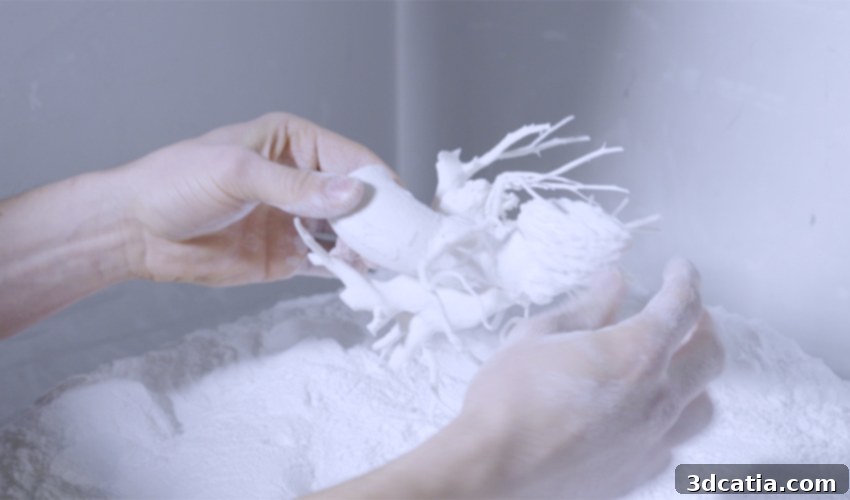
As we observe World Recycling Day, an annual occasion dedicated to raising global awareness about the critical importance of recycling, it’s timely to spotlight innovations pushing the boundaries of sustainable manufacturing. In the realm of additive manufacturing, this includes groundbreaking developments from companies committed to reducing environmental impact. One such innovation comes from Sindoh, a renowned South Korean manufacturer of 3D printers, which recently unveiled a machine poised to redefine eco-friendly production: the Sindoh S100. This state-of-the-art SLS 3D printer is significant for being the first of its kind capable of utilizing Materialise’s pioneering Bluesint PA12 material, a true game-changer in the industry. Materialise originally introduced Bluesint PA12 in November 2020, presenting it as a revolutionary material specifically engineered for 3D printing with 100% recycled powder. This innovation marks a monumental step towards ecological sustainability, directly addressing the pressing issues associated with plastic waste and significantly minimizing the material waste generated during typical 3D printing processes. It signifies a tangible shift towards a circular economy within additive manufacturing, offering a viable solution to environmental concerns that have long shadowed the industry.
The introduction of this novel polymer ushers in unprecedented ecological opportunities for the additive manufacturing sector. This commitment to sustainability is at the core of Materialise’s mission, championed by its CEO, Fried Vancraen. Vancraen articulates the company’s aspiration to foster “greener” production through their latest material, emphasizing the transformative potential of Bluesint PA12. “Bluesint PA12 represents a major step towards making 3D printing more sustainable. The introduction of the Sindoh S100 printer, the first to support Bluesint PA12, will help us empower our customers to make a choice for sustainability,” explains the president of the Belgian company. This sentiment underscores a growing industry-wide movement towards environmental responsibility. Materialise is certainly not alone in its quest to render 3D printing more environmentally benign. Indeed, the advent of this 100% recyclable polymer resonates with similar initiatives, such as Polymaker’s latest filament, the Polyterra, which also champions eco-friendly practices. However, it’s crucial to note that, as of now, the Sindoh S100 stands as the exclusive platform capable of fully harnessing the unique properties and sustainable benefits of Bluesint PA12, positioning it at the forefront of this green revolution in additive manufacturing.
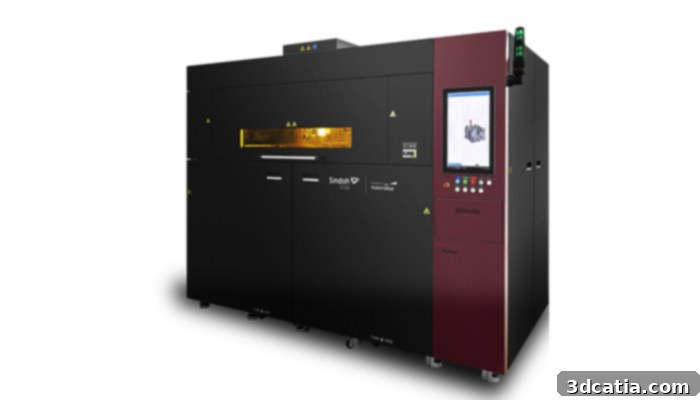
The Sindoh S100, the latest printer from the Korean manufacturer (photo credits: Sindoh)
Exploring the Advanced Characteristics of the Sindoh S100
Materialise, demonstrating its strong belief in the Sindoh S100’s capabilities and its vision for sustainable manufacturing, became the inaugural customer, acquiring five machines from the Korean manufacturer. This significant initial investment highlights the industry’s confidence in Sindoh’s engineering prowess and Materialise’s strategic commitment to integrating cutting-edge, environmentally responsible technologies. The Sindoh S100 is engineered for industrial-scale production, boasting an impressive print volume of 510 x 510 x 500 mm. This expansive build chamber makes it ideal for producing large parts or for high-volume batch manufacturing of smaller components, offering unparalleled flexibility for diverse applications across various industries. At its core, the S100 features a sophisticated dual-laser system, a key technological differentiator. One laser is dedicated to precisely sintering the new layer of powder, while the second laser expertly maintains the temperature of the preceding layer. This innovative dual-laser approach ensures exceptional thermal stability throughout the build process, which is critical for achieving superior part quality, dimensional accuracy, and mechanical properties, particularly when working with complex materials like recycled polymers. The precise temperature control minimizes thermal stress, reduces warping, and optimizes inter-layer adhesion, leading to robust and reliable parts.
Beyond its compatibility with Bluesint PA12, the Sindoh S100 stands out for its remarkable material versatility. The 3D printer is by no means limited to a single material; rather, it is designed as an open platform capable of processing a wide array of advanced polymers. With a potential processing temperature reaching up to 200 ℃, the S100 can handle various high-performance materials crucial for industrial applications. This includes widely used options such as Evonik’s PA12, known for its excellent mechanical properties and chemical resistance, and BASF’s Ultrasint PA11, recognized for its superior ductility and impact strength. Furthermore, the S100 supports flexible materials like TPU (Thermoplastic Polyurethane), which is essential for applications requiring elasticity and shock absorption, and PP (Polypropylene), valued for its lightweight nature and good chemical resistance. This broad material compatibility ensures that the Sindoh S100 can cater to diverse industry needs, from automotive and aerospace to medical and consumer goods, allowing manufacturers to choose the optimal material for their specific functional requirements while also exploring sustainable alternatives like Bluesint PA12. The ability to work with an open range of materials truly positions the S100 as a versatile and future-proof additive manufacturing solution.
The Synergy of Hardware and Software: Driving Economic and Environmental Value
Sindoh President Suk-Hyung Woo further elaborates on the strategic advantages of the S100, emphasizing its dual benefits: “Sindoh S100 has both performance and economic values through its large build volume and an unparalleled powder recycling rate.” This statement underscores two critical aspects for industrial adoption: the ability to produce parts efficiently and cost-effectively, and the significant reduction in material waste. The “unparalleled powder recycling rate” of the S100 is a direct contributor to its economic value, as it drastically reduces material consumption and operational costs. Traditional SLS processes often result in a significant percentage of unused powder being discarded or downgraded, but the S100’s optimized system ensures that a much higher proportion of unsintered powder can be reused in subsequent builds without compromising part quality. This not only makes the process more environmentally friendly but also more economically viable for mass production.
Woo concludes by highlighting the powerful collaboration that underpins this innovation: “This new product also demonstrates the excellent synergy of Materialise Software and the 60 years of hardware manufacturing experience of Sindoh. Combining the latest technologies of both companies, it enables significant reduction in production cost as well as excellent printing performance.” This synergy is paramount. Materialise brings decades of expertise in developing advanced 3D printing software, including build preparation, data optimization, and process control solutions, which are essential for maximizing the potential of any 3D printer. Sindoh, on the other hand, contributes its profound experience in precision hardware engineering and manufacturing, refined over 60 years. The seamless integration of Materialise’s intelligent software with Sindoh’s robust hardware creates a holistic solution that not only unlocks superior printing performance – delivering parts with consistent quality, accuracy, and mechanical strength – but also optimizes the entire workflow. This integrated approach is key to achieving the stated goal of significant production cost reduction, by minimizing errors, optimizing material usage, and streamlining operational processes. It is a testament to how collaborative innovation can lead to breakthroughs that benefit both industry and the environment.
The Future of Sustainable Additive Manufacturing
The introduction of the Sindoh S100, coupled with the revolutionary Bluesint PA12 material, marks a pivotal moment for the additive manufacturing industry. It signals a clear commitment from leading players like Materialise and Sindoh to address the environmental challenges associated with modern manufacturing. By offering a solution that not only utilizes 100% recycled powder but also ensures high performance and economic viability, they are setting a new benchmark for sustainability. This development encourages other manufacturers to explore similar eco-friendly materials and processes, fostering a ripple effect throughout the entire supply chain. As industries increasingly demand greener production methods, the ability to print functional parts from recycled materials at an industrial scale will become a competitive advantage, driving widespread adoption and innovation. The implications extend beyond just reducing waste; they encompass lower carbon footprints, reduced reliance on virgin plastics, and the creation of more circular economic models for product development and manufacturing.
This move towards sustainability is not merely a trend but a fundamental shift in how we approach production. The collaboration between a software powerhouse and a hardware expert exemplifies how interdisciplinary efforts can overcome complex technical hurdles. While challenges in scaling recycled material production and ensuring consistent material properties may still exist, the success of Bluesint PA12 on the Sindoh S100 demonstrates that these are surmountable. This innovation is crucial for sectors like automotive, aerospace, and consumer goods, where lightweighting, customization, and sustainable sourcing are paramount. Imagine car parts, medical devices, or everyday consumer products being manufactured with minimal environmental impact, utilizing materials that have completed their lifecycle and are given a new purpose. This vision is now becoming a tangible reality, paving the way for a more responsible and resource-efficient future in 3D printing.
What are your thoughts on Materialise’s Bluesint PA12 material and the Sindoh S100’s role in promoting sustainable 3D printing? We’d love to hear your insights! Let us know in a comment below or connect with us on our Facebook, Twitter, and LinkedIn pages! Don’t miss out on the latest advancements and news in additive manufacturing—sign up for our free weekly Newsletter here to get the freshest 3D printing news delivered straight to your inbox!