
Weekly 3D Printing Innovations: Applications, Insights, and Creative Solutions
Welcome to our comprehensive weekly roundup of the most captivating developments and insights in the world of 3D printing. This week’s edition showcases the remarkable versatility and expanding influence of additive manufacturing across various sectors, from industrial applications to creative personal projects and practical everyday fixes. We delve into the perspectives of industry leaders, witness ingenious custom fabrications, explore groundbreaking advancements in sports equipment, discover simple yet effective solutions for common household dilemmas, and provide essential guidance on achieving professional-grade finishes for your 3D prints. Join us as we unpack the cutting-edge innovations and practical applications that continue to shape the future of this transformative technology. Let’s get started with this week’s highlights!
Exploring Industry Visions: 3D Printing Users and the Significance of RAPID + TCT
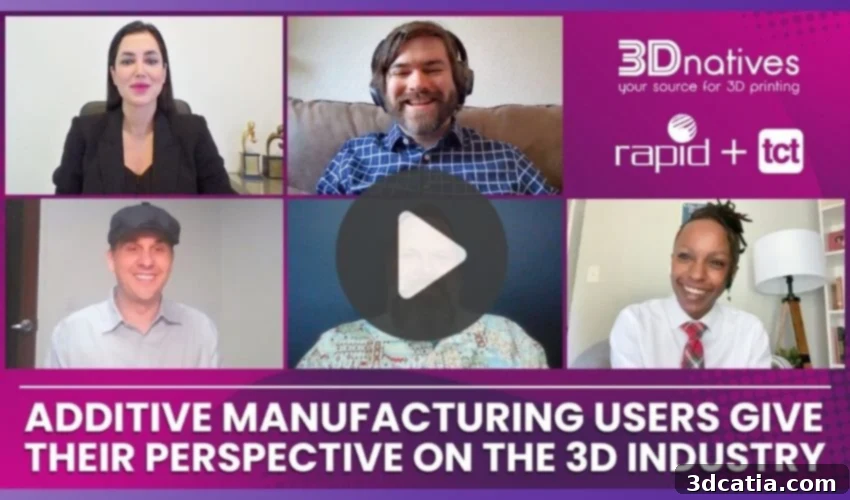
Our journey begins with an exclusive video feature, offering invaluable insights directly from a diverse range of 3D printing users within the industry. Through a series of engaging interviews, these professionals share their unique visions for the future of additive manufacturing (AM). They articulate the pivotal role AM plays in their respective fields, from accelerating product development to enabling complex geometries and facilitating on-demand production. A recurring theme in their discussions is the undeniable importance of major industry events, such as RAPID + TCT, in propelling the sector’s growth and fostering widespread technology adoption. These events serve as crucial platforms for networking, knowledge exchange, and showcasing the latest technological breakthroughs.
The video highlights how expos like RAPID + TCT provide an unparalleled opportunity for businesses and individuals to connect, collaborate, and stay abreast of the rapidly evolving AM landscape. From June 25th to 27th, North America’s largest additive manufacturing and industrial 3D printing event will once again open its doors in Los Angeles, California. This gathering is not just a trade show; it’s a nexus where ideas are sparked, partnerships are forged, and the roadmap for the industry’s future is collectively drawn. Hearing directly from users underscores the real-world impact of 3D printing and the collective optimism surrounding its continued expansion and innovation. Understanding the perspectives of these pioneers is key to appreciating the current state and future direction of the additive manufacturing industry.
Custom Creativity Unleashed: The 3D Printed Widebody VW Split Go-Kart Project
Next, we dive into a truly unique and captivating engineering feat presented by the build team at Critical. This video takes us through the intricate and exciting process of widebodying a Volkswagen mini split bus go-kart, a project born from a creative suggestion by a dedicated viewer. This endeavor perfectly exemplifies how 3D printing technology empowers custom fabrication and brings imaginative concepts to life with unprecedented precision and flexibility. The team’s challenge was to transform a standard go-kart into a widebody replica of the iconic VW split bus, requiring a significant scaling and adaptation of existing designs.
The core of this project involved utilizing a 3D-printed widebody kit originally designed by BlackboxSTL. What makes this particularly impressive is the team’s decision to scale this kit up by an astounding 1000% to fit the larger dimensions of the go-kart. This massive scaling presented numerous challenges, from ensuring structural integrity to achieving perfect alignment across multiple large printed parts. The choice of 3D printing for this application was strategic, allowing for intricate details and complex curves that would be difficult, if not impossible, to achieve with traditional manufacturing methods without incurring significant costs and lead times. It demonstrates the freedom of design and rapid prototyping capabilities that are inherent advantages of additive manufacturing.
After a meticulous printing process, which likely involved several iterations and material considerations for durability and finish, the team dedicated several days to the precise fitting and customization of these oversized components onto the kart’s body. This hands-on customization phase highlights the blend of digital design and traditional craftsmanship essential in advanced 3D printing projects. The post-processing work, including sanding, priming, and painting, was crucial to achieve the smooth, automotive-grade finish that makes the go-kart look professionally manufactured. The video culminates with the exciting reveal of the finished widebody go-kart at the SWK Grillkväll event. Here, the vehicle wasn’t just admired for its aesthetics; it was put to the ultimate test through thrilling drag races. This demonstration not only showcases the incredible visual transformation achieved with 3D printing but also proves the functional performance and robustness of the 3D-printed components under high-stress conditions. This project stands as a testament to the boundless possibilities that 3D printing offers for automotive enthusiasts, custom builders, and anyone looking to push the boundaries of design and engineering in personalized vehicles.
Revolutionizing Golf: Cobra Golf Unveils LIMIT3D 3D Printed Irons
In a move that promises to reshape the landscape of golf equipment, BunkeredGold brings us exciting news from Cobra Golf: the release of the first-ever commercially available set of 3D printed irons. This innovation immediately sparks curiosity about the future trajectory of golf club design and performance. Cobra’s LIMIT3D irons are engineered to combine the coveted precision and workability typically associated with a traditional blade iron with the enhanced forgiveness and playability found in game-improvement irons. This seemingly contradictory blend of characteristics is made possible through the revolutionary application of additive manufacturing.
The creation of these advanced irons involves a sophisticated manufacturing process known as laser binding stainless steel powder. This technique allows for unprecedented control over the internal geometry and weight distribution of the club head. By precisely layering and fusing metallic powder with a laser, Cobra can design intricate internal structures that are impossible to achieve with conventional forging or casting methods. This level of design freedom enables engineers to place mass exactly where it’s most beneficial, optimizing the center of gravity (CG) to deliver both exceptional feel and increased stability on off-center strikes. The result is a club that offers superior ball speed, tighter dispersion, and a more consistent flight path across the face, ultimately leading to lower scores and a more enjoyable golfing experience.
The performance of the Cobra LIMIT3D irons was rigorously tested on the prestigious Tour course at Camiral Golf & Wellness in Spain. The host of the video was notably impressed by their capabilities, reporting that these 3D printed irons deliver remarkable distance and maintain impressive consistency, even when contact isn’t perfectly centered. This ability to combine precision with forgiveness represents a significant leap forward in golf club technology. It suggests that 3D printing is not just a novelty for prototyping but a viable and superior manufacturing method for high-performance sports equipment, offering tangible benefits that can truly enhance a golfer’s game. This marks a new era where custom-engineered performance is becoming more accessible, demonstrating the transformative potential of 3D printing in the world of professional and amateur sports. The implications for other sports equipment, from cycling components to running shoe soles, are vast and hint at a future where personalized performance is the norm.
Empowering Everyday Solutions: 3D Printing for Practical Home Fixes
Fourth in our lineup, Chuck from CHEP brilliantly demonstrates how accessible and powerful 3D printing can be for solving more mundane, yet often frustrating, everyday problems around the home. His video focuses on a common issue: a patio umbrella that doesn’t fit properly in its table, leaving it unstable and prone to wobbling. Instead of resorting to makeshift solutions or purchasing a whole new table, Chuck leverages the precision and customization capabilities of 3D printing to create a perfect, tailor-made fix. This example perfectly illustrates the “maker” mentality and the growing trend of using personal 3D printers for practical applications.
Chuck’s approach involves designing a custom insert using Tinkercad, a user-friendly online 3D design tool. This choice highlights the ease with which even hobbyists can create functional parts without extensive CAD experience. Tinkercad’s intuitive interface allows users to quickly design, modify, and prepare models for 3D printing, making it an ideal choice for quick household repairs and custom parts. The custom insert is designed to precisely replace the existing, ill-fitting soft insert on the patio table, ensuring a snug and secure fit for the umbrella pole. This perfectly exemplifies the “design it yourself, print it yourself” philosophy that makes 3D printing so empowering for consumers. It’s about turning a specific frustration into an opportunity for a personalized, durable solution that perfectly meets the unique requirements of the situation.
The video further showcases the printing process itself, comparing the output from two popular 3D printers: a Creality Ender 3 V3 SE and a K1C printer. Chuck utilizes a 0.6mm nozzle on the K1C, highlighting the differences in printing time and final print quality that various printer setups and nozzle sizes can yield. This comparison is particularly valuable for aspiring 3D printing enthusiasts, as it provides practical insights into optimizing print settings for efficiency and strength. The Ender 3 V3 SE, known for its reliability and affordability, and the K1C, often chosen for its speed and advanced features, both demonstrate their capabilities in producing a functional part that perfectly addresses Chuck’s problem. This segment truly underscores the practical utility of desktop 3D printers in transforming irritating household nuisances into simple, elegant, and permanent solutions, making 3D printing a valuable tool for every modern home and empowering individuals to become problem-solvers in their own right.
Mastering the Finish: Comprehensive Post-Processing for Resin 3D Prints
Finally, we conclude this week’s highlights with another insightful video from the 3Dnatives team, featuring the latest episode of 3DExplained! This essential guide is hosted by Elliot, who provides detailed, step-by-step guidance on the often-underestimated but critically important process of post-processing resin 3D prints. Achieving an optimal finish and significantly improved print quality hinges on correctly executing these post-printing steps, which can transform a raw, fragile print into a professional-grade masterpiece. For those new to resin printing, this guide is an invaluable resource for understanding the nuances beyond just pressing print.
Elliot begins by emphasizing the paramount importance of safety precautions when handling resin prints. Given the nature of uncured liquid resin, which can be irritating or hazardous upon skin contact and requires proper ventilation to avoid inhaling fumes, he meticulously covers the use of personal protective equipment (PPE) such as gloves and eye protection, proper ventilation in the workspace, and safe handling practices to ensure a secure working environment. Following safety, he provides a comprehensive overview of every stage involved in post-processing. This includes the initial rinsing stage, crucial for effectively removing any uncured liquid resin from the surface of the print using isopropyl alcohol (IPA) or a specialized resin cleaner. Proper rinsing prevents sticky surfaces, ensures a clean canvas for subsequent steps, and is vital for the print’s final curing process.
The guide then moves into the vital curing process, explaining how exposure to UV light hardens the resin, giving the print its final structural integrity, strength, and physical properties. This post-curing step is critical for achieving the full mechanical properties of the resin. Elliot also covers advanced finishing techniques such as sanding, which helps to smooth layer lines, remove remnants of support structures, and prepare the surface for a flawless finish. He then delves into priming, which is essential for providing an even base coat, helping to reveal any minor imperfections that need further attention, and ensuring better adhesion for paint. Finally, he discusses painting, where artistic vision can truly bring the print to life with custom colors and intricate details. Each step is meticulously explained, offering practical tips and expert insights on achieving a flawless finish, enhancing durability, and maximizing the aesthetic appeal of your resin 3D prints. This video is an indispensable resource for anyone working with resin printers, ensuring their creations not only look but also perform their absolute best, transforming raw prints into polished, durable, and beautiful objects.
We hope you enjoyed this week’s exploration of the dynamic world of 3D printing. Which video was your favorite highlight, and what fascinating insights did you gain from these innovative applications? We’d love to hear your thoughts on these incredible 3D printing users and their diverse perspectives on the additive manufacturing industry. Please share your comments below or engage with us on our LinkedIn, Facebook, and Twitter pages! To stay continuously updated with the very latest in 3D printing news and trends, don’t forget to sign up for our free weekly newsletter here, delivered straight to your inbox. You can also explore our extensive library of compelling videos on our dedicated YouTube channel for more in-depth content.