
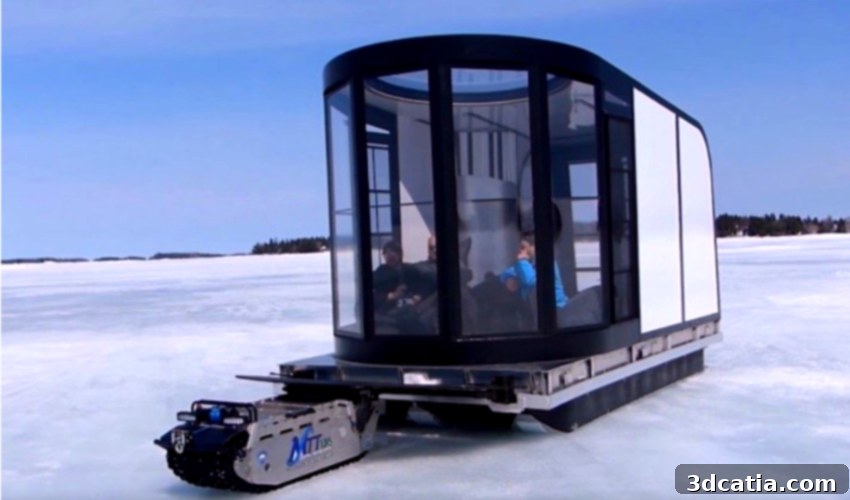
Revolutionizing Rescue: How My Track Technology Leverages 3D Printing for Advanced Eco-Friendly Vehicles
In a world increasingly challenged by natural disasters, remote emergencies, and the urgent need for specialized transportation, the role of rescue vehicles has never been more critical. Traditional manufacturing methods often impose limitations on design flexibility, production speed, and cost-effectiveness, especially for highly customized or low-volume specialized vehicles. However, a new paradigm is emerging, driven by innovative technologies that promise to transform emergency response. This is where companies like My Track Technology (MTT), based in Canada, are making significant strides. MTT is pioneering the design and manufacture of electric, environmentally-friendly track vehicles, distinguishing itself by heavily integrating advanced 3D printing technology into its production workflow. These versatile vehicles serve a multitude of critical purposes, ranging from saving lives in emergency situations to the urgent delivery of essential materials in challenging environments.
Initially, MTT relied on conventional manufacturing processes for its vehicle production. While these methods offered a familiar pathway, they quickly encountered inherent bottlenecks, including prolonged lead times, high tooling costs, and limited scope for rapid design iteration and customization. The company soon recognized the immense potential of additive manufacturing, understanding that it could offer benefits far beyond simple part creation. This pivotal realization prompted a strategic shift. To harness the full capabilities of 3D printing and ensure the production of high-quality, robust parts, MTT made the crucial decision to partner with one of the industry’s leading additive manufacturing service providers, Shapeways. This collaboration marked a turning point, propelling MTT’s innovative vision forward. The central question then becomes: What transformative impact did the strategic integration of 3D printing technology have on MTT’s vehicle production processes, and how has it enabled them to create more effective and sustainable rescue solutions?
The flagship product of My Track Technology, which shares the company’s name, is an innovative electric, remote-controlled track vehicle engineered for unparalleled performance in extreme and challenging terrains. Its design ethos prioritizes resilience and autonomy, qualities that render it indispensable across a diverse range of applications, from civilian emergency response to military operations and agricultural tasks. The MTT vehicle is built to withstand harsh environmental elements, ensuring reliable operation when and where it matters most. Furthermore, its autonomous capabilities allow it to perform critical missions with minimal human intervention, enhancing safety and efficiency in hazardous zones. Beyond its core capabilities, the MTT platform is remarkably versatile. Unlike rigid, mass-produced systems, the MTT models can be extensively personalized and customized to fulfill specific operational requirements. This adaptability means they can be configured for specialized tasks such as transporting individuals with reduced mobility across difficult landscapes, rapidly deploying critical first aid equipment to isolated areas, or even providing essential electrical energy during prolonged emergencies in remote locations. The vehicle’s intelligent design, featuring a remarkably low center of gravity, grants it the unique ability to effortlessly navigate steep slopes and challenging inclines, maintaining stability and control. Coupled with its simple yet robust mechanical design and maximum ground clearance, the MTT vehicle is adept at easily traversing various obstacles, from rocky paths and deep snow to dense vegetation, making it an ideal solution for last-mile logistics and frontline rescue missions.
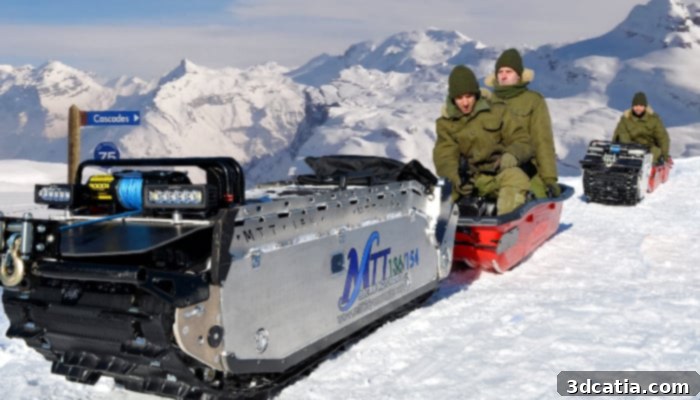
All image credits: My Track Technology
The catalyst for MTT’s decisive pivot to additive manufacturing was the pressing need to dramatically accelerate product development cycles and significantly reduce overall production costs. In the early stages of their journey, the company experimented with a desktop FDM 3D printer, primarily for creating initial prototypes and some minor parts “in-house.” While this provided an entry point into the world of 3D printing, it soon became evident that the limitations of desktop FDM – particularly concerning material properties, surface finish, part strength, and scalability – would hinder their ambitious goals. As they began to grasp the profound and expansive potential of additive manufacturing, particularly for functional end-use parts, MTT recognized the necessity of expanding their capabilities beyond basic prototyping. This understanding led them to seek out a professional 3D printing service provider for a strategic collaboration.
Shapeways, a global leader in additive manufacturing services, enthusiastically stepped in to bridge this gap, bringing the much-needed combination of high quality, advanced material options, and rapid production speed to MTT’s sophisticated workflow. This partnership proved invaluable, enabling MTT to transition from concept to functional prototype and then to robust, ready-for-market components with unprecedented efficiency. Michael Martel, the driving force behind MTT’s product development, articulates the strategic advantage perfectly: “When buying a printer you have an amazing amount of choice offered to you. The problem is to have a printer for all of the applications. The size of the parts, the surface finish, the resistance and the productivity of this printer are all to be considered. Unless you have $100,000 or more to invest in an SLS or HP printer you will never have the quality, robustness, precision and surface finish of a Shapeways part.” This insight underscores a fundamental truth in specialized manufacturing: while in-house capabilities are valuable, accessing industrial-grade additive manufacturing through a service provider like Shapeways offers an unparalleled level of quality, material diversity, and scalability without the prohibitive capital investment and operational complexities of owning and maintaining such high-end machinery. This strategic outsourcing allows MTT to focus on its core expertise – vehicle design and innovation – while leveraging Shapeways’ expertise in advanced manufacturing processes.
When it comes to the intricate and crucial components made with additive manufacturing, My Track Technology has found liberation from the geometric constraints that often plague traditional production methods. With AM, the possibilities for part complexity and functional integration are virtually endless, allowing engineers to design for optimal performance rather than manufacturing limitations. For the moment, MTT predominantly utilizes Selective Laser Sintering (SLS) 3D printing technology, primarily employing Nylon PA12 as the material of choice. SLS is an ideal process for producing strong, durable, and complex parts without the need for support structures, resulting in excellent surface finish and mechanical properties suitable for demanding applications. Nylon PA12, in particular, offers an exceptional balance of strength, impact resistance, chemical resistance, and thermal stability, making it perfectly suited for the robust components required in rescue vehicles that operate in harsh outdoor conditions. Furthermore, to craft specific custom parts that require distinct characteristics, such as flexible grommets or seals, MTT strategically employs thermoplastic polyurethane, commonly known as TPU. This material is highly valued for its outstanding flexibility, elasticity, and remarkable durability, providing excellent shock absorption and resistance to abrasion and environmental factors, crucial for protecting sensitive components and ensuring the longevity of the vehicle.
Michael Martel vividly illustrates the efficiency gains achieved through this collaboration: “In each MTT vehicle there are about 20 plastic parts. Last year we were in a very big rush to do a test with the US military and we had no time to build 20 molds for every single part. We saved at least 6 months (concept, drawing for molding, mold building and parts production) by 3D printing with Shapeways.” This statement powerfully underscores the strategic advantage that additive manufacturing provides. In conventional manufacturing, creating 20 unique molds for a limited production run would involve substantial upfront investment, lengthy design iterations, mold fabrication, and subsequent part production, easily extending the timeline by half a year or more. By contrast, 3D printing with Shapeways enabled MTT to bypass these bottlenecks entirely, facilitating rapid iteration and on-demand production of mission-critical parts. This agility is invaluable for meeting tight deadlines, especially for specialized military or emergency contracts, where time-to-market and operational readiness are paramount.
Beyond speed and cost savings, integrating advanced 3D printing technologies into their production workflow has unlocked a cascade of other significant benefits for My Track Technology. The precision and repeatability achievable with industrial-grade additive manufacturing processes, such as SLS, are significantly superior to many other traditional manufacturing techniques, including injection molding for low-volume runs where tooling might be less optimized, or even lower-end 3D printing methods. This means that every printed part conforms to exact specifications, ensuring consistent quality, reliable performance, and simplified assembly. Such high levels of accuracy are critical for components in rescue vehicles, where failure is not an option and every part must perform flawlessly under strenuous conditions. Moreover, the design freedom offered by AM has allowed MTT to optimize part geometries for strength-to-weight ratios, potentially consolidating multiple parts into a single, more robust component, thereby reducing assembly time and enhancing overall vehicle integrity. This streamlined approach to manufacturing, coupled with the inherent advantages of electric propulsion, positions MTT at the forefront of sustainable and highly effective rescue and specialized vehicle development.
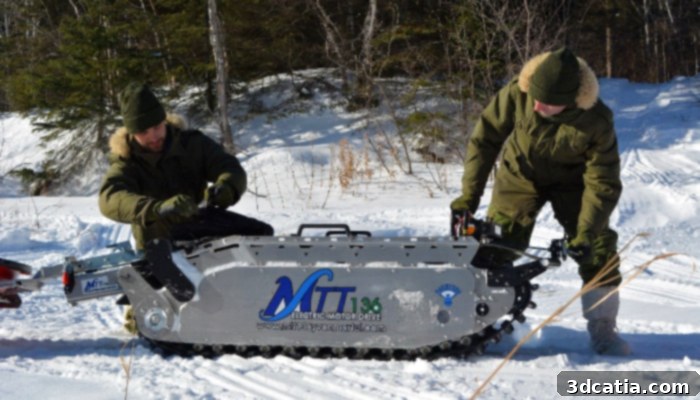
All image credits: My Track Technology
The innovative approach taken by My Track Technology, in close collaboration with Shapeways, represents a compelling case study for the transformative power of additive manufacturing in specialized vehicle development. By embracing 3D printing for their electric, eco-friendly rescue vehicles, MTT has not only accelerated product development and reduced costs but has also gained unprecedented design flexibility, enhanced part performance, and improved manufacturing precision. Their success highlights how strategic partnerships and advanced manufacturing technologies can lead to more resilient, adaptable, and sustainable solutions for critical applications. As the demand for highly specialized and rapidly deployable vehicles continues to grow, the integration of 3D printing will undoubtedly play an even more significant role in shaping the future of emergency response, logistics, and exploration.
What are your thoughts on these groundbreaking 3D printed rescue vehicles by My Track Technology? How do you envision additive manufacturing further impacting the future of specialized transportation and emergency services? We invite you to share your insights in the comments section below or join the conversation on our Facebook and Twitter pages! Don’t miss out on the latest advancements and news in the world of 3D printing; sign up for our free weekly Newsletter and have all the crucial updates delivered straight to your inbox!