
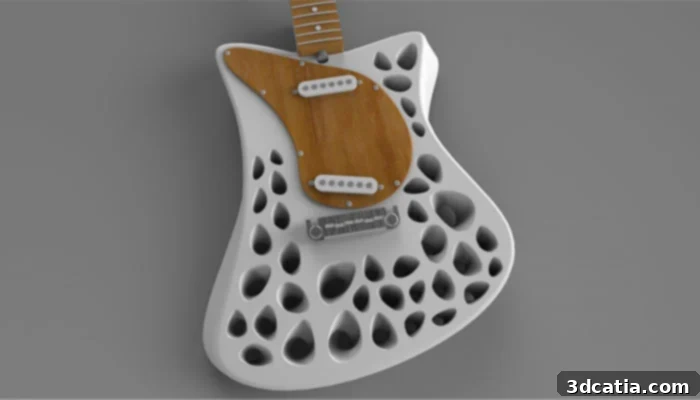
Revolutionizing Musical Instruments: Exploring the Innovation of 3D Printed Guitars with Francisco Bonansea
Additive manufacturing, commonly known as 3D printing, is a transformative technology that continues to reshape industries across the globe, and the world of music is no exception. We’ve witnessed a remarkable evolution in the creation of musical instruments, with 3D printed versions now capable of producing sound quality comparable to their traditionally manufactured counterparts. This innovative production method is rapidly gaining traction among both professional musicians seeking bespoke solutions and the vibrant maker community eager to push creative boundaries. The agility and precision offered by 3D printing open up a realm of possibilities, allowing for designs that are often impossible or prohibitively expensive to achieve with conventional techniques.
A compelling example of this paradigm shift was observed a few months ago when we explored Nik Huber Guitars’ pioneering use of 3D printing for crafting guitar bridges. By leveraging amorphous metals, they achieved significantly faster and more efficient production of high-performance components compared to traditional methods. This highlights how additive manufacturing isn’t just about creating entirely new instruments, but also about enhancing existing ones with superior parts. Building on this exciting trend, another project that has truly captured our attention comes from Argentina: the work of industrial designer Francisco Bonansea. Francisco is harnessing the power of 3D printing to develop his unique line of guitars under the distinctive “Bonansea” brand. To delve deeper into his innovative work and understand his profound connection with this advanced manufacturing method, we recently had the pleasure of sitting down with Francisco Bonansea.
The Journey Begins: Francisco Bonansea’s Introduction to 3D Printing and Design Philosophy
“I am Francisco Bonansea Mazzoni, originally from Bahía Blanca, Buenos Aires, Argentina,” Francisco began, introducing himself with a warm demeanor. “I am an industrial designer, a proud graduate of the Universidad Nacional de la Plata. After completing my studies, I embarked on a journey as a self-employed professional, which eventually led me to co-found Fractal Design with a partner. My career path has since involved various collaborations and diverse projects, each contributing to my evolving understanding of design and manufacturing.”
Francisco’s introduction to the tangible world of 3D printing wasn’t immediate, but rather a progressive integration into his design workflow. “My initial foray into 3D printing began in 2016 at a local entrepreneurs’ club,” he explained. “I started by creating prototypes and mock-ups of my designs, which was an incredible way to quickly visualize and refine concepts. The ability to rapidly iterate and hold a physical representation of a design in my hands was truly revolutionary for my process. This foundational experience soon propelled me towards producing final products. Last year marked a significant pivot for me, as I dedicated more focused energy to this exciting new facet of manufacturing. This included developing and producing various drum accessories, along with innovative stands for both guitars and basses, all leveraging the versatility of 3D printing technology.” This personal journey underscores the accessibility and practical benefits that additive manufacturing offers to designers and entrepreneurs alike.
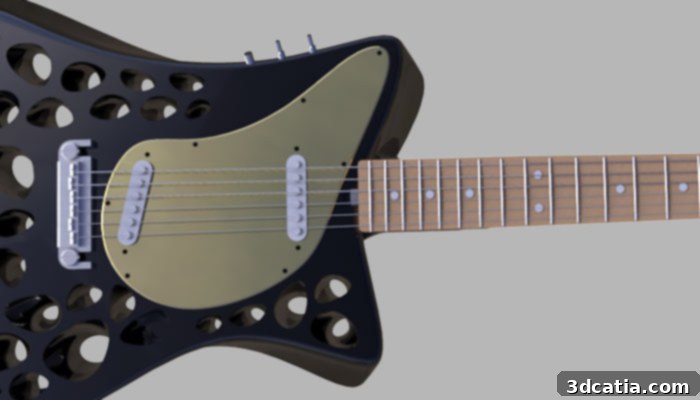
Unveiling the Innovation: Technical Specifications of the Bonansea 3D Printed Guitar
When discussing the technical innovations embedded in his guitar, Francisco highlighted several key features designed to enhance the musician’s experience. “One of the standout features of this guitar is its integrated headphone output,” he explained. “This allows the musician to listen to their playing directly through headphones, or connect to a speaker using a standard 3.5mm audio cable. This thoughtful design provides unparalleled flexibility, enabling guitarists to practice and play virtually anywhere – whether they are at home, traveling, or in a shared space. It means you can hone your skills or simply enjoy playing without disturbing others, offering a level of freedom that traditional instruments often lack.”
Beyond connectivity, the physical attributes of the Bonansea guitar also represent a significant improvement. “The guitar weighs only 2.5 kilograms,” Francisco noted, “which is a full kilogram lighter than many conventional guitars on the market. This reduction in weight is an incredibly important feature, especially for musicians who perform live shows. A lighter instrument can significantly reduce fatigue during long performances, allowing the artist to focus more on their music and less on physical strain.” He continued, detailing the integrated controls: “It also features comprehensive tone control, allowing adjustments for bass and treble, alongside an overdrive graduation function. Independent volume controls for both the guitar output and the headphone output further enhance the player’s control over their sound, providing a versatile and personalized playing experience.” These carefully considered technical characteristics underscore the guitar’s dual focus on performance utility and user comfort, all made possible through advanced design and 3D printing.
The Genesis of a Guitar: Detailing the Manufacturing Process with Additive Precision
Francisco offered fascinating insights into the intricate manufacturing process of his 3D printed guitars, emphasizing the blend of traditional design principles with cutting-edge technology. “The journey of this guitar began in a very classic way – with pencil and paper,” he recounted. “This initial sketching phase allowed me to freely explore shapes and concepts, capturing the organic essence I wanted for the instrument. From these foundational sketches, I then transitioned to modeling the design in three dimensions, working meticulously within the x, y, and z axes. During this critical digital design phase, I had to precisely account for the measurements of all the internal components: the microphone, bridge, neck, and the entire electronic system. This ensured that every part would fit perfectly within the 3D printed body, minimizing potential issues during assembly.”
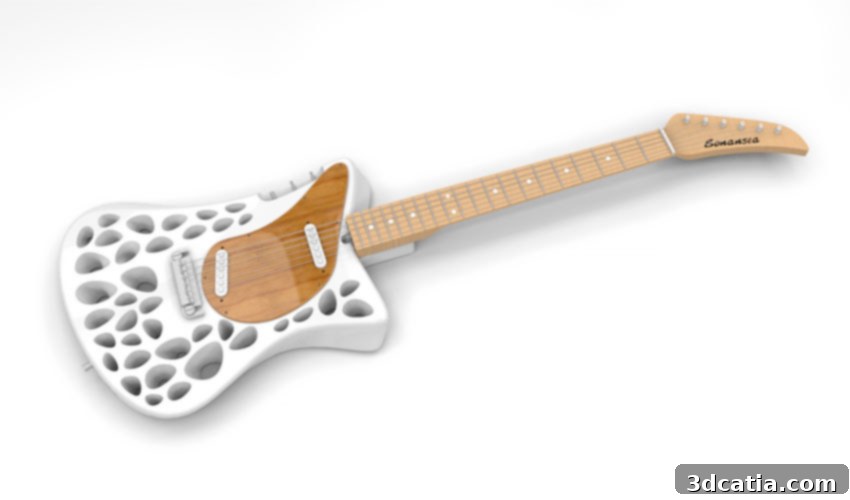
Once the digital design was fully defined and optimized, the physical creation process began. “With the final design locked in, I strategically divided the guitar body into six distinct parts,” Francisco elaborated. “These individual sections were then printed using biodegradable PLA (Polylactic Acid) filament. PLA was chosen not only for its environmental benefits but also for its ease of printing and suitable mechanical properties for this application. The modular approach of printing in sections is a key advantage of 3D printing, allowing for larger objects to be created on standard desktop printers and facilitating easier post-processing and assembly. After the printing was complete, these six pieces were carefully fitted and joined together to form the complete body of the guitar, creating a robust and aesthetically pleasing structure. Following the successful assembly of the body, I moved on to the meticulous task of integrating each of the guitar’s components – from the electronics and wiring to the pickups and hardware. To add a touch of traditional craftsmanship and provide a contrasting element to the modern 3D printed body, I decided to enclose the electronic compartment with custom-made wooden covers. This detail not only serves a functional purpose but also offers a visual nod towards the timeless appeal of conventional guitars, creating a harmonious blend of old and new.” This detailed breakdown showcases how Francisco leverages the flexibility of 3D printing at every stage, from concept to final assembly.
The Paramount Advantage: Unleashing Design Freedom with Additive Manufacturing
When asked about the most significant benefit that additive manufacturing has brought to his project, Francisco’s answer was immediate and profound: “The biggest benefit that this type of manufacturing has afforded me is an unparalleled freedom to design precisely what I envision, and then to materialize that vision right from the comfort of my own desk.” This statement encapsulates the democratizing power of 3D printing for designers and innovators.
He further elaborated on the versatility of the technology: “Beyond just direct fabrication, I also utilize 3D printing as an integral part of a hybrid process, enabling me to work with a diverse array of other materials such as steel, aluminum, wax, and even concrete. This is achieved through the creation of highly precise molds or 3D printed matrixes. This capability is truly transformative; it means that additive manufacturing isn’t confined to creating plastic prototypes or final products alone. Instead, it acts as a foundational tool, allowing for the rapid production of complex forms that can then be used to cast, shape, or otherwise work with a much broader spectrum of materials. This synergy between digital design, 3D printing, and traditional material processes greatly expands the creative and manufacturing possibilities, empowering designers like me to push the boundaries of what’s achievable with custom, intricate forms that would be either impossible or prohibitively expensive to produce using conventional tooling.” This flexibility not only accelerates the development cycle but also opens doors to unprecedented material combinations and aesthetic expressions in product design.
The Future of Sound: 3D Printing’s Expanding Role in the World of Music
Francisco holds an optimistic and expansive view on the future integration of 3D printing within the music industry and beyond. “I observe a clear trend: more and more products across various sectors are incorporating 3D printed components,” he stated. “In the present day, we’re already seeing individuals who aren’t necessarily trained in design or engineering successfully printing objects. The growing availability of user-friendly software and marketplaces for pre-designed models means that people can create physical items without needing to master complex 3D modeling skills themselves. This democratization of manufacturing is a pivotal shift.”
Looking ahead, he painted a vivid picture of a future where 3D printing is ubiquitous. “In the future, I believe it won’t just be musical instruments that we can print from our homes; the capabilities will extend far beyond. We will likely be able to print our daily utensils, customize food, produce personalized vitamins, and even scale up the printing process significantly. We’ve already witnessed groundbreaking projects where entire boats, cars, and even full-sized houses have been successfully 3D printed. This incredible scalability suggests that the technology’s potential is virtually limitless, enabling unprecedented levels of customization and local manufacturing for a vast array of goods, fundamentally changing how we produce and consume in our daily lives.” His vision underscores a future where digital fabrication empowers individuals and industries alike to create, innovate, and personalize on an unprecedented scale.
Harmonizing Innovation: Francisco Bonansea’s Future Projects with 3D Printing
When discussing his future endeavors, Francisco’s passion for both music and design shone brightly, indicating a robust pipeline of innovative projects centered around 3D printing. “As far as music is concerned, my ambition is to significantly expand the Bonansea line,” he shared enthusiastically. “I plan to develop different types of guitars, each incorporating unique technological functions and design aesthetics. My ultimate goal is to create a comprehensive family of musical products, which will include not only various electric guitars but also basses, cellos, violins, and even electric double basses. This expansion aims to demonstrate the versatility of 3D printing across a wider spectrum of string instruments, pushing the boundaries of what’s possible in terms of playability, sound, and visual design.”
Beyond instrument creation, Francisco is also involved in a particularly intriguing collaborative project that seeks to bridge the gap between abstract music and tangible form. “In addition to the instrument family, I’m collaborating with a colleague on a project that aims to give physical shape to music itself,” he revealed. “We want to explore ways to visualize and generate a more fluid connection in the reading of the vibratory waves produced by instruments. This could involve creating visual representations or even haptic feedback mechanisms that allow musicians and audiences to experience music in a profoundly new, multi-sensory way, deepening our understanding and appreciation of sound.”
His design philosophy extends beyond music into everyday life. “I will also continue to develop products for everyday use, driven by the idea of creating as many innovative products as my skills and the technology allow,” Francisco affirmed. “I remain steadfastly faithful to my organic line of design, where I constantly seek to generate a different perspective and reading in the products I create. My ultimate aim is to infuse inspiration and optimism into people’s daily lives through thoughtful, unique, and functionally superior designs. This holistic approach to design, leveraging 3D printing’s capabilities, allows him to impact various aspects of life, always with an eye towards enhancing user experience and bringing positive change.”
A Call for Innovation and Responsible Consumption: Francisco Bonansea’s Concluding Thoughts
3DN: Any last words for our readers?
Francisco concluded our insightful discussion with a powerful message that resonates far beyond the realm of 3D printing and musical instruments. “We are currently moving from an era of programmed obsolescence into a stage that I find truly revolutionary,” he asserted. “Today, thanks to technologies like 3D printing, we possess the incredible capability to manufacture and even repair objects or their individual parts that might otherwise be discarded when broken. This shift empowers individuals and fosters a more sustainable approach to consumption, moving away from a throwaway culture.”
He passionately encouraged engagement with this evolving landscape: “Finally, I would like to wholeheartedly encourage everyone to start getting involved in this fascinating world of additive manufacturing. By doing so, we can collectively become an increasingly self-sufficient society of individuals, less reliant on mass-produced, non-repairable goods. Imagine a world where we could consume in a truly responsible way, being acutely aware of all the materials that comprise our waste streams. If we lived in a spirit of brotherhood and consistently helped each other, I firmly believe that we could genuinely make the world a significantly better place. This vision extends beyond mere technological advancement; it’s about fostering a more conscious, collaborative, and sustainable future for all.” For those interested in exploring Francisco’s work further and connecting with his innovative spirit, additional information can be found on his LinkedIn profile.
What are your thoughts on the transformative potential of 3D printing within the music industry? How do you perceive the groundbreaking project from industrial designer Francisco Bonansea and his unique approach to crafting musical instruments? We invite you to share your insights and opinions in a comment down below or join the conversation on our Facebook and Twitter pages! Don’t miss out on the latest advancements and news in the world of additive manufacturing – be sure to sign up for our free weekly Newsletter, delivering all the essential updates directly to your inbox!