
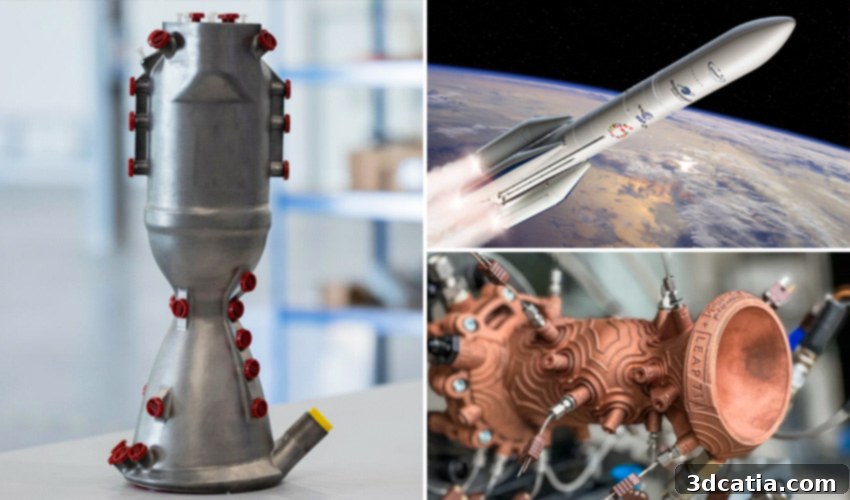
The Future of Space: How 3D Printing is Revolutionizing Rocketry and Space Exploration
Since humanity first dared to look up at the stars, the dream of reaching beyond Earth has captivated us. The monumental moon landing in 1969 with Apollo 11 marked a pivotal moment, yet it was merely the beginning of an ongoing journey into the cosmos. What has dramatically evolved since then are the methods and technologies employed to achieve these ambitious space endeavors. Rocketry, once an incredibly complex, time-consuming, and costly undertaking, is being fundamentally transformed by relentless innovation. In recent years, one technological advancement stands out as a true game-changer: additive manufacturing, commonly known as 3D printing. This revolutionary approach is enabling aerospace engineers and companies to rethink the design, production, and functionality of space vehicles, leading to an exciting new era of space exploration.
The advent of 3D printing in the aerospace sector has led to an increasing number of fully 3D printed rockets, as well as critical components like engines and intricate parts, being developed, tested, and even successfully launched into space. This profound shift is driven by the unparalleled benefits offered by additive manufacturing, including drastically reduced production times, significantly lower manufacturing costs, lighter components with enhanced performance, and the unprecedented ability to create highly complex geometries previously impossible with traditional manufacturing methods. These advantages are crucial for overcoming the extreme challenges of space travel, from surviving immense G-forces during launch to operating efficiently in the harsh vacuum of space and beyond.
In this comprehensive article, we delve into some of the most groundbreaking projects and initiatives that vividly highlight the transformative power of 3D printing in rocketry. We’ll explore everything from entire launch vehicles designed from the ground up for additive manufacturing to specialized rocket engines and other integral parts that have been meticulously optimized and produced using this cutting-edge technology. Each of these projects, presented in no particular order, represents a significant leap forward, demonstrating how 3D printing is not just a manufacturing process, but a powerful catalyst for innovation, making space more accessible, sustainable, and efficient than ever before. Discover the trailblazers shaping the future of space travel.
Agnibaan From Agnikul Cosmos: India’s Pioneering 3D Printed Rocket Engine
Agnibaan, meaning “an arrow of fire” in Sanskrit, represents one of the most significant recent strides in 3D printed rocketry, emerging from Agnikul Cosmos, an innovative Indian aerospace manufacturer. The company’s core philosophy centers on democratizing access to space, believing it should be within everyone’s reach, not just the domain of a few national agencies. This visionary approach directly led them to embrace 3D printing as a core manufacturing strategy. Agnikul Cosmos proudly claims Agnibaan to be the world’s first rocket featuring a single-piece 3D printed engine. This achievement is particularly remarkable as it streamlines the entire production process, consolidating multiple components into one and thereby potentially reducing manufacturing complexities, costs, and lead times. While the specific additive manufacturing technologies employed for this groundbreaking project have not been publicly disclosed by Agnikul, the successful maiden launch of Agnibaan on May 30th at 7:15 AM marked a monumental milestone. This event not only validated the immense capabilities of additive manufacturing for complex propulsion systems but also solidified India’s growing prominence in the global space industry, showcasing its commitment to leveraging advanced technologies for future space endeavors and opening up new possibilities for satellite launches.

Photo Credits: Agnikul Cosmos
The E-2 Rocket Engine From Launcher: High-Performance Propulsion through Metal AM
Founded in 2017, Launcher quickly established itself as a key player in developing high-performance rockets and orbital transfer vehicles, partnering with prestigious organizations like the US Space Force, the US Air Force, and NASA. Although acquired by Vast in 2023, Launcher’s legacy includes the innovative E-2 liquid rocket engine, a testament to its integration of state-of-the-art liquid propulsion technology with advanced 3D printing. The E-2 engine is a sophisticated closed-combustion system featuring a combustion chamber meticulously crafted from a copper-chromium-zirconium alloy. This particular material choice, combined with the precision of additive manufacturing, offers significant advantages: it substantially reduces production costs by minimizing waste and complex tooling, and it lessens dependence on fragile global supply chains, a crucial factor in the fast-paced aerospace sector. Launcher distinguishes itself as the first company in the launch vehicle industry to extensively utilize 3D-printed copper alloys for manufacturing rocket engine combustion chambers, setting a new industry standard. A critical design feature of this combustion chamber is its integrated cooling channels, which are essential for maintaining optimal operating temperatures and significantly enhancing thermal efficiency during intense, high-thrust operations. To achieve this complex internal geometry, Launcher collaborated with AMCM to develop the specialized AMCM M 4K 3D printer, specifically engineered for printing such intricate copper alloy components. Furthermore, the coaxial injector of the E-2 engine was produced using a Velo3D Sapphire 3D printer, highlighting the strategic use of multiple advanced AM platforms for different specialized parts requiring distinct capabilities. A major validation of the E-2 engine’s capabilities came in April 2022, when it successfully reached full thrust during rigorous hot-fire testing at NASA’s Stennis Space Center, marking the successful completion of a crucial test run and demonstrating its readiness for future launch vehicle applications.

Photo Credits: Launcher
Ariane 6: Europe’s Heavy-Lift Launcher Enhanced by Additive Manufacturing
ArianeGroup, a robust joint venture between aerospace giants Airbus Group and Safran, stands at the forefront of European space technology. With Ariane 6, they have developed Europe’s most advanced heavy-lift launcher, successfully completing its maiden launch in July 2024. This next-generation rocket boasts a highly flexible design, capable of transporting exceptionally large payloads into various orbits, thereby securing Europe’s independent and competitive access to space. A key factor in achieving Ariane 6’s optimized performance, reduced mass, and cost-efficiency has been the strategic adoption of industrial 3D printing. Numerous critical components of the Ariane 6’s engine and other structural elements were additively manufactured, leading to significant reductions in both production costs and manufacturing cycle times. The combustion chamber, a vital part of the propulsion system, was developed and manufactured in Germany, showcasing cutting-edge European expertise in advanced engineering. The casing of the liner was intricately printed using a specialized cold spraying process, a technique that allows for the deposition of metallic layers without melting, thus preserving material properties and enabling specific functionalities. Additionally, the complex monoblock injection head, crucial for precise and efficient fuel delivery, was manufactured using a laser sintering process. This injection head, incorporating all its intricate injection elements, was expertly produced by EOS, a leading company in high-end additive manufacturing solutions. The widespread use of AM in Ariane 6 underscores its role not just in cutting costs and accelerating development, but also in enabling complex geometries and integrated functionalities that improve overall rocket performance, reliability, and ultimately, Europe’s competitive edge in the global space race.

Photo Credits: ArianeGroup
Skyroot Aerospace and its 3D-Printed Dhawan Cryogenic Rocket Engines
Skyroot Aerospace, an innovative Indian company founded in 2018, is rapidly making its mark in the global space industry with a clear mission: to make space accessible to everyone through the provision of fast, precise, and affordable space launchers. Under its Vikram range of rockets, the company has developed several models, but it’s their propulsion systems that truly stand out. Skyroot’s rocket engines, aptly named Dhawan (after Indian rocket scientist Satish Dhawan), are entirely 3D printed, showcasing a commitment to advanced manufacturing techniques. These engines are sophisticated cryogenic engines, operating on a combination of liquid natural gas (LNG) and liquid oxygen (LOX). Both propellants require meticulous handling and storage at extremely low temperatures, below -150°C, for optimal performance. For the manufacturing of both the Dhawan-I and its subsequent, more advanced version, the Dhawan-II, metal additive manufacturing was the chosen method. This choice enables the creation of complex internal structures necessary for efficient cryogenic operation, such as cooling channels and injector designs, while also ensuring lightweight and robust components capable of enduring extreme conditions. Both engine models have undergone rigorous testing and demonstrated successful performance, validating Skyroot’s innovative approach. The Dhawan-II engine is specifically slated for integration into the Vikram-II rocket, which is scheduled for launch towards the end of the year, further pushing the boundaries of affordable and efficient space access through cutting-edge 3D printing technology.
The 3D Printed Hadley Engine From Ursa Major: Powering the Private Space Sector
Ursa Major, an American startup, has quickly garnered significant attention within the aerospace community for its pioneering work on 3D printed rocket engines, specifically designed to meet the growing demands of the private space sector. In a major announcement in March 2024, the company confirmed that its partially 3D printed Hadley engine had successfully completed its inaugural flight, achieving impressive speeds approaching Mach 5. This accomplishment marks a crucial step forward for the use of additive manufacturing in developing versatile and reliable propulsion systems for commercial and private space missions. While Ursa Major has not disclosed the precise additive manufacturing technologies or materials utilized in the intricate construction of the Hadley engine, it is widely understood that 3D printing played a critical role in its design and fabrication due to the complexity and performance requirements. Given the company’s prior collaborations with EOS, a renowned leader in metal additive manufacturing, it is highly probable that the Hadley engine benefited from advanced copper and other metal 3D printing techniques, most likely involving laser powder bed fusion. This technology allows for the creation of incredibly detailed and high-performance components vital for rocket engines, enabling superior thermal management and structural integrity. The successful flight of the Hadley engine stands as a tremendous milestone, underscoring the increasing reliability and capability of 3D printing to produce high-performing engines, thereby accelerating innovation and reducing barriers for entry in the dynamic private space sector, offering customizable solutions for a variety of launch needs.
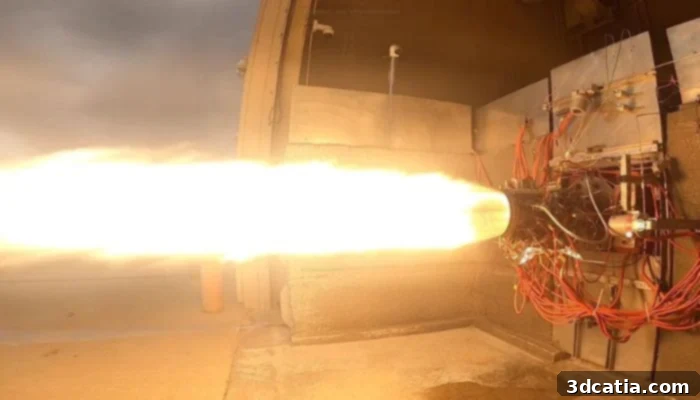
A hot fire test of the Hadley Engine (photo credits: Ursa Major)
NASA’s Rotating Detonation Rocket Engine (RDRE): Redefining Propulsion for Deep Space
As the world’s leading institution in space travel and flight science, NASA consistently pushes the boundaries of propulsion technology, setting new benchmarks for efficiency and performance. A prime example of this pioneering spirit is NASA’s development of the first full-size Rotating Detonation Rocket Engine (RDRE), meticulously engineered with the transformative capabilities of 3D printing. This revolutionary engine has the potential to fundamentally redefine the design and operation of future propulsion systems, especially for long-duration deep space missions. The RDRE operates on an advanced propulsion concept that harnesses the phenomenon of supersonic combustion. Unlike traditional deflagration-based engines, which rely on slower, subsonic burning, the RDRE utilizes a continuous, self-sustaining detonation wave that travels around an annular combustion chamber. This enables significantly higher performance with substantially lower fuel consumption, making it ideally suited for extended missions to distant celestial bodies like the Moon or Mars. The engine was manufactured using laser powder bed fusion, an advanced metal 3D printing technique, and specifically utilized the GRCop-42 copper alloy. This high-strength, high-conductivity copper alloy was developed by NASA itself, precisely to enable rocket engines to operate under extreme temperatures and pressures for extended periods without degradation. In the fall of 2023, NASA conducted a comprehensive series of hot-fire tests at the Marshall Space Flight Center, rigorously verifying the engine’s ability to withstand the extreme operational temperatures and meet critical requirements, such as the integration of a lambda sensor for combustion analysis. The successful completion of these tests underscores the RDRE’s robustness and efficiency, offering immense potential to support future ambitious missions, including sustained lunar presence and human exploration of Mars, solidifying 3D printing’s crucial role in the next generation of space travel.
EOS and Hyperganic: An AI-Designed 3D Printed Aerospike Rocket Engine
In a remarkable display of interdisciplinary innovation, EOS, a global leader in industrial 3D printing, and Hyperganic, a pioneering German company specializing in algorithmic design software, made significant headlines in 2022. Their collaboration resulted in the creation of an aerospike rocket engine with an exceptionally complex design, achieved through the synergistic integration of artificial intelligence and advanced 3D printing. Hyperganic, founded in 2015, leveraged its powerful algorithmic design software to generate a design that draws inspiration from intricate natural forms, enabling unprecedented levels of complexity and efficiency that would be impossible with traditional CAD tools. The aerospike rocket engine stands out due to its unique and highly sophisticated geometry, which aims to maintain optimal thrust efficiency across a wide range of altitudes, a significant advantage over traditional bell-nozzle engines. The initial prototype of this cutting-edge engine was 3D printed from a high-performance nickel alloy, specifically NickelAlloy IN718, using the robust EOS M 400-4 machine. This phase demonstrated the feasibility of printing such intricate designs with high-strength materials suitable for aerospace applications. In a subsequent stage, recognizing the superior thermal conductivity requirements for rocket engines, a larger-scale version of the engine was successfully manufactured from copper, further expanding the material and application possibilities for AI-driven 3D printing in aerospace. This project exemplifies how combining artificial intelligence for rapid, generative design with the advanced manufacturing capabilities of 3D printing can unlock new frontiers in engineering, pushing the boundaries of what is possible in propulsion system development and creating novel designs for space exploration.
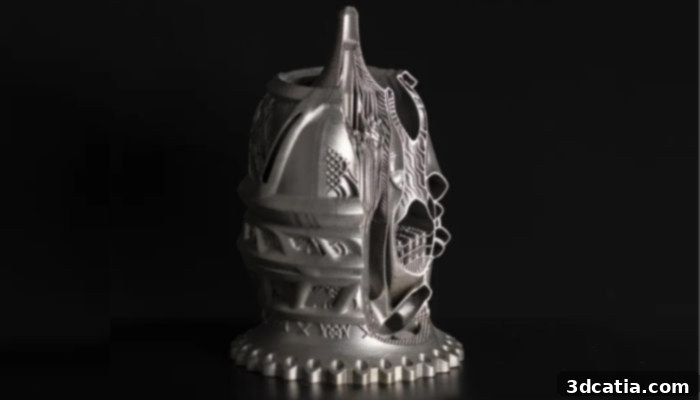
Photo Credits: EOS
AI and 3D Printing for TKL-5 Liquid-Propellant Rocket Engine by LEAP 71
LEAP 71, a forward-thinking Dubai-based company, is at the forefront of integrating computational engineering with additive manufacturing to achieve significant breakthroughs in space technology. Their development of the TKL-5 liquid-propellant rocket engine stands as a prime example of this innovative synergy. The project’s primary objective was to showcase the immense capabilities of Noyron, LEAP 71’s proprietary AI-based software. This revolutionary software enabled the TKL-5 rocket engine to be designed and produced almost entirely digitally and autonomously, minimizing human intervention in the iterative design phase. A key innovation was that the AI algorithms eliminated the need for traditional CAD design processes, drastically optimizing the entire production workflow for the engine to an astonishing two weeks from concept to physical part. The TKL-5 engine was manufactured by AMCM on an EOS M290 3D printer, utilizing copper as the primary material. This choice of copper, combined with an actively cooled design incorporating complex internal channels, resulted in an exceptionally powerful and efficient engine capable of high performance in extreme conditions. Following its production, the engine underwent post-processing by the University of Sheffield’s Race to Space team and was successfully tested at Airborne Engineering’s facilities. During these rigorous tests, the TKL-5 achieved an impressive thrust of 20,000 HP (approximately 89 kN), making it ideally suited for deployment in orbital rockets. LEAP 71 firmly believes that this 3D-printed, AI-designed rocket engine possesses the transformative potential to significantly accelerate the pace of innovation within space travel and substantially improve the overall accessibility of space, marking a new era where intelligent design meets advanced manufacturing for groundbreaking results.
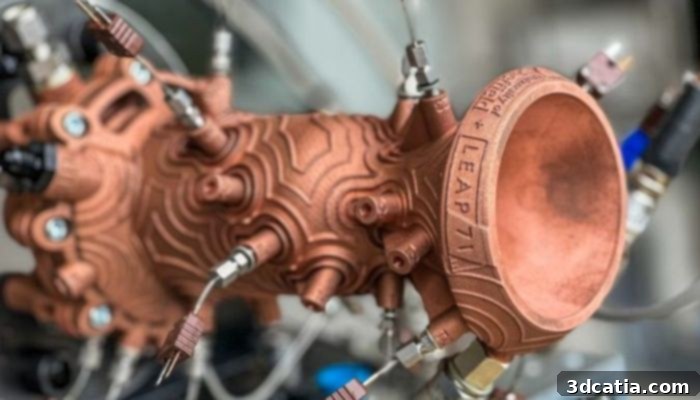
Photo Credits: LEAP 71
The Orbex Prime Rocket: Sustainable and Reusable Space Access with 3D Printing
Orbex, a visionary British aerospace company, is setting new standards for sustainability in the space industry with its development of the Orbex Prime rocket. This high-performance, low-carbon launch vehicle represents a significant step towards more environmentally responsible space access. A cornerstone of Prime’s manufacturing strategy is the extensive use of additive manufacturing, specifically employing Nikon SLM Solutions’ state-of-the-art SLM800 metal 3D printer. This advanced manufacturing capability allows Orbex to produce complex, lightweight, and highly optimized components essential for rocket performance, while also reducing waste in the production process. What truly sets Prime apart, however, is its unwavering commitment to environmental stewardship. The rocket is uniquely powered by biopropane, a 100 percent renewable fuel, which dramatically reduces carbon dioxide emissions by an estimated 90 percent compared to traditional kerosene-based rocket fuels. Furthermore, Orbex Prime is engineered for reusability, featuring an integrated recovery system. This system is meticulously programmed not only to facilitate the safe return and refurbishment of rocket stages but also to ensure that zero debris is left in Earth orbit, addressing a critical concern in space sustainability and reducing space junk. Prime was first publicly unveiled in 2022 in the United Kingdom, captivating the world with its innovative design and its promise of a cleaner, more sustainable future for orbital launches, truly showcasing the versatile applications of 3D printing in creating eco-conscious space solutions for the benefit of our planet and beyond.
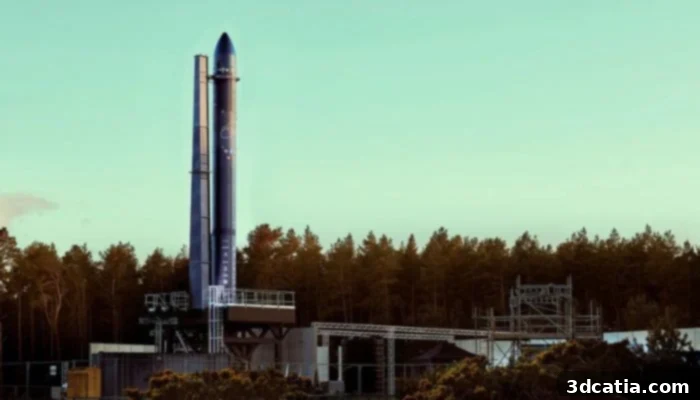
Photo Credits: Orbex
3D Printed Rockets From Relativity Space: The Terran Legacy and Future
Relativity Space, the Californian company founded in 2015, has rapidly become synonymous with the audacious goal of creating a fully 3D printed rocket, a concept that has captivated the aerospace world. Their ambition is nearing full realization, demonstrating the extraordinary potential of additive manufacturing for entire launch vehicles. The company’s first major achievement was the successful launch of Terran 1 in March 2023. Although Terran 1 did not ultimately reach orbit, its launch was a monumental engineering feat. This rocket was almost entirely 3D printed using a combination of Directed Energy Deposition (DED) and laser powder bed fusion technologies, making it, at the time of its launch, the tallest 3D printed metal structure ever built. This accomplishment alone proved the scalability and structural integrity achievable through advanced additive manufacturing, challenging conventional rocket production methods. Building on the invaluable lessons learned from Terran 1, Relativity Space is now focusing its efforts on the development of the Terran R. This next-generation rocket is projected to be 90% 3D printed and designed to carry a staggering 20 times more payload than its predecessor, significantly enhancing its commercial viability and mission capabilities for constellations of satellites. The Terran R is poised to commence launches from Launch Complex 16 at Cape Canaveral Space Force Base starting in 2026, propelling space exploration directly into a future where customizability, rapid iteration, and cost-effectiveness define the next generation of space travel, all thanks to the power of large-scale 3D printing and advanced robotics.

An image of what the Terran R will look like (photo credits: Relativity Space)
Navier: The French Engine Made With Additive Manufacturing by Latitude
Latitude, previously known as Venture Orbital Systems, is an ambitious French start-up specializing in the design and production of microlancers, small-scale rockets designed to efficiently deploy smaller payloads like satellites into orbit. Their flagship model, the Zephyr, measures 19 meters long and 1.5 meters in diameter, representing a compact yet capable launch vehicle tailored for the burgeoning small satellite market. A crucial innovation at the heart of the Zephyr is its propulsion system, powered by the Navier engine. This engine is a prime example of the advantages of metal 3D printing, specifically manufactured using Laser Powder Bed Fusion (LPBF). The Navier engine itself is a compact marvel, standing 45 centimeters high and weighing a mere 30 kilograms, yet capable of generating a substantial thrust of 1.2 tonnes (approximately 11.8 kN). It was fabricated from Inconel 718, a high-strength nickel-based superalloy known for its excellent mechanical properties at elevated temperatures and resistance to corrosion, on an SLM 500 machine. The inherent efficiency of additive manufacturing allowed for its production in just a few days, a remarkable turnaround compared to traditional manufacturing methods, significantly accelerating development cycles. At the start of 2023, Latitude successfully conducted a hot-fire test of the Navier engine, a significant achievement that validated its design and manufacturing process. This success underscores the ingenuity of the Reims-based startup and its commitment to leveraging advanced manufacturing to create agile and effective solutions for the rapidly growing small satellite launch market, positioning France firmly in the new space race.
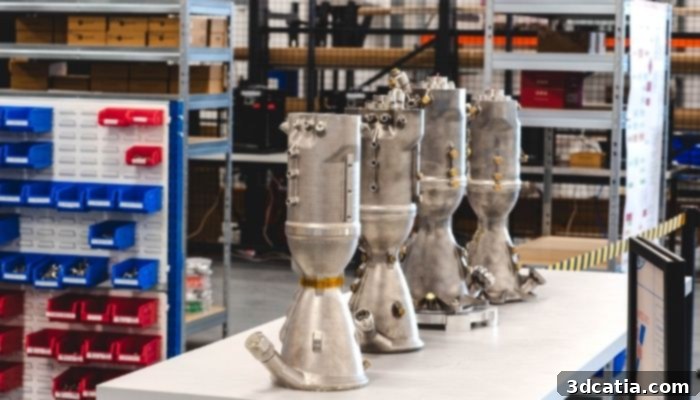
Photo Credits: Latitude
The Rutherford Engine From Rocket Lab: Pioneering Electric Propulsion with 3D Printing
Rocket Lab, a dynamic Californian startup and a prominent private aerospace company, has distinguished itself by developing the Electron rocket, notable as the world’s first battery-powered orbital launch vehicle. This groundbreaking rocket successfully completed its inaugural launch in 2017, powered by its equally innovative 3D-printed Rutherford engine. Named after the eminent New Zealand scientist Ernest Rutherford, the engine is a testament to how additive manufacturing can revolutionize propulsion system design and production. A significant number of the Rutherford engine’s critical components are 3D printed, including the thrust chamber, two essential turbopumps, the intricate injector, and the main propellant valves. This extensive use of 3D printing allows for complex geometries, integrated functionalities (like internal cooling channels), and significant weight savings – all crucial factors in aerospace applications where every gram counts. For its maiden flight, Rocket Lab capitalized on a ten-day launch window, successfully deploying the rocket from the Mahia Peninsula in New Zealand. Following this initial success, the second flight in 2018 achieved orbital spaceflight, paving the way for the company to transition into full commercial operation. The strategic adoption of additive manufacturing in the production of the Rutherford engine has yielded multiple benefits, most notably substantial reductions in manufacturing time and component weight. These efficiencies are paramount in the competitive aerospace industry, where every kilogram and every day saved translates into significant advantages. Rocket Lab continues its mission to mass-produce rockets that efficiently launch satellites into space, with the Rutherford engine remaining a cornerstone of their propulsion technology, demonstrating the power of 3D printing to enable electric-pump-fed rocket engines and making space access more affordable and frequent.
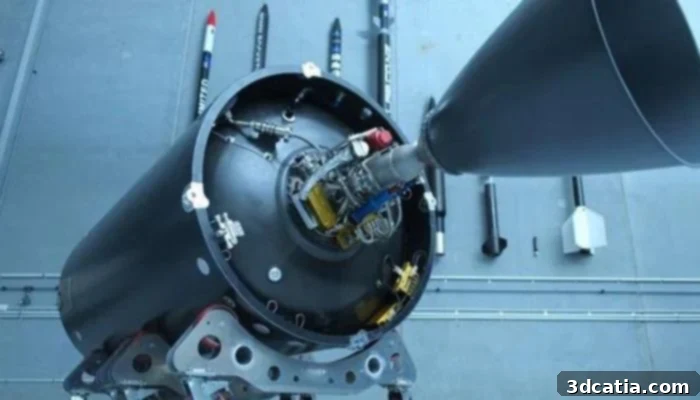
Photo Credits: Rocket Lab
A 3D-Printed Combustion Chamber by OPUS Aerospace for the Torgos Engine
OPUS Aerospace, another dynamic French company, is making significant strides in the design and development of innovative launchers and spacecraft. Their portfolio includes two distinct launcher models: Mesange and Sterne. Mesange is strategically designed to serve as a crucial testbed, paving the way and de-risking technologies for the larger, more advanced Sterne launcher. Both of these launchers incorporate the Torgos engine, a testament to modern propulsion engineering. A highlight of the Torgos engine is its combustion chamber, which was meticulously produced using metal 3D printing in a single, streamlined operation. This approach leverages the capabilities of additive manufacturing to create complex internal cooling channels and optimized geometries that are essential for high-performance rocket engines, all while significantly reducing part count, assembly complexity, and potential points of failure. The ability to print the combustion chamber as a single, integrated unit significantly enhances its structural integrity, thermal efficiency, and overall reliability under extreme operational conditions. Mesange is currently scheduled for launch from French Guiana in 2024. This test flight will be vital for gathering critical data and insights, which will then be used to further perfect the design and operational parameters of the Sterne launcher. OPUS Aerospace’s commitment to integrating advanced manufacturing techniques like metal 3D printing into their core development process demonstrates a forward-thinking approach to making space access more reliable, efficient, and ultimately, more successful for future missions.
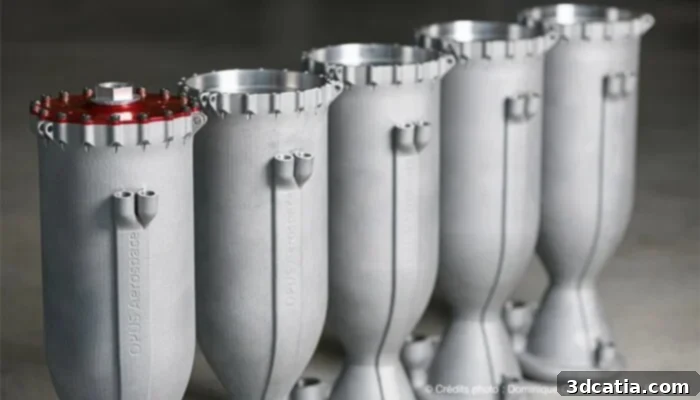
Photo Credits: Opus Aerospace
Stoke Space: 3D Printed Combustion Chambers for Fully Reusable Rockets
Stoke Space, an ambitious American company, is pushing the boundaries of space travel with its NOVA rocket, designed to be a fully reusable launch vehicle capable of supporting daily flights into space. Achieving this ambitious goal necessitates groundbreaking engineering and manufacturing techniques, and Stoke Space has turned to advanced 3D printing to realize its vision. A critical application of additive manufacturing within the NOVA project is the production of its copper combustion chambers. Copper, known for its excellent thermal conductivity, is an ideal material for rocket engine components that experience extreme temperatures and require efficient heat dissipation. 3D printing enables Stoke Space to rapidly fabricate these chambers, which is essential for iterating designs quickly and accelerating development cycles, bringing rockets to market faster. Furthermore, the reusability aspect of the NOVA rocket is directly facilitated by the use of these 3D-printed copper alloy combustion chambers, as their superior thermal properties allow them to withstand repeated operational cycles without significant degradation, extending their lifespan and reducing costs. The design of these combustion chambers is exceptionally complex, featuring intricate regenerative cooling channels, curved manifolds, and internal cavities. Such geometries are exceedingly difficult, if not impossible, to produce with traditional manufacturing methods. However, additive manufacturing provides the necessary design freedom to implement these highly optimized, complex designs, which are crucial for the engine’s efficiency and reusability. The Seattle-based company is actively testing its advanced developments at its facilities in nearby Moses Lake, systematically refining its fully reusable rocket technology and demonstrating how 3D printing is enabling a future of routine and sustainable space access.
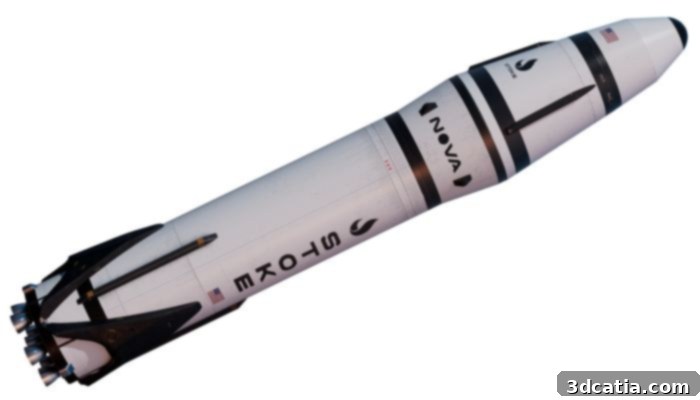
Photo Credits: Stoke Space
The rapid advancements in 3D printing technology have undeniably ushered in a new era for the aerospace industry, fundamentally transforming how rockets and propulsion systems are designed, manufactured, and utilized. As we’ve explored through these diverse and groundbreaking projects, additive manufacturing offers unparalleled advantages that are critical for the demanding environment of space exploration. From reducing development timelines and manufacturing costs to enabling the creation of intricate, high-performance components and fostering greater sustainability through reusability, the benefits are clear and far-reaching.
Companies and agencies worldwide, from established giants like NASA and ArianeGroup to agile startups such as Agnikul Cosmos, Relativity Space, and Stoke Space, are leveraging 3D printing to achieve feats previously deemed impossible. Whether it’s developing single-piece engines with enhanced thermal management, optimizing thrust efficiency with complex cooling channels, or building entire rockets from the ground up that are almost entirely 3D printed, additive manufacturing is accelerating innovation across the board. This technology is making space more accessible, enabling more frequent launches, and paving the way for a future where routine space travel and ambitious deep-space missions are not just dreams, but achievable realities. The journey to the stars continues, and with 3D printing as a powerful and indispensable tool, humanity’s reach is expanding further and faster than ever before, promising an exciting future for space exploration and beyond.
What do you think of these incredible examples of 3D printed rockets and engines? Share your thoughts and insights in a comment below or join the conversation on our LinkedIn, Facebook, and Twitter pages! Don’t forget to sign up for our free weekly newsletter here for the latest 3D printing news straight to your inbox! You can also find all our videos on our YouTube channel.