
Nicolas Cage’s Dracula Fangs: How 3D Printing is Revolutionizing Movie Magic and Dental Prosthetics
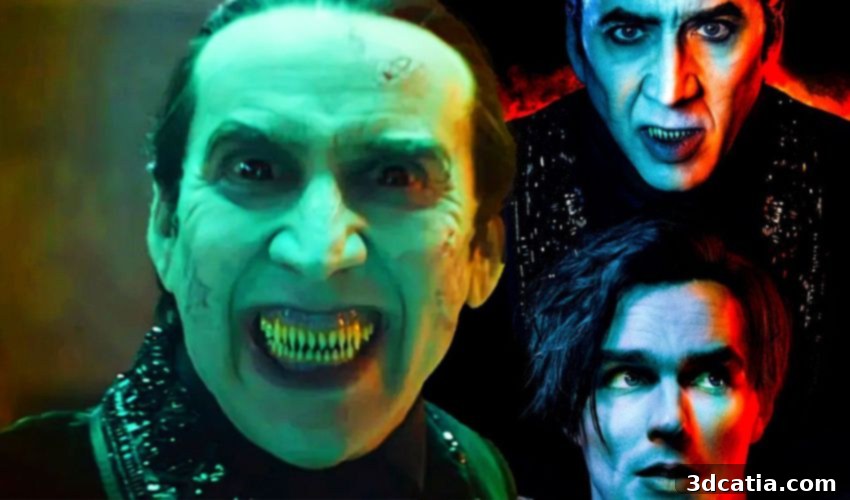
The cinematic world is buzzing with anticipation for “Renfield,” a unique supernatural comedy-horror film that promises a fresh take on the legendary Dracula narrative. Set to hit screens soon, this highly awaited movie features none other than the iconic Nicolas Cage in the titular role of Dracula, alongside Nicholas Hoult, who portrays Renfield, an asylum patient whose perspective drives the story. Cage’s dedication to his craft is well-documented, and his preparation for this role was no exception. Reports indicate that the Oscar-winning actor underwent significant physical transformations, including having his teeth subtly reshaped to accommodate the character’s terrifying grin. What truly captured the public’s imagination, however, was the revelation that the infamous dentures designed to give his Dracula a uniquely eerie and authentic appearance were, in fact, crafted using cutting-edge 3D printing technology.
This innovative approach to character design underscores a growing trend in both the entertainment and medical sectors: the power and precision of additive manufacturing. For “Renfield,” Cage reportedly committed three hours daily to his transformation, a meticulous process involving extensive prosthetics, makeup, and intricate hairpieces. Central to this transformation were the custom-made 3D printed dentures. These were not just any off-the-shelf fangs; they were painstakingly created by a specialized dental technician who utilized a digital scan of Cage’s own teeth. This crucial step ensured an impeccable, customized fit, allowing Cage to wear the dentures with unparalleled comfort and convincingly embody the iconic vampire’s menacing fangs without hindering his performance. This marriage of advanced technology and artistry enabled a level of realism previously difficult to achieve, proving invaluable for such a demanding role.
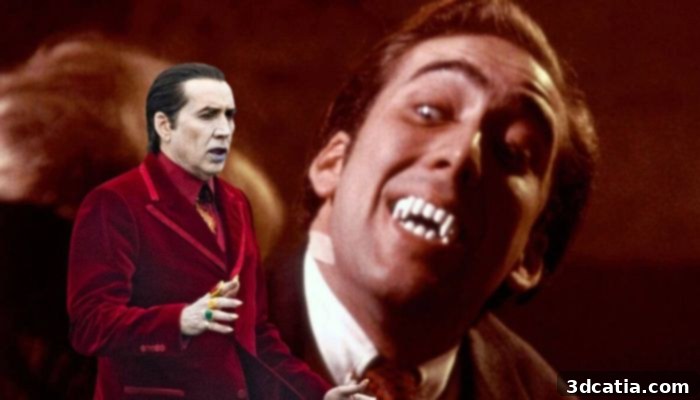
3D printed props are becoming increasingly popular in cinema (Photo credit: Universal)
The application of 3D printing in creating Cage’s Dracula dentures is a perfect illustration of how this technology is not only shaping the future of moviemaking but also revolutionizing the dental industry. It is no secret that 3D printing has been a cornerstone in dentistry for many years. Its adoption has provided a dramatically more cost-effective, efficient, and precise method for producing a wide array of dental prosthetics, including custom crowns, veneers, bridges, and even surgical guides. The ability to create patient-specific devices with high accuracy has transformed treatment plans and outcomes, offering dentists and patients alike superior solutions. This proven track record in a highly regulated field like dentistry made its transition into the equally demanding world of filmmaking a natural progression, allowing filmmakers to craft incredibly intricate and lifelike prosthetics and props that elevate the cinematic experience.
Precision and Performance: The Technology Behind Dracula’s Fangs
In the specific case of Nicolas Cage’s portrayal of Dracula in “Renfield,” the integration of 3D printed dentures represents a prime example of how technology is being harnessed to craft a more authentic and unforgettable movie experience. The process began with a highly accurate digital scan of Cage’s oral cavity. This digital blueprint was then used by the dental technician to design dentures that perfectly matched the actor’s unique dental anatomy. The material of choice for these specialized fangs was acrylic resin, a material widely favored in dentistry for its biocompatibility, durability, and realistic appearance. While specific details about the exact 3D printing technology employed for “Renfield” remain under wraps, given the use of resin, it is highly probable that a photopolymerization process, such as Stereolithography (SLA) or Digital Light Processing (DLP), was utilized. These technologies are well-established and highly effective within the dental sphere for their ability to produce incredibly detailed and smooth surfaces, crucial for comfortable and natural-looking prosthetics. The result was a set of dentures that not only looked terrifyingly authentic but also allowed Cage to speak, snarl, and act naturally, ensuring that the performance remained unhindered by his elaborate costume pieces.
Beyond Fangs: The Expanding Role of 3D Printing in Filmmaking
The innovative use of 3D printed dentures for “Renfield” is more than just a novelty; it signals a significant and accelerating trend across the entire film production landscape. 3D printing is rapidly gaining traction in cinema, particularly for the creation of intricate props, elaborate set pieces, and complex costume elements. This transformative technology offers unparalleled advantages. It’s not just about producing small items like dentures; it extends to crafting full-body prosthetics, highly detailed creature components, and even large-scale environmental props. The core benefit lies in its ability to facilitate the creation of exceptionally detailed and complex designs with remarkable speed and efficiency. For movie studios, this translates into a powerful tool for rapidly prototyping and producing unique attire and accessories for their characters, often at a lower cost and with greater design freedom than traditional manufacturing methods.
Consider the traditional methods of creating movie props and prosthetics. Often, these involved laborious hand-sculpting, molding, and casting processes, which were time-consuming, expensive, and sometimes limited in their ability to achieve extreme levels of detail or geometric complexity. 3D printing bypasses many of these limitations. Digital design software allows for boundless creative freedom, enabling artists and designers to experiment with forms and textures that would be impossible to realize physically through conventional means. Once a design is perfected digitally, a 3D printer can produce the physical object with incredible accuracy and repeatability. This agility is invaluable in a fast-paced production environment where deadlines are tight and revisions are common. Furthermore, the ability to iterate quickly and produce multiple versions of a prop or costume piece with absolute consistency ensures a cohesive visual aesthetic throughout a film.
A Game-Changer for Special Effects and Character Development
Nicolas Cage’s new Dracula movie, “Renfield,” stands as a compelling case study illustrating how 3D printing technology is fundamentally altering the movie industry. It’s making the previously complex and often arduous processes of makeup design, special effects, and prop fabrication significantly more streamlined and accessible. The precise application of 3D printed dentures, in particular, serves as a powerful testament to the technology’s remarkable capacity to produce customized, highly authentic, and performance-enhancing prosthetics. This level of customization ensures that an actor’s comfort and ability to deliver a nuanced performance are never compromised by the demands of their character’s appearance.
Looking ahead, the trajectory of 3D printing technology suggests an even broader and more impactful role in both dentistry and filmmaking. As materials evolve, printers become faster and more versatile, and design software becomes more intuitive, we can anticipate an explosion of even more innovative applications. Imagine increasingly sophisticated animatronics components, highly realistic creature effects created entirely through additive manufacturing, or even entire film sets produced with enhanced efficiency. In dentistry, the possibilities are equally exciting, with advancements leading to even more biocompatible materials, faster production of complex aligners, and even regenerative medicine applications that could one day print living tissues. The synergy between these two seemingly disparate fields – dental precision meeting cinematic spectacle – continues to drive innovation, promising a future where the boundaries of what’s possible are constantly being redefined.
What are your thoughts on Nicolas Cage’s 3D printed dentures and the growing influence of additive manufacturing in film? Share your insights in a comment below or connect with us on our Facebook, Twitter and LinkedIn pages! Don’t miss out on the latest advancements in 3D printing; sign up for our free weekly Newsletter here and get the freshest news delivered straight to your inbox!
*Cover Photo Credits: Universal