
Revolutionizing Aerospace Repairs: The Power of 3D Printed Kevlar Shields for Enhanced Structural Integrity
In an increasingly interconnected world, aircraft and spacecraft stand as pillars of modern society. From facilitating global travel and enabling real-time satellite communications to providing critical navigation services and bolstering national security, these sophisticated machines are indispensable. Their seamless operation is paramount, making rapid and effective repair capabilities not just convenient, but absolutely essential to prevent disruptions, ensure mission success, and, most importantly, safeguard lives. Traditional repair methodologies often fall short in meeting the demanding timelines and precision required for aerospace applications, leading to prolonged downtimes and exorbitant costs. However, a groundbreaking initiative, the SBORAEK project, is poised to redefine aerospace repair strategies by harnessing the transformative potential of 3D printed Kevlar shields, offering a novel solution to an age-old challenge.
Introducing the SBORAEK Project: Smart Solutions for Aerospace Exostructures
The SBORAEK project, an acronym for Smart Ballistic Optimization for Repairing of Aerospace Exostructures using 3D-printed Kevlar, cleverly plays on the word “Börek,” a layered Turkish pastry, to metaphorically illustrate its innovative approach to layered composite repair. This ambitious endeavor is spearheaded by Dr. Leonardo Barilaro, a distinguished Senior Lecturer in Aerospace Engineering at the Malta College of Arts, Science, and Technology (MCAST). The project’s vision is brought to life through funding from the Malta Council for Science & Technology, underlining a national commitment to advancing cutting-edge research. Furthermore, it thrives on a robust collaborative network, drawing expertise from MCAST’s Institute of Engineering and Transport (IET), CISAS of the University of Padova in Italy, and Skyup Academy, also based in Italy. This international synergy aims to develop advanced, custom-engineered shields that will significantly accelerate and reduce the cost of repairs for both space-faring vehicles and conventional aircraft, fundamentally enhancing their operational longevity and safety.
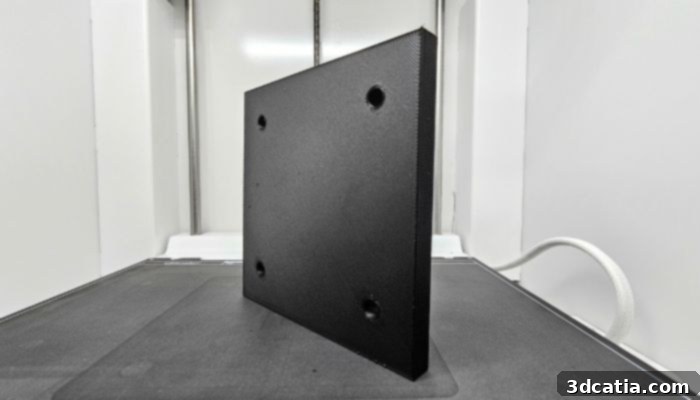
One of the 3D printed Kevlar shields made with continuous composite extrusion 3D printing
Addressing the Critical Challenge of Aerospace Damage and Debris
The structural integrity of aircraft and spacecraft is, without question, the cornerstone of safety and operational reliability. Yet, these sophisticated machines operate in environments fraught with hazards. In Earth’s orbit, the ever-growing problem of space debris – fragments of defunct satellites, rocket stages, and mission-related objects – along with naturally occurring micrometeoroids, poses a significant and constant threat. Collisions with even tiny particles can inflict substantial damage, ranging from minor cosmetic abrasions to catastrophic structural breaches, compromising crucial systems and endangering crew members. The sheer scale of this threat is staggering: the European Space Agency (ESA) reports over 40,500 tracked space debris objects larger than 10cm, with millions more untrackable smaller particles. Each represents a potential impact event. Given this persistent danger, the capacity for swift, efficient, and reliable repairs becomes not just an advantage, but a critical necessity for maintaining the vast network of satellites, manned missions like the International Space Station (ISS), and even commercial aviation. Current repair methods, however, are often laborious, requiring extensive downtime, costly specialized facilities, and prohibitively expensive materials, making prompt response to damage a considerable logistical and financial burden. The SBORAEK project is specifically engineered to overcome these challenges, promising a paradigm shift in how aerospace structures are maintained and repaired.
Innovative Design and Core Objectives of SBORAEK’s Repair Patches
The SBORAEK project is driven by three pivotal objectives designed to revolutionize aerospace maintenance, repair, and overhaul (MRO). Firstly, it focuses on developing a sophisticated methodology for optimizing the design of these protective shields to achieve superior ballistic performance. This means engineering patches that can withstand high-energy impacts, such as those from space debris or even military projectiles, with maximum effectiveness, dissipating impact forces and preventing further structural damage. Secondly, the project aims to enable the creation of highly customized repair patches through the application of continuous composite 3D printing. This advanced manufacturing technique allows for the precise integration of aramid fibers, most notably Kevlar, with other complementary materials. This combination not only enhances the intrinsic strength and impact resistance of the patches but also allows for tailored functionalities, such as embedded sensors for structural health monitoring. Finally, and crucially, SBORAEK seeks to dramatically reduce MRO time and associated costs by streamlining the entire repair process. By facilitating faster, more localized, and more adaptable repair solutions, the project endeavors to minimize the prolonged periods aircraft and spacecraft spend out of service. At the heart of achieving these ambitious goals lies 3D printing, a technology that offers unprecedented flexibility and precision in material deposition and structural customization for these advanced Kevlar shields.
The Power of Continuous Composite 3D Printing and Advanced Materials
So, how does this innovative repair system truly function? Drawing inspiration from the layered structure of Börek pastries, the underlying principle involves creating layered composite structures using continuous composite 3D printing. Unlike traditional additive manufacturing methods that often use chopped fibers, continuous composite 3D printing precisely extrudes continuous strands of high-performance fibers within a polymer matrix. This technique ensures superior material properties, as the fibers run uninterrupted through the part, mimicking the strength advantages of conventionally manufactured composites. The primary materials selected for these advanced shields are aramid fibers, exemplified by Kevlar, and carbon fiber. These materials are highly favored in the aerospace industry for compelling reasons: they possess an exceptional strength-to-weight ratio, offering performance comparable to or even exceeding many metals while being significantly lighter. This lightweight characteristic is critical for aerospace applications, where every gram impacts fuel efficiency and payload capacity. Furthermore, these fibers exhibit remarkable toughness, abrasion resistance, and thermal stability, making them ideal for the extreme conditions encountered in aeronautical and space environments. The ability to precisely control the orientation and density of these continuous fibers during the 3D printing process allows for the creation of anisotropic structures optimized to resist specific stress directions, further enhancing the ballistic performance and overall durability of the repair patches.
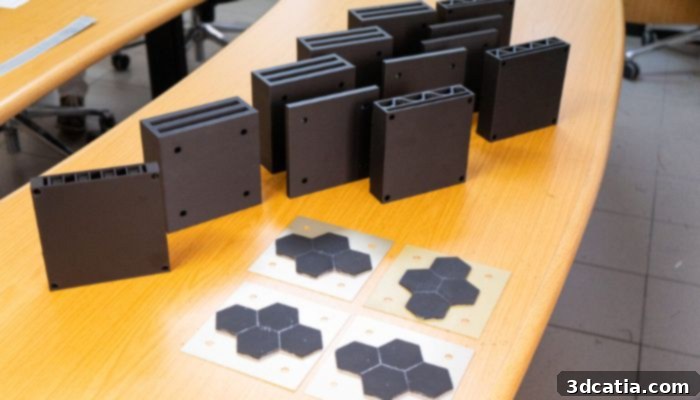
Examples of different 3D printed Kevlar shields made for the project
Unlocking Versatility and Efficiency: Benefits of Customized 3D Printed Shields
The resulting 3D printed Kevlar shields are far more than mere patches; they are sophisticated, custom-engineered components designed to act as targeted repair solutions. The fundamental rationale behind this innovative design approach is its capacity to deliver significant advantages across the entire lifecycle of aerospace assets. Firstly, these shields are engineered to minimize both downtime and repair costs. By enabling precise, on-site repairs, potentially even in challenging environments or orbital scenarios, the need to transport entire damaged sections or even whole aircraft to specialized facilities is drastically reduced. This localized repair capability translates directly into faster turnaround times and substantial cost savings in logistics and labor. Secondly, the nature of additive manufacturing allows for unparalleled customization. Each shield can be precisely tailored to fit the exact geometry and material requirements of a specific damage site, optimizing its protective and restorative properties. This level of personalization leads to superior repair outcomes compared to generic, off-the-shelf patches, while simultaneously allowing for reduced material usage and overall weight – a critical factor in aerospace where weight directly impacts performance and efficiency. Furthermore, the enhanced repairability fostered by these shields extends the operational lifespan of aerospace structures, contributing to greater sustainability. Beyond traditional aviation, these robust, lightweight, and customizable shields hold immense promise for a diverse array of applications, including advanced drone systems, future deep-space exploration vehicles, and even terrestrial high-performance vehicles where ballistic protection and structural integrity are paramount.
Rigorous Ballistic Testing for Aerospace Applications
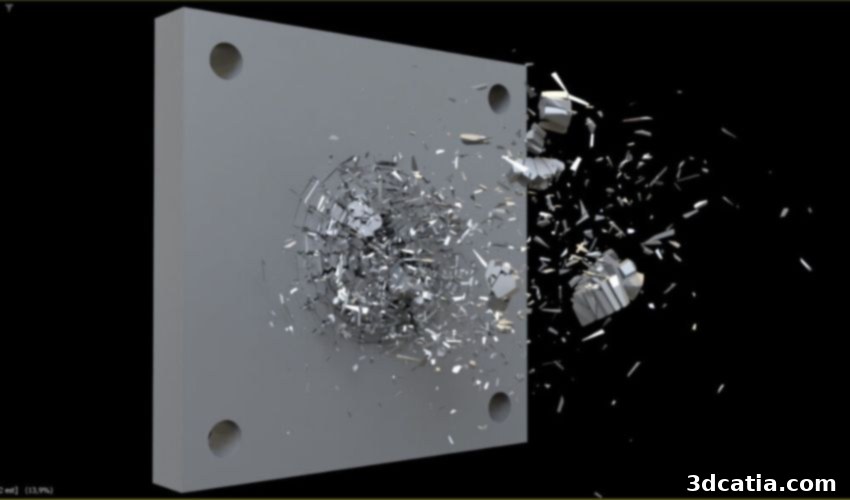
A critical phase in the SBORAEK project recently culminated in extensive testing of the 3D printed Kevlar shields. This rigorous evaluation was conducted in collaboration with Thiot Ingenierie (France), a renowned expert in high-energy impact phenomena, at their state-of-the-art Hypervelocity Impact facility. This facility is equipped with a specialized Light-Gas gun, a powerful tool capable of accelerating projectiles to speeds far exceeding those achievable by conventional firearms, accurately simulating the extreme conditions of space debris impacts or high-velocity ballistic threats. During these tests, the 3D printed Kevlar shields were subjected to high-energy impacts, meticulously designed to replicate potential collision scenarios – from micrometeoroid strikes on spacecraft outer shells to the impact of high-speed fragments or even bullets on aircraft structures. The objective was to precisely assess the ballistic performance of the novel composite shields, evaluating their ability to absorb and dissipate kinetic energy, resist penetration, and maintain structural integrity under severe stress. Such comprehensive testing is indispensable to validate the efficacy of the design, materials, and manufacturing process, providing crucial data that will inform future iterations and ultimately ensure the reliability and safety of these groundbreaking repair solutions for real-world aerospace applications.
A New Era for Aerospace Maintenance, Repair, and Overhaul (MRO)
As of now, the highly anticipated results from these pivotal ballistic performance tests have not yet been publicly announced. However, the potential ramifications of a successful outcome are undeniably transformative for the entire aerospace industry. Should the 3D printed Kevlar shields prove effective in meeting the stringent requirements for high-energy impact resistance, the ability to 3D print these custom-designed shields on demand would usher in an unprecedented level of flexibility and efficiency in aerospace maintenance, repair, and overhaul (MRO). This on-demand manufacturing capability would allow for much faster implementation of repairs, bypassing lengthy lead times associated with traditional spare parts procurement. Furthermore, the inherent personalization offered by 3D printing means that repair processes for a vast spectrum of aerospace assets – from the International Space Station (ISS) and large commercial airliners to compact CubeSats and unmanned aerial vehicles – could become significantly more efficient and tailored. This technology promises not only to extend the operational lifespan of valuable aerospace assets but also to enhance safety, reduce operational costs, and enable more ambitious missions by providing resilient, adaptable, and rapid repair solutions wherever they are needed. The SBORAEK project embodies a forward-thinking approach to aerospace challenges, demonstrating how additive manufacturing can push the boundaries of materials science and engineering to secure the future of our skies and beyond. You can delve deeper into the specifics of this innovative project by visiting their official page HERE.
What are your thoughts on these innovative 3D printed Kevlar shields developed by the SBORAEK project? Do you believe they represent a significant step forward in enhancing the repair and resilience of aerospace structures? We invite you to share your insights and opinions in a comment below or join the discussion on our LinkedIn, Facebook, and Twitter pages! Don’t miss out on the latest advancements and news in the world of additive manufacturing – be sure to sign up for our free weekly newsletter here to receive cutting-edge 3D printing updates directly in your inbox! Additionally, you can explore all our engaging video content, including interviews and technology showcases, on our dedicated YouTube channel.
*All Image Credits: SBORAEK