
Paganini’s Il Cannone Reborn: A 3D Printed Violin Bridging Music History and Modern Innovation
Niccolò Paganini, famously dubbed “The Devil’s Violinist,” carved an unparalleled niche in the annals of music history. His virtuosity, often performed on his legendary Il Cannone violin crafted by Guarneri “del gesù,” allowed him to deliver melodies of astonishing complexity and unmatched precision. Decades after his passing, Paganini’s enduring legacy is now being revitalized and illuminated through the remarkable application of modern technology, spanning Italy and reaching beyond its borders. At the heart of this innovative endeavor is a meticulously crafted 3D printed replica of Paganini’s iconic violin, poised to reawaken public fascination with his enigmatic persona, rich cultural heritage, and the captivating narrative of music history.
This ambitious project was conceived in celebration of the 70th anniversary of the prestigious Premio Paganini, a renowned international violin competition. The organizers of this esteemed event embarked on a journey to faithfully recreate the celebrated Guarneri violin through the transformative power of 3D printing. This significant undertaking involved a strategic collaboration with 3DiTALY, an esteemed Italian 3D printing company known for its expertise and cutting-edge capabilities. The partnership beautifully intertwines artistic preservation, technological advancement, and profound historical significance. Far beyond a mere restoration or a captivating tribute, the resulting 3D-printed Paganini violin stands as a powerful testament to the dynamic interplay between contemporary cultural education and the timeless essence of artistic mastery. It symbolizes a new frontier in making historical artifacts accessible and engaging for a modern audience, demonstrating how innovation can breathe new life into heritage.
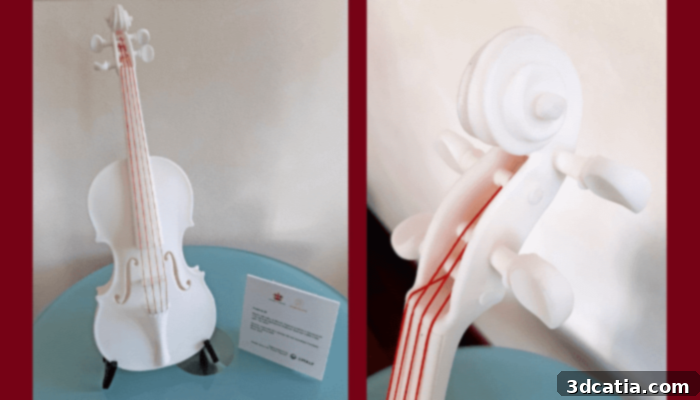
Art meets 3D printing in Genoa with the renowned Guarneri violin, reprinted from resin.
From Palazzo Tursi to Digital Model: The Meticulous Replication Process
The original Il Cannone, an instrument of immense historical and musical value, has been carefully preserved within the hallowed halls of Palazzo Tursi in Genoa since 1851, following Niccolò Paganini’s generous bequest to his cherished hometown. To embark on the creation of a precise 3D model, an exceptionally intricate and meticulous scanning process was undertaken. This delicate procedure was carried out directly within Palazzo Tursi, utilizing state-of-the-art scanning equipment to capture every nuance and curve of the priceless instrument. The Genoa City Council meticulously documented this process in a video, highlighting the care and precision involved in digitally preserving such an important artifact. Following the successful creation of the digital blueprint, the 3D printing process commenced.
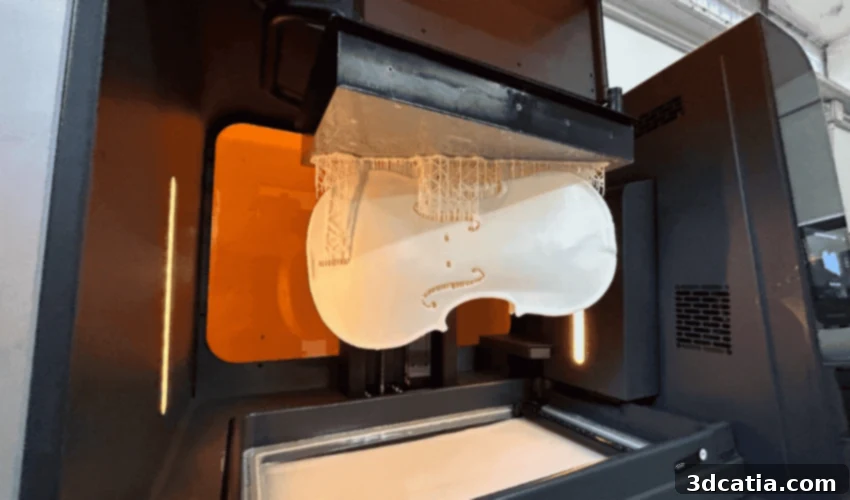
The resultant 3D printed Paganini violin is not merely a facsimile but an exact 1:1 replica of the original, a remarkable feat achieved through Stereolithography (SLA) technology by 3DiTALY. SLA, a sophisticated additive manufacturing process, is renowned for its ability to produce highly detailed and accurate parts with smooth surface finishes, making it an ideal choice for replicating the complex geometry and intricate details of a master-crafted instrument like Il Cannone. Due to the original violin’s profound intricacies and delicate features, the 3D printing process necessitated the use of numerous support structures. These supports were crucial for maintaining the fidelity of the model during printing but were subsequently meticulously removed during an extensive post-processing phase, ensuring a flawless finish that mirrors the original’s elegance. The final replica, crafted from elegant white resin and adorned with vibrant red nylon strings, possesses a carefully chosen color scheme that serves as a profound homage to Genoa’s rich heritage. It proudly references the Saint George flag, the enduring emblem of Genoa, as well as the contemporary new logo of the Premio Paganini competition and its organizing body, forging a visual link between past traditions and modern initiatives.
Exhibition and Future Accessibility of the 3D Printed Il Cannone
Currently, the exquisite 3D printed Paganini violin is proudly housed within Palazzo Doria Carcassi, serving as a focal point for the 57th edition of the Premio Paganini competition, which took place from October 16-27, 2023. This strategic placement allows the replica to inspire and educate the next generation of virtuosos and music enthusiasts attending the competition. Beyond Genoa, the replica also graced the 11th MakerFaire exhibition in Rome, an event that celebrates innovation and creativity, held from October 20-22, 2023. Its presence at such a prominent technology and innovation fair underscored the cutting-edge nature of the project and its potential to engage a broader audience. While these initial showcases have been highly successful in generating interest, it is important to note that, as of now, the 3D printed Guarneri violin replica is not yet accessible to the general public for direct interaction. However, its appearances at key events signal a broader ambition for its future role in cultural outreach and education.
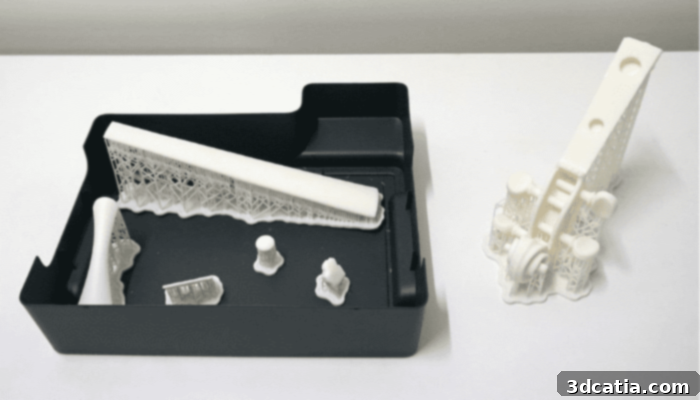
By employing the SLA method, it became feasible to incorporate notable intricacies of the authentic violin into the 3D printed rendition. However, numerous auxiliary structures were essential to achieve this outcome.
Old Story, New Story: How the 3D Printed Paganini Violin Revolutionizes Cultural Engagement
While the 3D printed Paganini violin undeniably serves a noteworthy purpose in promoting high-profile events like the MakerFaire in Rome and the Permio Paganini competition, its significance extends far beyond mere marketing. The increasing employment of 3D printed items for marketing endeavors has been a recurring trend across various sectors, notably in movies, corporate ventures, and broader industry trends over recent years. Yet, for this particular 3D printed violin, promotional intent is recognized as merely an incidental, albeit beneficial, outcome. Mayor Marco Bucci of Genoa articulates a grander, more profound mission embedded in this project: leveraging cutting-edge technology to seamlessly bridge the gap between classical music, cultural heritage, and previously untapped audiences, especially younger generations. He envisions the 3D replica of the iconic Guarneri violin as a revolutionary contemporary storytelling medium, capable of conveying an ancient narrative in a fresh and compelling manner. As Mayor Bucci eloquently states, “This is a great promotional initiative for the Premio Paganini, which will also be popular with young people. The 3D “Cannone” is an extra opportunity provided by new technologies, and it can be brought to schools and all over the city to recount Paganini in an unconventional way.” This vision emphasizes creating tangible connections with history, allowing individuals to physically interact with a representation of an invaluable artifact, fostering a deeper, more immersive understanding of Paganini’s genius and the era in which he lived.
The impact of the 3D printed Guarneri project is indisputable and far-reaching. It has successfully stirred intrigue, ignited widespread curiosity, and transcended Italy’s borders with its innovative approach to cultural preservation and education. The initiative’s core aspiration—to resurrect Paganini’s legendary legacy on a truly global scale—has unquestionably begun to bear fruit. This endeavor powerfully underscores the immense capacity of modern technologies, particularly 3D printing and additive manufacturing, to reframe and reinterpret history, making it not only accessible but also profoundly engaging for a broader, non-specialist audience. By offering a tactile, visual, and educational experience that cannot be replicated by traditional museum displays alone, this project paves the way for a new era in heritage interpretation. It serves as a compelling blueprint for how cultural institutions worldwide can harness technological advancements to connect diverse audiences with their shared past. More comprehensive information about Il Cannone from the 3D printer and the Premio Paganini competition can be found at HERE.
What are your thoughts on this groundbreaking 3D printed Paganini violin and the expanding role of 3D printing in cultural education and preservation? We invite you to share your perspectives in a comment below or engage with us on our LinkedIn, Facebook, and Twitter pages! Don’t miss out on the latest advancements in additive manufacturing—remember to sign up for our free weekly Newsletter here, delivering the freshest 3D printing news straight to your inbox! You can also explore all our insightful videos and compelling content on our YouTube channel for further exploration of this exciting field.
*All photo credits: Premio Paganini