
Digital Guardians: How 3D Scanning and Printing Preserve Cultural Heritage After Disasters Like the Rapa Nui Moai Fire
The recent devastating fire on Rapa Nui, more commonly known as Easter Island, has inflicted immense and irreversible damage upon a significant number of its iconic Moai statues. This tragic event, which ravaged over 100 hectares of the national park where these monumental figures stand, serves as a poignant reminder of the fragility of our global cultural heritage in the face of natural disasters and human-induced threats. In the wake of such a profound loss, the importance of proactive and innovative preservation methods becomes critically evident. Organizations like MyMiniFactory and Scan the World are at the forefront of this effort, spotlighting how advanced 3D scanning and 3D printing technologies offer a vital lifeline for safeguarding the memory and essence of invaluable artifacts around the globe, even when the physical originals are compromised or lost forever.
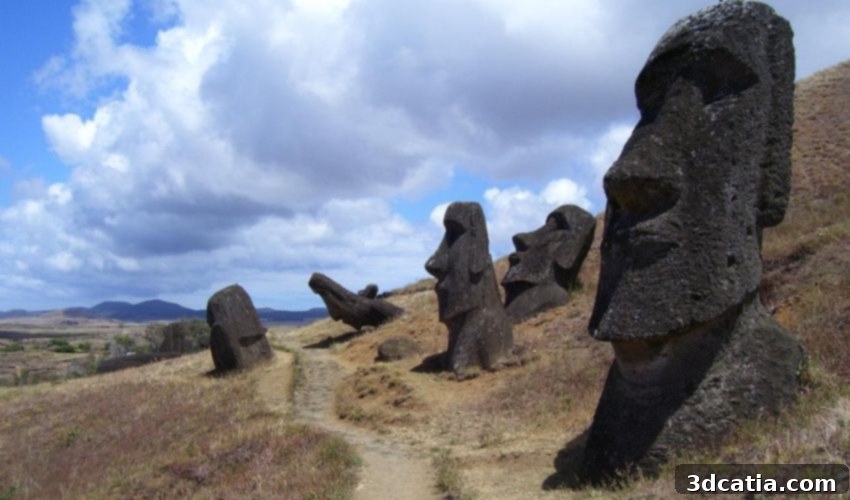
The Moai statues are not merely stone figures; they are monolithic human figures carved by the indigenous Rapa Nui people, dating back as early as the 13th century. These incredible works of art embody the spiritual and cultural identity of a civilization, representing ancestors and conveying profound historical narratives. While widely recognized for their distinctive, oversized heads, which earned them the popular moniker “Easter Island Heads,” the statues are, in fact, complete bodies, many of which were buried up to their shoulders, adding to their mystique and sacred significance. The recent inferno on the island has caused what local authorities and archaeologists describe as irreparable damage to the archaeological site, leaving scars that cannot be erased and raising urgent questions about the future of cultural preservation.
The Moai statues have been scanned previously in attempts to help preserve them (photo credits: 3D Systems)
The destruction on Rapa Nui is, unfortunately, not an isolated incident. Over the past several years, numerous monuments, artifacts, and historical sites have fallen victim to both human malice and catastrophic natural disasters. We recall with sorrow the Notre-Dame Cathedral blaze in Paris in 2019, which consumed a significant portion of the iconic church, or the deliberate destruction of ancient sites in Mosul by extremist groups in 2014. While the physical presence of these integral parts of our shared cultural heritage cannot be magically restored, the advent and increasing sophistication of 3D technologies offer a powerful means to at least preserve their memory, allowing future generations to study, appreciate, and learn from them. It was precisely to address such pressing issues of cultural heritage loss and to provide a robust solution that MyMiniFactory established Scan the World, a pioneering initiative dedicated to digital preservation.
Preserving Heritage With Scan the World: A Digital Revolution
Scan the World is a name that resonates deeply within the additive manufacturing and cultural heritage communities. This ambitious project, initiated in 2014, was born from a vision to democratize access to art and history by making 3D printable cultural artifacts available to everyone, irrespective of their geographical location or economic status. Starting with a handful of dedicated contributors, it has blossomed into an unparalleled digital repository, boasting a collection of over 20,000 digitized artifacts. These invaluable 3D models are painstakingly created by a vast network of contributors spread across the globe, leveraging various 3D scanning techniques, from photogrammetry to structured light scanning. As Jon Beck, manager of Scan the World, eloquently explains, “Through a global community dedicated to digitizing and sharing artifacts and cultural heritage, we can rapidly collect meaningful stories without the restrictions of large institutions.” This decentralized, community-driven approach bypasses many traditional barriers, enabling faster, more inclusive, and comprehensive preservation efforts.
The transformative benefits of 3D scanning for the preservation of cultural sites and artifacts have been demonstrated repeatedly. The Moai of Easter Island, for example, had the foresight to be scanned years prior to the recent fire, capturing their majestic forms and intricate details in digital format. This proactive measure now serves as an invaluable digital blueprint, a testament to their original magnificence, even as the physical structures bear new wounds. Beyond the Moai, countless other priceless artifacts have been eternally cataloged thanks to Scan the World’s dedicated efforts. These include monumental structures like the Arch of Septimius Severus in Palmyra, Syria, a site that tragically faced extensive destruction, and exquisite sculptures such as José Noja Ortega’s Largo Caballero. Both of these, among many others, were meticulously scanned and integrated into Scan the World’s robust platform before their physical counterparts were lost or severely damaged. For Scan the World, these detailed 3D scans transcend mere documentation; they serve to immortalize the history and artistic integrity of these objects, ensuring their narratives endure long after their physical presence might diminish.
A 3D scan as well as a 3D printed figurine of a Moai statue (photo credits: Scan the World)
In the wake of the devastating Rapa Nui fire, MyMiniFactory and Scan the World issued an impassioned call to their extensive community of users, urging them to contribute to the broader mission of preserving global heritage through both 3D scanning and 3D printing. This initiative underscores a fundamental principle of the platforms: open access. All digital files on Scan the World are freely available, empowering anyone with a 3D printer to create physical replicas of their chosen designs. While no digital model or 3D printed replica can ever truly replace the unique historical and spiritual significance of the original Moai statues destroyed in the fire, this accessibility serves as a powerful reminder of how 3D technologies can provide an enduring link to our past. They offer a tangible, albeit reproduced, presence that ensures the memory and artistic form of these objects persist despite immense tragedies. For those inspired to connect with the legacy of Rapa Nui, the digital files for printing your own Moai statue are readily available HERE.
The scope of 3D technology in cultural preservation extends far beyond creating simple replicas. It enables the creation of detailed digital twins, virtual representations that can be used for in-depth archaeological study, restoration planning, and immersive educational experiences. Imagine students worldwide interacting with a virtual Moai, rotating it, zooming into its intricate carvings, or exploring its historical context through augmented reality. This democratization of access to cultural assets fosters a deeper understanding and appreciation of diverse global histories. Moreover, digital archives provide redundancy and security; even if physical locations are destroyed, the digital data can be stored securely across multiple servers globally, safeguarding against total loss. This paradigm shift from solely physical preservation to a hybrid model incorporating robust digital strategies is crucial for the future of our collective heritage.
The Rapa Nui tragedy, while heartbreaking, highlights an urgent truth: the need for comprehensive and anticipatory cultural heritage preservation strategies. Relying solely on the physical longevity of artifacts is no longer sufficient in an era marked by climate change-induced disasters, geopolitical instability, and urban development pressures. The collaborative model championed by MyMiniFactory and Scan the World demonstrates that technology, combined with community engagement, offers a resilient framework for the future. By empowering individuals to participate actively in the digitization process, we build a global network of digital guardians, ensuring that the stories carved in stone, painted on canvas, or molded in clay are not lost to the sands of time or the ravages of unforeseen events. This ongoing effort serves as a beacon of hope, illustrating that even in the face of irreparable physical damage, the spirit and legacy of our shared human history can continue to thrive in the digital realm, accessible to all.
What are your thoughts on this incredible effort to help preserve cultural heritage through the innovative applications of 3D scanning and printing? We invite you to share your insights and comments below, or connect with us on our LinkedIn, Facebook, and Twitter pages! Don’t miss out on the latest advancements in additive manufacturing—be sure to sign up for our free weekly Newsletter here, delivering the most current 3D printing news directly to your inbox! You can also explore all our engaging videos on our YouTube channel.
*Cover Photo Credits: Horacio_Fernandez, CC BY 3.0 , via Wikimedia Commons