

Revolutionizing Neutron Science: ORNL’s 3D Printed Collimators Unlock Atomic Secrets with Unprecedented Precision
In the intricate and ever-evolving field of neutron science, the ability to unravel the fundamental secrets of materials at the atomic and molecular levels relies heavily on the precision and sophistication of experimental tools. For researchers pushing the boundaries of material discovery, the quality and accuracy of instrumentation are paramount. A groundbreaking advancement in this domain has been achieved by experts at Oak Ridge National Laboratory (ORNL), who have pioneered a novel and highly effective approach to designing and manufacturing neutron collimators. This significant breakthrough leverages the power of additive manufacturing, specifically 3D printing, to overcome long-standing limitations in the production of these critical components. Neutron collimators are essential for guiding and shaping neutron beams, a crucial step in neutron scattering experiments that allows scientists to meticulously study the structure and dynamics of materials. The innovative method developed at ORNL utilizes advanced 3D printing techniques to create multi-part collimators with exceptional precision, dramatically improving upon the capabilities and performance of traditional single-piece designs.
For decades, the engineering challenge of crafting large, highly accurate one-piece neutron collimators has presented significant hurdles. The inherent complexities of traditional manufacturing methods often led to compromises in design, material integrity, and overall performance, particularly when scaling up for larger experiments. However, a visionary team of experts, spearheaded by Fahima Islam, a distinguished neutron scientist at ORNL’s renowned Spallation Neutron Source (SNS), has discovered a revolutionary solution. They have ingeniously adopted what they refer to as a “Frankenstein design” strategy. This innovative methodology deviates from the conventional attempt to produce a single, large, monolithic structure. Instead, the team opted for an additive manufacturing approach, 3D printing multiple smaller, highly precise components that can then be effortlessly assembled into a robust and cohesive collimator. This modular strategy not only simplifies the manufacturing process but also unlocks new levels of customization and performance previously unattainable, paving the way for more accurate and reliable neutron scattering data.
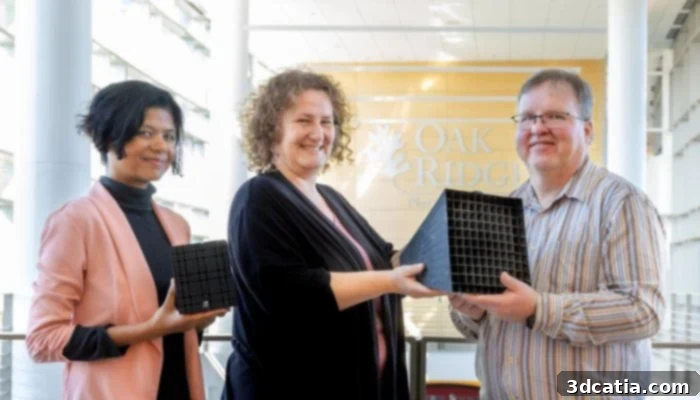
The team behind the “Frankenstein Design” collimator, significantly advancing neutron science through additive manufacturing: Fahima Islam, Bianca Haberl, and Garrett Granroth.
Neutron collimators, functioning much like highly specialized optical funnels, play an absolutely critical role in guiding and filtering neutron beams precisely towards detectors. Their primary purpose is to minimize unwanted interference and background noise that can severely distort experimental data. In neutron scattering experiments, it’s vital to isolate the signals generated by neutrons interacting specifically with the sample material. Neutrons that either fail to interact with the sample or scatter off surrounding surfaces and experimental apparatus can introduce undesirable signatures into the collected data, leading to inaccuracies and misinterpretations. This necessitates extremely precise collimation to ensure that only the desired signals are captured. The introduction of a fully customizable, 3D printed collimator represents a monumental leap forward, offering the improved accuracy and signal-to-noise ratio urgently needed for cutting-edge research. Emphasizing the detrimental effect of unfiltered neutrons, Fahima Islam articulated, “These unwanted neutrons produce undesirable signatures in the data, which is why we were working to produce a 3D printed collimator that could be custom designed to filter out these unwelcome background features during different types of neutron scattering experiments.” This capability for custom design, inherent to additive manufacturing, is what truly sets this innovation apart, allowing for tailored solutions for a vast array of experimental conditions and material samples.
To achieve the extraordinary levels of precision and intricate detail required for these advanced neutron collimators, the expert team at ORNL’s Manufacturing Demonstration Facility (MDF) strategically employed binder jetting 3D printers. This specific additive manufacturing process proved to be an ideal choice due to its unique combination of flexibility and capability. Binder jetting excels at creating highly complex geometries and intricate internal structures that are often impossible or prohibitively expensive to produce with traditional subtractive manufacturing methods. The ability to deposit a liquid binder onto a powder bed layer by layer, followed by a sintering or infiltration step, allows for the creation of components with fine features and excellent dimensional control. This precision is absolutely critical for efficient neutron collimation, where even minute imperfections can compromise data quality. The flexibility of binder jetting also enables rapid prototyping and iterative design improvements, allowing the ORNL team to quickly refine their collimator designs based on experimental feedback, a crucial advantage in accelerating scientific discovery and instrument development.
One of the most significant and persistent challenges frequently encountered when attempting to produce a single-piece collimator, especially for demanding scientific applications, is the difficulty of scaling up the part’s size while rigorously maintaining dimensional accuracy and structural integrity. In many advanced neutron scattering experiments, particularly those conducted under high-pressure environments, the need for larger collimators becomes critically apparent. These larger components are essential to effectively capture the widely scattered neutrons, thereby maximizing the signal and ensuring comprehensive data acquisition. However, traditional manufacturing methods have consistently proven inadequate for this scaling challenge. Larger, conventionally manufactured collimators are prone to a host of problems; they can produce less accurate data due to accumulated manufacturing tolerances, and are notably susceptible to cracking and breaking during experiments, leading to costly downtime and unreliable results. This inherent limitation with traditional methods was a major impetus for the ORNL team to intensively explore 3D printing as a viable and superior alternative, recognizing its potential to overcome these long-standing obstacles and revolutionize neutron instrument design.
The difficulties associated with scaling up traditional collimator designs were further elaborated upon by Garrett Granroth, a neutron scattering scientist also working at the Spallation Neutron Source (SNS). He highlighted the fundamental issues with monolithic designs, stating, “Simply scaling up the print as one large part with continuous blades was clearly not feasible without further optimizing the printing process.” Granroth emphasized that the primary reason for the observed cracking and structural failures in single-part designs was rooted in material science: the inconsistent contraction rates of the material during the curing and cooling phases of the manufacturing process. When a large, complex part cools, different sections can cool and contract at varying rates, inducing significant internal stresses that lead to cracks and warpage. By ingeniously opting for a modular design comprising smaller, individual parts, the ORNL team effectively mitigated this critical issue. As Granroth explained, “By reducing their overall size, the individual parts cooled more uniformly,” thereby minimizing internal stresses, preventing cracking, and significantly enhancing the structural integrity and dimensional stability of the final assembled collimator. This modular approach not only resolved a major manufacturing bottleneck but also ensured the creation of more robust and reliable instrumentation for cutting-edge neutron experiments.
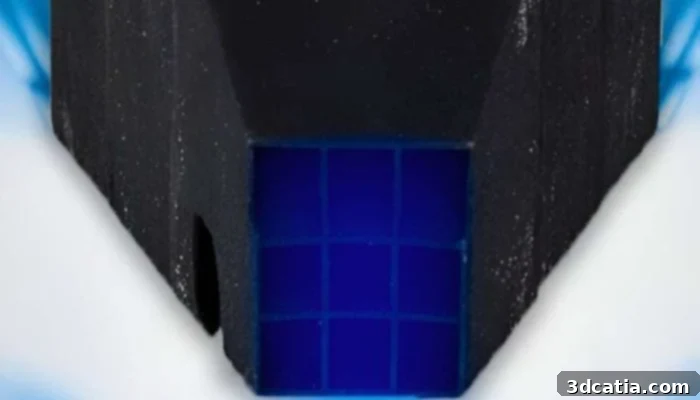
Upon closer inspection, the advanced 3D printed collimator exhibits subtle, visible “scars” where the individual modular components are precisely joined, a testament to its innovative multi-part additive manufacturing approach.
The efficacy and transformative potential of this novel 3D printed collimator design underwent rigorous evaluation at ORNL’s state-of-the-art Spallation Neutron and Pressure beamline. This specialized facility is globally recognized for its capabilities in conducting complex high-pressure neutron experiments, providing an ideal environment to test the new instrument under demanding scientific conditions. The results, as reported by the research team, were nothing short of impressive and unequivocally validated their innovative approach. The experiments revealed a significant and measurable improvement in the quality of the collected data. This enhancement translates directly into cleaner, more precise signals, a substantial reduction in background noise, and ultimately, a higher signal-to-noise ratio. For neutron scientists, such improvements are invaluable, enabling them to discern subtle features in material structures and dynamics that were previously obscured or undetectable. This means more reliable experimental outcomes, deeper insights into material properties, and the acceleration of new scientific discoveries in fields ranging from quantum materials to biological systems.
Looking ahead, Fahima Islam’s pioneering team at Oak Ridge National Laboratory is not resting on its laurels. They are already actively planning additional ways to further refine and enhance their groundbreaking design. Their future endeavors include implementing even stricter quality control measures throughout the additive manufacturing process, which will ensure unparalleled consistency and performance for each component. Furthermore, they aim to develop and integrate even more precise alignment techniques for assembling the modular collimator parts, pushing the boundaries of accuracy and minimizing any potential sources of error. By seamlessly combining cutting-edge advanced modeling and simulation techniques with the unparalleled capabilities of advanced 3D printing, the team firmly believes that this revolutionary project will not only profoundly impact how instruments for neutron experiments are designed, developed, and utilized, but also significantly push the very boundaries of what is scientifically and technically possible in the expansive and critical field of neutron science. This holistic approach promises to unlock new vistas for material characterization, ultimately accelerating fundamental research and technological innovation across various scientific disciplines.
What are your thoughts on this innovative 3D printed neutron collimator and its potential impact on material science? We invite you to share your perspectives in a comment below or engage with us on our LinkedIn, Facebook, and Twitter pages! Don’t forget to sign up for our free weekly newsletter here, for the very latest 3D printing news delivered straight to your inbox! You can also find all our comprehensive videos and interviews on our dedicated YouTube channel for an in-depth look at additive manufacturing innovations. To learn more about this specific project, click here.
*All Photo Credits: Oak Ridge National Laboratory