
Revolutionizing Manufacturing: A Deep Dive into AITIIP’s KRAKEN and BARBARA Projects for Advanced 3D Printing
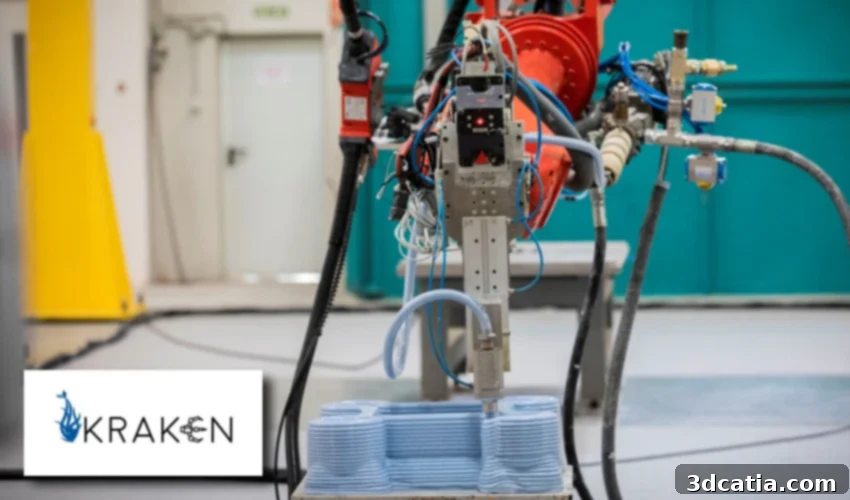
A few months ago, the manufacturing world turned its attention to the groundbreaking development of the KRAKEN project. This innovative system represents a significant leap forward, seamlessly integrating multiple cutting-edge technologies: advanced 3D printing, sophisticated robotics, and precise subtractive manufacturing techniques. At its core, KRAKEN leverages a powerful robotic arm that enables the fabrication of exceptionally large surfaces, spanning an impressive 20 square meters. This immense build volume, combined with its ability to process a diverse array of materials, positions KRAKEN as a transformative force in industrial production. The team behind this ambitious project claims remarkable efficiency gains: KRAKEN is reportedly 40% faster, 25% more productive, and 30% cheaper than traditional methods, setting new benchmarks for large-format additive manufacturing. To gain deeper insights into this revolutionary system and its implications for the future of manufacturing, we had the distinct pleasure of speaking with José Antonio Dieste, a prominent researcher and the visionary coordinator of the KRAKEN project at the AITIIP technology centre.
3DN: Could you introduce yourself and tell us about your relationship with 3D printing and advanced manufacturing?
I am José Antonio Dieste, and I lead the robotics and mechatronics department at AITIIP. Our journey with 3D printing technologies at AITIIP began remarkably early, back in the year 2000, when we acquired our very first machine – an advanced SLS (Selective Laser Sintering) system – which, testament to its robustness and our expertise, is still fully operational today. At that nascent stage, the terms “additive manufacturing” or even “3D printing” were not yet commonly used; we referred to it as “rapid prototyping.” This machine and its underlying technology were truly ahead of their time, offering capabilities that most industries had yet to grasp. We embarked on a mission to exploit its potential as a technology service provider for various companies. While its visual output was consistently impressive and captivated all our clients, many initially struggled to identify direct, immediate applications within their core business operations. It was primarily the larger corporations, particularly those entrenched in the highly competitive automotive sector, who began to commission our services to create intricate aesthetic prototypes for their new product developments and design validations. This early adoption by industry leaders underscored the latent potential of additive technologies, even before the mainstream recognition of 3D printing.
José Antonio Dieste, Head of Robotics and Mechatronics at AITIIP, a pioneer in additive manufacturing.
Internally, however, our engineering team recognized and made extensive use of the machine as an invaluable resource. It became indispensable for validating novel developments, testing new designs, and, crucially, significantly reducing the number of costly and time-consuming iterations typically required during product development cycles. This internal adoption dramatically boosted our competitiveness by accelerating project completion times and optimizing resource allocation. Fast forward to today, AITIIP boasts an extensive and diverse portfolio of materials and 3D printing technologies. Beyond our impressive hardware, we actively pursue multiple lines of cutting-edge research. These initiatives span material science, focusing on advanced polymers and composites, as well as the development of innovative manufacturing processes. A cornerstone of our current research, deeply anchored in the principles of 3D printing, is the circular economy – a commitment to sustainability that permeates all our projects. This holistic approach, from material development to process optimization and end-of-life considerations, solidifies our position at the forefront of sustainable advanced manufacturing.
3DN: How did the KRAKEN Project, a leader in large-format hybrid manufacturing, come about?
At AITIIP, our fundamental philosophy revolves around proactively identifying and solving complex problems faced by our clients and collaborators across various industries. A persistent challenge that emerged from around 2012 onwards was the increasing demand for manufacturing exceptionally large-sized components efficiently. This critical need sparked the central question that ultimately gave birth to KRAKEN: Is it possible to 3D print genuinely large pieces without compromising on speed, material properties, or cost-effectiveness? The KRAKEN project is our comprehensive response to the growing industrial requirement for producing substantial dimension products using advanced additive manufacturing technologies in an incredibly efficient manner. To achieve this, KRAKEN necessitated significant breakthroughs and the development of entirely new 3D printing technologies. These innovations specifically focus on enabling the rapid production of very large volumes, which led us to heavily invest in developing novel techniques characterized by high material contribution rates, applicable to both advanced polymers and robust metals. Furthermore, KRAKEN’s true ingenuity lies in its seamless integration with subtractive technologies. By incorporating processes such as precision milling, accurate drilling, and fine polishing, the system capitalizes on the strengths of both manufacturing philosophies – additive for rapid, complex material deposition, and subtractive for achieving high-tolerance finishes and geometric accuracy. This unique hybrid approach allows KRAKEN to establish an exceptionally efficient and robust methodology, perfectly tailored for widespread industrial application, bridging the gap between prototyping and large-scale, functional part production.
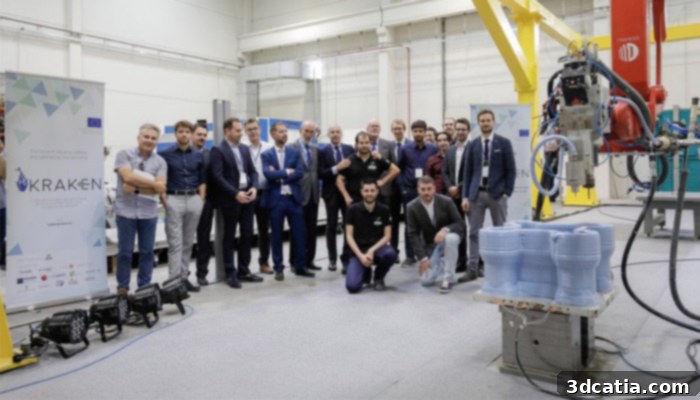
The dedicated team behind the KRAKEN project, pushing the boundaries of large-format additive and subtractive manufacturing.
3DN: What are the key benefits and transformative potential of the KRAKEN hybrid manufacturing system?
The KRAKEN project represents a remarkably extensive and multi-faceted development, pushing the boundaries not only in advanced additive manufacturing but also in sophisticated robotics. Its comprehensive architecture encompasses cutting-edge control systems, precise metrology capabilities, real-time error correction algorithms, advanced offline software for planning, and high-level software for seamless operation and integration. Each of these interconnected developments is designed with customization in mind, allowing us to conceptualize and deliver bespoke, turnkey systems for diverse companies. These solutions can be meticulously adapted to address their unique and specific manufacturing needs, offering unparalleled flexibility. Currently, we are continuously enhancing KRAKEN’s capabilities by developing new features, with a strong focus on the production of large-scale components. Our primary applications are centered around the manufacture of high-performance molds and industrial tools, leveraging KRAKEN’s extraordinary ability to print with multiple materials within a single build. Beyond tooling, we are also actively pursuing the direct manufacturing of final parts for demanding sectors such as aeronautics, where lightweighting and complex geometries are paramount; construction, which benefits from large-scale, customized structural elements; and the automotive industry, for both high-performance prototyping and end-use components. In essence, while the KRAKEN pilot line is engineered for grand dimensions and a multitude of advanced functions, its modular design ensures that its core technologies can be scaled down and adapted to simpler systems, making sophisticated large-format additive and subtractive manufacturing accessible even to small and medium-sized enterprises (SMEs). This adaptability democratizes access to advanced manufacturing capabilities, fostering innovation across the industrial spectrum.
3DN: In addition to KRAKEN, you are also working on the development of sustainable materials through your BARBARA project. Could you elaborate on this project and its connection to additive manufacturing?
The BARBARA project is inextricably linked to the broader landscape of additive manufacturing, specifically focusing on covering the entire value chain from raw material sourcing to final product application. Its core mission is the development of innovative new materials for Fused Deposition Modeling (FDM) 3D printing. What makes BARBARA particularly groundbreaking is its commitment to sustainability: these materials are developed by ingeniously repurposing waste streams from the food industry. This not only reduces waste but also creates valuable resources from what would otherwise be discarded. Beyond mere recycling, BARBARA significantly enhances these bioplastics by integrating specific biomaterials, thereby adding new functionalities. This integration leads to substantial improvements in critical properties such as mechanical strength, thermal resistance, and even allows for novel aesthetic finishes and a wider range of colors, offering a compelling and environmentally conscious alternative to traditional thermoplastics. This focus on bio-based and enhanced materials is crucial for the future of sustainable additive manufacturing.
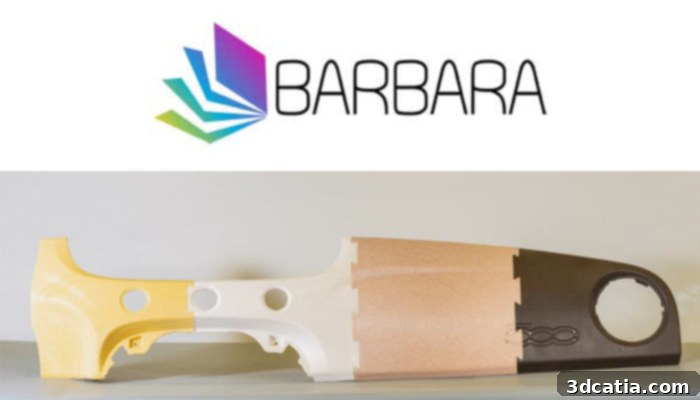
BARBARA’s objective is to develop new biomaterials with innovative functionalities, derived from food waste for sustainable 3D printing | Credits Aitiip
A substantial effort has been invested to ensure that these newly developed materials are not only appropriate for advanced 3D printing processes but also compatible with conventional manufacturing techniques, such as injection molding, widening their applicability. Crucially, BARBARA incorporates innovations directly into the Additive Manufacturing processes themselves. This includes advanced techniques designed to significantly improve the consolidation of layers, a perennial challenge in FDM. The goal is to produce functional parts that exhibit optimal mechanical performance in all directions, overcoming the inherent anisotropies often caused by insufficient layer adhesion. This ensures the reliability and durability of components made from these sustainable materials. Furthermore, much like KRAKEN and all projects coordinated by AITIIP, BARBARA is fundamentally industry-oriented, driven by the imperative to solve real-world industrial cases and meet tangible market needs. Consequently, in this advanced final phase of the project, all the developments in processes and the resulting real products are undergoing rigorous validation, specifically targeting critical applications within the automotive and construction sectors. This ensures that BARBARA’s innovations are not just theoretical but demonstrably effective in practical, high-demand industrial environments, paving the way for a more sustainable and efficient manufacturing future.
3DN: What future projects and directions can we expect from AITIIP in relation to additive manufacturing?
Additive manufacturing stands as one of the fundamental pillars and strategic standards of AITIIP. Our commitment to its advancement is unwavering, and we will continue to strategically invest in and champion the development of additive manufacturing across its entire spectrum – from pioneering new materials to optimizing complex processes, designing innovative machines, and creating novel products. Projects like KRAKEN and BARBARA, alongside many other initiatives spearheaded by AITIIP, have already facilitated tremendous progress, opening doors to groundbreaking applications and the creation of entirely new product categories. More profoundly, these successes have served as catalysts, generating a wealth of new ideas and future directions. These insights will empower us to further evolve and enhance these projects, ensuring that additive manufacturing becomes even more competitive, sustainable, and integral to industrial practices over the long term. Our vision extends beyond incremental improvements; we aim for transformative impact. The entire dedicated team at AITIIP remains steadfast in its mission to continue working tirelessly, solidifying our position as a pioneer and a leading reference in the field of additive manufacturing, not only within the Aragon region and Spain but across the broader European landscape. We are committed to fostering innovation, driving industrial adoption, and shaping the future of manufacturing through advanced additive technologies.
3DN: Do you have any last words or recommendations for our readers interested in advanced manufacturing and sustainability?
I wholeheartedly recommend that your readers engage with us by following our activities on social networks and regularly visiting our official website. These platforms serve as dynamic windows into our ongoing work, allowing them to witness firsthand how our projects and innovative ideas are continuously evolving and progressing. We place immense value on establishing and maintaining open lines of communication with users, industry professionals, and the wider community. This direct interaction is invaluable as it allows us to deeply understand their specific needs, identify pressing challenges they face, and, most importantly, actively listen to their diverse ideas and insights. Ultimately, AITIIP never operates in isolation; our strength comes from collaboration. It is through the invaluable input and partnership with our esteemed customers and partners that we are able to effectively focus our efforts on developing truly impactful and relevant new solutions. For those eager to delve deeper into our cutting-edge research and comprehensive portfolio of projects, more detailed information can be found HERE. We look forward to connecting with you and exploring the future of manufacturing together.
What are your thoughts on these innovative hybrid manufacturing systems and sustainable material developments? We invite you to share your insights and opinions in a comment below, or join the conversation on our Facebook and Twitter pages! Don’t miss out on the latest advancements in 3D printing – sign up for our free weekly Newsletter to receive all the crucial updates directly in your inbox!