
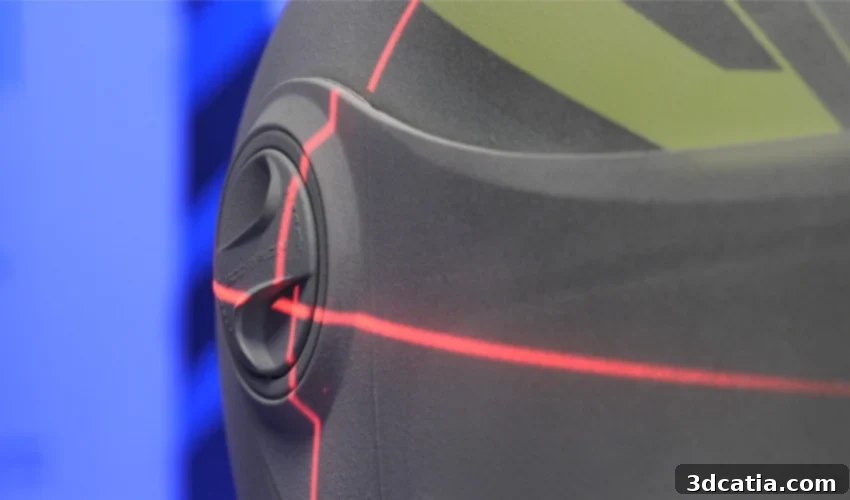
Revolutionizing 3D Scanning: Achieve Flawless Precision with AESUB Volatile Sprays
For professionals and enthusiasts alike who demand unparalleled **precision** and meticulous attention to **detail** in 3D scanning, the strategic application of a specialized scanning spray is not merely an option but an absolute necessity. Before initiating the scanning process, thoroughly coating an object with a dedicated scanning spray ensures the creation of a clean, uniformly matte surface. This crucial pretreatment significantly enhances overall scan quality and, for many challenging objects, makes the scanning process viable in the first place. Consider transparent or highly reflective components: without a spray, the scanner’s light beam would simply bounce off or pass through the surface, preventing accurate data capture. The matte layer provided by the spray effectively diffuses the light, allowing the scanner to precisely register the object’s geometry.
Beyond these challenging materials, utilizing a scanning spray offers substantial added value for a wide range of objects, profoundly impacting the quality and reliability of the resulting 3D model. The most significant improvements are often observed in precision and accuracy. A well-applied spray aids the scanner in discerning subtle differences in color, reflection, or texture, thereby minimizing heterogeneities and artifacts in the collected data. This leads to a more consistent and faithful digital representation of the physical object, critical for applications ranging from reverse engineering and quality inspection to product design and cultural heritage preservation. The evolution of 3D scanning technology continues to push boundaries, and innovative solutions like specialized sprays are at the forefront, bridging the gap between theoretical capability and practical application.
Amidst the expanding market for advanced 3D scanning solutions, the German manufacturer, **AESUB**, stands out with its exceptional range of scanning sprays. Based in Dortmund, AESUB has dedicated its expertise to the research, development, and production of sprays specifically engineered for optical 3D scanning applications. Their portfolio includes both traditional, pigment-containing sprays and, more notably, their groundbreaking volatile solutions, which have garnered multiple industry awards and widespread acclaim. AESUB has rapidly established a robust and expanding global sales network, boasting over 50 partners who distribute their innovative products worldwide. To gain deeper insights into the company’s philosophy, product development, and future aspirations, we recently had the opportunity to speak with AESUB’s visionary founder, Friedrich Schlott.
3DN: Can you introduce yourself and elaborate on your connection to additive manufacturing and optical metrology?

Friedrich Schlott, founder of AESUB (Photo Credits: AESUB)
Certainly. My professional journey began in development at BMW, a foundational experience that shaped my understanding of engineering and precision. Subsequently, I have accumulated over 20 years of dedicated experience within the field of optical measurement technology. Prior to establishing AESUB approximately three years ago, I had successfully managed a measurement services company for several years, which provided me with invaluable practical insights into the challenges and requirements of industrial metrology. What I’ve observed most keenly in recent years is the increasing convergence of additive manufacturing (AM) and optical metrology. These two technologies, once seen as somewhat distinct, are now intrinsically linked and mutually reinforcing.
Many modern engineering and design processes commence with highly accurate optical digitization, where an object is scanned to create a precise digital model. This digital model then serves as the direct input for various additive manufacturing techniques, enabling the production of complex geometries with unprecedented speed and accuracy. Conversely, once a component has been 3D printed, it is frequently subjected to another round of 3D scanning. This post-production scanning is crucial for validating the printed geometry against the original design specifications, ensuring quality control and adherence to tight tolerances. At AESUB, we regularly engage in printing scanned data from diverse components, and we are consistently impressed by the remarkable fidelity of the printed 3D components and the overall efficiency and precision of the entire workflow. This close integration underscores the critical role that accurate initial scanning plays in the success of additive manufacturing projects.
3DN: How did the innovative idea for founding AESUB first come about?
The genesis of AESUB was rooted in a deep-seated frustration with the limitations of existing 3D scanning solutions, particularly the challenges posed by traditional scanning sprays. These conventional sprays typically contain opaque color pigments, which, when applied, create a uniform white layer on the object’s surface. While this layer effectively enables the capture of the component’s geometry by optical scanners, it introduces a significant and often costly problem: the necessity for extensive and complex subsequent cleaning of the component. This post-scanning cleanup process is not only time-consuming but can also be detrimental, especially when dealing with delicate or intricate prototypes that might be damaged by aggressive cleaning methods.
Furthermore, the pervasive nature of these pigments meant that the entire measurement environment, including the personnel and the sensitive scanning equipment, would become contaminated with fine white dust. In the early days, I frequently received calls from customers who, while appreciative of the high quality of our scans, would invariably ask, “Who is going to clean the entire scanning hall from this persistent white dust from the matting agent?” The financial and operational implications were often substantial. I vividly recall a particularly frustrating incident where a very expensive 3D scanner malfunctioned and broke down. Its internal cooling fan became clogged with pigment particles, leading to overheating and irreparable damage. Such occurrences were not isolated incidents but rather recurring issues that highlighted a critical unmet need in the industry. It was this constant cycle of problems – the time expenditure, the cleaning costs, the risk of equipment damage, and the overall mess – that made me realize there had to be a better way. This conviction ultimately propelled me to found AESUB, driven by the vision of developing a truly residue-free and efficient scanning spray solution.
3DN: What is the significance of scanning sprays for the resulting 3D scan, and how do they impact the overall digitization process?
The fundamental and most compelling advantage of utilizing scanning sprays lies in their ability to enable the digitization of components that would otherwise be impossible to scan with optical scanners. This category includes a broad spectrum of challenging materials and surface finishes, such as transparent plastics, glass, or liquids, as well as highly reflective, mirror-like, or high-gloss surfaces like polished metals or chrome. Moreover, deeply structured components, like those made from carbon fiber with intricate weave patterns or parts featuring deep grooves, holes, or complex undercuts, also present significant difficulties for traditional optical scanning methods. The spray effectively transforms these problematic surfaces by providing a temporary, uniform matte coating, allowing the scanner to capture accurate data points without interference from reflections or light refraction.
However, the significance of scanning sprays extends far beyond merely making an object scannable. It’s not just about *whether* a component can be scanned, but critically, *how* it can be scanned. Attempting to achieve a high-quality scan of demanding components with intricate geometries without a pre-treatment spray typically requires an immense amount of specialized know-how, considerable patience, and a significant investment of time. Operators often have to adjust scanner settings repeatedly, reposition the object, or spend hours manually cleaning and refining the raw scan data to compensate for missing or erroneous information. Pretreatment with an appropriate scanning spray dramatically accelerates the entire scanning process. By presenting a consistently matte and ideal surface to the scanner, the spray allows for quicker data acquisition, reduces the need for manual adjustments, and crucially, provides a higher density of reliable data points. These superior data points are then seamlessly combined to form a more accurate, complete, and precise digital image of the component’s geometry, leading to better outcomes in subsequent design, analysis, or manufacturing stages. Ultimately, scanning sprays enhance efficiency, reduce operational complexity, and elevate the overall quality and reliability of 3D scan data.
3DN: What distinct advantages do AESUB products offer, and how do your various products differ from each other to meet diverse scanning needs?
Our innovative product range, featuring self-volatilizing sprays such as AESUB blue, AESUB orange, and AESUB green, provides a decisive advantage over conventional scanning sprays. The core innovation lies in the fact that the applied coating simply evaporates after a certain period, leaving absolutely no residue behind. This eliminates the often laborious and time-consuming component cleaning process that is typically required after scanning with traditional pigment-based sprays. This revolutionary feature means that even delicate prototypes or components used in sensitive environments no longer need to undergo post-scan cleaning, saving valuable time and preventing potential damage. This efficiency is encapsulated in our concise and powerful slogan: **SPRAY | SCAN | DONE!**
A further significant benefit is that our self-volatilizing sprays are entirely free of any solid pigments. This pigment-free formulation completely eliminates the risk of contamination to the measurement environment or the scanner itself. There are no pigment deposits to clog air filters or delicate optical components, which was a common problem with traditional sprays. This allows our sprays to be used directly on or very close to the scanner, a scenario that was previously unthinkable due to the risk of equipment damage and messy cleanup. Within our self-volatilizing lineup, AESUB blue and AESUB orange are both available in convenient spray cans and primarily differ in their sublimation time – the duration for which the matte coating remains active before fully evaporating. This allows users to choose a product best suited for the duration of their scanning task. AESUB green, on the other hand, is designed as a container solution, specifically formulated for application with a spray gun. This makes AESUB green particularly effective and economical for large-area scanning projects or for integration into automated scanning workflows, where consistency and volume of application are key.
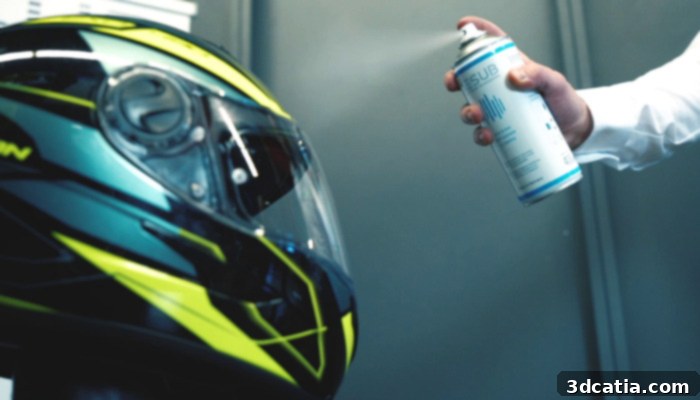
Spray, Scan, Done – AESUB sprays enable 3D scanning without subsequent cleaning (Photo Credits: AESUB)
In addition to our cutting-edge self-volatilizing product range, we also offer AESUB white, a high-quality pigment-containing spray. AESUB white is specifically engineered for extremely complex and time-consuming scanning processes that may exceed the sublimation time of our volatile sprays. This product ensures sustained matting for extended projects where the residue-free evaporation is not the primary concern. Critically, unlike many common pigment-containing sprays available on the market, AESUB white is completely free of titanium dioxide (TiO2). The European Union has classified titanium dioxide as a potential carcinogen when inhaled in respirable particle sizes. By formulating AESUB white without TiO2, we prioritize user safety and environmental responsibility, offering a safer alternative for applications requiring a traditional, long-lasting matte coating.
3DN: For which industries and sectors is the integration of scanning sprays particularly beneficial and why? Can you provide examples of your diverse customer base?
When one initially considers industrial 3D scanning, the mind naturally gravitates towards the manufacturing industry, especially prominent sectors like automotive and aerospace. Indeed, these industries represent a significant portion of our customer base, relying heavily on precise 3D data for quality control, reverse engineering, and prototyping of complex parts. However, the utility of our scanning sprays is far broader; they are invaluable wherever accurate 3D scanning without matting agents is challenging or simply impossible. Our products enable the digitization of objects across a remarkably diverse range of applications and industries, expanding the scope of what is achievable with optical metrology.
Beyond numerous automobile manufacturers and their extensive network of suppliers, our customer base spans various creative and technical fields. Designers, for instance, utilize our sprays to capture intricate models and prototypes with high fidelity, ensuring their digital creations perfectly mirror their physical designs. Artists find our sprays indispensable for digitizing sculptures, artifacts, and other unique pieces, facilitating digital preservation, replication, or scaling. Hobbyists, too, appreciate the ease of use and improved results our sprays provide for their personal projects, from custom part creation to recreational scanning. Moreover, our sprays are increasingly adopted in sectors such as medical device manufacturing, where precise scans of human anatomy or prosthetics are critical; in cultural heritage, for the detailed documentation and restoration of historical artifacts; and in research and development for accurate data collection across a multitude of scientific disciplines. Essentially, any field requiring the high-precision optical capture of objects, particularly those with difficult-to-scan surfaces like transparency, reflectivity, or intricate textures, finds significant advantage in integrating AESUB scanning sprays into their workflow. Our global network of dealers serves this wide array of customers, making our innovative solutions accessible to a vast market.
3DN: What exciting future projects and innovations are currently planned for AESUB?
At AESUB, our commitment to innovation is continuous, driven largely by the evolving needs of our customers. We are increasingly approached by clients who have very specific and often unique requirements concerning the ingredients of our sprays, desired sublimation times, and precise layer thickness. These highly tailored demands reflect the growing sophistication and specialized nature of 3D scanning applications across various industries. Instead of offering a one-size-fits-all solution, we embrace these challenges as opportunities for collaborative development. Based on these invaluable customer requirements, we engage in joint development efforts to create highly customized matting solutions.
This bespoke approach allows us to fine-tune our spray formulations to perfectly match niche applications, ensuring that the use of our sprays, and by extension the entire digitization process, can be further optimized for maximum efficiency, accuracy, and user experience. We are constantly researching new chemical compounds and application methods to enhance performance, extend product versatility, and address emerging industry needs. This includes exploring even faster evaporation times for rapid scanning workflows, developing formulations suitable for extremely sensitive materials, and researching novel application systems for fully automated environments. Our goal is not just to provide excellent standard products but also to be a responsive and innovative partner for specialized challenges, ensuring that AESUB remains at the forefront of 3D scanning spray technology and continues to push the boundaries of optical metrology.

The AESUB team wants to further optimize the 3D scan in the future (Photo Credits: AESUB)
3DN: Do you have a few last words or a message you’d like to share with our readers?
Absolutely. For far too long, spraying objects before 3D scanning has, understandably, been perceived as a necessary evil within the industry. This perception stemmed directly from the numerous disadvantages we’ve discussed – the messy cleanup, the potential for equipment damage, and the overall disruption to the workflow. However, I am incredibly proud to say that with AESUB’s innovative volatile scanning sprays, this frustration and negative perception are now firmly a thing of the past. We have transformed a burdensome prerequisite into a seamless and efficient step in the 3D scanning process. As I’ve already emphasized, our approach is designed for simplicity and effectiveness: **SPRAY | SCAN | DONE!** We believe this paradigm shift empowers users to achieve superior scan quality without any of the traditional drawbacks, making advanced 3D scanning more accessible and enjoyable for everyone.
AESUB products are readily available through a comprehensive global network of trusted distributors. To locate a distributor in your specific area and discover how AESUB can enhance your 3D scanning operations, please visit our website here.
Are you currently incorporating a specialized spray to elevate the quality and precision of your 3D scans? We invite you to share your experiences and insights in a comment below! Alternatively, you can connect with us and join the discussion on our Facebook, Twitter and LinkedIn pages! For the very latest news, trends, and innovations in the world of 3D printing and additive manufacturing, don’t forget to sign up for our free weekly Newsletter here, delivered straight to your inbox!