
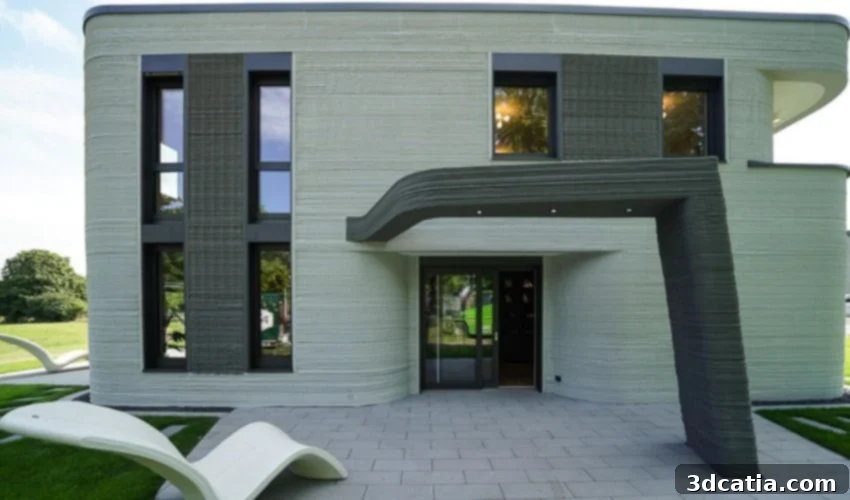
Germany’s Pioneering 3D Printed House: A New Era for Sustainable Construction and Architectural Innovation
The world of construction recently witnessed a monumental leap forward with the official inauguration of Germany’s first 3D-printed house. Situated in Beckum, North Rhine-Westphalia, this groundbreaking project has captivated national and international attention since its unveiling. Far from being merely a structural marvel, this 160-square-meter single-family residence represents a paradigm shift in how we envision and execute building projects, proving to be so innovative that it was honored with the prestigious “German Innovation Award” in 2021. Constructed using state-of-the-art concrete 3D printing technology, the house serves as a powerful testament to the fact that 3D printed house construction has truly reached market maturity. This landmark achievement warrants a closer examination of its creation, from the specific 3D printing technologies and advanced printer deployed to its singularly unique and appealing design.
Even from a distance, the exterior facade of this innovative home distinguishes itself dramatically from conventional structures in the city. The distinctive, individual concrete layers, a signature of additive manufacturing, are unmistakably visible, creating an organic aesthetic that contrasts sharply with the smooth, often monotonous surfaces of traditional buildings. Furthermore, the residence embraces a flowing, round shape rather than the common angular designs, challenging established architectural norms and demonstrating the immense design freedom offered by 3D printing. The visionary concept for this remarkable building was brought to life by the esteemed regional architectural office Mense-Korte. Subsequently, the PERI Group, a global leader in formwork and scaffolding, meticulously transformed these plans into reality under their specialized venture, Hous3Druck. After an intensive but efficient construction period of approximately eight months, all stakeholders expressed profound satisfaction with the successful completion of this pilot project. They collectively agreed that this achievement truly ushers in a new era for the construction industry, where concrete 3D printing is poised to become a permanent and transformative feature. The 3D-printed house in Beckum, Germany, stands as an exemplary model of the feasibility and potential of such projects, joining a growing global portfolio of notable 3D-printed residences seen this year, including SQ4D’s historic listing of the first 3D-printed home for sale in the United States and the innovative first 3D-printed home made available on Airbnb.
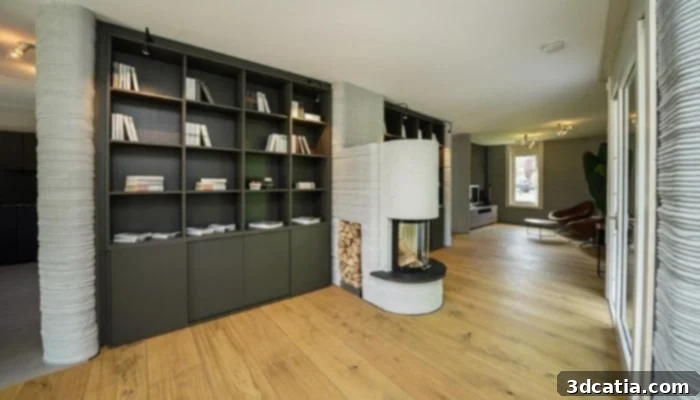
The chimney inside the residential building was also created layer by layer (photo credits: Robert Szkudlarek)
Stepping inside the Beckum house reveals an interior equally as captivating as its exterior. Here too, the distinctive gray concrete layers and graceful, curved shapes are a dominant feature, creating a contemporary and cohesive aesthetic throughout. The additive manufacturing process has allowed for the seamless integration of functional elements directly into the structure, with stunning highlights such as the bespoke concrete fireplace and an elegantly designed concrete bathtub. These elements not only showcase the versatility of 3D printing but also contribute to the house’s unique, modern flair. Lisa-Maria Hanhues, the enthusiastic future owner of the house, is set to move into her new residence in 2023. Until then, the building in Beckum will serve a vital role as a public show house, offering visitors an immersive experience of what future living could look like. Hanhues, who is the sister of the managing partner of Hous3Druck, shared her initial impressions at the inauguration: “I’m pleasantly surprised that you can find so much space for furniture despite the curves.” This observation highlights a crucial aspect of the design – that innovative architecture doesn’t compromise practicality. Beyond its striking appearance, the house boasts other significant advantages, functioning as a fully integrated smart home. Its climate control system, for instance, is efficiently regulated by a geothermal heat pump, a sustainable technology that leverages the earth’s natural energy to provide heating and cooling. Furthermore, all essential home functions can be effortlessly managed at the touch of a button, embodying convenience and modern living at its best. This integration of smart technology with cutting-edge construction underscores the comprehensive vision behind the Beckum project.
PERI Relies on the World’s Fastest 3D Concrete Printer for Unprecedented Efficiency
The extraordinary speed and precision required for the construction of the Beckum house were made possible by deploying a BOD2 3D printer from the renowned Danish manufacturer COBOD. This advanced system was instrumental in printing both floors of the residence, each offering a generous living area of over 80 square meters. According to PERI, the BOD2 operates as a gantry printer, characterized by its print head’s precise movement across three axes within a permanently installed metal frame. This robust and stable setup allows for highly accurate and consistent printing. The specialized material chosen for this ambitious project was “i.tech 3D,” a proprietary concrete mixture meticulously developed by HeidelbergCement specifically for 3D printing applications, ensuring optimal compatibility and performance with the BOD2 system. What truly sets the BOD2 apart is its incredible operational speed; PERI reports that it can extrude an astonishing 1 meter of concrete per second, firmly establishing its position as the fastest 3D concrete printer available on the market today. This remarkable velocity translates into unparalleled efficiency in construction, exemplified by the fact that printing a double-skin wall – a common requirement for insulation and structural integrity – takes a mere 5 minutes per square meter. Such speed not only drastically reduces construction timelines but also makes 3D printed housing a far more economically viable and attractive option for future developments, pushing the boundaries of what is achievable in modern construction.
The increasing embrace of additive manufacturing as a pioneering technology within the construction industry is further underscored by the significant governmental backing for the Beckum project. The state of North Rhine-Westphalia provided substantial financial support, contributing 200,000 euros through its “Innovative Construction” funding program. This investment reflects a clear recognition of 3D concrete printing’s potential to revolutionize building practices, address housing challenges, and promote sustainable development. At the grand opening ceremony of Germany’s first 3D-printed residential building, Minister Ina Scharrenbach (CDU), responsible for regional development, expressed profound confidence in the project’s ripple effect. She firmly believes that this initiative will pave the way for numerous other innovative construction ventures across the state and beyond. Minister Scharrenbach articulated her vision, stating, “With the first 3-D printed residential building in Germany, positive pressure is being generated in the construction industry: for innovative construction with new technologies, for greater attractiveness in construction professions and for modern architecture with new styles. Now we need to gain experience with the building and establish the manufacturing process on the market, because only more housing provides affordable rents.” This statement highlights a multi-faceted strategy: fostering technological advancement, enhancing the appeal of construction careers, driving architectural creativity, and ultimately, making housing more accessible and affordable for all. The state’s commitment to allocating funds to advance innovative technologies for creating living space underscores a proactive approach to tackling contemporary housing demands through sustainable and efficient methods. Further insights into this pioneering project and the future of 3D printing in construction can be found in the video below or in the detailed press release HERE.
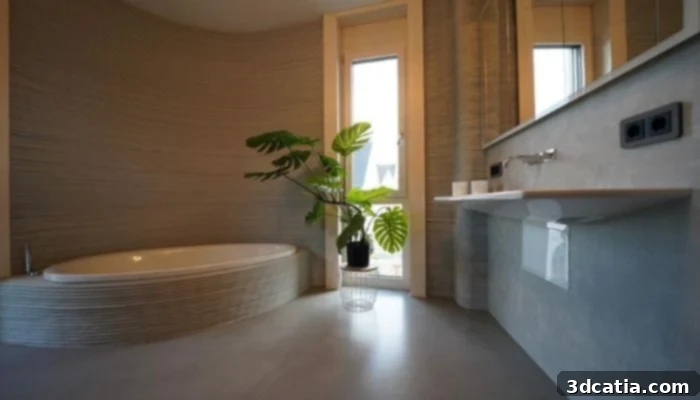
Gray in gray in the modern bathroom of the house (photo credits: Robert Szkudlarek)
The successful completion and inauguration of Germany’s first 3D-printed house marks a significant milestone not just for Beckum or Germany, but for the global construction industry. It showcases the immense potential of additive manufacturing to deliver sustainable, efficient, and architecturally inspiring homes. This project demonstrates how cutting-edge technology, combined with forward-thinking design and strategic partnerships, can overcome traditional construction challenges and pave the way for a more innovative and affordable future in housing. As the world grapples with housing shortages and the urgent need for more sustainable building practices, concrete 3D printing offers compelling solutions, promising faster construction times, reduced material waste, and unprecedented design flexibility. The Beckum house will undoubtedly serve as a crucial reference point, inspiring further research, development, and adoption of this transformative technology across the globe. It stands as a beacon of progress, proving that the homes of tomorrow are not merely a distant vision but are rapidly becoming a tangible reality today.
What are your thoughts on the inauguration of the first 3D-printed house in Germany and its implications for the future of construction? Have you heard of or seen any 3D-printed houses in your own country, or perhaps even worldwide that have caught your attention? We invite you to share your perspectives and insights in a comment below, or engage with us on our Facebook and Twitter pages. Stay informed about the latest advancements and news in the rapidly evolving field of 3D printing by signing up for our free weekly newsletter, delivered directly to your inbox!
*Thumbnail Photo Credits: Robert Szkudlarek