
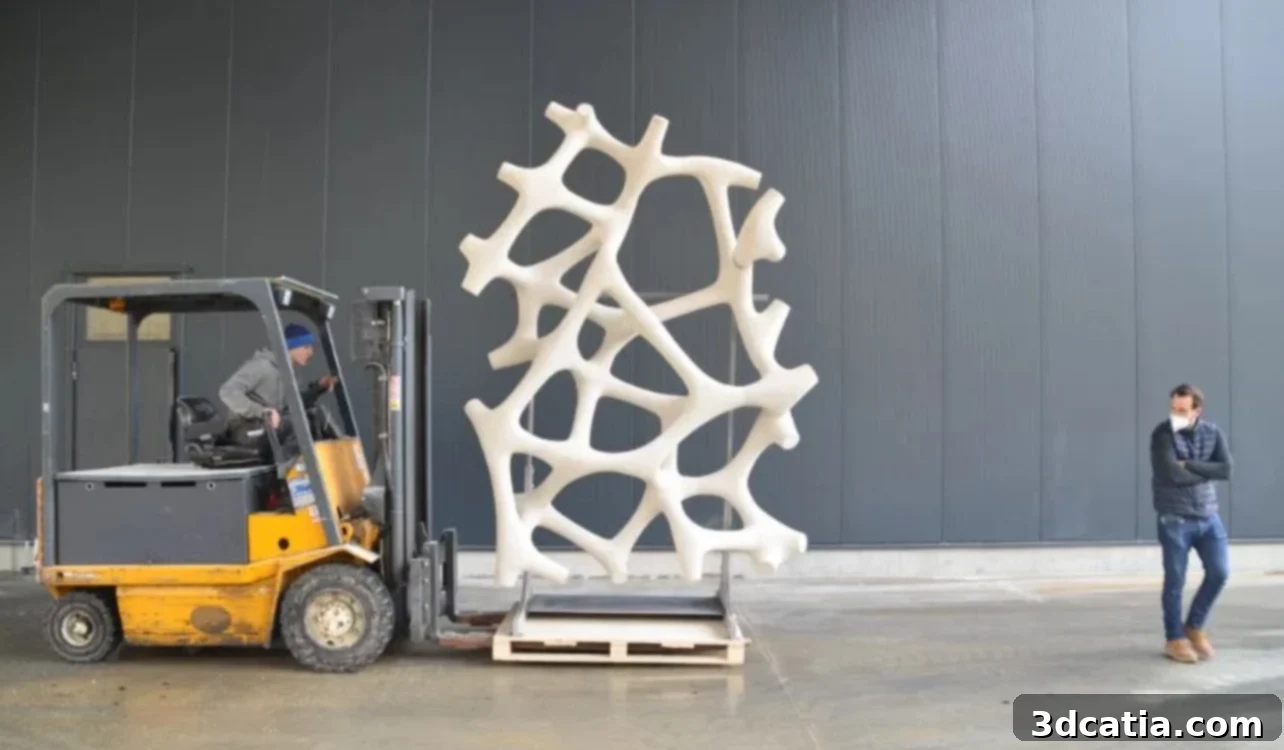
Additive Tectonics: Pioneering the Future of Construction Through Advanced 3D Printing
The construction industry is on the cusp of a profound transformation, with 3D printing emerging as a revolutionary force. Projections from Precedence Research indicate a staggering growth trajectory for this market, valued at $15.43 billion in 2025 and expected to soar to an impressive $1.4 trillion by 2034. This disruptive technology offers compelling solutions to some of the sector’s most persistent challenges, including excessive material waste, extended construction timelines, labor shortages, and a widespread digital lag. Within this dynamic landscape, Additive Tectonics stands out as a visionary company, not merely demonstrating the viability of 3D printing in architecture but actively harnessing its potential to radically reshape how buildings are conceptualized, designed, and ultimately brought to life. We had the privilege of speaking with Bruno Knychalla, the insightful founder and CEO of Additive Tectonics, who shared his profound perspectives on the transformative power of 3D printing in construction and offered an exclusive look into some of their groundbreaking projects. His insights reveal a future where efficiency, sustainability, and unprecedented design freedom converge to redefine our built environment.
Meet Bruno Knychalla: Bridging Fabrication and Architectural Innovation with 3D Printing

Founder and Director at Additive Tectonics
“Hi, I’m Bruno Knychalla, founder and managing director of Additive Tectonics,” he introduces himself. Bruno’s journey to the forefront of architectural additive manufacturing is a unique blend of practical fabrication experience and formal architectural education. “My background is in architecture, but I was more of a fabricator before my studies,” he explains, highlighting his roots in a family of industrial fabricators. This practical foundation provided him with a deep understanding of manufacturing processes, even leading him to develop 3D printers within his uncle’s company – an uncle who today plays a crucial, behind-the-scenes role as “the wise man in the back, quietly making things work” at Additive Tectonics. This early hands-on experience with manufacturing and additive technologies set the stage for his future innovations.
His decision to pursue architecture was driven by a powerful vision. “When I decided to study architecture, it was because I wanted to understand how to build and design, but also because it seemed like the perfect use case for 3D printing,” Bruno elaborates. He recognized that architecture, by its very nature, demands complexity, variation, and custom components, as “every building is (or at least should be) different.” This inherent need for unique solutions made additive manufacturing a natural fit. While he acknowledged the significant limitations of 3D printing in construction 15 years ago—primarily concerning scale, material properties, and speed—he remained convinced of its potential. “But we’ve solved a lot of that now,” he asserts, pointing to the rapid advancements in the field. “So, in a way, I’m still in the process of proving a theory I had 15 years ago: that additive manufacturing and architecture are compatible or even made for each other.” This long-held conviction underpins the innovative spirit and ambitious goals of Additive Tectonics, pushing the boundaries of what is possible in the built environment.
The Genesis of Additive Tectonics: Addressing Critical Gaps in Construction
Additive Tectonics was founded out of a clear recognition that the architecture and construction industries are grappling with a confluence of pressing challenges. “Architecture is facing some serious challenges right now: massive material waste, a growing shortage of skilled labor, an industry-wide digital lag, and let’s be honest—a lot of aesthetic monotony,” Bruno explains. These issues not only hinder efficiency and profitability but also contribute significantly to environmental degradation and a lack of innovation in design.
Furthermore, Bruno identified a critical void in the market: “At the same time, we saw that no one—especially from the digital fabrication side—was really stepping up with answers that could scale industrially.” Traditional construction companies, burdened by legacy processes and inherent risk aversion, often “tend to move slowly when it comes to innovation.” Conversely, many existing additive manufacturing companies, while technologically advanced, “weren’t thinking at the scale or complexity of architecture,” failing to bridge the gap between niche applications and the demands of large-scale building. This dual failure—of traditional players to innovate and digital players to scale—created a unique opportunity. “So, we decided to start our own company,” he states, driven by the conviction that a new approach was desperately needed.
Additive Tectonics was thus born from the audacious idea that digital production could transcend mere efficiency gains; it could fundamentally “reshape the logic of how we build.” The company’s vision is not about printing novelty items but about focusing on “real-world components: roofs, walls, acoustic systems, parts that need to perform structurally, fit into workflows, and still allow for design freedom.” Their ambition extends beyond simply applying 3D printing to existing architectural concepts. “Our goal was never to just ‘3D print architecture.’ We wanted to rethink tectonics—the fundamental way buildings are assembled—through an additive lens.” This philosophy emphasizes a holistic, integrated approach where material, structure, and design are intricately linked and optimized by digital fabrication. They aimed to achieve this in a manner that is “practical, scalable, and materially meaningful,” ensuring that their innovations have tangible, real-world impact. Ultimately, their comprehensive goal is to offer a wide range of digitally fabricated solutions, encompassing “3D-printed buildings, interiors, and furniture,” thereby revolutionizing multiple facets of the built environment.
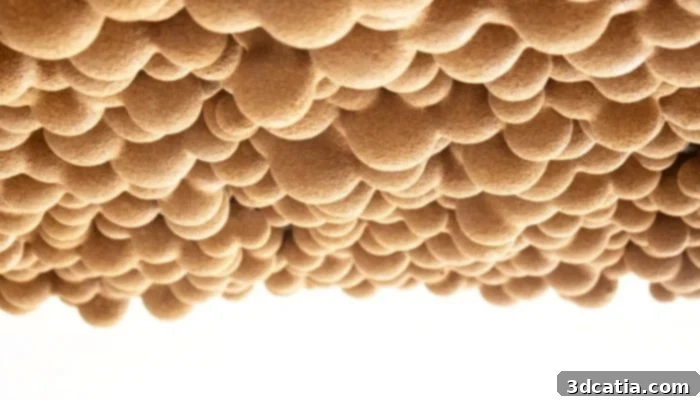
Structure printed in 3D with the material econitWood.
Unveiling Selective Cement Activation (SCA) Technology: A Game Changer for Architectural 3D Printing
Additive Tectonics’ innovative core lies in its proprietary Selective Cement Activation (SCA) technology, a particle-bed 3D printing process meticulously developed for the unique demands of architectural construction. “Selective Cement Activation, or SCA, is a particle-bed 3D printing process we developed specifically for architecture,” Bruno explains. A crucial differentiator of SCA is its ability to work with “material systems made from standard building materials,” which he notes is “the first hurdle to clear when working in construction.” This emphasis on conventional, readily available components ensures broad applicability and compatibility within existing industry practices.
Among their various formulations, econitWood stands out as a flagship achievement. Bruno describes it as “a hybrid of repurposed beech wood chips and a magnesium-based Sorel cement used as a binder.” The process is remarkably straightforward yet highly effective: “We mix the dry binder with wood particles and activate it using saltwater. Wherever the activator touches, the material hardens. The rest stays loose and can be reused.” This ingenious method minimizes waste, as unactivated material can be recovered and utilized in subsequent prints. A significant advantage of econitWood is that “the binder not only holds the particles together but also makes the material fire-resistant,” adding a critical safety and performance benefit.
The true power of SCA, however, lies in the unparalleled design freedom and functional integration it offers, all while operating at a speed suitable for industrial construction. “What’s exciting about SCA is the level of freedom it offers at a scale and speed fit for the building industry,” Bruno enthuses. Unlike traditional methods that rely on molds and standardized parts, SCA liberates designers and builders from these constraints. “No molds, no standardized parts. We can print structural elements with integrated reinforcement channels, patterns that perform like insulation inside the parts, cavities for technical systems, and even embed connection points directly into the component.” This ability to customize every aspect of a component, from its internal geometry to its surface features and connection details, allows for unprecedented material efficiency and multi-functional design. The technology is also poised for rapid deployment, with a current print speed of “around 1.5 m³ per hour,” making it “ready for large-scale construction.”
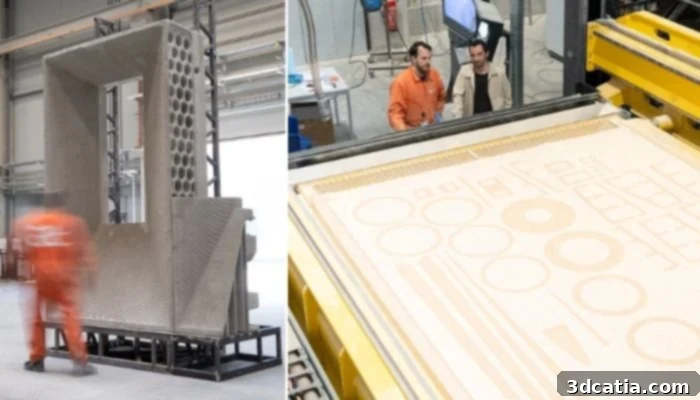
3D printed facade element using the SCA process (left). The selective cement activation technology (right).
Looking ahead, Additive Tectonics is actively “developing hybrid systems like roof components that act as both lost formwork and structure, or multi-functional building skins that combine digital detailing and building functions like insulation with spatial expression.” These developments promise to further blur the lines between structure, enclosure, and performance. Furthermore, the company has achieved a significant milestone: “We’ve also just finished developing a next-generation version of the technology, capable of producing parts with the strength and resilience of concrete and doing so even faster.” This advancement positions SCA to address an even broader spectrum of structural applications, solidifying its role as a transformative force in concrete construction and beyond.
Ensuring Sustainability: Materials and Processes at Additive Tectonics
Sustainability is not merely an afterthought but a foundational principle deeply embedded in Additive Tectonics’ production processes and material selection. Bruno highlights econitWood as a prime example of their circular economy approach. “Let’s take econitWood as an example. It’s a material we developed using waste beech wood, the kind that’s normally pressed into pellets and then burned,” he explains. Instead of following this conventional linear path, “we give it a second life as a high-value, design-ready material for interiors, furniture, and acoustic systems.” This innovative repurposing of waste not only conserves resources but also avoids the energy-intensive process of pelletization and combustion. “Together with the mineral binder, we’ve created a material system that avoids plastics and embraces circular input streams,” further demonstrating their commitment to environmentally responsible material usage.
Beyond wood waste, Additive Tectonics is at the forefront of developing advanced, low-carbon binders. “We’re also actively developing local geopolymer binders as a replacement for traditional cement,” Bruno states. The environmental benefits of geopolymers are substantial: “Geopolymers are made from industrial byproducts and can be processed at much lower temperatures than Portland cement. That means significantly less CO₂ emissions, no need for limestone calcination, and a more resilient, durable end product.” This represents a significant step towards decarbonizing construction, as cement production is a major contributor to global CO₂ emissions. Their strategy also emphasizes regionality: “Because we work regionally, we can source and formulate these materials based on what’s available locally, keeping both carbon and supply chains short.” This localized approach reduces transportation emissions and fosters robust, resilient supply networks.
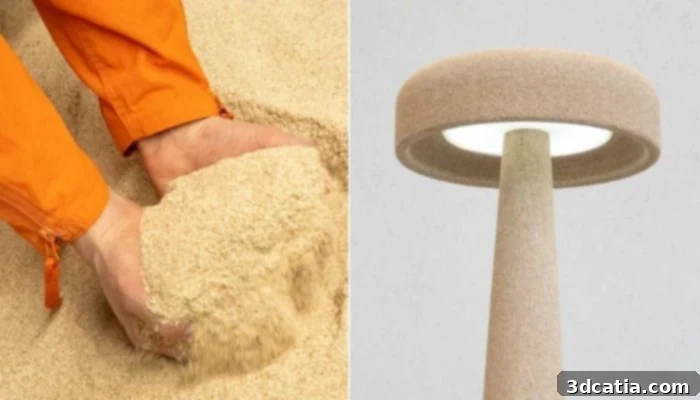
econitWood is a material for additive manufacturing based on beech wood waste.
The inherent efficiency of additive manufacturing itself further amplifies Additive Tectonics’ sustainability efforts. “Beyond the materials themselves, additive manufacturing allows us to use them more intelligently,” Bruno emphasizes. Unlike conventional construction that often involves cutting materials to size, leading to significant offcuts and waste, AM processes build objects layer by layer, precisely placing material only where it is functionally required. “We only place material where it’s needed, no excess, no offcuts, no formwork waste.” The elimination of formwork, which is a major source of waste in concrete construction, is a particularly impactful benefit. Furthermore, “there’s no need for molds, and every component is customized by default.” This bespoke production capability means that each part is optimized for its specific function, minimizing material over-engineering. “That level of control means less waste, less transport, and less post-processing, all of which adds up to a much leaner, smarter approach to building,” ultimately contributing to a more sustainable and resource-efficient construction paradigm.
Showcasing Innovation: Representative Projects by Additive Tectonics
Additive Tectonics’ commitment to pushing the boundaries of architectural 3D printing is vividly demonstrated through their recent projects, which highlight both their technical prowess and design sensibility. “Two recent highlights come to mind,” Bruno shares, beginning with “Printed Nature,” a captivating collaboration with designer Harry Thaler at Alcova 2024 during Milan Design Week. “It was a spatial installation showing curvy furniture made from econitWood placed inside a dune-scape,” he describes. This project not only showcased the aesthetic versatility of econitWood but also its structural capabilities. “What many people didn’t know is that the ‘dunes’ which looked like mountains of wood chips were also printed in econitWood.” A significant challenge involved adapting to the venue’s limitations: “Since the old building slabs where the installation took place couldn’t bear much weight, we invented a lightweight flooring system to make it possible.” This innovative solution underscored their ability to overcome site-specific constraints through intelligent design and material use, creating an immersive environment that defied conventional expectations.
The second pivotal project is their large-scale installation at the prestigious Venice Biennale, developed in partnership with the Berlin-based architecture office SUB. “It’s about to be published and demonstrates how additive manufacturing can operate architecturally at scale,” Bruno reveals. This installation is a testament to deep integration: “It’s a deep integration of form, structure, and material designed and built as a unified system.” They proudly represent the “Natural” section of an exhibition titled “Intelligens: Natural. Artificial. Collective.,” showcasing how their additive approach can harmonize with natural principles and advanced technology. The project served as a rigorous test for their systems: “Beyond the concept and setting, it also meant printing every day for three weeks straight—a kind of stress test for our system, and one we’re proud to have passed.” This demanding schedule affirmed the reliability and industrial readiness of their technology.
Looking to the future, Additive Tectonics is already venturing into even more ambitious undertakings. “We’re also currently working on full-scale building applications,” Bruno confirms. He acknowledges that “these are still in development and as always in architecture, that takes time—but the first test parts are already being printed.” This ongoing work represents the culmination of their research and development, where the true potential for widespread impact will be realized. “This is where the real innovation will unfold,” he concludes, indicating that their most transformative contributions to the built environment are yet to come, moving from installations to inhabitable structures.
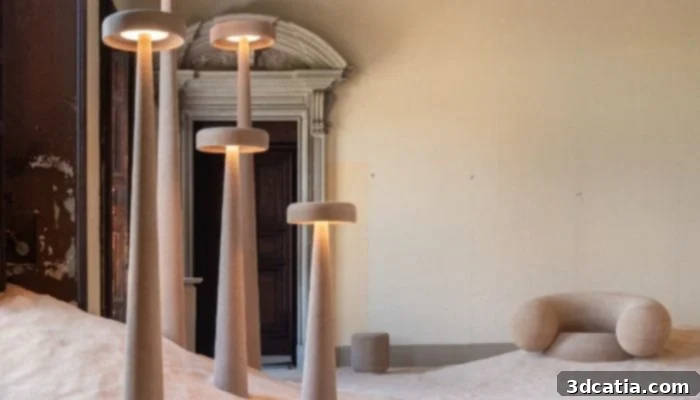
“Printed Nature” installation.
A Vision for the Future: Craft, Code, and Care in Construction
As our conversation with Bruno Knychalla drew to a close, he offered a powerful summary of Additive Tectonics’ philosophy and the urgent need for change in architecture. “Architecture has to change fast,” he asserts, underscoring the critical global challenges confronting humanity today, from climate change and resource depletion to rapid urbanization and the need for resilient infrastructure. Yet, amidst these challenges, he sees immense opportunity: “We’re facing global challenges, but also gaining access to tools that allow us to rethink how and why we build.”
For Bruno, additive manufacturing is far more than just an incremental improvement in construction techniques. “Additive manufacturing isn’t just a more efficient method; it’s a new logic for construction—one that lets us combine performance with expression, precision with sustainability.” This “new logic” fundamentally redefines the design-to-build paradigm, enabling unprecedented levels of customization, material optimization, and integrated functionality, all while drastically reducing environmental impact. He envisions a future where every building component is designed not only for structural integrity but also for aesthetic appeal, environmental performance, and efficient resource use. This holistic approach ensures that innovation serves both functional necessity and creative ambition.
At the heart of Additive Tectonics’ vision is a unique synthesis of traditional values and cutting-edge technology. “We believe that the future of building lies at the intersection of craft, code, and care, and we’re just getting started,” Bruno declares. ‘Craft’ speaks to the meticulous attention to detail and quality inherent in bespoke production; ‘code’ represents the digital intelligence and automation that drives their additive processes; and ‘care’ embodies their deep commitment to sustainability, ethical practices, and the well-being of the planet. This tripartite philosophy guides their every endeavor, ensuring that technological advancement is coupled with responsibility and human-centered design.
Concluding with a direct appeal, Bruno extends an invitation to collaborate: “Please don’t hesitate to reach out if you feel like you have the right project in the world of construction that could benefit from this approach.” He emphasizes the critical need for tangible examples to drive broader adoption and understanding: “We need built examples to break down the barriers of the unknown.” By partnering with forward-thinking clients and designers, Additive Tectonics aims to construct not just buildings, but a new narrative for sustainable, innovative, and aesthetically rich architecture, proving that the future of construction is already here.
What is your impression of Additive Tectonics and their pioneering work? Let us know in a comment below or on our LinkedIn or Facebook pages! Plus, don’t forget to sign up for our free weekly Newsletter to get the latest 3D printing news straight to your inbox. You can also find all our videos on our YouTube channel.
*All Photo Credit: Additive Tectonics