
Unlocking High Performance: FDM 3D Printing of Carbon Fiber PEEK Composites Rivaling Injection Molding
The landscape of additive manufacturing is continually evolving, driven by advancements in both technology and materials science. A recent study by researchers in China highlights a significant leap forward, exploring the synergistic power of short carbon fibers when combined with high-performance polymers like PEEK. Their investigation utilized the highly accessible and cost-effective Fused Deposition Modeling (FDM) 3D printing technology, a method typically associated with more general-purpose plastics rather than advanced composites. The findings, meticulously outlined in their paper entitled “Flexural Properties and Fracture Behavior of CF/PEEK in Orthogonal Building Orientation by FDM: Microstructure and Mechanism,” demonstrate how these carbon fiber reinforced PEEK (CF-PEEK) composites possess the potential to revolutionize numerous industrial sectors by offering properties previously unattainable with FDM.
Polyether Ether Ketone, commonly known as PEEK, stands as a cornerstone in the realm of high-performance polymers. Its exceptional mechanical strength, superior thermal stability, and excellent chemical resistance make it an invaluable material across a diverse range of demanding industries. Sectors such as aerospace, automotive, oil & gas, and the medical field have an ever-increasing demand for PEEK, employing it in critical components where reliability under extreme conditions is paramount. From lightweight aircraft parts to sterilizable surgical instruments and robust downhole drilling components, PEEK’s unique attributes offer solutions that few other materials can match. However, when it comes to additive manufacturing, particularly FDM, challenges often emerge. A common hurdle, especially with high-temperature polymers like PEEK, is achieving optimal layer adhesion. This issue can compromise the structural integrity and mechanical performance of the final printed part. While PEEK is renowned for its inherent strength, additive manufacturing techniques haven’t always managed to fully harness the material’s potential to the same extent as traditional methods like injection molding. Consequently, researchers globally are actively pursuing strategies to augment PEEK’s properties, often by combining it with reinforcing agents to further enhance its strength, stiffness, and overall performance in 3D printed applications.
Among the various reinforcing agents, carbon stands out as a particularly popular choice in industrial 3D printing. Its ability to significantly boost the mechanical properties, including tensile strength, stiffness, and impact resistance, of various base polymers is well-documented. The addition of carbon fibers transforms ordinary plastics into advanced composites capable of withstanding higher loads and more extreme environments. However, integrating carbon fibers, especially short chopped fibers, into the FDM process introduces its own set of complexities. Challenges such as increased porosity within the printed part and difficulties in achieving strong, consistent layer adhesion—issues that already plague PEEK extrusion—can become even more pronounced. Acknowledging these hurdles, the research team, comprised of Qiushi Li, Wei Zhao, Yongxiang Li, Weiwei Yang, and Gong Wang, embarked on a novel approach. Their study focused on combining short carbon fibers with PEEK and meticulously printing the resulting composite in an orthogonal building orientation. A crucial aspect of their research involved a rigorous comparison of the mechanical properties of these 3D printed parts against those produced through conventional injection molding, a benchmark for high-quality polymer manufacturing.
Methodology and Experimental Design: Bridging FDM and Injection Molding
For this groundbreaking study, the parts were precisely printed using the Intamsys Funmat HT, a high-performance FDM printer renowned for its capability to process engineering and high-performance polymers. The Funmat HT’s enclosed heated chamber and high-temperature extrusion system are critical for successfully printing materials like PEEK, PEKK, ULTEM, and PPSU, as well as engineering-grade polymers such as PC, PA, PA-CF, ABS, and TPU, ensuring excellent layer adhesion and minimal warping. The 3D models required for the study were meticulously designed using Catia V5, a leading computer-aided design software, ensuring geometric accuracy and precision. These models were then imported and prepared for printing using Intamsuite, Intamsys’s proprietary slicing software, which optimizes print parameters for their machines. To ensure a fair and direct comparison, all samples were printed using identical printing parameters, but crucially, in both horizontal and vertical orthogonal orientations. This allowed the researchers to systematically investigate the anisotropic properties inherent in FDM parts and the specific impact of build direction. Furthermore, for the injection molding comparison, the very same filament material was first processed into pellets. These pellets were then subjected to standard injection molding conditions to produce comparable samples. This meticulous approach ensured that any observed differences in mechanical properties could be attributed directly to the manufacturing process (3D printing vs. injection molding) and the building orientation, rather than variations in the base material. The initial results from these comparative tests were highly encouraging, revealing that the composites tested through both 3D printing and injection molding exhibited “similar high strength and toughness,” a finding that challenges conventional limitations of FDM technology.
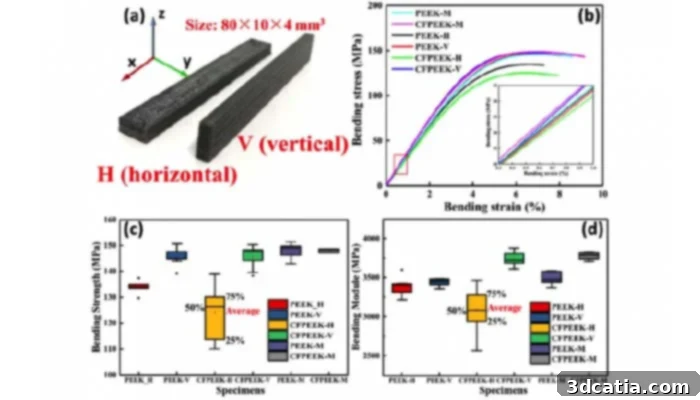
Flexural properties of printed and molded PEEK CF-PEEK specimens.
(a) CF/PEEK bending specimens with orthogonal printing direction (horizontal and vertical) both printed according to ISO 178:2010 (size: 80 × 10 × 4 mm3).
(b) Typical stress to strain curves of flexural experiments. The inset in the bottom right corner shows the linear range that determines the module of each bending specimen.
(c)The boxplots of bending strength and
(d) bending modulus of flexural specimens, which indicate the distribution of experimental data
Key Findings: A Breakthrough in Mechanical Performance
Upon the meticulous completion and analysis of the study, the research team arrived at several pivotal conclusions that underscore the significant advancements achieved. One of the most astonishing revelations was the mechanical performance of the vertically printed PEEK and CF/PEEK composites. As quoted by the authors themselves: “Surprisingly, the vertically printed PEEK and CF/PEEK composites displayed a value of 146 MPa, which was similar to the value of the molded samples. Such a similar value between printed samples and molded samples is rare, but quite highly desired, for 3D printing.” This statement encapsulates the monumental nature of their achievement. In the realm of additive manufacturing, particularly FDM, matching the mechanical properties of injection-molded parts has long been an elusive goal, often regarded as the holy grail for high-performance applications. Achieving a flexural strength of 146 MPa for vertically printed parts, directly comparable to injection-molded counterparts, represents a significant paradigm shift. It suggests that with optimized material combinations and printing strategies, FDM can indeed produce parts that meet the rigorous performance standards traditionally reserved for mass-produced components.
Beyond the impressive strength values, the study also revealed notable enhancements in material stiffness. The incorporation of carbon fibers played a crucial role here, leading to an 8.30% higher modulus for the CF/PEEK molded samples when compared to the pure PEEK samples. This increase in modulus indicates a stiffer material, which is desirable in applications requiring high rigidity and resistance to deformation. Furthermore, the benefits of carbon fiber reinforcement were not limited to injection-molded parts. A statistically significant increase in the modulus was also observed for the vertically printed CF/PEEK samples. This finding is particularly important for additive manufacturing, as it confirms that the benefits of carbon fiber reinforcement translate effectively into 3D printed structures, offering designers and engineers access to stiffer, more robust components produced through FDM. The image above provides a visual representation of these flexural properties, showing typical stress-strain curves, bending strengths, and bending moduli for both printed and molded specimens, visually underscoring the remarkable similarities in performance.
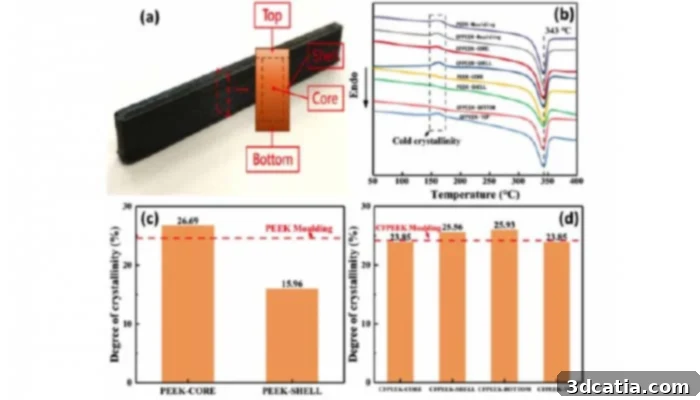
Differential scanning calorimetry (DSC) results of printed PEEK and CF/PEEK parts.
(a) The position of DSC testing samples.
(b) Heat flow curves of CF/PEEK and PEEK parts.
(c) Otherness of crystallinity of shell and core of printed PEEK parts.
(d) Corresponding crystallinity results of printed CF/PEEK parts
Microstructural Insights and Design Implications
While the addition of carbon fibers significantly enhanced mechanical properties, the study also observed an increased porosity within the printed structures. This is a common trade-off with fiber reinforcement in FDM, where the fibers can sometimes disrupt the flow and fusion of polymer layers, leading to tiny voids. However, understanding and managing this porosity is key to optimizing performance. The researchers meticulously analyzed the failure mechanisms, identifying four distinct fracture modes during bending tests, particularly under large strain conditions. These modes, which vary depending on print orientation and material composition, provide invaluable data for predicting how parts will behave under stress and for designing more robust structures.
A critical insight gleaned from the research pertains to the strategic approach to designing and printing these advanced composites. The authors concluded: “The design of a printing route along the stress orientation that cooperates with the incorporation of a reinforced phase into the matrix provides an effective method to enhance the mechanical properties of composites and enlarges the application of 3D printing in lightweight design fields.” This statement highlights a fundamental principle for optimizing 3D printed composite parts: tailoring the print path to align with the anticipated stress directions in the final component. By orienting the layers and fibers in a way that directly counteracts the applied loads, designers can maximize the benefits of the carbon fiber reinforcement, leading to parts with superior strength-to-weight ratios. This approach is particularly impactful for lightweight design, where minimizing material while maintaining structural integrity is paramount. The study’s findings are expected to be profoundly helpful to designers, offering a deeper understanding of how microstructures—the internal arrangement of layers and fibers—influence the performance of printed composites during the manufacturing process. This knowledge empowers engineers to make more informed decisions about material selection, print orientation, and post-processing, ultimately leading to more reliable and higher-performing FDM-printed components.
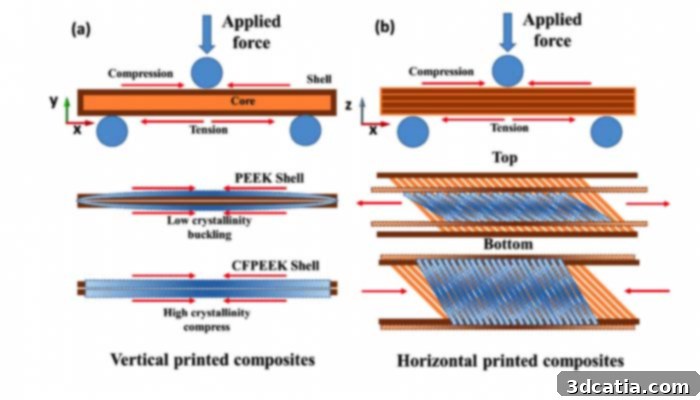
The major mode of deformation during bending.
(a) The deformation mode of the vertically printed specimens.
(b) The deformation mode of horizontally printed specimens
The Future of Additive Manufacturing: Beyond Monolithic Materials
The profound results of this study unequivocally demonstrate that the future of 3D printing will be characterized by an increasing reliance on sophisticated material combinations. Moving beyond the limitations of single, monolithic materials, researchers are now actively exploring the vast potential that arises from blending different polymers, metals, ceramics, and even bio-materials. This burgeoning field of composite additive manufacturing promises to unlock diverse applications across an ever-expanding number of fields. From aerospace components demanding extreme lightness and strength, to medical implants requiring specific biocompatibility and mechanical properties, to consumer goods seeking enhanced durability and aesthetics, the possibilities are virtually limitless. This research into CF-PEEK composites by FDM is a testament to the fact that additive manufacturing is maturing rapidly, transitioning from a prototyping tool to a robust method for producing end-use parts with tailored properties. It underscores the importance of continuous innovation in material science to truly harness the transformative power of 3D printing.
What are your thoughts on studies like this one? Do you envision carbon fiber PEEK and other advanced material combinations becoming the standard in the future of 3D printing, moving beyond specialized applications into mainstream manufacturing? We invite you to share your perspectives in a comment below or join the discussion on our Facebook and Twitter pages! For those eager to stay at the forefront of the latest developments in additive manufacturing, be sure to sign up for our free weekly Newsletter here, delivering the most pertinent 3D printing news directly to your inbox!
If you wish to delve deeper into the specifics of this comprehensive study, you can access the full research paper by clicking HERE.