
Revolutionary 3D Printed Blood Vessels Enable Advanced Remote Blood Pressure Monitoring
Cardiovascular diseases remain a leading cause of morbidity and mortality worldwide, often requiring surgical interventions such as blood vessel replacement. In the United States alone, an alarming 450,000 patients annually undergo such operations to address critical conditions like blood clots, coronary artery disease, and damage resulting from strokes. While these procedures are life-saving, a significant challenge persists in post-operative monitoring. Currently, grafted blood vessels are typically monitored through expensive and often inconvenient imaging techniques such as CT scans and ultrasounds. These methods are not only costly but also provide only intermittent snapshots of a patient’s vascular health, failing to offer continuous, real-time insights. More critically, between 40% and 50% of these vital grafts unfortunately fail, highlighting an urgent need for more effective and proactive monitoring solutions that can detect complications early and facilitate timely, life-saving interventions.
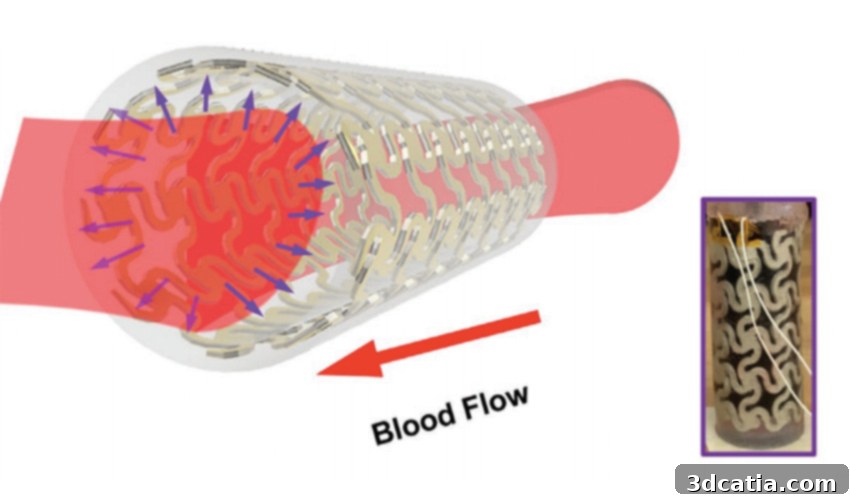
Addressing this critical unmet need, scientists at the University of Wisconsin-Madison have achieved a remarkable breakthrough: the development of innovative 3D printed blood vessels capable of enabling remote and continuous blood pressure monitoring. This pioneering research promises to transform post-surgical care, moving away from reactive treatments to a more preventative and personalized approach. The key innovation lies in an implantable, self-powered artificial vessel designed by a team of materials science engineers, allowing healthcare providers and patients to remotely track vital health parameters without the need for external power sources or frequent hospital visits. This novel device represents a significant leap forward in medical technology, offering the potential to drastically improve patient outcomes and reduce healthcare costs associated with graft complications.
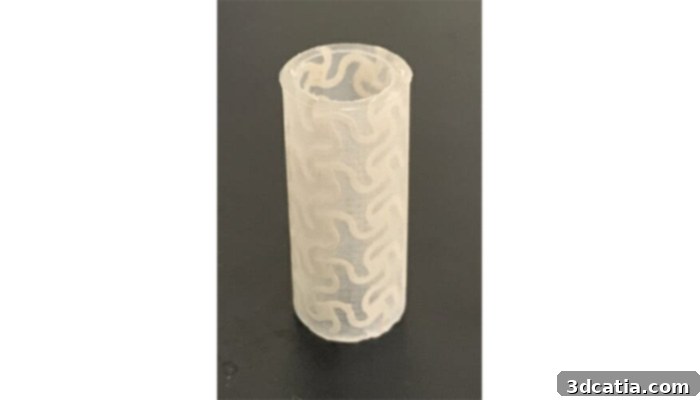
The 3D printed implantable blood vessel
The Science Behind the Innovation: Self-Powered Sensing and Biocompatible Composites
The implantable vessel is meticulously crafted from a flexible composite material, specifically engineered for both its mechanical and electrical properties. Led by Professor Xudong Wang and graduate student Jun Li, the research team published their groundbreaking findings in the prestigious *Advanced Functional Materials* journal. Professor Wang elucidated the core functionality of their creation: “This artificial vessel can produce electric pulses based on pressure fluctuation which will be able to tell precisely the blood pressure in the vessel without using any additional power source. And because of the 3D geometry, the electric pulse profile will be able to tell if there is an irregular motion due to blockage inside in the very early stages.” This self-powered characteristic is a game-changer, eliminating the need for batteries or wireless charging within the body, thus reducing complexity and potential failure points in long-term implants. The ability to detect subtle changes in pressure and identify irregular blood flow patterns early on is paramount for preventing serious complications like graft failure or further cardiovascular events.
Professor Wang’s extensive background in material science, particularly in developing novel materials for arterial projects, paved the way for this invention. His long-standing research focus has been on identifying materials that possess a unique combination of flexibility, piezoelectricity, and biocompatibility. Piezoelectric materials are remarkable because they can generate an electric charge in response to mechanical stress or pressure, a phenomenon central to the functionality of the new artificial blood vessel. This intrinsic property allows the implant to convert the mechanical force of blood flow and pressure into an electrical signal, effectively acting as a tiny, self-reporting sensor. Furthermore, ensuring biocompatibility is non-negotiable for any implantable device, as it must seamlessly integrate with the body’s tissues without causing adverse reactions or rejection.
To achieve these critical properties, the team engineered a sophisticated composite material. They combined sodium potassium niobite piezoceramic nanoparticles with a polyvinylidene fluoride (PVDF) polymer. PVDF is a ferroelectric material, meaning its electrical polarity can be flipped when an external electric field is applied. This ferroelectric property is vital for enhancing the overall piezoelectric response of the composite. By carefully embedding the piezoceramic nanoparticles within the flexible PVDF matrix, the researchers created a material that is not only robust and pliable but also highly sensitive to pressure changes. This synergistic combination provides the necessary electromechanical coupling for accurate and reliable blood pressure monitoring.
Precision Manufacturing: 3D Printing for Functional Arteries
The fabrication process for these advanced artificial blood vessels leverages the power and precision of 3D printing technology. The team successfully 3D printed a tubular artery structure using their custom composite material and an off-the-shelf 3D printer. The choice of an easily accessible printer underscores the potential for this technology to be scalable and widely adopted in the future, bypassing the need for highly specialized or expensive manufacturing equipment. A crucial step in the printing process involves extruding the composite material through a strong electric field positioned close to the printer’s nozzle. This electric field serves a critical purpose: it polarizes the ceramic particles within the composite material as it is being deposited. This polarization process is what imbues the entire 3D printed structure with its essential piezoelectric property, enabling it to generate electrical signals from mechanical pressure. Without this precise polarization, the material would not be able to function as a self-powered blood pressure sensor. The ability to create such a complex, functional device in a single, streamlined 3D printing step represents a significant advancement over multi-stage fabrication processes, paving the way for more efficient and cost-effective production of sophisticated medical implants.
Rigorous Testing and Promising Future Directions
Once the artificial arteries were fabricated, the critical testing stage began. Graduate student Jun Li meticulously connected the 3D printed artificial artery to a sophisticated artificial heart system. This system was designed to realistically simulate various physiological conditions, including common vascular issues such as partial blockages, instances of high blood pressure, and irregular blood flow patterns. During these rigorous tests, the self-powered composite material consistently demonstrated its ability to correctly detect even subtle changes in force and pressure within the simulated artery. This successful validation in a controlled, yet physiologically representative, environment is a monumental step towards clinical application. It confirms that the device can accurately monitor the internal dynamics of blood flow, providing precise data that is essential for early diagnosis and intervention.
Building on this success, the researchers are now focused on several key areas for optimization and future development. One immediate goal is to further refine the production process of the new ferroelectric composite material, ensuring greater consistency and scalability. Simultaneously, they aim to optimize the 3D printing parameters to enhance the structural integrity and functionality of the vessels. A significant objective is to make the 3D printed structure even more sensitive, allowing for the detection of even finer changes in blood pressure and flow, which could lead to earlier identification of potential issues. Furthermore, the team plans to forge collaborations with researchers in the biomedical field. These partnerships will be crucial for conducting more extensive testing using increasingly realistic models of the circulatory system, including animal studies, which are necessary steps before human clinical trials. These future investigations will push the boundaries of the technology, bringing it closer to widespread clinical adoption.

On the left Xudong Wang and on the right Jun Li
Advantages and Transformative Potential in Cardiovascular Healthcare
While the scientific community is actively exploring various approaches to developing artificial blood vessels and organs, Professor Wang believes that their specific technique offers distinct advantages over more complex alternatives. “This is an easy, scalable technology,” he states, emphasizing the practicality and potential for widespread implementation. The innovation lies in its simplicity and efficiency: “Our new printable composite material allows us to make a 3D structure in one step that can show multi-functionality right out of manufacture.” This single-step manufacturing capability for a multi-functional device is a significant benefit, potentially reducing production costs and timelines, making these advanced implants more accessible. The multi-functionality, encompassing both structural support and active blood pressure sensing, positions this technology as a highly integrated and effective solution.
The transformative potential of this 3D printed blood vessel for cardiovascular healthcare cannot be overstated. By providing continuous, remote monitoring of blood pressure and flow within grafted vessels, it could usher in an era of proactive patient management. Instead of waiting for symptoms of graft failure to manifest, clinicians could receive early alerts about subtle changes, allowing for timely medical or surgical intervention. This capability is expected to significantly reduce the incidence of catastrophic graft failures, minimize costly re-operations, and dramatically improve the long-term quality of life for patients undergoing vascular surgeries. Furthermore, the remote monitoring aspect empowers patients by giving them a greater sense of security and reducing the burden of frequent hospital visits for diagnostic imaging. It aligns perfectly with the growing trend towards personalized and preventative medicine, offering a seamless integration of advanced materials science with critical clinical needs. This innovation not only addresses a current healthcare challenge but also sets a precedent for how future medical implants can be designed—smart, self-powered, and seamlessly integrated into patient care pathways. You can find more detailed information regarding their published study HERE.
What are your thoughts on this incredible project and its potential to revolutionize patient care? We invite you to share your perspectives in a comment below or join the conversation on our Facebook and Twitter pages! Don’t miss out on the latest advancements and news in the world of 3D printing. Sign up for our free weekly Newsletter to get all the cutting-edge updates delivered straight to your inbox!