
Unlocking Advanced 3D Printing: A Comprehensive Guide to Grasshopper for Parametric Design
Emerging in 2007 as a groundbreaking tool, Grasshopper stands as an algorithmic modeling solution seamlessly integrated within the powerful Rhinoceros CAD software. Initially a standalone installable plug-in, its undeniable utility led to its full integration into Rhino 6 and all subsequent versions, solidifying its place as an indispensable component for designers and engineers alike. As an easy-to-learn CAD program, Grasshopper empowers users to define and generate complex 3D geometries based on mathematical representations and logical relationships. Its intuitive visual programming interface represents each design component as a “box,” allowing users to connect these boxes via “wires” to establish relationships and data flow. This interconnected node diagram visually describes the intricate dependencies between each block, providing a clear, dynamic overview of the design logic. This methodology inherently removes limitations on the complexity, degree of detail, or sheer size of your models, enabling the creation of designs previously unattainable with traditional modeling methods. But what precisely are the overarching advantages of leveraging Grasshopper, and why has it become an increasingly vital tool for advancing the capabilities of 3D printing?
One of Grasshopper’s most significant differentiators, setting it apart from conventional programming languages like RhinoScript or rhino.Python, is its fundamental design philosophy: it requires absolutely no prior knowledge or experience in programming or coding. This accessibility is a game-changer, democratizing complex design and generative algorithms. The plug-in provides a visual programming environment where developers and designers can construct sophisticated algorithms without writing a single line of text-based code. Instead, design modifications and their underlying logic are immediately visualized through the node diagram, which explicitly illustrates every mathematical and geometric relationship within a three-dimensional model. Since complex shapes and intricate patterns can be directly generated from defined data and parameters, a paramount advantage of Grasshopper is its unparalleled ability to modify geometry almost infinitely by simply adjusting parameter values. This dynamic control means that design iterations can be explored rapidly and efficiently, without the cumbersome process of canceling or restarting an entire design from scratch. This iterative freedom fosters innovation and allows for rapid optimization. But the true potential of this powerful program truly shines when its generative capabilities are combined with the transformative power of additive manufacturing technology.
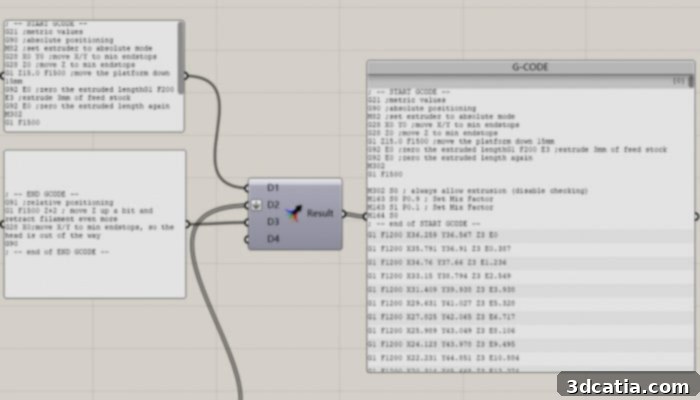
Direct G-code generation via Grasshopper streamlines the 3D printing workflow (Photo credits: Eazao)
Grasshopper’s Synergy with 3D Printing: Transforming Additive Manufacturing
The ability to modify geometry almost ad infinitum, as offered by Grasshopper, represents an enormous windfall for additive manufacturing. This parametric approach aligns perfectly with the iterative nature of 3D printing, enabling designers to explore a vast design space with unprecedented flexibility. Furthermore, the core concept of using a visual flowchart capable of understanding and managing the relationships between different design “boxes” means that not only can a highly complex and optimized 3D design be created, but also a direct G-code output that can be directly executed on a 3D printer. This innovative capability essentially allows users to bypass the traditional, often limiting, slicing stage required by most conventional 3D printing workflows. To achieve this direct G-code generation, the design model needs to be intelligently deconstructed within Grasshopper into a series of polylines and precise points, with X-Y-Z coordinates meticulously defined for the printer’s path. With this advanced system, designers gain unparalleled control to fine-tune every aspect of the print. For instance, it becomes possible to create highly specialized, non-flat slices, or layers with variable heights – a significant departure from traditional slicers that typically cut STL models into uniform, horizontal layers. This profound level of control directly over extruder movements opens up a world of possibilities for optimizing part performance, aesthetics, and material usage, far beyond what standard slicer software can offer.
The advantages of Grasshopper become particularly pronounced and valuable in the production of ceramic parts, or components utilizing materials with significantly higher density and specific extrusion characteristics compared to common thermoplastics. Take, for example, Liquid Deposition Modeling (LDM) technology, a method expertly employed by the Italian company WASP. They utilize LDM to extrude highly viscous materials such as ceramics, porcelain, clay, alumina, zirconia, and other high-performance technical ceramics. This enables the promotion of digital craftsmanship and supports in-house production of intricate and functional ceramic objects. With advanced manufacturing methods like these, traditional slicer software, which is optimized for standard filament-based printing, often falls short or is entirely unsuitable for preparing files for subsequent 3D printing. This is precisely where Grasshopper seamlessly steps in, providing the granular control and customizability needed to manage the unique rheology and deposition strategies required for such specialized materials. By allowing direct control over toolpaths and material deposition, Grasshopper bridges the gap between complex digital designs and the physical reality of printing with challenging, non-standard materials, ensuring precision and fidelity in the final product.
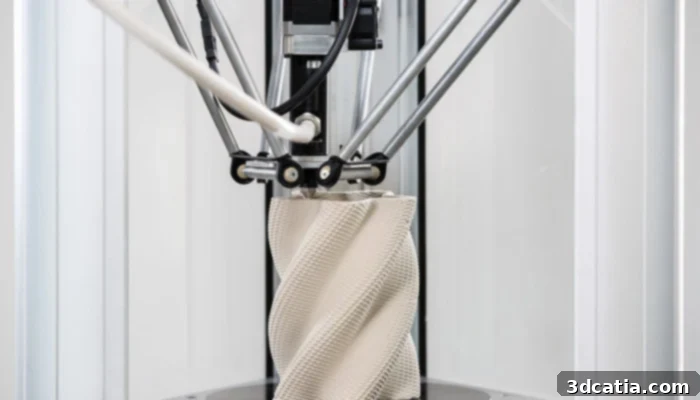
Grasshopper’s precision is highly beneficial for ceramic 3D printing, enabling intricate designs (photo credits: WASP)
Beyond its direct G-code generation capabilities, Grasshopper extends its utility by offering an array of powerful features for advanced design customization and optimization in 3D printing. The program empowers users to customize intricate infill patterns that go far beyond standard grid or honeycomb structures, allowing for tailored internal geometries that can optimize material quantity, enhance structural integrity, or achieve specific thermal properties. It also facilitates the seamless integration and manipulation of open-source objects and external geometric data, enabling complex Boolean operations and precise intersections to create highly articulated designs. Designers can generate elaborate surface patterns and textures, directly influencing the aesthetic and functional properties of the printed part. Crucially, Grasshopper provides unparalleled control over the exact path the extruder will follow, which is critical for managing material flow, preventing defects, and achieving specific surface finishes. A particularly significant benefit is its ability to streamline the creation of advanced lattice structures. These intricate, lightweight internal geometries are vital for optimizing the quantity of material to be printed, drastically reducing the weight of the final part while often maintaining or even improving its mechanical strength. Finally, Grasshopper dramatically simplifies the process of creating design iterations. By allowing designers to quickly adjust the parameters within their visual node diagram, they can rapidly generate and evaluate multiple design variations, enabling a much faster exploration of solutions and significantly reducing the potential for costly errors during the design and prototyping phases. For those eager to delve deeper into the vast capabilities of Grasshopper, additional information can be found by clicking HERE.
Are you currently harnessing the power of Grasshopper for your 3D printing projects or considering its integration into your workflow? We’d love to hear about your experiences and insights! Please share your thoughts in a comment below or connect with us on our social media channels: LinkedIn, Facebook, and Twitter. Don’t miss out on the latest advancements and news in the additive manufacturing world – be sure to sign up for our free weekly newsletter here, delivering the most important 3D printing updates straight to your inbox! You can also find all our comprehensive video content and tutorials on our YouTube channel.
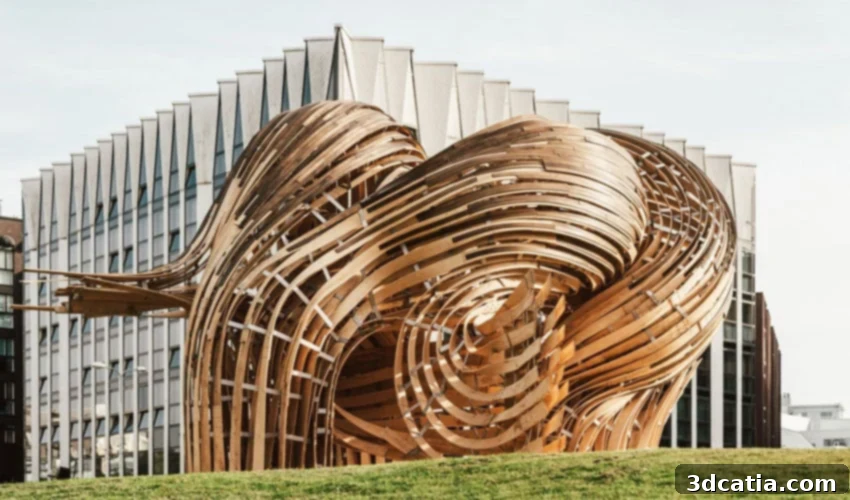
*Cover Photo Credits: Steampunk Pavilion © Tõnu Tunnel