
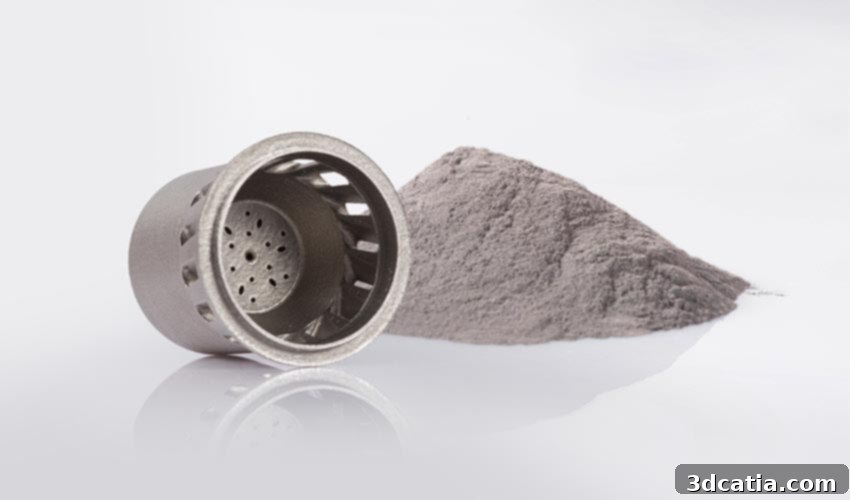
EOS Unveils Four Advanced Metal Materials to Propel Industrial Additive Manufacturing Forward
Leading innovator EOS has significantly expanded its material portfolio for metal additive manufacturing, introducing four new, high-performance materials designed to unlock novel applications and accelerate industrial-scale production. This strategic release underscores EOS’s commitment to pushing the boundaries of metal 3D printing, making it a more viable and competitive alternative to traditional manufacturing methods. The newly launched metal materials are EOS StainlessSteel CX, EOS Aluminium AIF357, EOS TitaniumTi64 Grade 5, and EOS Titanium Grade 23. These additions are poised to make a substantial impact across diverse industrial sectors, from the demanding requirements of automotive and aerospace engineering to the critical applications within the medical device industry. By enhancing material performance and providing extensive documentation, EOS aims to empower companies to seamlessly integrate Direct Metal Laser Sintering (DMLS) into their production workflows, facilitating a robust comparison against conventional fabrication techniques, and ultimately fostering greater adoption of metal additive manufacturing.
This latest release augments EOS’s already impressive offering of over 20 distinct metal materials, reinforcing its position as a key enabler in the industrialization of additive manufacturing. Hannes Gostner, Director of Research and Development at EOS, articulated the company’s foundational philosophy: “At EOS, the development of systems, materials, process parameters, software, and services has always gone hand in hand. All of the elements are perfectly aligned to each other. The result is reproducible high-quality parts at a competitive cost per part. This combination is of crucial importance, particularly for series manufacturing.” Gostner’s statement highlights EOS’s holistic ecosystem approach, where every component of the additive manufacturing process is meticulously developed in unison. This integrated strategy is fundamental to achieving the consistency, reliability, and cost-effectiveness essential for mass production. It signifies EOS’s unwavering belief that additive manufacturing has matured beyond prototyping and is unequivocally ready for demanding industrial-scale production, offering tangible benefits for companies seeking to innovate and optimize their manufacturing processes.
The four innovative materials – comprising one stainless steel, one aluminum, and two distinct grades of titanium – are all meticulously engineered for optimal performance with DMLS 3D printing technology. A cornerstone of EOS’s commitment to industrial readiness is providing unprecedented transparency and comprehensive documentation for its materials. Each new material is accompanied by a wealth of data, including the precise number of test specimens used to determine its mechanical properties, ensuring statistical validity and reliability. Furthermore, detailed scanning electron microscope (SEM) images are provided, offering invaluable insight into the microstructure and overall quality of the printed parts. This level of detail is critical for engineers and manufacturers who need to understand the material’s behavior, predict its performance in various applications, and gain confidence in comparing DMLS-produced components with those manufactured using traditional methods. Such rigorous validation and transparent data empower industries to confidently adopt these advanced materials for their most demanding applications, accelerating the transition to additive manufacturing for serial production.
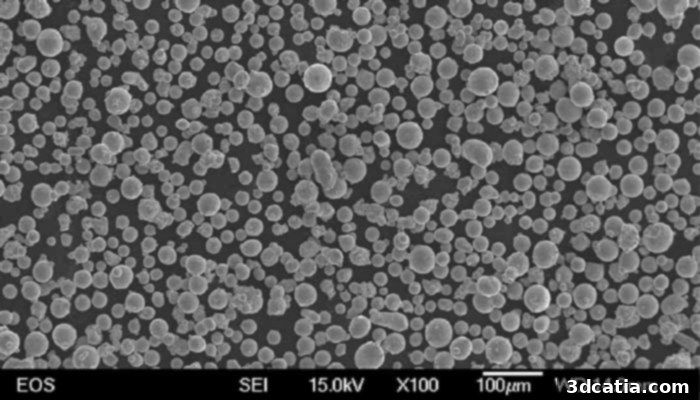
A SEM image of EOS StainlessSteel CX | Source: EOS
Unveiling the Advanced Properties of EOS’s New Metal Additive Manufacturing Materials
The introduction of these four new metal materials represents a significant leap forward in expanding the capabilities and applications of Direct Metal Laser Sintering (DMLS). Each material has been developed with specific industrial needs in mind, offering a unique combination of properties tailored for high-performance use cases. Let’s delve into the distinctive characteristics and intended applications of each new offering from EOS.
EOS StainlessSteel CX: Precision and Resilience for Tooling and Beyond
EOS StainlessSteel CX stands out as a pioneering tooling grade steel, meticulously engineered for production with the robust EOS M 290 3D printer. This material masterfully combines exceptional corrosion resistance with an impressive balance of high strength and hardness, making it an ideal choice for demanding industrial applications. Components fabricated from EOS StainlessSteel CX are not only celebrated for their durability and performance but also for their superior machinability and the ability to achieve an excellent polished finish. This combination of attributes is particularly beneficial in the tooling sector, where complex geometries, such as those found in conformal cooling channels for injection molds, can be realized with unprecedented precision and efficiency. The material’s corrosion resistance ensures longevity and reliability in harsh operating environments, while its hardness guarantees resistance to wear and deformation, critical for tools subjected to repetitive stress. The ease of post-processing, including machining and polishing, streamlines the manufacturing workflow, ultimately reducing overall production time and cost for high-quality, durable components.
EOS Aluminum AlF357: Lightweight Performance for Advanced Engineering
EOS Aluminum AlF357 emerges as a game-changer for applications where a lightweight yet incredibly strong material is paramount. It is the ideal choice for components that demand an exceptional blend of mechanical and thermal strength. Parts crafted from this advanced aluminum alloy are characterized by their remarkable lightweight properties, excellent corrosion resistance, and superior performance under high dynamic loading conditions. Originally developed and optimized for production with the high-throughput EOS M 400 system, there are strategic plans to make this versatile material also available for the widely used EOS M 290 system in the near future, broadening its accessibility and application scope. The lightweight nature of EOS Aluminum AlF357 makes it invaluable for the aerospace industry, where every gram saved contributes to fuel efficiency, and for the automotive sector, especially in the development of electric vehicles where weight reduction directly impacts range and performance. Its outstanding thermal strength ensures component integrity in high-temperature environments, while its ability to withstand high dynamic loading makes it suitable for structural components exposed to significant stress and vibration, guaranteeing reliability and safety in critical applications.
EOS Titanium Ti64 Grade 5: Uncompromised Fatigue Strength for Critical Applications
EOS Titanium Ti64 Grade 5 has been specifically developed to deliver exceptionally high fatigue strength, a critical property for components subjected to cyclic loading, without the need for hot isostatic pressing (HIP). This significant advantage streamlines the post-processing workflow, reducing both time and cost associated with part production. Designed for seamless production with the EOS M 290 system, this material also boasts excellent corrosion resistance, making it an indispensable choice for the most demanding applications in aerospace and automotive industries. In aerospace, its high fatigue strength ensures the structural integrity and long-term reliability of critical components such as airframe parts, brackets, and engine components, where failure is not an option. For automotive applications, particularly in high-performance or racing segments, components requiring robust fatigue resistance, like suspension parts or specialized engine components, greatly benefit from Ti64 Grade 5. The inherent corrosion resistance of titanium further ensures optimal performance in harsh environments, from extreme temperatures to exposure to various chemicals, extending the lifespan and reliability of printed parts.
EOS Titanium Ti64 Grade 23: Enhanced Toughness for Medical Innovation
Also developed with high fatigue strength without requiring hot isostatic pressing (HIP), EOS Titanium Ti64 Grade 23 is optimized for production with the EOS M 290. While sharing the excellent fatigue properties of Ti64 Grade 5, Ti64 Grade 23 distinguishes itself by offering improved elongation and superior fracture toughness, albeit with a slightly lower overall strength. These specific characteristics make it particularly well-suited for advanced medical applications. The enhanced elongation means the material can undergo greater deformation before fracturing, a crucial property for implants and prosthetics that must withstand dynamic biological loads and offer a degree of flexibility. The superior fracture toughness ensures that components are highly resistant to crack propagation, adding an extra layer of safety and durability for long-term use within the human body. Its biocompatibility, combined with the ability to create patient-specific geometries through DMLS, positions Ti64 Grade 23 as an ideal material for custom orthopedic implants, dental prostheses, and other complex medical devices that require both strength and a degree of inherent flexibility and resilience to prevent premature failure. This material truly exemplifies how additive manufacturing can revolutionize personalized healthcare solutions.
To further instill confidence and streamline industrial adoption, EOS has adopted the rigorous framework of Technology Readiness Levels (TRL), a system originally introduced by NASA for classifying technological maturity. All four of these groundbreaking materials are designated as PREMIUM materials, signifying their readiness for series production, with TRL ratings consistently between 7 and 9. This high TRL classification assures manufacturers that these materials have undergone extensive validation, testing, and optimization, proving their capability for reliable, high-volume production. It dramatically reduces the risk associated with adopting new technologies, providing a clear pathway from development to full-scale industrial application. Indeed, a core strategic objective for EOS is to actively facilitate and accelerate the transition towards mass production in additive manufacturing. By continuously developing and releasing materials with precisely engineered properties, combined with comprehensive data and validated performance, EOS is empowering industries worldwide to fully harness the transformative potential of metal 3D printing, driving innovation and efficiency across manufacturing sectors.
For more in-depth information and technical specifications about these latest material innovations, you can find further details HERE.
We’d love to hear your thoughts on these new additions to EOS’s material portfolio and how you envision them impacting the future of metal additive manufacturing! Share your insights and comments below, or connect with us on our Facebook and Twitter pages. Don’t miss out on the latest advancements and news in the world of 3D printing; remember to sign up for our free weekly Newsletter, delivered directly to your inbox!