
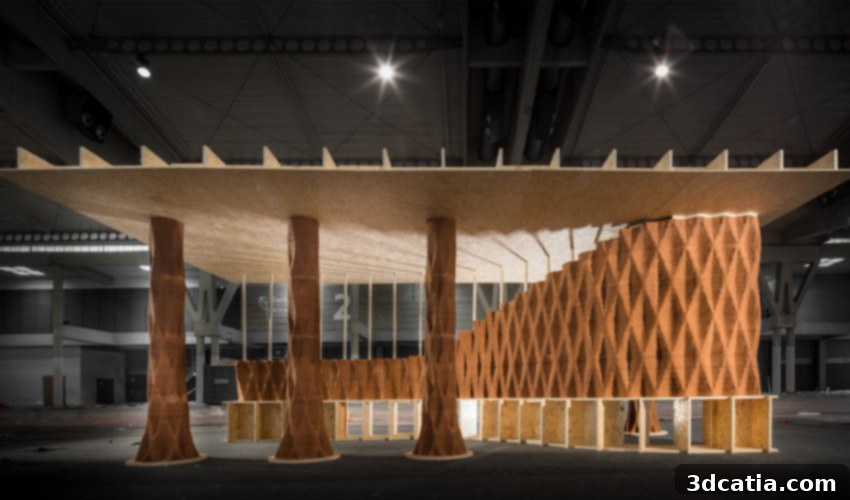
IAAC: Pioneering Sustainable Architecture Through 3D Printing and Advanced Robotics
The Institute for Advanced Architecture of Catalonia (IAAC), nestled in the vibrant city of Barcelona, stands as a beacon of innovation in the field of sustainable architectural development. Dedicated to reimagining the built environment, IAAC consistently pushes the boundaries of design and construction by harnessing the power of cutting-edge technologies, prominently featuring 3D printed houses and advanced robotics. Their ambitious mission is not merely to theorize about the future of our societies but to actively build it today.
In a compelling discussion, we had the privilege of speaking with Areti Markopoulou, the esteemed Academic Director of the Institute. Our conversation delved into the profound importance of 3D printing and additive manufacturing technologies in shaping the trajectory of modern architecture and construction.
The Genesis of IAAC: Pioneering New Technologies in Architecture
The establishment of IAAC was a direct response to the transformative emergence of new digital technologies and an increasingly information-driven world. Recognizing the paradigm shift these advancements presented, the Institute was founded with a clear vision: to cultivate future change-makers. These professionals are envisioned as innovators capable of devising processes and creating spaces that are not only more synchronized with our natural environment but also more interactive with their users. Furthermore, IAAC aims to equip them with the skills to address and influence significant social and economic challenges through their work. Central to this philosophy is the unwavering commitment to leveraging new technologies to give tangible form to novel ideas in both design and construction, ensuring that architectural practice remains at the forefront of global progress.
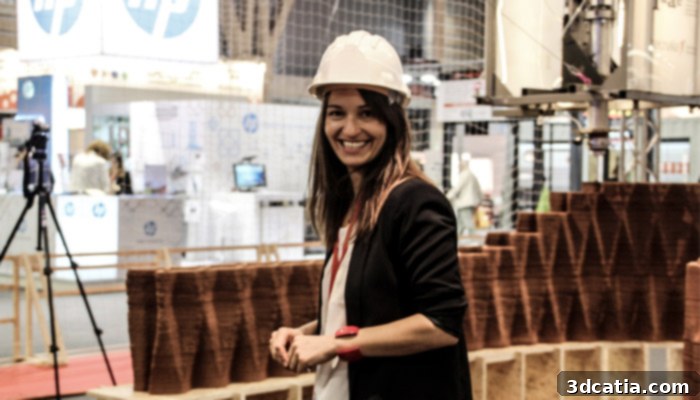
Areti Markopoulou, Academic Director of the Institute
IAAC’s Pioneering Research in Additive Manufacturing for Architecture
For over a decade, IAAC has been at the vanguard of integrating 3D printing into the realm of architecture. Their research journey has seen them evolve from crafting experimental prototypes to realizing tangible infrastructures and fully functional buildings. A testament to this pioneering spirit is the world’s first 3D printed pedestrian bridge, an innovative structure inaugurated a year ago in Alcobendas park in Madrid. This groundbreaking project underscores IAAC’s commitment to moving beyond theoretical concepts to practical, real-world applications. Currently, the Institute is channeling its research efforts into two primary and highly promising areas:
1. Advanced Materials for Sustainable 3D Printed Buildings
IAAC’s researchers are deeply engaged in exploring and developing novel materials for 3D printing, with a strong emphasis on sustainability. Their investigations focus on printing buildings and structures using 100% natural, locally sourced, and often recycled materials. This includes raw earth, primarily uncooked clay, and bioplastics derived from urban organic waste. The use of raw earth, when combined with intelligent, customized designs, facilitates the creation of “passive buildings.” These structures are inherently designed to maintain comfortable indoor temperatures, requiring minimal energy for heating or cooling, thus drastically reducing their operational carbon footprint. Furthermore, bioplastics, repurposed from waste streams, present immense potential as a new generation of sustainable construction materials, significantly contributing to urban waste reduction, material reuse, and the broader circular economy within our cities.
Simultaneously, IAAC is exploring the frontier of 3D printing with graphene compounds, often hailed as the material of the future due to its exceptional properties. The goal here is to create architectural elements embedded with integrated intelligence. Imagine building facades or structural components that can not only generate and store energy but also wirelessly distribute real-time data without the need for cumbersome cables or electrical plugs. This represents a monumental leap forward, enabling future buildings to seamlessly exchange energy and information. Such integrated intelligence would allow structures to better synchronize with their occupants’ needs and the dynamic environmental conditions, fostering truly responsive and efficient living spaces.
2. On-Site Robotics: Bringing 3D Printing to the Construction Site
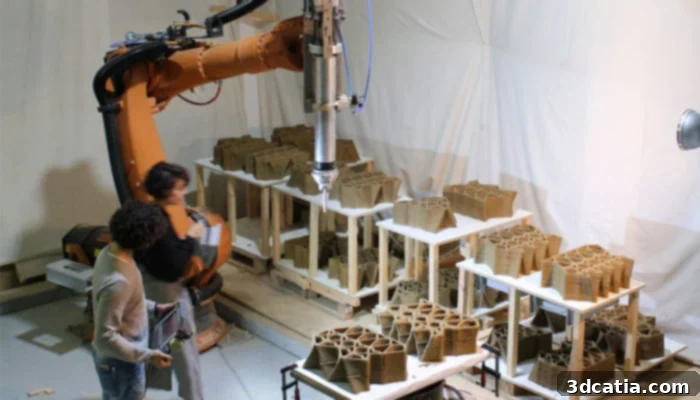
One of IAAC’s most ambitious undertakings is the endeavor to bring 3D printing technology directly to the construction site – a concept they term “On-Site Robotics.” This groundbreaking approach aims to integrate automation into the actual construction location, thereby eliminating the need for pre-printing parts in off-site factories and transporting them. The implications of this are vast: it would enable construction in remote or challenging environments where traditional infrastructure is scarce or non-existent. By leveraging local resources and minimizing the transport of heavy machinery and materials, this method promises a significant reduction in logistical complexities, costs, and environmental impact.
To achieve this vision, IAAC is actively developing new generations of 3D printing machines specifically designed for large-scale construction. These innovations seek to overcome the traditional limitations imposed by the physical size of the printer. For instance, their research includes exploring 3D printing capabilities using mobile cable robots and even drones. These versatile robotic systems can print components far larger than their own physical dimensions, offering unprecedented flexibility and reach on a construction site. Moreover, these intelligent systems can continuously monitor the state of construction in real-time, enhancing precision, quality control, and overall project efficiency.
The Transformative Importance of 3D Printing in Modern Architecture
The relationship between 3D printing and architecture is increasingly vital, holding the promise of profoundly reshaping how we design, build, and inhabit our world. Looking ahead, 3D printing is poised to enable construction that is faster, more cost-effective, and fundamentally more sustainable than traditional methods. Beyond mere efficiency, it will usher in a new era of architectural aesthetics, allowing for the exploration of novel materials and the creation of complex, organic forms that were previously impossible or prohibitively expensive to achieve. Architects will soon be able to materialize intricate designs with the click of a mouse, transforming digital blueprints into physical realities with unprecedented ease.
The urgency for such innovation is underscored by global demographic trends. According to the United Nations, the world will require approximately 100,000 new homes every day for the next 15 years to accommodate population growth. The ability to rapidly construct affordable and high-quality housing is not merely an ambitious idea; it is a pressing global necessity. 3D printing offers a scalable and efficient solution to this monumental challenge, enabling the rapid deployment of housing solutions where they are most needed, helping to alleviate housing crises worldwide.
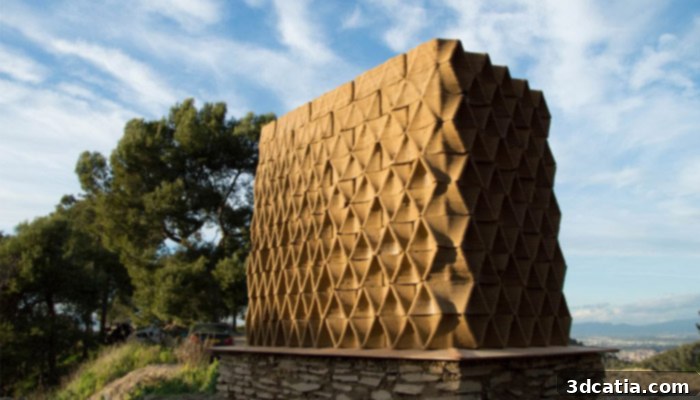
While 3D printing is unlikely to completely replace conventional architectural construction techniques, its role will be instrumental in optimizing numerous production and assembly processes. It introduces new, more efficient, and sustainable construction tools and methodologies, driving an evolution rather than a revolution in the industry. However, it is crucial to recognize that 3D printing is just one facet of a broader wave of technical innovations set to define 21st-century architecture. Technologies such as the Internet of Things (IoT), intelligent and biological materials, augmented reality (AR), and artificial intelligence will collectively converge to fundamentally transform existing construction models, creating smart, adaptive, and environmentally conscious buildings for the future.
IAAC’s Vision for the Future in Spain and Europe
IAAC is resolutely focused on translating its pioneering research into practical, real-world applications. The Institute’s next significant challenge is to successfully 3D print an entire house, pushing the boundaries of what is currently possible in automated construction. To achieve this ambitious goal, IAAC has forged strategic collaborations with leading research centers and prominent construction companies across Spain and Europe, as well as extending its partnerships to China and the USA. This global collaborative effort underscores the monumental scale of the undertaking and the collective commitment to advancing construction technologies worldwide.
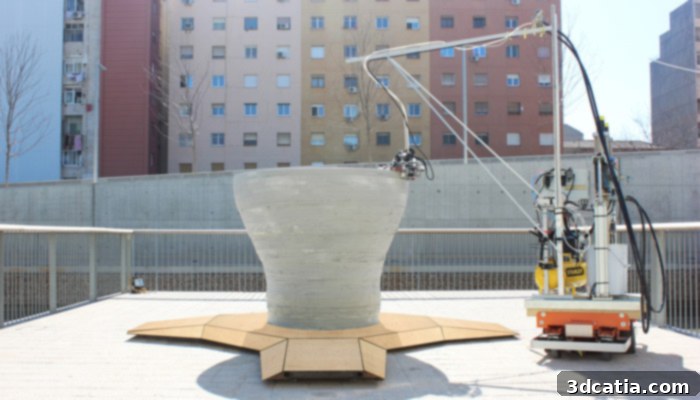
IAAC’s ‘Grip’ robot.
IAAC’s Educational Philosophy and Target Audience
IAAC’s educational programs and research initiatives are designed to attract and nurture individuals who aspire to make a significant positive impact on pressing social, economic, and environmental challenges. As a multidisciplinary education and research center, IAAC thrives on projects that span a vast spectrum—from the intricate development of micro-sensors and advanced robotics to the comprehensive planning of entire buildings and expansive urban layouts. The Institute actively seeks out individuals who possess a natural curiosity, relish the process of learning through experimentation and hands-on application, and are willing to step outside their comfort zones. At IAAC, students are not only taught innovative ways of thinking and problem-solving but are also encouraged to contribute to a vibrant environment of continuous learning, where faculty and students alike are constantly evolving and discovering new frontiers.
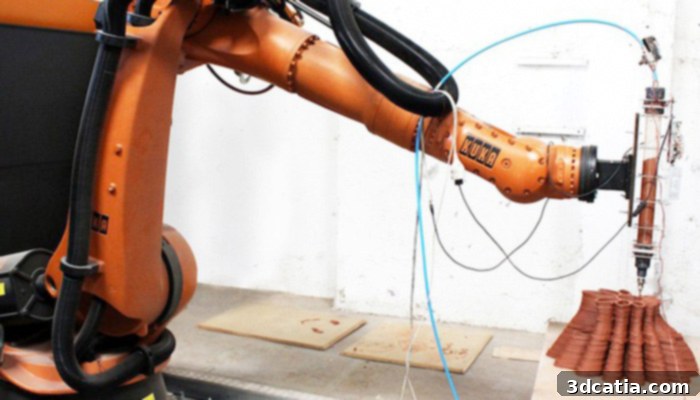
A Message from IAAC: Asking the Right Questions
Reflecting on the rapid advancements in technology, Areti Markopoulou offers a profound insight: “Technologies can only be the answer if we know how to ask the right questions!” This statement encapsulates IAAC’s core philosophy—that innovation must be guided by purpose, foresight, and a deep understanding of the challenges we aim to solve.
What are your thoughts on IAAC’s groundbreaking work in sustainable architecture and 3D printing? Share your insights and join the conversation in the comments below or connect with us on our Facebook and Twitter pages! Don’t forget to sign up for our free weekly Newsletter to receive all the latest news and innovations in 3D printing delivered straight to your inbox!