
Hitachi Rail Accelerates Railway Innovation with Roboze 3D Printing: A New Era for Manufacturing and Spare Parts
The railway industry, a cornerstone of global transportation and logistics, is undergoing a profound transformation. Faced with the constant challenge of needing to supply highly specialized parts with advanced properties in increasingly shorter timeframes, traditional manufacturing methods often struggle to keep pace. This imperative for speed, precision, and material innovation has propelled additive manufacturing, commonly known as 3D printing, to the forefront as a game-changing solution. Leading players in the sector are recognizing its immense potential to enhance operational efficiency, streamline supply chains, and unlock new possibilities in design and material science.
A testament to this growing trend is the strategic partnership recently announced between Hitachi Rail, a global pioneer with a rich history in the rail industry, and Roboze, an Italian-American manufacturer renowned for its high-performance 3D printers. This collaboration signifies a major leap forward in integrating advanced manufacturing technologies into railway operations. Hitachi Rail plans to bolster its capabilities by installing state-of-the-art Roboze ARGO 500 3D printers at two key facilities: its high-tech plant in Naples, Italy, and its brand-new facility in Washington County, Maryland, USA. This dual deployment underscores Hitachi Rail’s commitment to leveraging 3D printing across its international operations for immediate and long-term benefits.
Hitachi Rail’s Global Reach and Local Commitment
With an impressive annual revenue exceeding $7 billion and a dedicated workforce of 24,000 employees spread across more than 50 countries, Hitachi Rail stands as a truly global entity. Yet, its strength lies not only in its expansive reach but also in its unwavering focus on local operations. The company consistently invests in the communities and people where it operates, fostering local talent and contributing to regional economic development. While globally recognized for iconic achievements such as Japan’s high-speed bullet train, Hitachi Rail is committed to achieving excellence in every market. This strategic approach ensures that global expertise is tailored to meet local demands, a principle perfectly exemplified by its significant investments and operations in Italy and the United States.

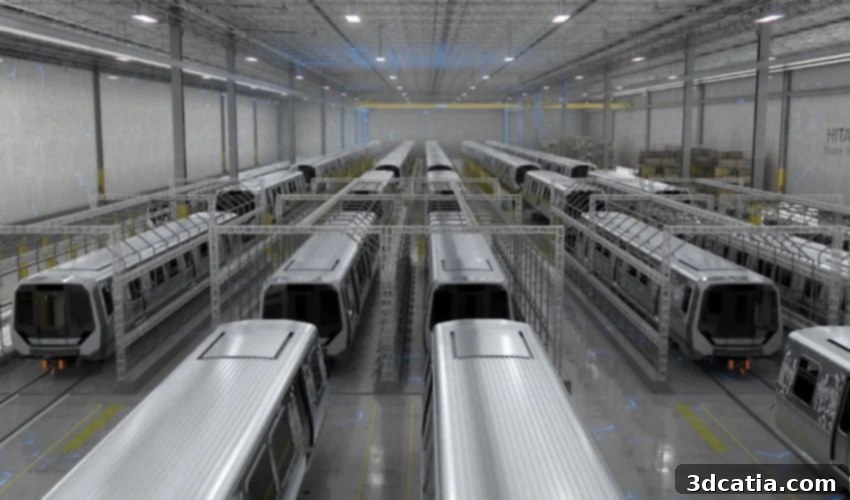
Hitachi Rail has signed a contract with the City of Naples to supply 22 trains by 2025 for the city’s new Metro Line 6 (photo credits: City of Naples)
Addressing Key Challenges: Spare Parts and Efficiency through Additive Manufacturing
The primary impetus behind the partnership between Hitachi Rail and Roboze is the critical need to resolve long-standing issues within the rail industry, particularly the limited availability of spare parts and the exorbitant costs associated with traditional manufacturing processes. Maintaining extensive inventories of physical spare parts for an array of train models, some decades old, is an incredibly expensive and logistically complex endeavor. Furthermore, sourcing custom-machined metal components can lead to protracted lead times, causing significant delays in maintenance and repair, ultimately impacting service reliability and operational continuity.
By implementing the cutting-edge Roboze ARGO 500 solution, Hitachi Rail is set to revolutionize its approach to part production. The plan involves a strategic shift from conventionally machined metal parts – often produced through chip removal methods – to advanced 3D printed components. These parts will be fabricated using high-performance engineering materials such as ULTEM™ 9085 and Carbon PEEK. This transition is not merely about adopting a new technology; it’s about fundamentally transforming the supply chain. By embracing additive manufacturing, Hitachi Rail anticipates a dramatic reduction in both the financial costs and the lead times associated with procuring and producing vital components for its extensive fleet of trains.
The choice of materials like ULTEM™ 9085 and Carbon PEEK is particularly significant for the demanding environment of the railway industry. These advanced thermoplastics offer a unique combination of properties, including exceptional strength-to-weight ratios, high temperature resistance, chemical inertness, and superior flame retardancy. Such characteristics are crucial for ensuring the safety, durability, and performance of railway components, often exceeding the capabilities of traditional plastics and offering a viable alternative to certain metals. This capability allows for the production of lightweight parts that contribute to improved energy efficiency for the trains themselves, without compromising structural integrity or safety standards.
Beyond the Machines: Roboze’s Engineering Expertise and Support
The partnership extends far beyond the mere supply of 3D printing equipment. Hitachi Rail will also gain invaluable access to the extensive engineering services and expert advice provided by ROBOZE’s highly skilled teams. Operating in both the United States and Italy, these experts will collaborate closely with Hitachi Rail engineers, providing critical support in design optimization for additive manufacturing (DfAM), material selection, process validation, and application development. This integrated approach ensures that Hitachi Rail can fully harness the potential of 3D printing, moving from initial concept and prototyping to the successful production of end-use parts. Roboze’s commitment to offering comprehensive support ensures that Hitachi Rail can rapidly integrate this new technology and maximize its operational benefits, accelerating innovation and overcoming potential technical hurdles with specialist guidance.
Hitachi Rail’s Strategic Deployment of 3D Printing in Key Projects
Transforming Production at the Washington Metro Project
In 2021, Hitachi Rail secured a significant contract with the Washington Metropolitan Area Transit Authority (WMATA), valued at up to $2.2 billion. This contract is for the supply of next-generation carriages for the Washington Metro, a vital public transportation system. To fulfill this monumental order, Hitachi Rail is establishing a brand-new, state-of-the-art train factory in Washington County, Maryland, representing a substantial investment of $70 million. This facility is specifically designed to deliver a new fleet of 8000-series subway cars, setting new benchmarks in modern rail transport.
The Maryland factory is envisioned as Hitachi Rail’s most advanced digital site globally, drawing upon the comprehensive technological expertise of the entire Hitachi Group. Within this highly innovative environment, 3D printing will play a pivotal role. It will be utilized extensively for the rapid production of prototypes, allowing for quick design iterations and validation, thereby significantly shortening development cycles. More importantly, additive manufacturing will also be employed for the on-site production of various end-use parts, ranging from interior components to maintenance spares. This localized, on-demand manufacturing capability will ensure greater supply chain resilience, customization options, and ultimately, faster deployment of new trains and efficient maintenance throughout their operational lifespan.
Modernizing the Naples Metro Line 6 in Italy
Concurrently, Hitachi Rail’s Italian plants, particularly the one in Naples, are engaged in major ongoing projects aimed at enhancing local transportation infrastructure. One of the flagship initiatives is the delivery of 22 new trains by 2025 for the Naples Metro Line 6. These new trains are engineered to offer significantly higher capacity and enhanced passenger experience compared to the older models currently in service, reflecting a commitment to modernizing urban mobility.
Looking further ahead, between the summer of 2025 and December 2026, an additional six new trains are scheduled for delivery. This continuous infusion of advanced rolling stock is designed to make the Naples Metro Line 6 not only faster and more efficient but also more state-of-the-art, ensuring a superior public transport experience for the city’s residents. In this context, the integration of the Roboze ARGO 500 at the Naples plant will facilitate the rapid production of crucial components for these new trains, supporting both initial manufacturing and ongoing maintenance needs with unprecedented agility.
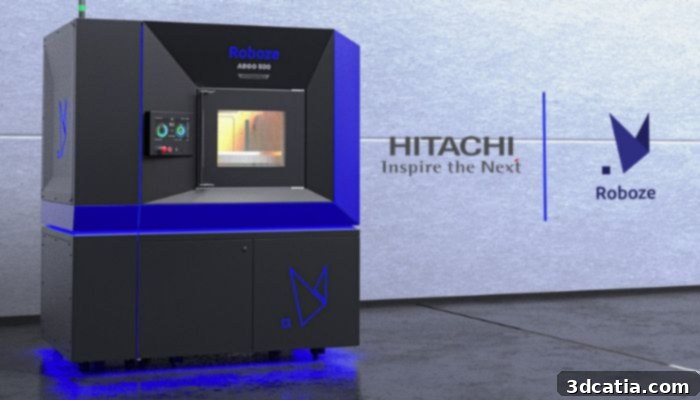
The Roboze ARGO 500 3D printer (photo credits: Hitachi Rail)
Leadership Perspective: A Commitment to Advanced Manufacturing and Operational Excellence
Commenting on this pivotal collaboration, Luca D’Aquila, COO Hitachi Rail Group and CEO Hitachi Rail Italy, emphasized the strategic importance of the partnership: “Our partnership with ROBOZE underlines our commitment to delivering advanced, high-quality manufacturing for our customers. The partnership will enable us to harness 3D printing to improve operational efficiency and reduce costs for producing prototypes and railway spare parts.” His statement clearly articulates Hitachi Rail’s vision: a dedication to quality and a pragmatic approach to innovation, where additive manufacturing serves as a powerful tool to achieve both efficiency gains and significant cost reductions across the entire lifecycle of railway components. This reflects a forward-thinking approach that prioritizes both technological advancement and tangible business outcomes.
The Broader Implications: Sustainability, Agility, and the Future of Rail Manufacturing
Hitachi Rail’s decisive move to adopt 3D printing on such a large scale unequivocally underscores the escalating importance and transformative potential of this technology within the global rail industry. By enabling a more agile, decentralized, and highly focused production of parts, additive manufacturing transcends mere production efficiency. It paves the way for a paradigm shift towards more digital, sustainable, and resilient manufacturing processes. The benefits are multifaceted:
- Optimized Costs: Reducing the need for expensive tooling, minimizing material waste, and streamlining inventory management.
- Reduced Lead Times: Enabling on-demand production and rapid prototyping, drastically cutting the time from design to deployment.
- Material Efficiency: Producing complex geometries with minimal waste and utilizing high-performance materials precisely where needed.
- Enhanced Design Freedom: Allowing for the creation of lighter, more structurally optimized, and functionally integrated components that would be impossible or prohibitively expensive with traditional methods.
- Sustainability: Lowering carbon footprint through local production, reduced transportation, and the ability to manufacture lighter components that improve fuel efficiency for trains.
- Supply Chain Resilience: Creating a more robust supply chain less susceptible to disruptions, as parts can be printed locally and on demand.
This forward-looking adoption signifies a critical step towards continuous technological advancement and innovation in the railway sector. As the industry continues to evolve, the ability to rapidly produce specialized, high-performance parts will be paramount for maintaining competitive edge, ensuring operational uptime, and delivering superior service to passengers and freight customers alike. The partnership between Hitachi Rail and Roboze serves as a compelling blueprint for how advanced manufacturing can drive a smarter, more efficient, and sustainable future for global rail transportation.
Engage with Us
What are your thoughts on the increasing use of 3D printing in the railway industry? Do you foresee this technology becoming standard practice for manufacturing and maintenance? Share your insights in a comment below or connect with us on our LinkedIn, Facebook, and Twitter pages! Don’t miss out on the latest advancements and news from the additive manufacturing world – sign up for our free weekly newsletter here to receive updates directly in your inbox. You can also explore all our informative videos and exclusive content on our YouTube channel.
*Cover Photo Credits: Hitachi Rail