

McLaren Racing: Driving F1 Innovation and Sustainability with Cutting-Edge 3D Printing
In a significant stride towards the future of sustainable engineering and advanced manufacturing, McLaren Racing, renowned as Formula 1’s pioneering carbon-neutral team, has fully embraced 3D printing as the fundamental cornerstone of its rapid prototype development process. This transformative shift marks a pivotal moment for the sport, as McLaren now reports producing more prototypes through additive manufacturing than through traditional engineering methods. This strategic transition not only underscores McLaren’s unwavering commitment to fostering innovation and achieving unparalleled performance but also highlights its dedication to significantly reducing its environmental footprint within the fiercely competitive world of Formula 1 racing. By leveraging the power of 3D printing, McLaren is not just competing; it is actively setting new benchmarks for efficiency, design agility, and ecological responsibility, influencing the broader automotive and manufacturing sectors.
McLaren’s deep-rooted commitment to pushing the boundaries of innovation and championing sustainability is vividly demonstrated within its state-of-the-art 3D printing laboratory. This unique and dynamic space, nestled within their bustling Southwest London headquarters, serves as the nerve center for advanced additive manufacturing operations. This vibrant hub is equipped with an impressive array of over 20 advanced Stratasys printers, a fleet capable of producing a staggering volume of more than 9,000 distinct parts annually. These components are incredibly diverse, ranging from meticulously crafted, intricate wind tunnel models – crucial for aerodynamic analysis and optimization – to vital aerodynamic elements that directly influence a car’s performance, such as precision-engineered front and rear wings, complex side bodywork, and essential upper body components. Under the visionary leadership of McLaren’s Chief Operating Officer Piers Thynne, this advanced approach ushers in a new era of sustainable rapid prototyping. Each part is meticulously crafted with unparalleled precision, ensuring optimal functionality while simultaneously achieving minimal material waste, thus aligning with McLaren’s overarching environmental goals. This facility isn’t just about making parts; it’s about making them smarter, faster, and more responsibly.
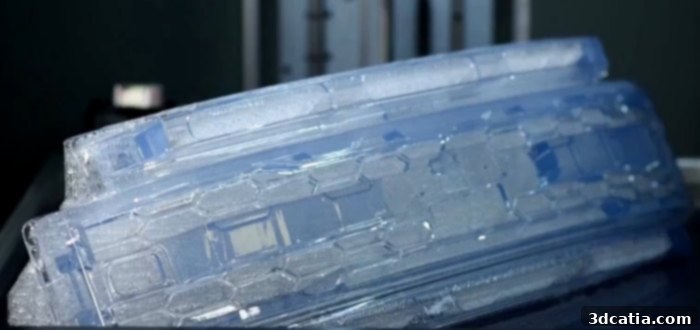
A 3D printed McLaren F1 prototype part showcasing complex geometries.
The design and manufacturing of a Formula 1 car are an engineering marvel, characterized by immense complexity and the continuous pursuit of marginal gains. Consider the front wing assembly alone: it demands thousands of individual parts, many of which are specifically designed for single-use testing or rapid iteration. In such a high-stakes environment, material choice and manufacturing agility are paramount. McLaren’s strategic and deeply integrated partnership with Stratasys, a globally recognized leader in 3D printing and additive manufacturing solutions, has proven instrumental. This collaboration has empowered the McLaren team to harness a diverse and advanced range of printing filaments, including cutting-edge carbon fiber composites known for their exceptional strength-to-weight ratio, and increasingly, innovative recycled materials. This symbiotic relationship not only significantly enhances the performance characteristics of the produced parts – contributing to improved aerodynamics, reduced weight, and increased structural integrity – but also aligns seamlessly with McLaren’s ambitious vision for a greener, more sustainable future in motorsport. By embracing these advanced materials and manufacturing techniques, McLaren is demonstrating that high performance and environmental responsibility can, and indeed must, go hand-in-hand.
The broader additive manufacturing industry is keenly aware of the growing imperative for sustainable practices. Yann Regeul, Senior Vice President at Stratasys, eloquently articulated this shift, emphasizing the critical move towards utilizing recycled filaments and minimizing manufacturing waste across the sector. Regeul stated, “The ability to print 100% recycled filament with our new OpenAM software is really a change for the industry, enabling McLaren to significantly reduce their waste—a top preoccupation for most customers today.” This statement highlights not just a technological advancement but a fundamental philosophical change in manufacturing. For McLaren, this translates into tangible benefits: significantly reduced material consumption, lower energy usage compared to traditional methods that involve machining from solid blocks, and a substantial decrease in the volume of waste destined for landfills. This commitment to recycled materials and waste reduction positions both McLaren and Stratasys at the forefront of eco-conscious engineering, demonstrating that environmental stewardship can be integrated into even the most demanding and performance-driven industries.
The implementation of 3D printing technology has profoundly impacted McLaren’s operational efficiency and environmental footprint. By bringing production in-house and leveraging the speed of additive manufacturing, McLaren has drastically streamlined various production processes. This move has successfully curtailed the often-prohibitive long delivery times associated with outsourcing specialized components, thereby accelerating the entire development cycle. The benefits extend far beyond race car parts, encompassing a wide array of auxiliary equipment critical to garage operations and car maintenance. This includes the rapid production of bespoke fixtures, custom jigs, and small, intricate molds. Traditionally, these essential tools required lengthy, laborious, and costly production processes, often involving subtractive machining from solid blocks of metal, which inevitably generated significant material waste and consumed considerable energy. With 3D printing, these items can be designed, iterated, and produced on-demand, often overnight, using precise material quantities and reducing lead times from weeks to mere days or even hours. This not only enhances agility on and off the track but also contributes substantially to a more sustainable and resource-efficient operational model.
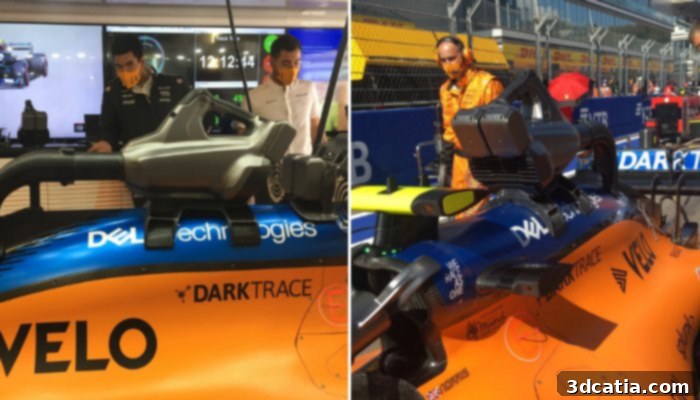
A highly efficient 3D printed engine cooling duct meticulously fitted on a McLaren F1 racecar, demonstrating real-world application.
The profound advantages of McLaren’s additive manufacturing strategy resonate deeply within the Formula 1 community. Jeremy Hart, a highly respected veteran F1 commentator, eloquently captured the essence of this transformation, stating, “Formula 1 is the most advanced sport on the planet, and therefore it’s great to find ways to cut down waste and to be more efficient in terms of how it produces its cars.” This observation underscores the critical role that F1 plays as a proving ground for cutting-edge technologies that ultimately trickle down to broader industrial applications. McLaren’s proactive integration of 3D printing aligns perfectly with Formula 1’s ambitious trajectory toward achieving net-zero carbon emissions by 2030, a monumental goal that includes mandatory sustainability enhancements for all cars by 2026. By embracing and championing these eco-friendly engineering practices, McLaren not only fortifies its competitive edge but also unequivocally cements its role as a trailblazer and a leading innovator in advancing sustainable and environmentally responsible racing practices, setting an inspiring example for the entire motorsport world and beyond.
The Multifaceted Advantages of 3D Printing in F1 Engineering
Beyond sustainability, the adoption of 3D printing offers McLaren a suite of unparalleled advantages critical for success in Formula 1. Firstly, **unprecedented design freedom** is a game-changer. Additive manufacturing allows engineers to create highly complex geometries and intricate internal structures that are impossible with traditional manufacturing methods. This translates into parts that are lighter, stronger, and more aerodynamically efficient, directly contributing to performance gains measured in milliseconds. Engineers can optimize airflow paths, design lightweight lattice structures, and integrate multiple components into a single print, reducing assembly time and potential failure points. This capability is vital for components like brake ducts, engine covers, and aerodynamic appendages where every gram and every millimeter of design optimization counts.
Secondly, **accelerated iteration and testing cycles** are inherent to 3D printing. In the relentlessly fast-paced world of F1, where car designs evolve constantly throughout a season, the ability to rapidly design, print, test, and refine parts is invaluable. McLaren can now produce a new prototype part, test it in the wind tunnel or on the track, analyze its performance, and implement design modifications within days, rather than weeks or months. This agility allows the team to react swiftly to performance challenges, exploit new design ideas, and adapt to changing regulations more effectively than ever before, giving them a crucial competitive advantage on the grid.
Thirdly, **cost efficiency and material optimization** are significant benefits, especially over the long term. While the initial investment in 3D printing technology can be substantial, the operational savings are considerable. Additive manufacturing uses only the material necessary for the part, drastically reducing waste compared to subtractive methods. Furthermore, the ability to print custom tools, jigs, and fixtures on-demand eliminates the need for expensive, specialized tooling from external suppliers, further streamlining costs and supply chains. This localized and efficient production model empowers McLaren to maintain tighter control over its intellectual property and manufacturing processes.
Finally, **enhanced performance through advanced materials** is a continuous area of innovation. The partnership with Stratasys allows McLaren to experiment with and implement a wide range of high-performance materials, from advanced polymers infused with carbon fiber to resilient thermoplastics. These materials can withstand the extreme temperatures, immense forces, and high-vibration environments characteristic of Formula 1. The ability to precisely control material properties and internal structures through 3D printing enables the creation of parts with tailored characteristics – whether it’s improved heat resistance, increased impact absorption, or superior stiffness – all contributing to the overall reliability and performance of the F1 car.
The Future Landscape: 3D Printing’s Impact on F1 and Beyond
McLaren’s pioneering work with 3D printing serves as a compelling blueprint for the future of high-performance engineering, not just in Formula 1 but across the entire automotive industry and beyond. The insights gained from pushing additive manufacturing to its limits in the crucible of F1 will undoubtedly accelerate the development of more advanced materials, sophisticated printing technologies, and refined design methodologies. We can anticipate further integration of 3D printing for critical, end-use parts, moving beyond just prototyping. The vision of “digital spare parts” – where components are printed on-demand at race locations, eliminating the need for extensive physical inventories – is becoming increasingly feasible. This paradigm shift holds the promise of even greater efficiency, cost reduction, and environmental benefits, fundamentally transforming global supply chains. As F1 continues its drive towards full sustainability, McLaren’s commitment to 3D printing will remain a cornerstone of its strategy, ensuring it stays at the vanguard of both performance and environmental responsibility in motorsport.
What are your thoughts on McLaren’s groundbreaking switch to 3D printing for prototyping and beyond? We encourage you to share your insights in a comment below or join the conversation on our LinkedIn, Facebook, and Twitter pages! For the very latest advancements in additive manufacturing and 3D printing news delivered directly to your inbox, don’t forget to sign up for our free weekly newsletter here. You can also explore all our informative videos and engaging content on our dedicated YouTube channel.
*All Photo Credits: Stratasys