
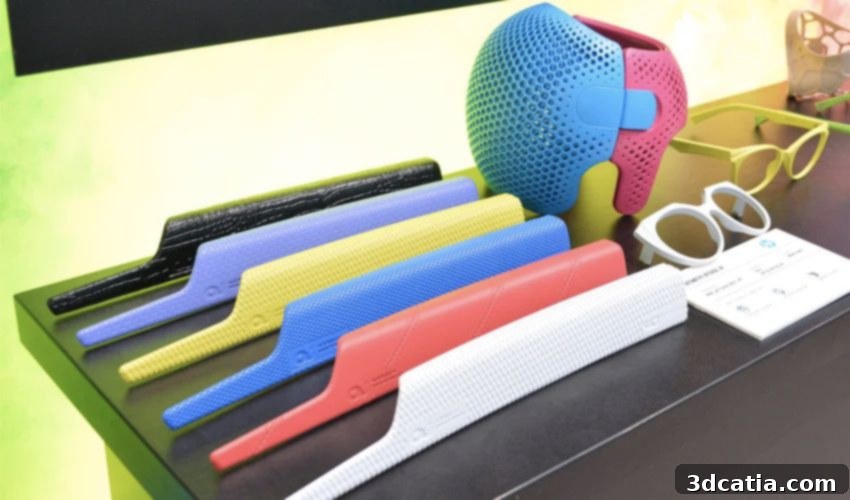
Formnext 2022: Unveiling the Latest Innovations in 3D Printing Materials and Additive Manufacturing
The realm of additive manufacturing is continuously evolving, with 3D printing materials standing out as one of its most pivotal elements. These materials are fundamental, dictating the mechanical, chemical, and functional properties of the final printed part. From robust polymers to high-performance metals, and even specialized substances like silicone and advanced ceramics, the diversity and capabilities of 3D printing materials are expanding at an unprecedented rate. Such innovations empower users to engineer components that are not only more resistant and lighter but also possess enhanced flexibility, durability, and specific functionalities tailored to complex industrial demands. These advanced materials are crucial for meeting the stringent requirements of demanding sectors, including aeronautics, medical device manufacturing, and the automotive industry, where precision, reliability, and performance are paramount. Formnext 2022, a premier global exhibition for additive manufacturing and industrial 3D printing, served as a crucial platform to showcase these groundbreaking advancements. This article delves into the most compelling material innovations presented at Formnext 2022, highlighting how leading companies are pushing the boundaries of what’s possible with 3D printing.
Elkem Silicones: Pioneering Advancements in Silicone 3D Printing
Silicone, a material celebrated for its unique properties such as flexibility, biocompatibility, and resistance to extreme temperatures, is rapidly gaining traction within the additive manufacturing market. Its versatility makes it an attractive solution for a myriad of industries, from healthcare to consumer goods. Elkem Silicones, a long-standing specialist in silicone technology, continues to lead the charge in this sector. At Formnext 2022, Elkem Silicones significantly expanded its material portfolio for additive manufacturing, introducing new additions to its well-regarded AMSil™ and AMSil™ Silbione™ ranges. The company proudly announced its capability to offer a broad spectrum of silicones, ranging from ShoreA 10 to ShoreA 70, specifically formulated for Liquid Deposit Molding (LMD) based processes. This wide range of hardness allows for the creation of parts with varying degrees of flexibility and rigidity, addressing a broader array of application requirements.
Further enhancing design freedom, Elkem Silicones also unveiled AMSil™ 92100, an innovative water-soluble support material. This breakthrough is particularly exciting as it enables the fabrication of even more intricate and complex geometries that would otherwise be challenging or impossible to produce with traditional support structures. The ability to easily dissolve support material post-printing streamlines the production process and reduces the risk of damaging delicate parts. Visitors to Elkem Silicones’ booth F91 in Hall 12.1 at Formnext 2022 had the opportunity to witness live demonstrations of these materials in action. A standout feature at their booth was a Swiss Deltatower 3D printer, configured to simultaneously print parts using multiple silicones. This multi-material printing capability allows for the creation of elastomeric components exhibiting different Shore hardnesses within a single part, opening up new possibilities for functional designs with localized properties. Such innovations are poised to revolutionize how industries approach the design and manufacturing of silicone-based products. For more in-depth information, interested parties are encouraged to explore Elkem Silicones’ dedicated additive manufacturing solutions HERE.
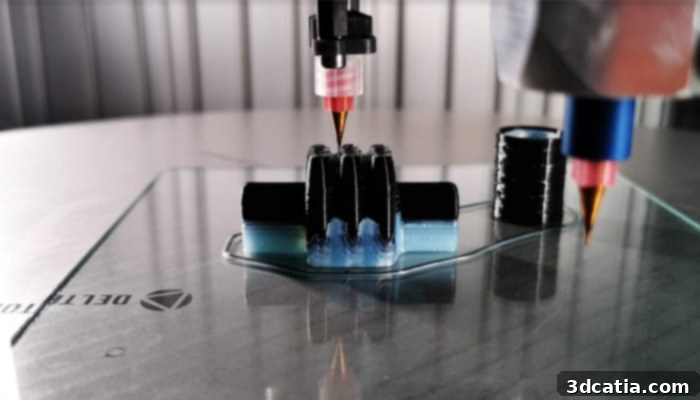
Photo credits: Elkem Silicones showcasing their advanced silicone 3D printing solutions.
Sandvik’s Expanded Range of High-Performance Metallic Powders
Continuing our exploration of cutting-edge 3D printing materials, we turn our attention to Swedish metal powder manufacturer Sandvik, a global leader renowned for its advanced materials and comprehensive manufacturing solutions. At Formnext 2022, Sandvik significantly bolstered its esteemed Osprey® range of metal powders, which are highly regarded for their consistent quality and optimal performance in additive manufacturing applications. The most notable expansion to the Osprey® collection was the introduction of a new copper powder. This specialized copper powder, characterized by its fine and medium particle sizes, is engineered to offer exceptionally high thermal and electrical conductivity. These properties are critical for components where efficient heat transfer or superior electrical performance is required, such as in heat exchangers, electrical connectors, and various electronic applications.
The inclusion of copper into the Osprey® portfolio is a strategic move that addresses a growing demand for materials capable of meeting the rigorous performance requirements of modern industrial applications. Its excellent thermal expansion coefficient matching further ensures structural integrity and reliability in multi-material assemblies or fluctuating temperature environments. More broadly, Sandvik’s Osprey® range of metal powders has already established itself as a preferred choice across a diverse array of demanding sectors. These include the production of high-precision medical implants, intricate aerospace components where lightweight and high-strength properties are vital, and various parts for precision engineering applications. The expansion into copper further solidifies Sandvik’s commitment to providing comprehensive material solutions that enable engineers and manufacturers to push the boundaries of design and functionality in additive manufacturing, delivering parts with superior performance characteristics and enhanced operational efficiency. The consistent quality and tailored specifications of Sandvik’s powders ensure optimal printing results and reliable part performance.
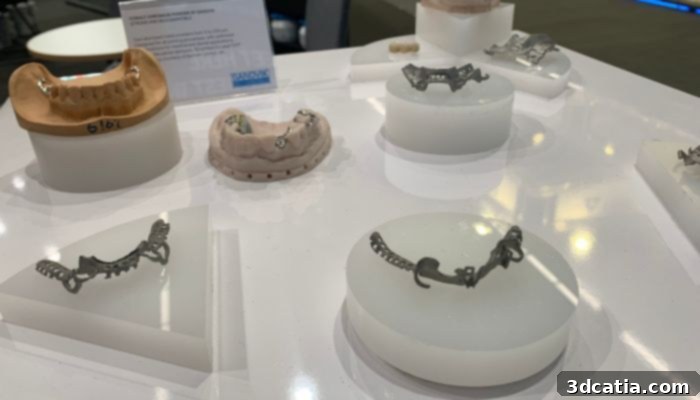
Photo credits: 3Dnatives featuring Sandvik’s advanced metallic powders.
EOS Emphasizes Sustainability with New Polymer and Metal Materials
EOS, a foundational and pioneering force in the additive manufacturing industry, particularly renowned for its cutting-edge powder-based processes, took Formnext 2022 as an opportunity to reinforce its commitment to sustainability. The company introduced two significant new 3D materials designed to minimize environmental impact: PA 1101 and PA 2200. These introductions underscore EOS’s dedication to developing materials that not only meet high performance standards but also align with global efforts for more sustainable manufacturing practices.
PA 1101 represents a major step forward in sustainable polymer 3D printing. This material is a biosourced and climate-neutral powder, meaning it is derived from renewable biological resources and its production process aims for a net-zero carbon footprint. Its development highlights the industry’s shift towards materials that reduce reliance on fossil fuels and mitigate environmental pollution. Components manufactured with PA 1101 can find applications in various sectors looking to improve their ecological footprint without compromising on mechanical properties. Complementing this, EOS also presented PA 2200, a low-carbon polymer powder. Users of PA 2200 receive a verifiable certificate, providing transparent documentation of the fair calculation and compensation of its carbon emissions. This level of accountability is crucial for companies aiming to demonstrate genuine commitment to sustainability and green manufacturing. The introduction of these materials reflects a broader trend in additive manufacturing where material innovation is inextricably linked with environmental responsibility.
Beyond polymers, EOS also expanded its metal material offerings at Formnext. The manufacturer showcased an array of 3D printed parts made from copper, a material recently developed and optimized by EOS for its metal additive manufacturing systems. Copper is highly valued for its exceptional thermal and electrical conductivity, making it ideal for applications in electronics, heat management systems, and power distribution. The ability to 3D print complex copper geometries opens up new possibilities for designing highly efficient components with improved performance characteristics. By focusing on both biosourced, climate-neutral polymers and low-carbon alternatives, alongside high-performance metals like copper, EOS demonstrates a holistic approach to material development that prioritizes both advanced functionality and environmental stewardship, setting new benchmarks for the additive manufacturing industry.
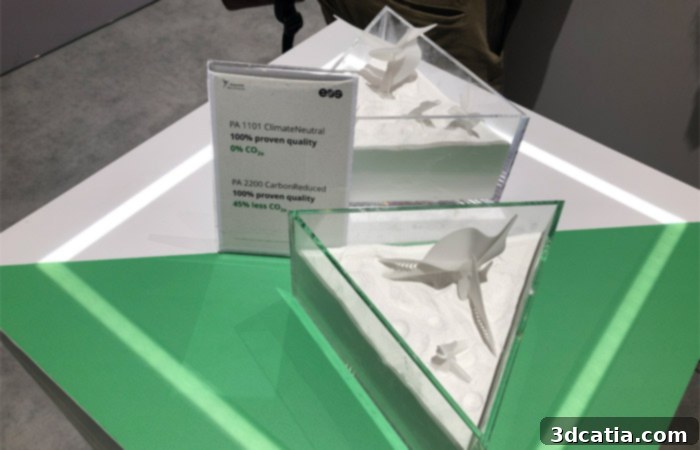
PA 1101 powder, a biosourced and climate-neutral material from EOS (photo credits: 3Dnatives)
Nanoe Launches Innovative Filaments for Advanced Electronic Applications
The French manufacturer Nanoe, a specialist in advanced ceramic and metal powders, made a significant splash at Formnext 2022 by introducing three groundbreaking new filaments as part of its Zetamix Epsilon range. These filaments are specifically engineered to offer different permittivity values, spanning a range from 2.2 to 7.5. This controlled variation in dielectric constant is a critical feature for developing advanced electronic components and systems. A major advantage of these new Zetamix Epsilon filaments lies in their exceptionally low dielectric losses. In high-frequency applications, minimizing dielectric loss is paramount to ensure signal integrity and reduce energy dissipation, making these materials highly suitable for cutting-edge electronics. With these innovative 3D materials, users are empowered to design and produce more complex shapes and precisely vary the permittivity within a single part. This capability enables the creation of highly specialized components such as advanced antennas, integrated sensors, and sophisticated dielectric resonators, all with optimized electrical performance.
The ability to tailor both the geometry and the electrical properties of a printed part opens up unprecedented opportunities in various high-tech sectors, including telecommunications, radar systems, and smart sensor development. By allowing for greater design freedom and precise material control, Nanoe’s new filaments facilitate the development of components that were previously impossible or highly challenging to manufacture with conventional methods. To illustrate the practical implications and potential of these materials, Nanoe showcased several concrete application cases at their booth, located at 11.1-B59. These demonstrations provided attendees with a tangible understanding of how the Zetamix Epsilon range can address complex engineering challenges and accelerate innovation in the field of functional 3D printing. Nanoe’s commitment to pushing the boundaries of ceramic 3D printing materials is clearly demonstrated through this new range, promising significant advancements for industries reliant on high-performance electronic components.
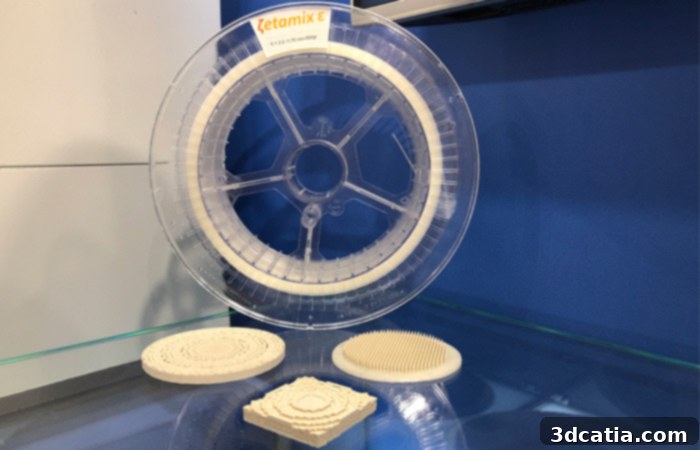
The new Zetamix Epsilon filaments and examples of 3D printed parts for electronic applications (photo credits: 3Dnatives)
6K Additive Introduces Superior Low-Oxygen Titanium Powder
6K Additive, a company rapidly gaining recognition for its innovative approach to advanced powder manufacturing, particularly through its proprietary UniMelt® plasma technology, made headlines at Formnext 2022 with the launch of a new, high-performance metal powder. The company unveiled a revolutionary low-oxygen titanium powder, specifically a Ti64 alloy, demonstrating a significant improvement over typical industry standards. This new material boasts an impressively low oxygen content, ranging from 500-700 ppm, which is substantially lower than the more common industry average of 900 ppm. This reduction in oxygen content is not merely a technical detail; it translates directly into tangible benefits for 3D printed parts. Lower oxygen levels in titanium powders are critical for enhancing the mechanical properties of the final component, leading to improved ductility, superior fatigue resistance, and reduced brittleness. These characteristics are paramount for applications in demanding sectors where part integrity and longevity are non-negotiable.
By providing a Ti64 powder with such reduced oxygen levels, 6K Additive is enabling users to design and manufacture parts with significantly better quality and durability. This is particularly crucial for industries like aerospace, defense, and medical implants, where components are subjected to extreme stresses and require absolute reliability. The enhanced material properties mean that engineers can achieve lighter, stronger, and more resilient parts, opening new avenues for innovation in critical applications. This advanced titanium material seamlessly integrates into 6K Additive’s already extensive portfolio of high-quality metal powders, which includes other widely used alloys such as Ni718, Ni625, 316/17-4 stainless steel, and 18150 copper, among others. 6K Additive’s continuous innovation in material science underscores its commitment to providing additive manufacturing professionals with superior options that push the boundaries of performance and reliability, ensuring that 3D printed parts can withstand the most rigorous operational environments.
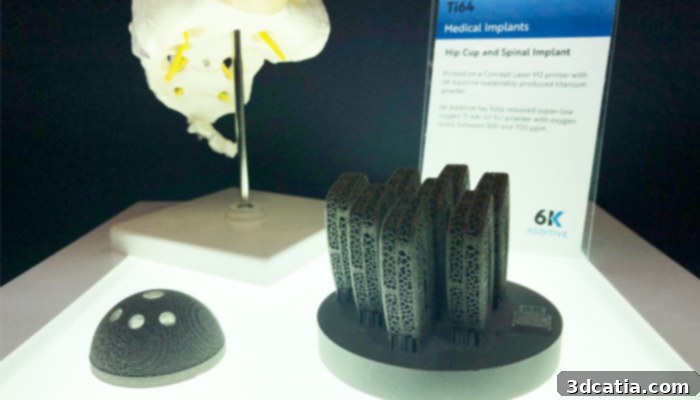
3D printed parts showcasing the quality achieved with 6K Additive’s low-oxygen Ti64 powder (photo credits: 3Dnatives)
Inkbit Unveils Titan Tough Epoxy 85 for Industrial End-Use Parts
Inkbit, an innovative MIT spin-off company, has previously garnered attention for its pioneering additive manufacturing solutions, particularly its revolutionary Inkbit Vista™ AM system. This system is distinguished by its proprietary Vision-Controlled Jetting (VCJ) technology, a unique approach that fundamentally redefines material jetting. Instead of relying on traditional printheads, VCJ employs four distinct printing modules and utilizes a wax support structure, essentially inverting and optimizing the conventional material jetting process. At Formnext 2022, Inkbit further solidified its position as a leader in advanced materials by launching its latest innovation: the Titan Tough Epoxy 85.
While the precise chemical composition of Titan Tough Epoxy 85 remains proprietary, its performance characteristics are designed to meet the rigorous demands of industrial applications. This new material has been specifically formulated to be highly impact-resistant and to withstand long-term exposure to UV radiation, making it exceptionally durable in challenging environments. Its properties are remarkably close to those of Nylon 12, a widely used engineering plastic, yet it combines this robustness with the inherent flexibility and precise dimensional performance enabled by the VCJ process. This unique combination of properties makes Titan Tough Epoxy 85 particularly well-suited for multi-component designs, allowing for the creation of complex functional parts with integrated features and varying material thicknesses.
The introduction of Titan Tough Epoxy 85 marks a significant milestone for Inkbit and the broader additive manufacturing industry. The company harbors strong aspirations that this new material will serve as a catalyst for inkjet technologies to transcend their traditional role in rapid prototyping and firmly establish themselves in industrial applications, including the production of high-performance end-use parts. By offering a material that boasts both exceptional mechanical properties and the precision of VCJ technology, Inkbit is paving the way for advanced manufacturing solutions that can deliver components with superior performance, longevity, and design complexity, thereby unlocking new possibilities across a wide array of industrial sectors from automotive to consumer electronics.
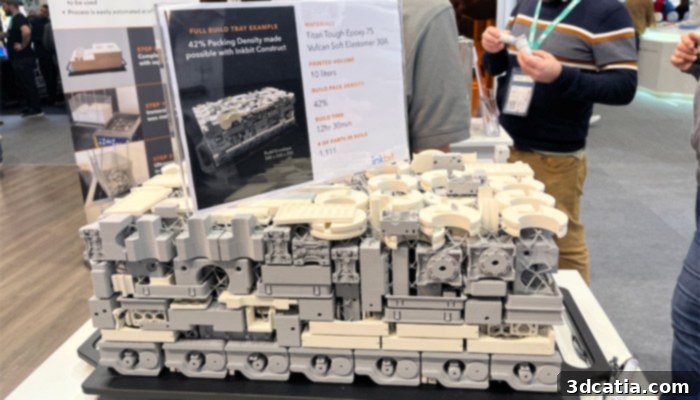
Photo credits: 3Dnatives showcasing an example printed with Inkbit’s Titan Tough Epoxy 85.
The innovations in 3D printing materials showcased at Formnext 2022 underscore a pivotal shift in additive manufacturing. From Elkem Silicones’ versatile silicone range and Sandvik’s high-conductivity metallic powders to EOS’s sustainable polymer solutions, Nanoe’s advanced electronic filaments, 6K Additive’s superior low-oxygen titanium, and Inkbit’s durable Titan Tough Epoxy 85, the industry is witnessing a relentless pursuit of performance, sustainability, and expanded application possibilities. These advancements are not just incremental; they represent fundamental breakthroughs that are driving additive manufacturing from a prototyping tool to a robust industrial production method for critical end-use parts. The continuous evolution of materials is empowering engineers and designers to overcome previous limitations, enabling the creation of components that are lighter, stronger, more functional, and environmentally responsible. As material science progresses, we can expect even more transformative developments that will redefine what is achievable with 3D printing across virtually every industry. We invite you to share your thoughts on these remarkable new material solutions presented at Formnext. Let us know in the comments below, or connect with us on our Facebook or Twitter channels! For all the must-see news and updates in additive manufacturing, you can also subscribe to our dedicated newsletter.