
Unlocking Industrial Potential: The Game-Changing Power of Pellet 3D Printing
The landscape of additive manufacturing is evolving rapidly, with an increasing number of companies recognizing and leveraging the significant advantages offered by pellet 3D printing. For many industries, traditional 3D printing methods, primarily based on filaments, have presented considerable challenges, particularly concerning material limitations and prohibitive costs. These constraints have often hindered the widespread adoption of additive manufacturing for industrial-scale production. However, a transformative shift is underway as interest in using raw polymer pellets instead of pre-extruded filaments continues to surge. Pellets, being the foundational raw material for filament production, naturally come with a significantly lower cost structure, often making them up to 90% more economical than their filament counterparts. This economic benefit, coupled with an exponentially wider array of certified and specialized materials available directly in pellet form (which are often not accessible or are prohibitively expensive as filaments), makes them highly attractive to both industrial and research & development sectors. This growing market demand for more flexible, cost-effective, and material-diverse solutions is driving innovation, leading to a proliferation of companies offering sophisticated pellet 3D printing systems. A prime example of this innovation is Tumaker, a pioneer that has developed a groundbreaking dual-extrusion solution. This technology uniquely allows users to employ both pellets and traditional filaments within a single machine, providing unparalleled versatility and customization for various additive manufacturing applications.
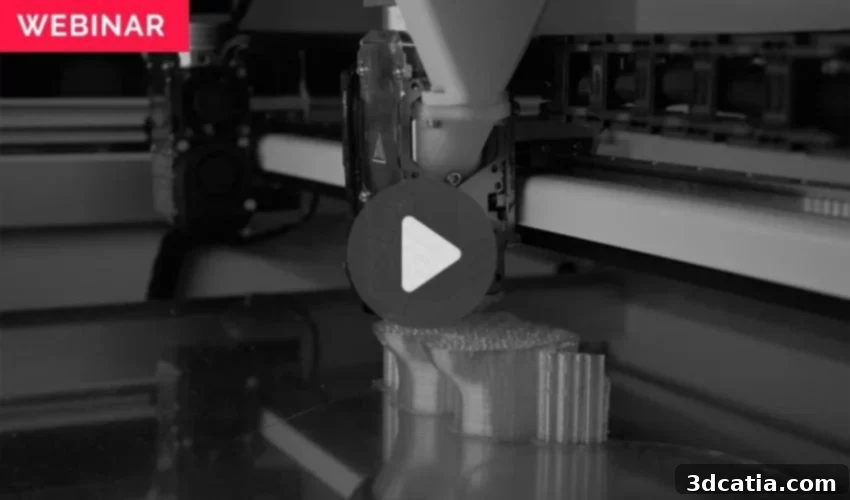
To delve deeper into the intricacies and transformative potential of pellet 3D printing, 3Dnatives recently collaborated with Tumaker to host an insightful webinar titled “Breaking Boundaries With Pellet 3D Printing.” This highly anticipated event, held on January 25th at 4 PM CEST (10 AM EDT), served as a comprehensive platform for understanding how pellet 3D printing operates, its distinct advantages over conventional filament printing, and its diverse range of real-world applications across various sectors. During the webinar, Tumaker specialists provided extensive and detailed explanations regarding the myriad benefits of integrating pellet 3D printing into manufacturing workflows. They highlighted how this technology addresses critical industry pain points related to material costs, supply chain flexibility, and the ability to work with advanced engineering polymers. Furthermore, the event featured a special guest, Dr. Frank Clemens from EMPA (Swiss Federal Laboratories for Material Science and Technology), who shared fascinating insights into his cutting-edge research. Dr. Clemens elaborated on his innovative work, specifically showcasing how he leverages pellet 3D printing for complex research projects, including advancements in the field of soft robotics. Attendees gained invaluable knowledge about this unique additive manufacturing process and left with a clear understanding of how pellet 3D printing is poised to revolutionize, streamline, and optimize manufacturing processes globally. For those who missed the live session, the complete webinar replay is available below, offering a rich resource for anyone interested in the future of industrial 3D printing.
Why Pellet 3D Printing is Revolutionizing Additive Manufacturing
The shift towards pellet-based additive manufacturing is not merely a trend; it represents a fundamental evolution in how we approach industrial production with 3D printing. The core advantage lies in its ability to significantly reduce operational costs while simultaneously expanding material possibilities and enhancing production scalability. By directly processing plastic granules—the same raw materials used in traditional injection molding—companies can bypass the costly intermediate step of extruding these materials into filaments. This direct-to-pellet approach not only slashes material expenses but also opens the door to bulk purchasing strategies, further amplifying cost savings. The economic incentive is profound, making high-volume or large-format 3D printing projects financially viable where filament-based methods might have been impractical.
Beyond cost, material versatility is a cornerstone of pellet 3D printing’s appeal. The market for polymer pellets is vast, encompassing everything from commodity plastics like ABS and PLA to advanced engineering polymers such as PEI, PEEK, and PPSU, as well as fiber-reinforced composites. This means manufacturers are no longer limited to a narrow selection of materials available in filament form but can access an industrial-grade palette of materials, many of which are certified for specific applications. This expanded material freedom enables the production of parts with enhanced mechanical properties, improved chemical resistance, or specialized functionalities, perfectly tailored to demanding industrial requirements across automotive, aerospace, medical, and consumer goods sectors. Furthermore, the ability to work with recycled or custom-blended pellets contributes significantly to more sustainable manufacturing practices and allows for the development of unique material formulations for niche applications.
Industrial scalability and increased throughput are also key drivers behind the adoption of pellet 3D printing. Pellet extruders often feature larger nozzle diameters and higher melt flow rates compared to filament-fed systems. This capability translates directly into faster print times and the ability to produce much larger parts, layer by layer, with greater efficiency. The robust nature of these systems makes them ideal for continuous operation in demanding industrial environments, facilitating the production of prototypes, tools, jigs, fixtures, and even end-use parts at volumes and sizes previously unimaginable with desktop or even prosumer 3D printers. This transition enables industries to move beyond mere prototyping and truly integrate additive manufacturing into their core production strategies.
Tumaker’s Innovative Dual Solution: Bridging the Gap
Tumaker’s development of a dual solution that accommodates both pellets and filaments within a single machine represents a significant leap forward in addressing diverse manufacturing needs. This innovative approach provides unparalleled flexibility, allowing users to select the most appropriate material form factor based on their specific project requirements. For instance, high-precision details or intricate geometries might still benefit from filament printing, while large structural components or parts requiring specialized, cost-effective materials can be efficiently produced using pellets. This hybrid capability simplifies the transition for companies already invested in filament-based workflows, offering a seamless pathway to leverage the economic and material benefits of pellets without abandoning existing infrastructure or expertise. Tumaker’s focus on fully customized 3D printing solutions underscores their commitment to empowering industries with adaptable and powerful additive manufacturing tools, making advanced production more accessible and efficient.
Meet the Expert Speakers: Insights from the Forefront of Additive Manufacturing
 Zoltan Matyas brings over two decades of invaluable front-line B2B business experience in international Sales and Marketing to the world of additive manufacturing. His extensive academic background includes university-level studies in Management, Sales, and Marketing, complemented by a degree in Digital and Social Media Marketing. Further enhancing his strategic capabilities, Zoltan holds a master’s degree in International Business and Life Coaching. Throughout his distinguished career, he has been instrumental in creating several highly successful international sales campaigns, developing robust market strategies, and effectively leading sales teams across various industries. His expertise also extends to managing complex internationalization and sales expansion projects, successfully opening new markets in multiple countries. Since 2021, Zoltan has been pivotal in steering the internationalization strategy of the TUMAKER brand as its Country Manager, playing a crucial role in bringing their advanced pellet 3D printing solutions to a global audience and helping companies understand the market potential of this transformative technology.
 Dr. Toni Iborra is a highly accomplished professional with a strong foundation in Chemistry, having graduated from the University of Valencia (UVEG) following enriching academic stays at the University of Manchester (UK) and Pontificia Catholic University of Argentina (UCA). He further diversified his expertise by earning an MBA with a specialization in International Finances and Investments from the University of North Carolina, blending scientific rigor with business acumen. Dr. Iborra commenced his research career at the prestigious University of Southampton, where he successfully obtained his PhD in Chemistry for his groundbreaking research focused on materials with photocatalytic properties, simultaneously engaging in impactful teaching activities. His scholarly contributions are recognized through presentations at numerous national and international congresses, including those at the University of Oxford and E-MRS Strasbourg, and through peer-reviewed articles published in leading scientific journals within the first quartile. He currently serves as a lecturer at Francisco de Vitoria University (UFV) and holds a position as Professor in Chemistry at Florida State University (FSU), teaching Chemistry I / II & Experimental Lab. Since 2021, Dr. Iborra has been instrumental in leading the commercial strategy and market positioning of the NovaSpider Project at IT3D GROUP, where his profound expertise in materials sciences is critical to advancing and commercializing innovative solutions in additive manufacturing, particularly those leveraging the versatility of pellet materials.
 Dr. Frank Clemens stands as a distinguished Group Leader for Smart Ceramic Processing in the Laboratory for High Performance Ceramics at Empa, the renowned Swiss Federal Laboratories for Materials Science and Technology, Switzerland. His extensive scientific and applied research is dedicated to the thermoplastic processing of powder-based sensors, actuators, and structural materials. Dr. Clemens’s group actively spearheads national and international projects in this critical field, fostering collaborative efforts with physicists, chemists, material scientists, and engineers to rigorously investigate activation energies across diverse processing steps. Beyond fundamental research, he is deeply involved in developing novel strategies for the advanced processing of functional ceramics and innovative soft sensor materials and structures. His work with pellet 3D printing is particularly significant, as it enables the direct fabrication of complex geometries with highly functional materials, pushing the boundaries of what is possible in areas like soft robotics and advanced sensing. Since 2003, Dr. Clemens has shared his profound knowledge as a lecturer at ETH Zurich (CH), and from 2010 to 2021, he also held a lectureship at ZHAW (CH). His prolific contributions to the scientific community are evidenced by his authorship of more than 150 peer-reviewed articles and numerous patents, solidifying his status as a leading authority in material science and advanced manufacturing.
The “Breaking Boundaries With Pellet 3D Printing” webinar provided a comprehensive overview of a technology that is rapidly redefining what’s possible in additive manufacturing. From significant cost reductions and unparalleled material versatility to enhanced industrial scalability, pellet 3D printing offers compelling advantages for businesses looking to innovate and optimize their production processes. We encourage you to watch the replay and join the conversation. Do you plan to explore the benefits of pellet 3D printing in your operations? Let us know your thoughts in a comment below or engage with us on our social media platforms. You can find us on LinkedIn, Facebook, and Twitter! Don’t miss out on the latest advancements and insights in the world of 3D printing; make sure to sign up for our free weekly Newsletter here, delivering the most important news directly to your inbox. Additionally, explore our extensive library of videos and tutorials on our dedicated YouTube channel for even more content on additive manufacturing innovations.