

Unpacking the 3D Printing Market: Expansion Dominates Over Consolidation in Additive Manufacturing
The year 2021 witnessed a remarkable flurry of mergers and acquisitions (M&A) across the additive manufacturing industry. This activity led many observers to believe that the industry was rapidly maturing and that a significant period of consolidation was inevitable, especially as we moved into 2022. However, a recent and comprehensive report from IDTechEx challenges this widely held assumption. In their detailed publication, 3D Printing Hardware 2022-2032: Technology and Market Outlook, authored by Sona Dadhania and Dr. Richard Collins, a compelling argument is made: contrary to prevailing expectations, the 3D printing market has not yet reached a consolidated state. Furthermore, the report suggests that, due to the extreme rate of market expansion, particularly driven by innovative technologies and a constant influx of new companies, it is likely to continue on an expansive trajectory rather than a consolidative one.
IDTechEx readily acknowledges the substantial number of mergers and acquisitions that took place in 2021, which indeed seemed to signal an impending consolidation within the industry. Reflecting on the historical context and the persistent expectation of market consolidation, the company elaborated: “In the 2020s, a recent flurry of mergers and acquisitions have brought 3D printing observers to again expect the market to consolidate in the near future. In 2021, IDTechEx noted well over 40 mergers or acquisitions taking place in 3D printing, which seems to support that claim.” Despite these clear indications of M&A activity, the report meticulously argues that even if some consolidation has occurred, its scale is insufficient to counterbalance the overwhelming expansion that has simultaneously characterized the market throughout 2021. This fundamental distinction between localized consolidation and overarching market expansion forms the crux of IDTechEx’s analysis, presenting a nuanced view of the additive manufacturing landscape.
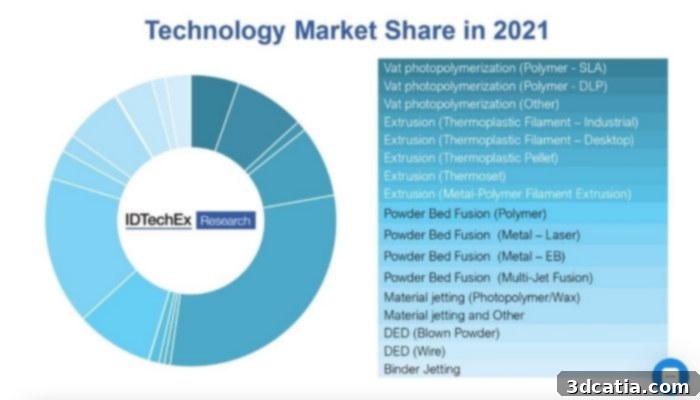
The technology market share in 2021 between seventeen technology segment. Increasing innovation and more 3D printing technologies are both pointed to by IDTechEx as reasons why we cannot say the AM market is consolidating (image source: IDTechEx)
Understanding the Dynamics: Why Isn’t the Market Consolidating?
According to the authors of the IDTechEx report, the notion that the additive manufacturing market is not consolidating rests on two pivotal and interconnected trends: sustained innovation and significant investment. At first glance, this might appear counter-intuitive, as both innovation and investment are generally considered vital for market health and success. However, in the unique context of 3D printing, IDTechEx posits that these very forces are driving such rapid growth and fostering the entry of so many new companies that they are effectively preventing the kind of widespread consolidation seen in other mature industries. Even as some established players engage in M&A activities, the sheer volume of new entrants, fueled by fresh ideas and capital, contributes to an overall expansion of the market, diluting any localized consolidation efforts.
Investment Fuels Unprecedented Growth
Investment has emerged as a formidable engine for the additive manufacturing industry’s expansion. The IDTechEx report meticulously highlights that the market cannot be deemed consolidating in the face of escalating financial inflows. Publicly announced investments in 3D printing companies alone amounted to a staggering $950 million over the course of 2021. This substantial capital injection signals strong investor confidence in the sector’s long-term potential and profitability. Beyond the raw figures, the report also observed an increased presence of innovative startups, alongside a growing number of established companies from adjacent industries that are strategically diversifying into the 3D printing market. These entities are drawn by the proven profitability and transformative capabilities of additive manufacturing, further contributing to market diversification rather than concentration.
As visually represented in the accompanying graph, while a significant portion of this investment—approximately two-thirds—was channeled into hardware companies, the impact of funding is clearly reverberating throughout the entire additive manufacturing pipeline. Materials development, post-processing solutions, service providers, and software innovations all received substantial chunks of investment. This balanced distribution of capital across various segments indicates a holistic growth strategy, fostering advancements in every aspect of the AM workflow. The broad allocation of funds ensures that the entire ecosystem, not just printing hardware, is continuously evolving, attracting new businesses, and driving overall market expansion. This robust investment landscape not only validates the industry’s potential but also acts as a centrifugal force, pushing against any centralizing tendencies.
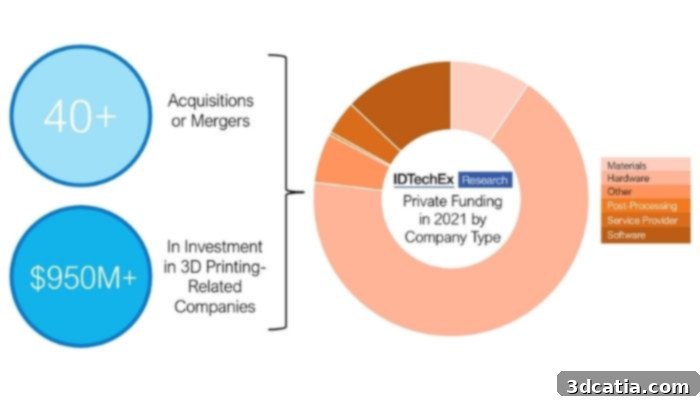
3D Printing Investment Overview for 2021 (Image Source: IDTechEx)
Innovation Drives Market Diversification
Parallel to investment, relentless innovation has been a primary catalyst for the dramatic expansion of the 3D printing market. This continuous wave of technological advancement leads to the creation of more diverse and specialized printing solutions, thereby lowering barriers to entry and enabling an ever-increasing number of companies to join the market. IDTechEx highlights several compelling examples of this trend. Companies such as Azul3D, Holo, Xerox, Massivit3D, and Evolve Additive Solutions have successfully entered the competitive landscape, each bringing proprietary technologies that introduce novel capabilities and applications to the industry. These new solutions often address niche demands or offer significant improvements over existing methods, carving out new market segments rather than merely competing within established ones.
Furthermore, the report notes the significant evolution and growing prominence of specific 3D printing technologies throughout 2021. Multi-material printing, for instance, has advanced considerably, allowing for the creation of complex parts with varying material properties, opening doors to new functional prototypes and end-use components. Bound Metal Extrusion (BME) and Bound Ceramic Extrusion (BCE) have also gained traction, offering cost-effective ways to produce metal and ceramic parts with intricate geometries, bridging the gap between traditional manufacturing and additive techniques. Another notable trend is the increased presence and capability of pellet 3D printers. This technology, which allows for the use of more affordable and a wider variety of raw materials in pelletized form, became clearer as more FDM manufacturers began offering extruders adapted for pellets or developing hybrid machines capable of processing both filaments and pellets. This innovation significantly reduces material costs and expands the range of printable materials, attracting new users and applications.
While such innovation is undeniably crucial for an industry like additive manufacturing to thrive, its direct consequence is rapid market expansion driven by a continuous influx of new companies and technologies. This dynamic is expected to persist, as IDTechEx specifically points to ongoing innovation within academic circles. Research institutions worldwide are consistently pushing the boundaries of what’s possible in 3D printing, exploring new materials, processes, and applications. This academic pioneering acts as a crucial feeder for commercial innovation, ensuring a continuous stream of advancements that will continue to drive change and expansion in the sector for years to come, further postponing any significant market consolidation.
The Nuance: Consolidation Within Specific Segments
Despite the overarching narrative of market expansion, it is crucial to acknowledge that instances of consolidation are indeed occurring, albeit often within more specialized segments of the additive manufacturing market. The report thoughtfully distinguishes between industry-wide consolidation and segment-specific integration. For example, within the binder jetting technology sector, the strategic acquisition of ExOne by its competitor Desktop Metal represents a significant consolidation. This merger has the potential to grant the combined entity a dominant market share in binder jetting for the foreseeable future. Such moves streamline competition within a particular technological niche, potentially leading to greater efficiency, shared R&D, and a more concentrated market for that specific process.
This type of segment-specific consolidation is a natural part of market evolution, even within an expanding industry. As certain technologies mature, stronger players may absorb smaller ones to gain intellectual property, expand market reach, or eliminate direct competition. It is logical to expect similar consolidation trends to continue in other specific technology areas throughout the coming years, particularly as certain processes move from nascent development to industrial adoption. However, whether these localized mergers and acquisitions truly signify a broad, industry-wide consolidation of the entire 3D printing market remains open to interpretation. IDTechEx’s report suggests that these individual consolidations are offset by the much larger forces of investment and innovation, which continually introduce new players and technologies into the broader AM landscape, thereby maintaining an expansive market dynamic.
Implications for the Future of Additive Manufacturing
The IDTechEx report’s findings present a fascinating outlook for the future of additive manufacturing. An industry characterized by persistent expansion rather than early consolidation implies a landscape of vibrant competition, continuous innovation, and diverse solutions for a wide array of applications. This dynamic environment suggests that users of 3D printing technologies will benefit from a constant stream of improved machines, advanced materials, and sophisticated software, tailored to increasingly specific needs. For businesses, this means more options to explore customization, optimize supply chains, accelerate product development, and achieve manufacturing efficiencies that were once thought impossible.
However, this expansive growth also poses challenges. For new entrants, while investment is available, standing out in a crowded, rapidly evolving market requires unique value propositions and significant R&D efforts. Established companies must remain agile and responsive to technological shifts to avoid being outmaneuvered by innovative startups. The sheer pace of development might also complicate standardization efforts, making interoperability across different systems a persistent challenge. Ultimately, IDTechEx’s analysis suggests that the additive manufacturing industry is still in a relatively early stage of its growth curve, brimming with potential and dynamism, far from settling into a mature, consolidated structure.
For those interested in delving deeper into these market dynamics, more detailed information from the report can be found in IDTechEx’s insightful article HERE, or the full report can be downloaded directly HERE.
What are your thoughts on the future of the 3D printing market? Do you believe it is primarily consolidating, or do you see a dominant trend of expansion? Share your insights and join the conversation in a comment below or on our Linkedin, Facebook, and Twitter pages! Don’t miss out on the latest additive manufacturing news—sign up for our free weekly Newsletter here, delivered straight to your inbox! You can also explore all our engaging videos on our dedicated YouTube channel.
*Cover Photo Credits: Negative Space – Pexels account, CC0, via Wikimedia Commons