

Unpacking the Environmental Footprint of Metal Additive Manufacturing: A Path Towards Sustainable 3D Printing
The Additive Manufacturer Green Trade Association (AMGTA) recently unveiled a pivotal report delving into the environmental implications of metal additive manufacturing. This comprehensive study, spearheaded by Jeremy Faludi from Delft University of Technology and Corrie Van Sice of Dartmouth College, meticulously scrutinizes metal 3D printing processes against conventional fabrication methods. Its core objective is to ascertain whether these advanced technologies genuinely offer environmental advantages, in addition to the well-documented economic and functional benefits they provide in numerous applications. By commissioning and disseminating this research, the AMGTA seeks to elevate the discourse surrounding sustainable manufacturing, prompting critical questions: Can industries truly formulate responsible additive manufacturing strategies? And do metal 3D printing technologies indeed pave the way for a more sustainable industrial future?
Metal additive manufacturing, often referred to as metal 3D printing, is undeniably a rapidly expanding segment within the broader manufacturing landscape. A recent Grand View Research study underscored this growth, estimating the metal 3D printing market to be valued at an impressive $1 billion by 2020, with projections indicating a robust annual growth rate of 27% over the subsequent years. This dynamic field encompasses a variety of sophisticated processes, including Laser Powder Bed Fusion (LPBF), Directed Energy Deposition (DED), and Electron Beam Melting (EBM). Each of these technologies brings distinct advantages to production, collectively offering unparalleled design freedom, significant reduction in the total number of components required for an assembly, streamlined assembly steps, substantial weight reduction in finished parts, and extensive personalization capabilities. For niche applications and especially for the production of small to medium-sized batches, metal AM has emerged as an indispensable alternative to traditional processes, liberating manufacturers from the constraints and prohibitive costs associated with expensive mold production. Despite its burgeoning popularity and myriad benefits, it remains a less universally understood manufacturing method, still grappling with challenges related to material costs, process optimization, and, crucially, its broader environmental footprint.
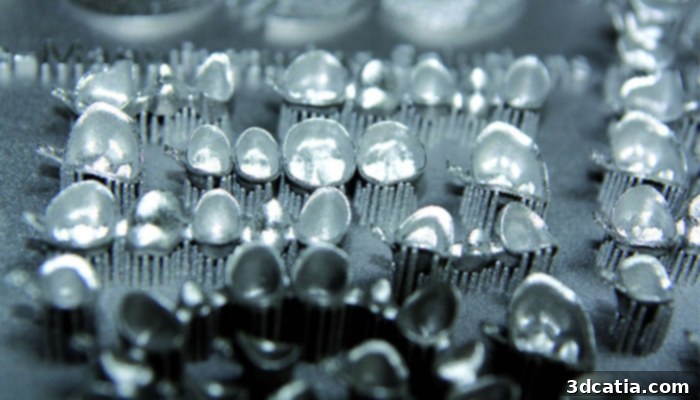
Metal additive manufacturing is particularly popular in the medical sector for custom implants and intricate devices | Photo Credits: EOS
The Critical Importance of Environmental Impact Assessment in Additive Manufacturing
The environmental impact of metal additive manufacturing stands as one of its most complex and critical challenges, forming the central focus of the AMGTA’s groundbreaking study. The association explicitly stated that the research was undertaken to “summarize current knowledge and identify areas where information is scarce, unclear and much needed.” This highlights the industry’s commitment to transparency and evidence-based decision-making. The authors meticulously conducted a life cycle comparison, assessing metal 3D printing against conventional manufacturing methods across every stage of a part’s life cycle. Their investigation paid particular attention to the environmental impact stemming from the raw materials used, specifically stainless steel, aluminum, and titanium, and the energy-intensive processes involved in their transformation into finished components. Furthermore, this comprehensive comparison was contextualized by sector, scrutinizing industries such as aerospace, automotive, and medical – three sectors where metal additive manufacturing has profoundly revolutionized production processes and supply chains, offering unique advantages in performance and customization.
Initial Findings: Metal 3D Printing’s Higher Carbon Footprint Per Kilogram
The study’s findings present a nuanced and somewhat challenging conclusion: metal additive manufacturing generally exhibits a larger carbon footprint per kilogram of material processed when directly compared to traditional fabrication methods. This initial assessment might lead one to infer that, in many scenarios, additive manufacturing is a less sustainable choice. However, this perspective necessitates a deeper understanding of the specific applications and inherent advantages of 3D printing. The crucial differentiator lies in the geometry and functional requirements of the part being produced. For instance, while it would be environmentally preferable to machine a simple, solid cube using conventional methods due to their higher material utilization rates and lower energy per unit volume, metal 3D printing becomes the unequivocally superior choice for manufacturing complex structures like intricate lattice designs or hollow shells. These geometries are either impossible or prohibitively expensive and wasteful to produce with traditional subtractive or formative techniques.
Sherry Handel, Executive Director of the AMGTA, eloquently articulated this distinction, stating, “No one should expect additive manufacturing to be a more sustainable way of producing basic metal parts given the focused energy inherent in laser fusion, but it should provide a more sustainable path for the manufacture of finished precision components.” Her insight underscores the fundamental principle that the sustainability benefits of metal AM are not universal but are instead highly dependent on the part’s design, its function, and the overall value chain. The high energy density required by processes like laser or electron beam fusion to precisely melt and fuse metal powders contributes significantly to the ‘per kilogram’ carbon footprint. However, this energy intensity is offset when AM enables the creation of parts that are lightweight, highly consolidated, or functionally optimized, leading to downstream environmental savings.
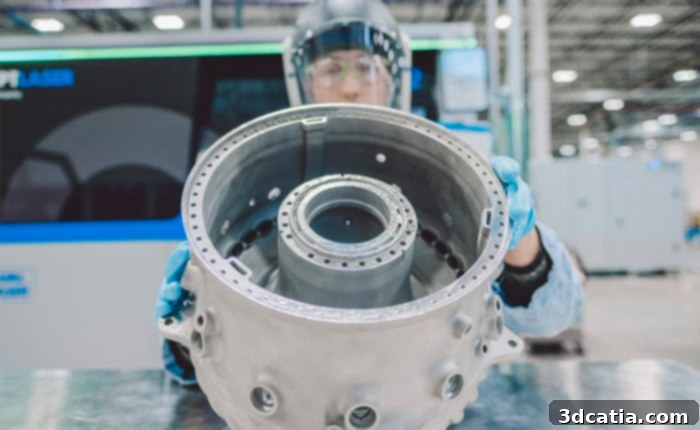
Metal additive manufacturing excels at reducing component counts, as demonstrated by GE Additive’s transformation of an engine component from 855 parts to just 12 | Credits: Nick Hurm, GE Additive
Beyond the Machine: The Holistic View of Life Cycle Assessment (LCA)
While the initial carbon footprint per kilogram might seem daunting, the authors of the AMGTA study emphasize that a more comprehensive and accurate picture requires far more extensive comparative data. The existing literature, they note, is still nascent and not sufficiently robust to draw definitive, overarching conclusions. Ideally, future environmental assessments should adopt a full product life cycle assessment (LCA) methodology, meticulously accounting for every stage from raw material extraction to end-of-life disposal. Critical factors often overlooked in narrower analyses include the energy and resource demands of raw material sourcing, the specific processes like gas atomization used to produce fine metal powders, and the global logistics involved in transporting materials and finished products. Each of these elements undeniably contributes a significant portion to the overall carbon footprint.
Moreover, the intricacies of the additive manufacturing process itself introduce additional considerations for environmental impact. Factors such as the typical fail rates in 3D printing, which result in scrapped parts and wasted material, and the extensive post-processing steps often required for metal AM components, must be rigorously studied. Post-processing can include heat treatments for stress relief and material property enhancement, support structure removal, surface finishing (e.g., polishing, sandblasting), and precise machining to achieve final tolerances. Each of these steps consumes energy, may require additional materials, and generates waste, thereby impacting the final carbon footprint. A true LCA will integrate these elements, providing a holistic understanding of the environmental trade-offs and benefits across the entire value chain of an additively manufactured part versus its conventionally produced counterpart.
Navigating the Nuances: When Metal AM Proves More Sustainable
In summary, the AMGTA study posits that the carbon footprint per kilogram of material in additive manufacturing appears to be approximately ten times higher compared to more traditional direct manufacturing processes. However, this seemingly stark disparity requires careful interpretation. The pivotal insight is that where 3D printing enables substantial savings in material mass, it can ultimately lead to lower overall environmental impacts than traditional machining, particularly when working with materials known for their high environmental impact, such as titanium. For instance, in critical aerospace applications, even a small reduction in weight achieved through AM can translate into significant fuel savings over the lifespan of an aircraft, dramatically offsetting the higher initial manufacturing footprint.
To guide the industry towards a more sustainable future, the AMGTA has put forth several actionable recommendations for reducing the carbon footprint associated with additive manufacturing. These recommendations focus on optimizing printer usage and making informed material choices. The association strongly encourages users to maximize printer efficiency, for example, by sharing printers among facilities or by meticulously reducing unused build plate space in each print job. This optimization minimizes idle time and ensures that the considerable energy investment in operating these machines is fully utilized. Furthermore, users are advised to carefully select metals that inherently minimize processing energy requirements. This involves considering factors such as a material’s melting point, its reflectance (which affects how much laser energy is absorbed), and its thermal conductivity. Choosing materials that require less energy to melt and fuse can significantly lower the overall energy consumption per part. These strategies, combined with ongoing research into more energy-efficient machines and recyclable powders, are crucial steps on the path to making metal additive manufacturing a truly sustainable technology for the future. You can access the complete study and its detailed findings HERE.
What are your thoughts on the environmental impact of metal 3D printing and its potential for a more sustainable future? We invite you to share your insights in the comments section below or join the conversation on our Facebook and Twitter pages! Don’t miss out on the latest advancements and news in the world of 3D printing; sign up for our free weekly Newsletter and have all the essential updates delivered straight to your inbox!