
Top 5 3D Printing Innovations: Weekly Insights into Additive Manufacturing’s Future
Welcome to our latest compilation showcasing the week’s most compelling advancements in 3D printing and additive manufacturing. This technology continues to push boundaries across various sectors, from healthcare to consumer goods, offering unprecedented customization, efficiency, and innovation. This week, we delve into five remarkable videos that highlight this evolution, bringing you closer to the cutting edge of what’s possible. We kick off with 3D Systems, providing a detailed look at their groundbreaking dental innovations, first unveiled at AMUG 2023. Following this, The 3D Print Zone walks us through the intricate process of 3D printing and assembling a fully functional electric guitar, demonstrating the creative potential of additive manufacturing. Next, CEAD’s CEO, Lucas Janssen, offers invaluable insights into staffing strategies for large format additive manufacturing (LFAM), shedding light on the specialized skills required. We then explore how NATEP and Intelligens are harnessing Machine Learning for Additive Manufacturing Experimental Design (MEDAL) to revolutionize production efficiency. Finally, DW Shift reveals the life-changing potential of 3D printing in organ development and transplantation. Prepare to be inspired by the diverse and impactful applications of this transformative technology. Let’s get started!
Top 1: 3D Printing’s Diverse Dental Applications with 3D Systems
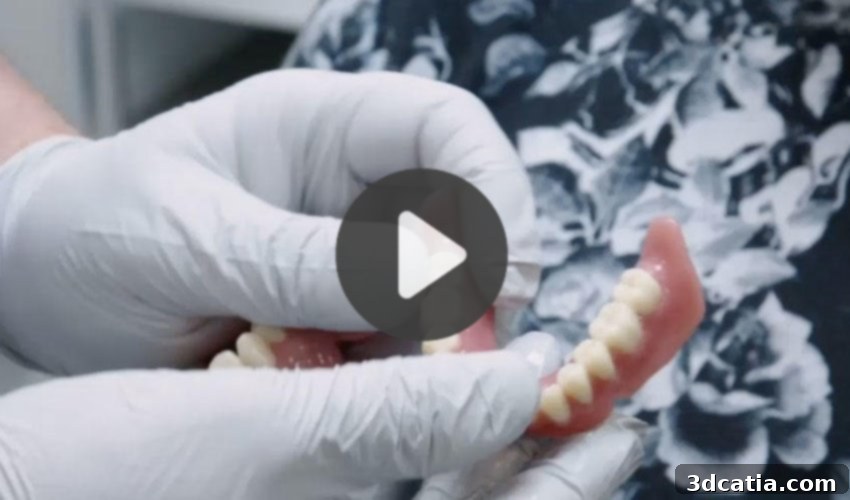
Our first featured video highlights 3D Systems’ pioneering work in dental additive manufacturing, as demonstrated at the prestigious AMUG 2023 event in Chicago. This segment focuses on the expansive range of new materials and solutions designed to meet the intricate demands of modern dentistry. 3D Systems showcases transparent and flexible options ideal for creating patient-specific splints, nightguards, and retainers, offering enhanced comfort and precision compared to traditional methods. Furthermore, the video introduces a highly durable base material specifically formulated for removable dentures, promising longevity and improved fit. Perhaps one of the most exciting developments is the advent of 3D printed metal crowns, which leverage the precision and material properties inherent in additive manufacturing to deliver superior restorative solutions. Beyond these specific applications, 3D Systems emphasizes the overarching benefits of their innovations: high resolution printing capabilities ensure intricate details are accurately reproduced, while ease of printing streamlines workflows for dental laboratories. Crucially, these solutions are presented as cost-effective, allowing dental professionals to fulfill the diverse needs of their patients more efficiently and accessibly. The integration of 3D printing in dentistry signifies a significant leap forward, offering customizable, high-quality, and rapidly produced solutions that are transforming patient care and laboratory operations.
Top 2: 3D Printing a Functional Electric Guitar – The Telecaster Project
The second video in our lineup, presented by The 3D Print Zone, takes us on an extraordinary journey: the creation of a fully functional, 3D printed electric guitar. This comprehensive, step-by-step guide is a testament to the immense capabilities of desktop additive manufacturing for complex, multi-component projects. The video meticulously details the entire design process, beginning with the initial CAD modeling phases where the guitar’s body, neck, and various components are digitally crafted with precision. Viewers gain insight into the selection of materials, discussing how different filaments and resins can impact the instrument’s aesthetics, durability, and even its acoustic properties. The actual printing phase is shown in detail, demonstrating how various parts are fabricated layer by layer, addressing challenges such as print orientation, support structures, and post-processing. A particularly engaging segment highlights the host’s experimentation with various resins, not just for structural integrity but also for achieving the desired “funky and electric aesthetic” that defines the guitar’s unique character. This includes exploring how different resin types can be combined or finished to produce vibrant colors, textures, and a professional-grade appearance. The video doesn’t stop at printing; it continues with the meticulous assembly process, showing how electronic components, hardware, and the printed parts come together to form a playable instrument. This project serves as an excellent example of how 3D printing empowers creators to design, prototype, and manufacture custom products with remarkable functionality and artistic flair, opening new avenues for personalized manufacturing in music and beyond.
Top 3: Strategic Staffing for Large Format Additive Manufacturing (LFAM)
Our third video features Lucas Janssen, co-founder and CEO of CEAD, who provides critical insights into a often-overlooked aspect of advanced manufacturing: the human element. Janssen emphasizes the paramount importance of carefully selecting the right personnel for successful implementation and operation of large format additive manufacturing (LFAM) technologies. Despite the increasing automation in this field, he argues that human expertise remains absolutely vital. LFAM involves complex machinery capable of printing objects on a much larger scale than conventional 3D printers, often utilizing unique materials and demanding precise operational control. Janssen outlines key positions essential for any LFAM operation, detailing the specific skill sets required for each. Designers, for instance, need a deep understanding of LFAM design principles, including considerations for material flow, structural integrity on a large scale, and optimizing designs for additive processes. Programmers are crucial for translating complex CAD models into executable machine instructions, often involving advanced G-code and adapting existing software for the unique characteristics of large format printers. Operators, the hands-on specialists, require comprehensive training in machine setup, monitoring, maintenance, and troubleshooting to ensure continuous, high-quality production. Janssen points out that recent graduates from practical schools and universities are particularly well-suited for LFAM roles. Their innate digital literacy, combined with practical, hands-on experience, makes them highly adaptable to the innovative and rapidly evolving landscape of additive manufacturing. This trend of integrating fresh talent with specialized skills is poised to gain significant momentum as LFAM continues to expand its industrial footprint, creating exciting career opportunities in a high-tech field.
Top 4: Revolutionizing Additive Manufacturing with Machine Learning
In our fourth compelling video, presented by NATEP, we are introduced to Intelligens, a material science and technology company that is at the forefront of integrating artificial intelligence with additive manufacturing. Their groundbreaking innovation, the Machine Learning for Additive Manufacturing Experimental Design Algorithm (MEDAL), promises to redefine how research and development are conducted in various industries. MEDAL is specifically engineered to efficiently handle and analyze real-life experimental data, which is often complex, sparse, and noisy. This advanced algorithm allows companies to accelerate the discovery and optimization of materials and processes. For Intelligens, leveraging MEDAL has yielded tangible benefits, enabling them to produce chemicals and drugs faster, with greater purity, and at significantly reduced costs. By intelligently predicting outcomes and optimizing experimental pathways, MEDAL minimizes trial-and-error, saving valuable resources and time. Furthermore, the video highlights MEDAL’s broader impact, particularly its capacity to empower small and medium-sized enterprises (SMEs). Through enhanced data analysis and predictive capabilities, Intellegens is better equipped to assist these businesses in achieving ambitious goals within highly demanding sectors like the aerospace industry. In aerospace, where material performance and process reliability are paramount, MEDAL provides a crucial advantage by enabling the development of advanced materials and optimized manufacturing parameters with unprecedented speed and accuracy. This exemplifies how machine learning is not just improving efficiency but also democratizing access to cutting-edge manufacturing capabilities, pushing the boundaries of what is technologically feasible.
Top 5: Organ Development and Transplantation with 3D Bioprinting
We conclude our Top 5 with a truly transformative video from DW Shift, exploring the profound potential of 3D printing technology to revolutionize organ development and transplantation. This segment delves into the rapidly evolving field of bioprinting, where the principles of additive manufacturing are applied to biological materials. Unlike conventional 3D printing, bioprinting utilizes living cells, growth factors, and biocompatible materials (bioinks) to construct functional tissues and organs layer by intricate layer. The video showcases incredible advancements, providing glimpses of 3D printed ears, which are already being clinically tested for reconstructive surgery. It also highlights experimental endeavors to bioprint complex organs like hearts and kidneys, demonstrating the scientific community’s ambitious efforts to address the critical shortage of donor organs. These bioprinted structures are designed to mimic the complex architecture and cellular composition of natural organs, aiming for full functionality upon transplantation. However, the video thoughtfully addresses the remaining significant challenges associated with 3D bioprinting. These include the difficulty of replicating the delicate vascular networks essential for nutrient and oxygen supply within larger organs, ensuring long-term cell viability and function, and navigating the complex immunological responses that can occur post-transplantation. Ethical considerations and stringent regulatory hurdles also represent crucial aspects that need to be overcome before widespread clinical application. Despite these challenges, the vision of personalized, on-demand organs created through 3D bioprinting remains a powerful driving force, promising a future where organ failure may no longer be a death sentence, profoundly impacting millions of lives globally.
Which of these incredible 3D printing videos was your favorite this week? We’d love to hear your thoughts on these innovations, from 3D Systems’ cutting-edge dental tools to the life-changing potential of bioprinting. Let us know in a comment below or connect with us on our LinkedIn, Facebook, and Twitter pages! Don’t forget to sign up for our free weekly newsletter here, delivering the latest 3D printing news straight to your inbox every week! You can also find all our featured videos and more groundbreaking content on our dedicated YouTube channel. Stay tuned for more innovations shaping the future of manufacturing!
*Cover Photo Credits: 3D Systems