
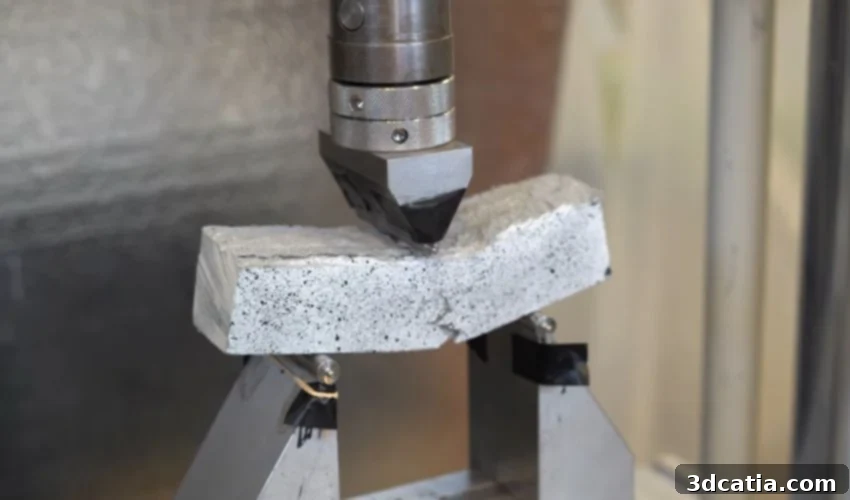
Revolutionizing Construction: UNM’s Bendable Concrete for Advanced 3D Printing
Concrete, the cornerstone material of modern construction and a favorite for construction 3D printing, is poised for a significant transformation thanks to groundbreaking research from the University of New Mexico (UNM). Researchers at UNM have successfully patented a novel bendable concrete material design, meticulously formulated for optimal performance in 3D printing applications. This pioneering development addresses long-standing limitations of traditional concrete, promising to usher in an era of stronger, more resilient, and cost-effective infrastructure. While this year has seen other notable advancements in optimizing 3D printing with concrete, such as the University of Virginia’s development of a 3D-printable concrete that reduced carbon emissions by 31 percent in October, UNM’s focus on ductility presents a unique and critical step forward in material science for additive manufacturing.
Traditional concrete is renowned for its exceptional strength under compression, making it ideal for bearing heavy loads. However, its primary drawback lies in its brittleness and poor performance under tension. This inherent fragility means that concrete is highly susceptible to cracking and breaking when subjected to pulling or bending forces. Even when reinforced with conventional steel bars, which are standard practice in construction, concrete structures – whether buildings, bridges, or sidewalks – frequently require ongoing maintenance and costly repairs throughout their lifespan. The development of a concrete with significantly enhanced tensile properties, like the innovative material conceived at UNM, could dramatically alter this paradigm. Such a material would enable the construction of more robust infrastructures that not only last longer but also incur substantially lower maintenance expenses. This advancement holds particular significance for regions prone to natural disasters, such as earthquakes, which impose immense lateral stress on buildings and can lead to catastrophic structural failures. A bendable, ductile concrete could absorb and dissipate seismic energy more effectively, safeguarding lives and property.
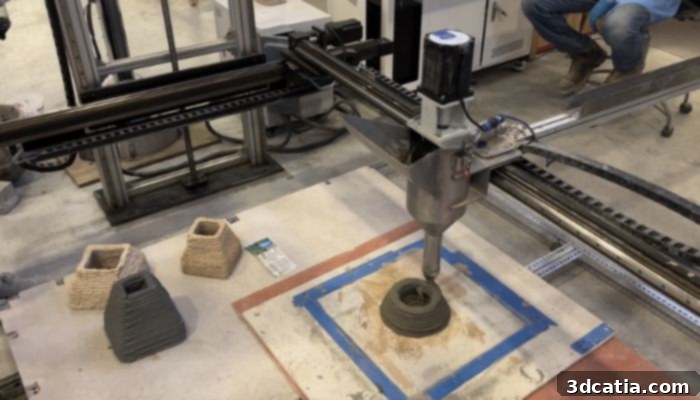
Samples of the bendable, 3D-printed concrete developed at UNM (Photo credit: UNM)
Addressing the challenges posed by conventional concrete has been a long-standing goal for material scientists and engineers worldwide. As highlighted in UNM’s official release regarding the research, numerous attempts have been made to develop alternative materials and construction processes to overcome these limitations. While some large-scale structures have incorporated partial 3D printing techniques, most current methods still necessitate the manual placement of additional support materials, such as steel beams or rebars. This requirement significantly diminishes the inherent automation advantages that 3D printing promises for construction. To fully leverage the potential of additive manufacturing in building complex geometries without such external support, the printing material itself must possess sufficient intrinsic strength to be self-supporting during extrusion, while also maintaining the necessary workability for the printing process.
Leading this innovative quest was Maryam Hojati, an assistant professor within UNM’s esteemed Gerald May Department of Civil, Construction and Environmental Engineering. Professor Hojati, along with her dedicated team, embarked on a mission to engineer a solution that would fundamentally change how concrete structures are built. Her graduate research assistant, Muhammad Saeed Zafar, eloquently articulated their core objective: “If we can successfully design ultra-high ductile material without using conventional steel bars, [it] will solve the problem of the incompatibility of reinforcement with the 3D printing process.” This vision directly targeted the bottleneck in automated construction, striving for a material that could intrinsically provide the necessary strength and flexibility.
How Was the Bendable Concrete Mix Created?
The innovative breakthrough in UNM’s bendable concrete lies primarily in the strategic incorporation and precise management of fibers within the concrete mixture. Zafar’s meticulous approach involved crafting numerous concrete mixtures, each containing variable amounts and types of fibrous materials. To rigorously test the viability and performance of these experimental compositions, he then undertook a complex and iterative process of precisely mixing, measuring, and 3D printing them. This phase was fraught with delicate challenges: an insufficient quantity of fibers often led to the collapse of the printed structures, as the material lacked the necessary tensile integrity. Conversely, an excessive amount of fiber caused the mixture to become too viscous and unworkable, preventing it from passing smoothly and consistently through the 3D printer’s nozzle, thereby hindering the extrusion process. This delicate balance required extensive experimentation and fine-tuning.
Through this iterative design and testing cycle, Zafar successfully 3D printed a wide array of concrete designs. These included various small structures, geometric prisms, and specialized “dog bone” shapes, which are standard in material science for tensile testing. Once printed, each of these designs underwent rigorous evaluation for its bending and direct tensile strength. This comprehensive testing provided critical feedback, allowing the team to refine their formulations. The process was then repeated, with the team exploring different material compositions and incorporating a diverse range of additives. These included polyvinyl alcohol (PVA) fibers, known for their high strength and excellent bonding properties; fly ash, a by-product of coal combustion that enhances concrete’s workability and long-term strength; silica fume, which significantly improves density and impermeability; and ultra-high molecular weight polyethylene (UHMWPE) fibers, celebrated for their exceptional tensile strength and toughness. Each component was carefully selected and proportioned to contribute to the material’s overall ductility and printability.
The culmination of this extensive research was the creation of a truly novel substance, aptly named a “self-reinforced ultra-ductile cementitious material.” This groundbreaking material was officially patented in August 2024 by UNM Rainforest Innovations, on behalf of the brilliant minds behind its development: Professor Maryam Hojati, Muhammad Saeed Zafar, and Amir Bakhshi, who provided invaluable research assistance during the early stages of the project. The patent meticulously details four distinct mixes of this innovative material, each demonstrating remarkable improvements in strain capacity – boasting up to 11.9 percent higher strain capacity compared to traditional concrete. This means the material can deform significantly more under stress before fracturing, a crucial characteristic for bendable and earthquake-resistant construction.
Emphasizing the core innovation, Professor Hojati stated, “Because of the incorporation of large quantities of short polymeric fibers in this material, it could hold all of the concrete together when subjected to any bending or tension load. If we use this material at a larger scale, we can minimize the requirement of external reinforcement to the printed concrete structure.” This statement underscores the transformative potential of the material, which essentially builds in its own reinforcement, moving beyond the need for conventional steel bars and enabling true freedom in 3D printed architectural design.
The journey to develop this bendable, printable concrete-like substance was significantly bolstered by crucial financial support. Grants from the Transportation Consortium of South-Central States (Tran-SET) and Region Six’s University Transportation Center provided the essential funding that propelled the research forward. UNM reported that this generous funding enabled the execution of three interconnected research projects. These included: “developing a 3D printable engineered cementitious material, evaluating the material’s properties in both fresh and hardened states, and developing a 3D printable eco-concrete.” The systematic progression through these phases was key to the project’s success. Once the first two projects – focused on material development and comprehensive property evaluation – were successfully completed, the researchers had not only designed an unparalleled material but also gathered sufficient empirical data to confidently submit their innovation for a patent, securing its intellectual property.
What Could Bendable Concrete Mean for Construction 3D Printing?
The implications of this self-reinforced ultra-ductile cementitious material for the future of construction, particularly for construction 3D printing, are monumental. This material is uniquely optimal for 3D printing buildings and various other infrastructure components, offering a host of advantages that traditional concrete cannot match. Foremost among these is significantly greater resilience to natural disasters, such as earthquakes and extreme weather events, drastically reducing the risk of catastrophic structural failure. Furthermore, its inherent durability would lead to less frequent maintenance requirements and a substantial reduction in long-term operational costs. Crucially, the material’s self-reinforcing properties fully unlock the potential for greater construction automation, allowing 3D printers to create complex, robust structures without the post-printing integration of traditional reinforcements. This streamlines the construction process, reduces labor, and accelerates project completion.
However, Professor Hojati’s vision extends far beyond terrestrial applications. She also has her sights firmly set on the vast frontier of space. Currently, she is actively involved in several cutting-edge projects dedicated to addressing the formidable challenges of space construction. In this extreme environment, where transporting building materials from Earth is prohibitively expensive and logistically complex, construction 3D printing with advanced, ductile materials like the one developed at UNM could play a pivotal and transformative role. Imagine printing habitats, landing pads, or essential infrastructure on the Moon or Mars using locally sourced regolith mixed with such binder systems, creating structures that can withstand extreme temperature fluctuations, radiation, and micrometeoroid impacts. This bendable concrete could be a game-changer for establishing humanity’s presence beyond Earth.
Reflecting on the monumental achievement, Professor Hojati proudly stated, “This was very successful research. This material has 3D printing property and very high structural viability that could be used in the construction industry.” Her words encapsulate the profound potential of this innovation to reshape the built environment on Earth and beyond. To delve deeper into the intricacies of this groundbreaking research and witness its implications firsthand, we encourage you to watch the informative video above. Additionally, you can find a comprehensive article detailing UNM’s original announcement and further insights into their work by reading their official news release here.
What are your thoughts on the revolutionary bendable concrete developed for 3D printing? Do you envision its widespread adoption in future construction projects, or perhaps in even more audacious applications like space habitats? We invite you to share your insights and predictions in the comments section below, or engage with us on our social media platforms: LinkedIn, Facebook, and Twitter. Don’t miss out on the latest advancements and breaking news in the additive manufacturing industry! Be sure to sign up for our free weekly Newsletter here to receive the freshest 3D printing news delivered straight to your inbox. For a visual feast of all our captivating videos and demonstrations, you can also explore our dedicated YouTube channel.
*Cover Photo: Screenshot from UNM video illustrating the innovative bendable concrete material.