

3D Printing Transforms Head and Neck Cancer Surgery with Precision Patient-Specific Guides
The medical field has witnessed an extraordinary acceleration in the adoption of 3D printing technology, primarily driven by its unparalleled capability to craft customized solutions tailored precisely to individual patient anatomies. This innovative approach not only enhances the efficacy of treatments but also significantly reduces critical lead times, a crucial factor in complex surgical procedures. Among the pioneering institutions at the forefront of this medical revolution is Birmingham University Hospital in England, where remarkable strides have been made in the treatment of patients battling head and neck cancer. Through the strategic integration of customized 3D-printed incision guides, the hospital has achieved a groundbreaking reduction in surgical times, often cutting procedures by as much as three hours, profoundly impacting patient care and surgical efficiency.
This monumental breakthrough marks a transformative shift in how aggressive tumors are approached and removed, especially in delicate and critical areas like the head and neck. Previously, the creation of surgical guides involved a laborious, highly manual process where metal templates were cut and bent by hand directly on the operating table, with the patient already under anesthesia. This traditional method was not only exceptionally time-consuming, adding considerable duration to already lengthy surgeries, but also inherently prone to potential errors, which could compromise surgical precision and patient outcomes. The introduction of precise, patient-specific incision guides, meticulously prepared *prior* to surgery, completely circumvents these long-standing challenges.
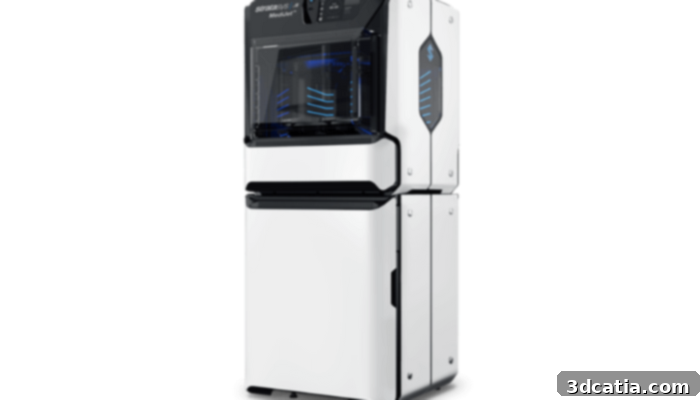
To achieve this level of accuracy and customization, Birmingham University Hospital has partnered with industry leader Stratasys, leveraging their state-of-the-art J5 MediJet 3D printer. This advanced system utilizes PolyJet technology, renowned for its ability to produce models with exceptional detail, multi-material capabilities, and vibrant color accuracy. For medical applications, this technology is invaluable as it facilitates the creation of “amazingly realistic, biocompatible, and sterilizable anatomical models,” as highlighted by Stefan Edmondson, Consultant Clinical Scientist (Reconstructive Science) at the hospital. These high-fidelity models and guides are instrumental in preoperative planning, allowing surgical teams to visualize and rehearse complex procedures with unprecedented clarity and confidence.
By integrating customized 3D-printed surgical guides, medical teams optimize patient outcomes while significantly reducing intervention times (photo credits: Stratasys).
Enhancing Surgical Precision with Advanced 3D Printing Technology
The integration of 3D printing into surgical protocols empowers medical teams to design and produce highly accurate devices directly from detailed patient scans, such as CT or MRI data. These custom-made guides boast an incredible resolution of less than 150 microns, ensuring that every contour and anatomical nuance is perfectly replicated. Such exacting precision translates directly into measurably improved surgical results, minimizing invasiveness and enhancing the functional and aesthetic outcomes for patients. The ability to create guides that perfectly match a patient’s unique anatomy is a cornerstone of personalized medicine, moving beyond a “one-size-fits-all” approach to truly patient-centric care.
These sophisticated surgical devices are fabricated using Biocompatible Clear MED610™ resin, a rigid and transparent material specifically engineered for medical applications. This advanced resin is particularly well-suited for scenarios demanding prolonged contact with the skin, extending up to 30 days, as well as limited contact with tissue, bone, or mucous membranes for durations up to 24 hours. The material’s transparency allows surgeons a clear view of the underlying anatomy during the procedure, further enhancing precision. Its biocompatibility ensures patient safety and reduces the risk of adverse reactions, making it an ideal choice for internal and external medical devices used during critical operations.
Stefan Edmondson consistently emphasizes the profound and multifaceted impact of 3D printing on their surgical practice. He notes, “In addition to saving up to three hours of surgery time, 3D printing also enables much better surgical planning.” This improved planning capacity is a game-changer. Utilizing comprehensive patient scans, the surgical team can generate intricate 3D visualizations that faithfully represent the distinct and unique anatomy of each patient. This virtual rehearsal allows surgeons to anticipate potential challenges, optimize their approach, and refine their strategy long before entering the operating room. Crucially, they then leverage the same 3D printing technology to produce not only highly realistic anatomical models for physical planning but also the personalized surgical cutting guides essential for executing the actual operation with unmatched precision.
The precision afforded by 3D printing extends beyond just time savings; it fundamentally enhances the quality and safety of surgical interventions. For complex reconstructive procedures, especially those involving the delicate and vital structures of the head and neck, accurate fabrication of incision guides is absolutely paramount. Any inaccuracy in cuts during these procedures could lead to significant fit problems, potentially resulting in rejection by the body, persistent discomfort for the patient, and requiring subsequent corrective surgeries. The stakes are incredibly high, as successful reconstruction is crucial for restoring function, speech, swallowing, and appearance.
One particularly challenging application where 3D printing demonstrates its superior capabilities over traditional methods is in reconstructive surgery involving the transplantation of bone segments. A common procedure for head and neck reconstruction involves taking a segment of a patient’s fibula (a bone from the lower leg), carefully molding it, and then transplanting it into the target area in the head or neck while meticulously preserving its vascular supply and bone tissue. This intricate process demands extraordinary precision to ensure proper alignment, integration, and long-term viability of the transplanted tissue. With 3D-printed guides, surgeons can achieve exact cuts and perfect anatomical fit, dramatically improving the success rate of these complex microvascular free flap procedures, thereby offering patients significantly better functional and aesthetic outcomes.
Reflecting on the transformative power of this technology, Stefan Edmondson eloquently concludes: “This capability means we can not only accurately predict the surgery before it’s done, but that we have the tools to ensure that the meticulous pre-surgical planning can be executed with the utmost precision. The surgical team is also much better prepared and the patient is far more at ease, as we can talk through the process and expected outcomes prior to going into the operating theater.” This sentiment underscores the holistic benefits: increased surgical efficiency, enhanced precision, reduced risks, and crucially, improved patient confidence and psychological well-being through informed communication and predictable results. It highlights a future where personalized medicine, driven by advanced manufacturing, becomes the standard of care for complex surgical challenges.
The pioneering work at Birmingham University Hospital is a testament to the revolutionary impact of 3D printing in the medical sector, particularly for complex and life-altering surgeries. These advancements not only shorten operating times but also significantly elevate the standard of care, offering patients greater hope and improved quality of life. The adoption of such innovative technologies underscores a global shift towards more precise, efficient, and patient-centric healthcare solutions, with 3D printing positioned at its very core.
We invite you to share your thoughts on these groundbreaking 3D-printed incision guides and their potential to further reshape modern medicine. Let us know your perspective in a comment below or engage with us on our LinkedIn, Facebook, and Twitter pages! Don’t forget to sign up for our free weekly Newsletter here, bringing the latest 3D printing news straight to your inbox! You can also find all our videos on our YouTube channel, offering visual insights into the world of additive manufacturing.
*Cover Photo Credits: Freepik