
The Game Changer: 3D Printing’s Impact on Sports Equipment and Athlete Protection
The landscape of sports is undergoing a profound transformation, largely driven by the advancements in additive manufacturing technologies, commonly known as 3D printing. These innovative processes offer an array of unparalleled benefits to athletes, ranging from bespoke equipment tailored to individual needs to geometrically complex designs and the integration of cutting-edge, ‘smarter’ materials. For years, leading sports equipment manufacturers have keenly recognized the immense potential of incorporating 3D printed components into their product lines, leveraging it as a pivotal strategy to deliver enhanced functionality, superior performance, and ultimately, a competitive edge. This paradigm shift is vividly illustrated by industry titans such as Adidas, which pioneered the development of revolutionary 3D printed soles for its high-performance running shoes, and Riddell, a frontrunner in protective gear, which introduced advanced 3D printed liners for its state-of-the-art helmets. These examples underscore a clear trend: 3D printing is not just an incremental improvement but a fundamental redefinition of what’s possible in athletic gear.
Revolutionizing Athlete Safety: The Rise of 3D Printed Helmets
Among the various categories of sports equipment, helmets have perhaps witnessed some of the most dramatic and vital advancements in recent times, largely due to the integration of additive manufacturing. Companies like Riddell, HEXR, and Kupol are at the forefront of this revolution, having seamlessly incorporated 3D printing into their design and manufacturing processes. A primary catalyst for this widespread adoption is the unparalleled level of protection that 3D printing can bestow upon headgear, significantly enhancing athlete safety in high-impact sports. This technology enables the creation of intricate internal structures that were previously impossible with traditional manufacturing methods, leading to vastly improved shock absorption and impact dissipation capabilities.
Consider the innovative approach of HEXR, for instance. This company designs and produces helmets featuring a unique 3D printed curved honeycomb structure. Crafted from PA 11, a high-performance polyamide known for its strength and flexibility, this intricate lattice is engineered to absorb impacts with remarkable effectiveness. Crucially, each HEXR helmet is meticulously modeled according to the individual wearer’s head shape, derived from detailed scans, ensuring a perfect, customized fit that maximizes both comfort and protective efficacy. Similarly, Riddell has elevated its helmet technology by utilizing Carbon’s cutting-edge Digital Light Synthesis (DLS) technology. This allows for the 3D printing of advanced elastomer lattice structures within helmet liners. These structures are specifically designed to excel at handling high-impact shocks, and like HEXR, they can be precisely customized to fit an athlete’s head perfectly, offering an unprecedented level of personalized protection.
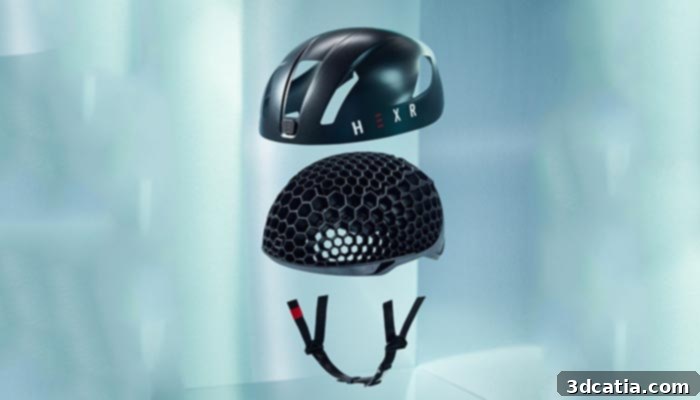
HEXR creates helmets that have a 3D printed curved honeycomb structure | Credits: HEXR
KAV Sports: Making Advanced Protection Accessible with FDM 3D Printing
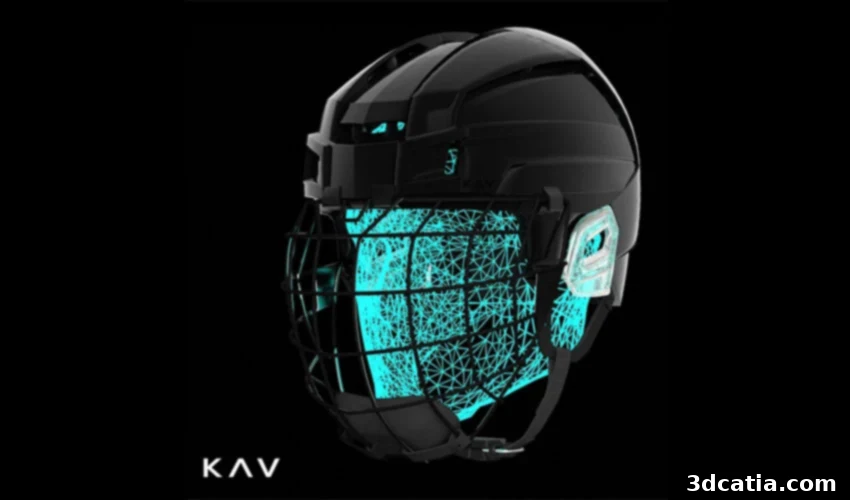
Further underscoring the versatility and growing adoption of 3D printing in sports, KAV, an innovative startup based in California, is making significant strides in the realm of hockey helmets. Like its counterparts, KAV is driven by a core mission: to deliver protective equipment that not only meets stringent safety standards but also elevates athletic performance. KAV’s decision to integrate 3D printing into its design workflow and manufacturing process stemmed from a clear identification of critical shortcomings in traditional hockey helmets – namely, a glaring lack of personalization and insufficient size variation. Conventional helmets often offer a “one-size-fits-most” approach, which can compromise both safety and comfort for many players.
What sets KAV apart is its commitment to accessibility. While companies like Riddell leverage advanced and often more expensive technologies such as Carbon’s CLIP (similar to SLA), KAV has opted for FDM (Fused Deposition Modeling) technology. This strategic choice enables KAV to produce high-quality, customized helmets at a more accessible price point, democratizing advanced protective gear for a broader spectrum of athletes. FDM, known for its robustness and cost-effectiveness, allows KAV to efficiently iterate on designs and scale production without incurring the prohibitive expenses associated with other additive manufacturing techniques, making personalized protection a reality for more hockey players.
Innovation Through Collaboration: KAV and BCN3D’s Synergy
KAV’s journey in transforming hockey helmet design has been significantly bolstered by its collaboration with BCN3D, leveraging their innovative IDEX (Independent Dual Extruder) technology. This partnership has proven instrumental in accelerating KAV’s development cycle, allowing them to rapidly prototype and create designs that can be reviewed and rigorously impact-tested by athletes in a remarkably short timeframe – often a matter of days. This agility in design and testing is a critical advantage, enabling swift iterations and optimization based on real-world feedback, a process that would be considerably slower and more expensive with traditional manufacturing methods.
By utilizing BCN3D’s platform, KAV effectively produces tailored helmets, significantly reducing the prohibitive expense of tooling typically associated with manufacturing complex parts. Furthermore, this technology opens up entirely new possibilities for integrating novel internal structures, allowing for unprecedented design freedom. The interior of KAV’s helmets is crafted from advanced carbon polymers, meticulously chosen for their superior protective qualities and lightweight properties. What’s more, KAV employs sophisticated machine learning algorithms to optimize material placement within the helmet’s structure. This data-driven approach ensures that material is strategically allocated precisely where it’s needed most for protection, while minimizing overall weight, thereby enhancing comfort and reducing potential strain on the athlete.
Beyond material innovation, KAV has also fundamentally rethought helmet design. They have successfully simplified the traditional two-shell mechanism found in many hockey helmets, streamlining the structure without compromising safety. This holistic approach – combining advanced 3D printing, smart materials, machine learning, and refined design – results in a hockey helmet that offers unparalleled personalization, enhanced protection, and improved performance on the ice.
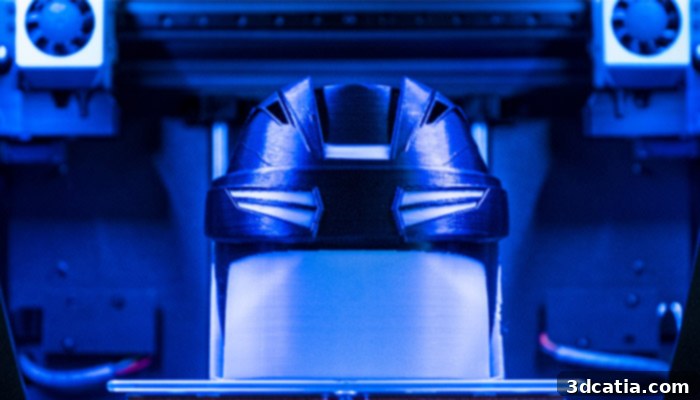
KAV creates designs that can be reviewed and impact tested by athletes in a matter of days | Image via BCN3D
Beyond Helmets: The Expanding Horizon of 3D Printing in Sports
The success story of KAV, along with Adidas, Riddell, and HEXR, represents just a glimpse into the transformative power of 3D printing within the sports industry. While the number of players fully embracing additive manufacturing for their core equipment might still be relatively small when considering the vastness of the global sports market, this trend is undeniably accelerating. The benefits – from unparalleled customization and enhanced performance to revolutionary safety features and rapid prototyping capabilities – are too significant for the industry to ignore.
As 3D printing technologies continue to evolve, becoming faster, more precise, and capable of working with an even wider array of advanced materials, we can anticipate an explosion of new applications across various sports. Imagine custom-fit running shoes perfectly molded to an athlete’s unique biomechanics, lightweight yet incredibly strong bicycle components, personalized protective padding for various contact sports, or even highly specialized training aids. The potential extends to areas like custom prosthetics for para-athletes, performance-enhancing wearables with integrated sensors, and sporting goods designed for optimal aerodynamic or hydrodynamic efficiency.
The future of sports equipment is undeniably intertwined with the continuous innovation in additive manufacturing. We eagerly await the myriad of groundbreaking applications that 3D printing will undoubtedly bring to this dynamic industry, pushing the boundaries of what athletes can achieve and how safely they can pursue their passions. For those interested in delving deeper into KAV’s pioneering work with 3D printed hockey helmets, more information is available HERE.
What are your thoughts on the revolutionary potential of 3D printed helmets and other sports equipment? Share your insights and opinions in a comment below or join the conversation on our Facebook and Twitter pages! Don’t miss out on the latest advancements in additive manufacturing – sign up for our free weekly Newsletter to receive all the cutting-edge 3D printing news directly in your inbox!