
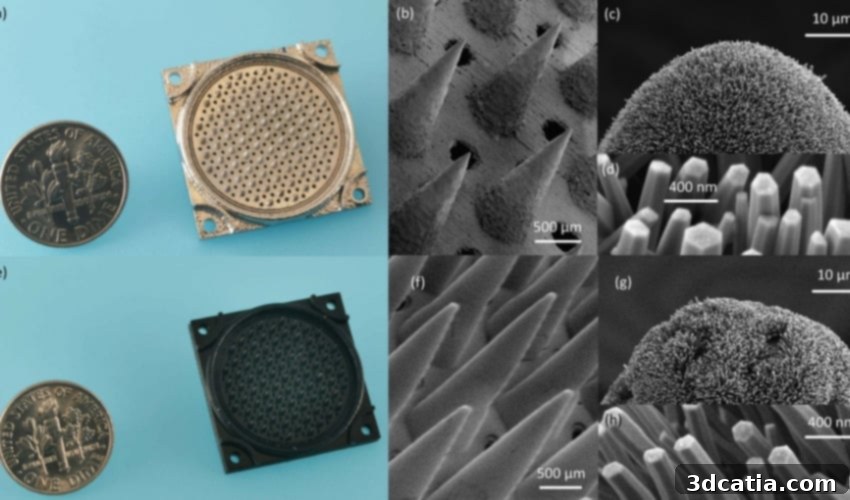
Revolutionizing Space Travel: MIT’s 3D Printed Ion Thrusters Propel Nanosatellites to New Frontiers
In a groundbreaking endeavor funded by the MIT Nanotechnology program and the NewSat project, researchers have unveiled a cutting-edge 3D printed, ion-powered thruster specifically designed for nanosatellites. This innovative development marks a significant leap forward in space propulsion technology. By leveraging advanced metal and resin 3D printing techniques, combined with hydrothermally grown zinc oxide nanowires (ZnONWs), the research team successfully engineered nanosatellite thrusters capable of emitting a precise stream of pure ions. This pivotal work is detailed in their research paper, titled “Additively manufactured electrohydrodynamic ionic liquid pure-ion sources for nanosatellite propulsion.” The publication not only highlights the first-ever demonstration of a fully 3D-printed thruster of this kind but also proudly presents the first thruster to produce pure ions directly from the ionic liquids utilized for propulsion. Furthermore, it validates the nanosatellite electrospray ionic liquid pure-ion rocket, setting new benchmarks in the field of miniaturized space propulsion.
Understanding MIT’s Advanced 3D Printed Nanosatellite Thrusters
Nanosatellites, defined as miniaturized satellites weighing between 1 and 10 kilograms, represent a rapidly expanding segment of the space industry. Their compact size and lower launch costs have democratized access to space, enabling diverse applications from Earth observation and telecommunications to scientific research and technology demonstrations. Traditionally, these small spacecraft have relied on chemical-based propulsion systems, which, despite their simplicity and high thrust, come with inherent limitations. Chemical thrusters often require heavy propellant tanks, complex plumbing, and offer lower specific impulse (a measure of propellant efficiency), thereby limiting mission duration and scope for nanosatellites where every gram and cubic centimeter counts.
However, as spacecraft power systems have advanced, many modern nanosatellite missions are now transitioning towards higher energy electric propulsion (EP) systems. Electric propulsion offers significantly higher specific impulse, meaning they use propellant far more efficiently, allowing for longer mission durations or more complex orbital maneuvers with less fuel. The MIT research team specifically focused on electrospray thrusters, a type of electric propulsion system that is exceptionally well-suited for nanosatellites. The underlying physics of electrospray thrusters inherently favor miniaturization, making them an ideal candidate for propulsion in the confined spaces of small satellites. These thrusters operate by using strong electric fields to extract ions from a liquid propellant, typically an ionic liquid, which are then accelerated to generate thrust. This pure ion emission is crucial for maximizing efficiency and minimizing degradation of the thruster components, leading to a longer operational lifespan in space.
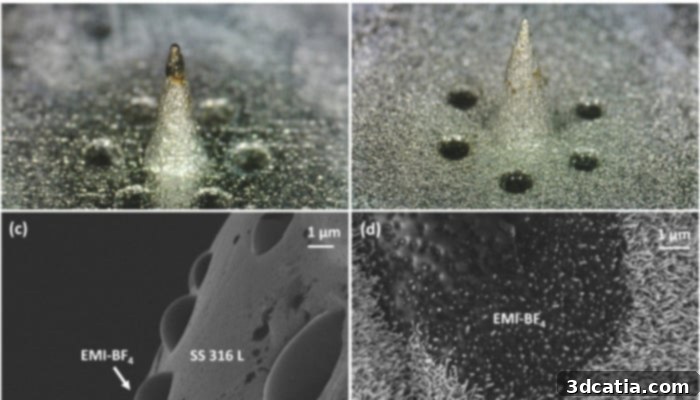
Preliminary experimental results suggesting the reported devices have a long life. (photo credits: Additive Manufacturing journal)
Advanced Manufacturing for Miniaturized Propulsion: Binder Jetting and Vat Polymerization
The success of this nanosatellite thruster hinges significantly on the capabilities of additive manufacturing (AM), commonly known as 3D printing. A key advantage of additive manufacturing techniques is their ability to function effectively and precisely on a miniature scale, fabricating intricate geometries that would be impossible or prohibitively expensive to create with traditional subtractive methods. Recognizing this, the MIT researchers experimented with two distinct additive manufacturing processes to fabricate the critical emitting electrodes for their nanosatellite thrusters: binder jetting and vat polymerization.
For the binder jetting process, the team selected SS 316L, a robust and corrosion-resistant stainless steel. Binder jetting involves selectively depositing a liquid binding agent onto a layer of powdered material, joining particles to form a solid part layer by layer. This method is particularly adept at producing complex metal parts with excellent mechanical properties, making SS 316L an ideal choice for components that must endure the harsh conditions of space and interaction with ionic liquids. While the stainless steel electrodes demonstrated superior overall performance in initial tests, the fabrication process proved to be quite expensive due to material costs and post-processing requirements.
As an alternative, the researchers utilized vat polymerization – a family of 3D printing technologies including stereolithography (SLA) and digital light processing (DLP) – for resin-based components. For this method, they chose FunToDo Industrial Blend resin (FTD-IB), a highly cross-linked, acrylic-based polymer. Vat polymerization works by selectively curing liquid photopolymer resin with a light source, solidifying it layer by layer. This process is known for producing parts with exceptional detail and smooth surface finishes. Remarkably, the polymer equivalent thrusters produced using FTD-IB rivaled the performance of their stainless steel counterparts, despite incurring significantly lower production costs. This cost-performance balance is crucial for the wider adoption and scalability of nanosatellite propulsion technology. The ability to produce high-performing thruster components from both metal and polymer materials using readily available 3D printing methods underscores the versatility and potential of additive manufacturing in developing advanced space hardware.
The Strategic Advantage of 3D Printing in Space Propulsion
The adoption of 3D printing in the aerospace industry has been a game-changer, facilitating remarkable innovations from critical components for commercial aircrafts to entirely 3D printed rockets. Its relative efficiency, design flexibility, and cost-effectiveness are proving to be invaluable, especially for highly specialized applications like nanosatellite propulsion. In the context of the MIT thruster, 3D printing offers distinct advantages over traditional manufacturing methods. Miniaturized thrusters produced using conventional subtractive machining or semiconductor cleanroom microfabrication techniques often struggle to achieve the propulsive efficiency required for next-generation missions. A critical limitation of these traditional methods is their inability to exclusively emit pure ions, leading to a mix of ions and neutral particles that reduces thrust efficiency and can cause sputtering or erosion of thruster components. This problem is particularly pronounced at the micro-scale, where precise control over electric fields and material structures is paramount.
This is where 3D printing emerges as a significant improvement. Additive manufacturing allows for the creation of intricate internal geometries and highly optimized structures that precisely control the electric fields needed for efficient ion extraction and acceleration. This level of design freedom is difficult, if not impossible, to achieve with traditional methods. By leveraging 3D printing, researchers can fine-tune the design of the emitting electrodes and surrounding structures to ensure that only pure ions are generated and expelled, maximizing the specific impulse and extending the operational life of the thruster. The ability to integrate complex micro-features and optimize fluidic pathways for ionic liquids significantly boosts performance.
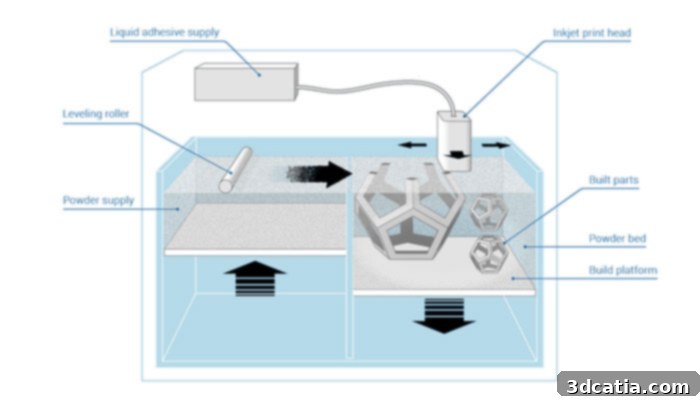
An illustrated example of Binder Jetting, one of the processes used in the creation of these nanosatellite thrusters (photo credits: Additively)
As Luis Fernando Velásquez-García, the lead researcher on this project, eloquently commented: “If you want to be serious about developing high-performance hardware for space, you really need to look into optimizing the shapes, the materials, everything that composes these systems. 3D printing can help with all of these things.” This statement perfectly encapsulates the strategic advantage of additive manufacturing. It enables iterative design, rapid prototyping, and the ability to experiment with novel geometries and materials, all of which are critical for pushing the boundaries of space technology. By optimizing every aspect of the thruster’s design and material composition through 3D printing, the team has been able to achieve unprecedented levels of performance and efficiency for nanosatellite propulsion.
Democratizing Space: The Future Impact of 3D Printed Ion Thrusters
The combination of advanced 3D printing techniques and hydrothermal growth of materials like zinc oxide nanowires (ZnONWs) holds immense potential to democratize access to sophisticated nanosatellite propulsion technology. By simplifying the manufacturing process and reducing costs associated with highly specialized components, this research could significantly lower the barrier to entry for academic institutions, startups, and smaller nations seeking to deploy their own nanosatellites. Furthermore, the rapid prototyping capabilities of 3D printing drastically reduce design iteration time, allowing engineers to test and refine thruster designs much faster than with conventional methods. This accelerated development cycle fosters quicker innovation and ensures that propulsion systems can keep pace with the rapidly evolving demands of space missions.
The implications of this study extend far beyond just nanosatellites. This advancement has the potential to profoundly impact future developments in a wide range of miniaturized spacecraft propulsion ion beam applications. Imagine constellations of hundreds or thousands of nanosatellites, each with highly efficient and long-lasting propulsion, capable of performing complex orbital maneuvers, station-keeping with precision, or even embarking on deep-space missions. The technology could also be adapted for larger satellite platforms requiring fine attitude control, precise formation flying, or extended mission lifetimes. Moreover, the principles demonstrated here could pave the way for advancements in other ion beam technologies, such as those used in scientific instruments for space-based analysis or even for future asteroid mining operations. This research represents not just a new thruster, but a new paradigm for how propulsion systems are designed, manufactured, and utilized in space, promising a future of more accessible, agile, and ambitious space exploration.
For those interested in delving deeper into the technical specifics of this groundbreaking research, the full paper is available for review HERE.
What are your thoughts on this exciting development in 3D printed space propulsion? Share your insights and comments below, or engage with us on our Facebook and Twitter pages! Don’t miss out on the latest advancements in additive manufacturing – sign up for our free weekly Newsletter here and get the most recent 3D printing news delivered straight to your inbox!
*Thumbnail photo credits: MIT