

Strengthening National Security: Stratasys ProtectAM Elevates Cybersecurity for Government and Defense 3D Printing
In recent years, the U.S. government and military sectors have significantly embraced 3D printing, or additive manufacturing (AM), for an expansive range of critical projects. This integration spans everything from rapid prototyping and on-demand spare parts production to the creation of advanced components for defense applications. However, this transformative adoption has been accompanied by a persistent and paramount question: what are the cybersecurity implications of using 3D printing technology in these sensitive environments, and more importantly, how can these risks be effectively mitigated, especially when national security hangs in the balance? Addressing this crucial challenge head-on, Stratasys, a global leader renowned for its polymer 3D print solutions, has unveiled a potentially groundbreaking answer. The company recently announced the launch of ProtectAM, an innovative data security solution designed to substantially enhance cybersecurity measures, particularly tailored for government and defense sector applications where data integrity and operational security are non-negotiable.
The specter of cybersecurity threats is far from novel. Since the dawn of the internet era, digital battlegrounds have steadily emerged as the new frontier for 21st-century warfare. Governments, critical infrastructure, and corporations worldwide routinely confront sophisticated cyberattacks. According to statistics from the Center for Strategic & International Studies (CSIS), the year 2021 alone witnessed over 90 significant cyber incidents globally. These incidents are defined as cyberattacks targeting government agencies, defense and high-tech companies, or economic crimes resulting in losses exceeding a million dollars. The United States, in particular, has borne a substantial financial burden; it was estimated that in 2018, the U.S. government incurred costs exceeding $13.7 billion due to the repercussions of cyberattacks. Given these stark realities, it is hardly surprising that cybersecurity has remained a central focus for various government agencies and successive American administrations, including the current one.
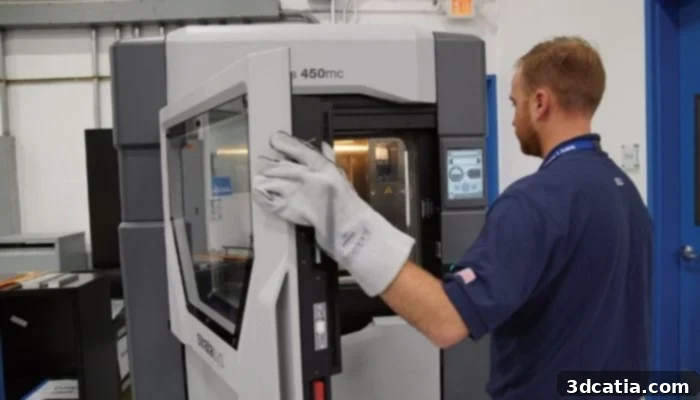
ProtectAM will be compatible with several large-format Stratasys printers, ensuring robust security for industrial applications (photo credits: Stratasys)
Within the specialized domain of additive manufacturing, cybersecurity concerns are equally pertinent and have been a subject of ongoing discussion for several years. It has become increasingly evident that 3D printing systems can present attractive targets for cyberattacks, potentially creating critical vulnerabilities within governmental and defense supply chains. A seminal paper titled “Manufacturing and Security Challenges in 3D Printing,” authored by researchers from New York University’s Tandon School of Engineering, precisely highlighted these cybersecurity vulnerabilities. The researchers pointed out that malicious actors could potentially gain unauthorized access to critical design files, such as CAD (Computer-Aided Design) files, and introduce subtle, yet potentially dangerous and often undetectable, defects into the printed parts. The implications of such an attack could be catastrophic, especially for the U.S. Military, which is leveraging 3D printing for highly sensitive applications across various sectors, including aerospace components, advanced battle helmets, and bespoke field equipment. These vulnerabilities underscore the urgent need for robust security solutions that can protect the integrity of the manufacturing process from design to final product. Stratasys’ latest solution, ProtectAM, aims to provide exactly this level of protection, thereby enabling even wider and more secure adoption of additive manufacturing for critical defensive and governmental applications.
Introducing Stratasys ProtectAM: A Comprehensive Data Security Platform
ProtectAM is not merely another software update; it represents a dedicated, comprehensive data information security solution engineered specifically for select Stratasys 3D printers. Its primary objective is to meet and exceed the stringent cybersecurity requirements set forth by the U.S. Department of Defense (DoD). One of ProtectAM’s distinguishing features is its pioneering use of Red Hat Enterprise Linux as its foundational security platform within the additive manufacturing industry. Red Hat Enterprise Linux is widely recognized and preferred by the U.S. government for its robust security features, open-source transparency, and long-term stability, making it an ideal choice for sensitive defense applications. By leveraging this trusted operating system, ProtectAM is designed to comply fully with the comprehensive U.S. Defense Information Systems Agency’s (DISA) Security Technical Implementation Guide (STIG). DISA STIGs are meticulously crafted guidelines that outline specific security controls and configurations required to protect against a broad spectrum of cybersecurity threats, ensuring the highest level of data integrity and system resilience.
The initial rollout of ProtectAM will focus on several industrial and large-format Stratasys 3D printers, which are already extensively utilized by government clients for crucial end-use applications in sectors such as aviation, ground vehicle maintenance, and various defense logistics. This strategic phased deployment ensures that the most critical applications receive enhanced security first. Currently, ProtectAM is compatible with the Fortus® 450mc™ printers, known for their reliability and precision in demanding environments. Later in the year, Stratasys plans to extend compatibility to include the F900® 3D printers, further broadening the scope of secure additive manufacturing for its governmental and defense clientele. The company’s commitment to expanding this security umbrella underscores the growing importance of securing the entire AM ecosystem, from design data to the physical production process.

Stratasys hopes that ProtectAM will allow the US government and military to expand their AM applications, including those for the aerospace sector, with uncompromised security (photo credits: Stratasys)
Enabling Broader Adoption and Strategic Advantages in Additive Manufacturing
Ultimately, Stratasys has meticulously developed the ProtectAM system to unlock new and more expansive applications for their printers within the government and defense sectors, moving beyond traditional research and development (R&D) roles. This security solution is designed to instill the necessary confidence for deploying 3D printing in highly sensitive operational contexts. One compelling example of a potential future use case, as envisioned by Stratasys, involves empowering the U.S. military to establish a geographically distributed enterprise network of 3D printers across its military bases worldwide. Such a network, secured by ProtectAM, would revolutionize logistics and supply chain resilience, enabling on-demand production of critical parts in remote or forward operating locations, significantly reducing lead times and transportation costs.
Dick Anderson, Senior Vice President for Manufacturing at Stratasys, eloquently summarized the profound benefits of this advancement: “The advantages of 3D printing are unequivocally clear, encompassing the ability to deliver critical products precisely where they are needed, with unparalleled speed and minimal cost. This technology also significantly extends the lifespan of existing assets, thereby realizing substantial savings for taxpayers. Furthermore, the integrity of parts printed from digital files is absolutely essential for critical applications. With ProtectAM, we have established a world-class security solution that will accelerate the adoption of additive manufacturing by government agencies, and ultimately, pave the way for its secure integration into commercial segments as well.” This vision highlights ProtectAM’s role as a catalyst for widespread, secure AM deployment.
The implications of ProtectAM extend beyond merely safeguarding individual printers. It addresses the broader cybersecurity posture of the entire additive manufacturing workflow, from secure file transfer and validated print jobs to authenticated machine operations. This holistic approach ensures that potential vulnerabilities at any stage of the AM process are minimized, protecting intellectual property, critical designs, and the physical integrity of produced parts. For defense applications, where failure is not an option, this level of security is indispensable. By offering a platform that meets the rigorous standards of the U.S. Department of Defense, Stratasys is not only protecting its customers but also contributing to the advancement of national security capabilities through resilient and trustworthy manufacturing.
Looking ahead, Stratasys harbors ambitious plans to extend the reach of ProtectAM beyond its initial focus on government and defense industries in the coming years. The company anticipates that the demand for enhanced cybersecurity in additive manufacturing will grow across various commercial sectors, particularly in industries dealing with proprietary designs, critical infrastructure components, or sensitive product development. This strategic expansion will likely see ProtectAM become a standard for secure AM practices, setting a new benchmark for data integrity and operational reliability in industrial 3D printing. For more detailed information about ProtectAM and its capabilities, interested parties can refer to the official press release available on Stratasys’ corporate website HERE.
What are your thoughts on Stratasys’ ProtectAM and its potential impact on the future of secure additive manufacturing? Share your insights and perspectives in a comment below or join the discussion on our Facebook and Twitter pages. Don’t miss out on the latest advancements and news in the 3D printing world—sign up for our complimentary weekly newsletter, delivered directly to your inbox!
*Cover Photo Credits: freestocks on Unsplash