
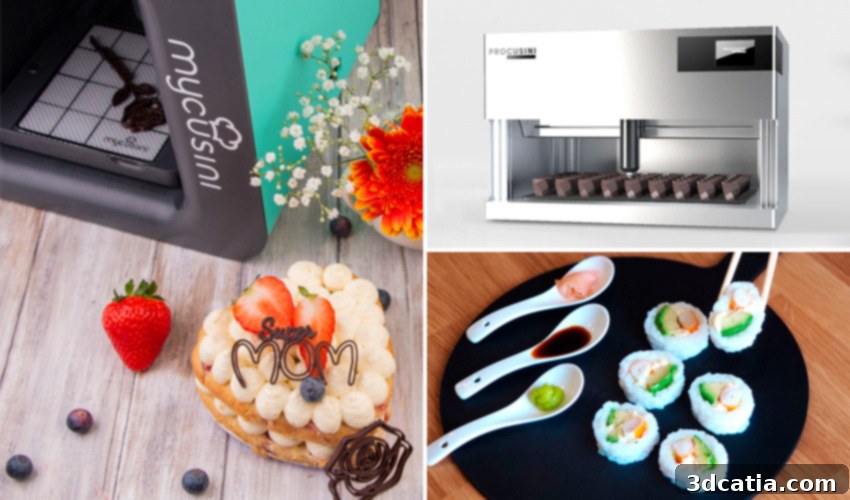
The Ultimate Guide to 3D Food Printers: Reshaping Gastronomy for Home and Professional Use
While 3D printing is most commonly associated with industrial applications like plastics and metals, a truly revolutionary frontier is emerging in our kitchens: food 3D printing. These innovative devices are transforming the way we perceive and create culinary delights, offering unprecedented freedom and precision. Imagine crafting intricate pastries, personalized chocolates, or even customized meals that cater to specific dietary needs or artistic visions. Beyond pure aesthetics, food 3D printers can also play a vital role in reducing food waste and making healthy eating more accessible and engaging.
Though they won’t be replacing your traditional ovens or microwaves anytime soon, 3D food printers represent a significant advancement for culinary enthusiasts, professional chefs, and even those exploring solutions for specialized nutrition. They empower users to explore new textures, shapes, and flavors, pushing the boundaries of gastronomic creativity. While some pioneering companies like Steakholder Foods and Revo Foods have developed advanced 3D printing systems to produce ready-to-eat food products like plant-based fish or meat, their specialized machines are not typically available for direct purchase by consumers or smaller businesses. This guide, however, focuses exclusively on the remarkable 3D food printers that are currently available on the market, ready to be integrated into your kitchen or professional culinary environment. We’ve compiled an alphabetical list of the top contenders, showcasing the diverse capabilities and innovative designs pushing the boundaries of edible creation.
Choc Creator V2.0 Plus: Precision Chocolate Artistry
Building on the legacy of its successful predecessors, the Choc Creator V1 and V2 (which are no longer in production), the Choc Creator V2.0 Plus stands as the refined and optimized version of Choc Edge’s renowned chocolate 3D printer. This machine is a dream come true for chocolatiers and baking enthusiasts seeking to elevate their creations with unparalleled precision. One of its standout advantages is an expanded design area, measuring a generous 180 mm x 180 mm x 40 mm, which allows for larger and more ambitious chocolate designs. The V2.0 Plus excels at producing incredibly fine chocolate lines, with a minimum width of just 0.8 mm, enabling the creation of intricate patterns, delicate edible decorations, and personalized chocolate gifts that would be impossible to achieve by hand.
Ease of use is central to the Choc Creator V2.0 Plus’s design. It supports standard STL files, making it compatible with a wide range of 3D design software. These files can be effortlessly transferred directly to the device using a USB stick, streamlining the printing process. The printer comes equipped with two 0.8 mm metal nozzles, ensuring consistent and high-quality extrusion. To help users get started immediately, the machine includes pre-installed 2D and 3D G-codes, offering ready-to-print designs right out of the box. This immediate functionality makes the Choc Creator V2.0 Plus an accessible entry point for those new to chocolate 3D printing, while its precision appeals to seasoned professionals. Priced at approximately €3,350, it represents a valuable investment for those looking to add a touch of innovative artistry to their chocolate production.
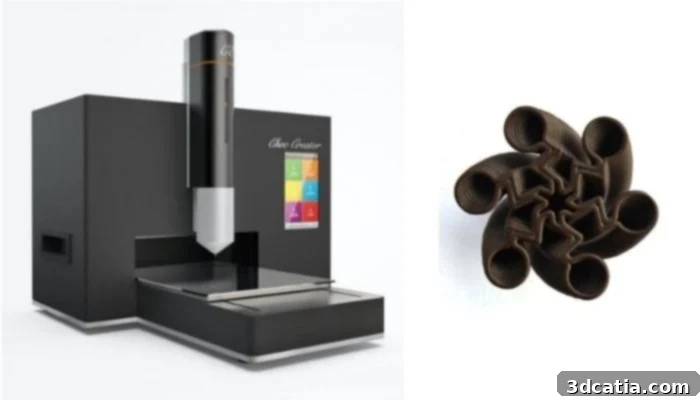
Photo Credits: Choc Edge
Cocoa Press 2: DIY Chocolate Innovation
The Cocoa Press 2.0 brings the magic of 3D-printed chocolate directly into your home kitchen. Presented as a comprehensive 3D printing kit, it’s specifically engineered for enthusiasts who delight in crafting homemade chocolates with a personalized touch. This innovative device empowers users to design and produce complex chocolate patterns with remarkable precision and speed, transforming ordinary chocolate into edible works of art. Its compact form factor, with a print volume of 135 mm x 135 mm x 150 mm, makes it an ideal fit for any countertop, and its intuitive design ensures easy assembly, even for those new to 3D printing.
At the heart of the Cocoa Press 2.0 is its meticulously designed chocolate extruder, which is optimized to ensure an ideal chocolate flow and maintain precise temperature control throughout the printing process. This critical feature guarantees smooth, consistent results, preventing clogs and ensuring that every delicate detail of your design is perfectly replicated. The device boasts compatibility with popular open-source software such as Prusa Slicer, offering users the flexibility to customize printing parameters to suit their specific chocolate types and desired outcomes. With overall dimensions of 460 mm x 350 mm x 380 mm, the Cocoa Press 2.0 is a robust yet manageable machine. It targets passionate chocolate creators who are eager to explore advanced techniques, including the exciting possibilities of multicolor chocolate printing and the creation of seamless, continuous patterns. Whether for personal enjoyment, unique gifts, or small-batch artisanal production, the Cocoa Press 2.0 provides an accessible platform for chocolate innovation.
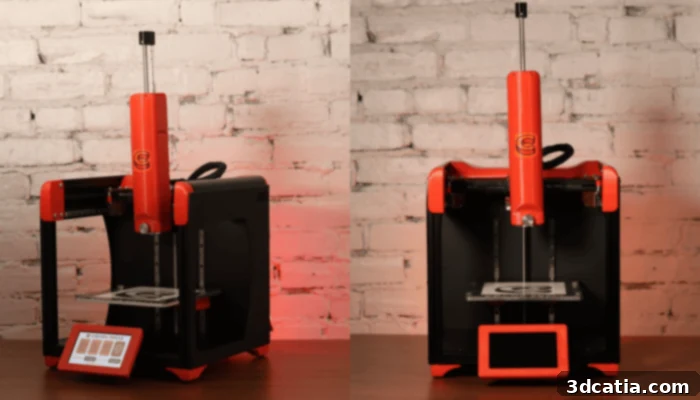
Photo Credits: Cocoa Press
FELIX Food 1.6: Gastronomic Precision from the Netherlands
The FELIX Food 1.6 SINGLE Head 3D Printer is a testament to meticulous engineering from the Netherlands-based company FELIXprinters, known for its high-quality 3D printing solutions. This culinary 3D printer harnesses advanced extrusion technology, allowing it to precisely craft edible objects up to an impressive 170 mm in height. Its design philosophy centers around delivering both precision and ease of use, making it an excellent addition to a variety of environments, from the modern home kitchen to bustling restaurants and the demanding hospitality sector.
Equipped with a suite of sophisticated features, the FELIX Food 1.6 ensures an intuitive and consistent printing experience. It boasts a heated bed and syringe system, crucial for maintaining optimal temperatures for various food pastes, from chocolate to vegetable purees. Automatic calibration simplifies the setup process, while a responsive touch screen provides seamless control over printing parameters. A built-in webcam allows for convenient monitoring of the printing process, ensuring everything runs smoothly. The printer utilizes a generous 100 cc syringe, minimizing refills during longer print jobs, and offers a substantial printing area of 220 x 195 x 170 mm, accommodating a wide range of creative culinary projects. Each FELIX Food 1.6 machine is handmade in Europe, underscoring its commitment to quality and craftsmanship. This dedication also translates into modular upgrades, ensuring that the printer can evolve with future technological advancements, promising a long service life and continued utility. The FELIX Food 1.6 is designed not just to print food, but to redefine creativity in the kitchen, seamlessly integrating 3D printing into the professional gastronomic world and empowering chefs to innovate like never before.
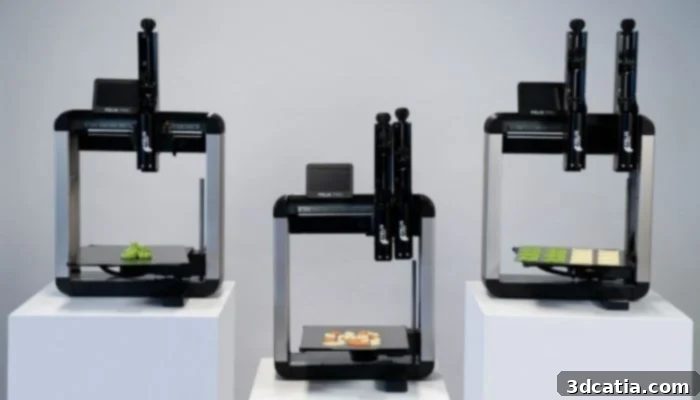
Photo Credits: FELIXprinters
Foodini: The User-Friendly Culinary Creator
Foodini, developed by Natural Machines, has cemented its reputation as one of the most recognized and user-friendly 3D food printers available today. This innovative kitchen appliance is designed to bring the power of customized food creation to a wider audience, from home cooks to professional caterers. Its appeal lies in its straightforward and intuitive operation, making 3D food printing accessible even to those with no prior experience in additive manufacturing. The process is remarkably simple: users prepare their desired ingredients, creating pastes or purees, which are then loaded into one of the five available stainless steel cartridges.
Once loaded, the ingredients are automatically fed to the machine’s nozzle, which meticulously prints delicious and original dishes layer by layer. This controlled extrusion allows for incredible precision in shaping and detailing, opening up a world of creative possibilities for appetizers, main courses, and desserts. The Foodini is designed with practicality in mind, featuring a relatively small footprint of 43×45.8×43 cm, ensuring it can comfortably share counter space with other conventional kitchen appliances. It can print dishes with a maximum height of 110 mm and an impressive diameter of up to 257 mm, providing ample scope for diverse culinary projects.
Natural Machines highlights several key benefits of the Foodini. Beyond the aesthetic appeal, the solution promotes healthier eating by encouraging the use of fresh, natural ingredients, allowing for precise control over sugar, salt, and fat content. It also enhances kitchen efficiency by automating repetitive tasks and significantly contributes to reduced food waste by precisely portioning ingredients. A large, intuitive touch screen, coupled with numerous on-screen aids, guides the user through every step of the process, from design selection to ingredient loading and printing. This comprehensive and user-friendly package makes Foodini an exceptionally popular choice for enthusiasts eager to dive into the world of 3D-printed food. It truly offers an unparalleled way to start exploring the future of culinary art.
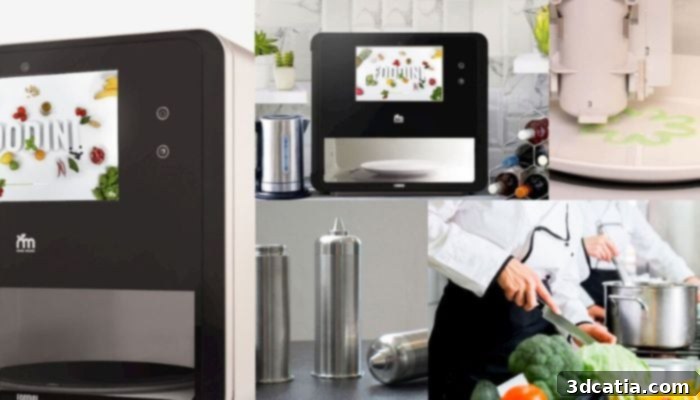
Photo Credits: Foodini
mycusini® 2.0: Stylish Chocolate Personalization
The mycusini® 2.0 represents the cutting-edge of chocolate 3D printing technology, building upon its predecessor with a host of enhanced features and a striking design. The first thing that captivates users is its elegant, timeless aesthetic, accentuated by playful pink elements that make it a true visual highlight in any kitchen. However, its appeal extends far beyond its looks. The mycusini® 2.0 is a powerhouse of creativity, featuring an integrated library of over 1,000 pre-designed 3D objects. These can be effortlessly accessed and previewed directly on the vibrant 3.5″ touch color display, offering immediate inspiration for your chocolate creations.
For those who prefer to design their own unique 3D objects, the mycusini® 2.0 offers complimentary access to the exclusive mycusini Club. This online platform provides tools and resources for users to unleash their imagination, designing custom shapes, intricate patterns, and personalized messages. Objects are printed using the specially formulated Choco Refills, which ensure optimal flow and consistency for perfect results, with a maximum print size of up to 90 x 90mm. Practicality is also a key consideration in its design; the removable printing platform makes cleaning the device incredibly simple and hygienic, ensuring it’s always ready for your next project. Available directly from the manufacturer’s website for an accessible price of €478.00, the mycusini® 2.0 makes personalized chocolate printing an affordable and enjoyable reality for hobbyists and small businesses alike, offering an exceptional blend of style, functionality, and creative freedom.
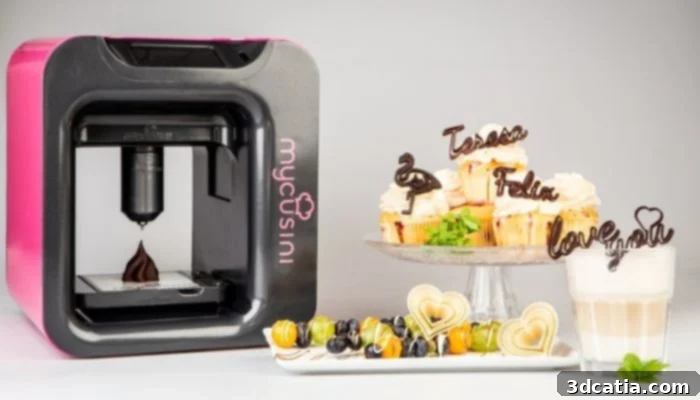
Photo Credits: mycusini
nūfood from Dovetailed: Liquid-Based Edible Innovation
nūfood, an innovative creation from the UX Designers at Dovetailed, stands out as the world’s first liquid-based food 3D printer. This pioneering device redefines what’s possible in edible creation by specializing in printing vegan foods in liquid form, opening up a fascinating realm of decorative and flavorful possibilities. Beyond solid confections, nūfood even allows users to craft imaginative and visually stunning cocktails, showcasing its versatility and novel approach to food fabrication. The technology behind nūfood draws inspiration from cutting-edge scientific advances in printing biological textiles, demonstrating a sophisticated fusion of design and scientific research.
The printer itself features an elegantly minimalist design, characterized by a sleek, movable robotic arm. This arm precisely releases food, drop by exquisite drop, into a liquid-filled container on the printing table. This method allows for the creation of intricate structures and shapes that would be impossible with traditional extrusion, resulting in unique textures and presentations. nūfood offers the capability to print food in a diverse array of shapes, sizes, and colors, providing unparalleled creative control to its users. To simplify the design process, nūfood comes with a dedicated app, making 3D food design intuitive and accessible. Users can effortlessly draw custom shapes on a virtual grid or select from a library of ready-made models, transforming complex ideas into tangible edible forms with ease.
Designed for both professional and home kitchens, nūfood prioritizes ease of use, speed, and minimal maintenance, ensuring a seamless user experience. Its unique liquid-based approach opens doors for molecular gastronomy enthusiasts, avant-garde chefs, and anyone keen on exploring the artistic potential of food. Further enhancing its appeal, Dovetailed offers a unique catering service, providing the option to rent the nūfood printer for special dinners, events, or demonstrations. This not only showcases the printer’s capabilities but also allows a broader audience to experience the magic of liquid-based 3D food printing firsthand.
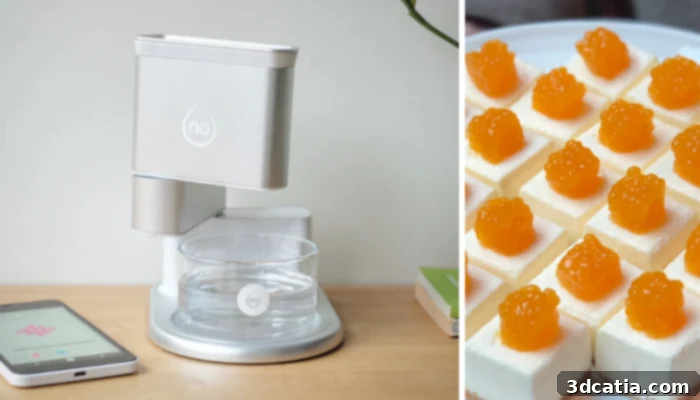
Photo credits: Dovetailed
OPUS from byFlow: Professional Culinary Excellence
The OPUS by byFlow is a high-performance 3D printer specifically engineered for the discerning professional culinary world, particularly excelling in chocolate processing. This robust machine is an indispensable tool for confectioners, chocolatiers, and chefs who aspire to create extraordinary chocolate masterpieces and other intricate food designs with unwavering precision. The OPUS supports these culinary artists by delivering exceptional reliability, unparalleled consistency, and pinpoint accuracy in every print, ensuring that complex patterns and delicate structures are perfectly realized time and again.
Beyond its technical capabilities, the OPUS offers remarkable flexibility in design. Its aesthetics can be adapted to individual preferences or integrated seamlessly into various kitchen environments, blending functionality with style. Crucially, it enables production to be scaled efficiently, making it suitable for both small-batch artisanal work and larger commercial demands, all while maintaining its user-friendly interface. byFlow, the innovative company behind the OPUS, articulates its core philosophy with a powerful mission statement: “It’s our mission to empower food professionals with innovative, user-friendly products & services that enhance their craftsmanship and productivity.” This commitment to empowering culinary professionals is evident in every aspect of the OPUS, from its robust construction to its intuitive operation. It’s more than just a printer; it’s a partner in culinary innovation, allowing chefs to push creative boundaries, personalize dishes, and ensure consistent quality, ultimately elevating the dining experience for their customers.
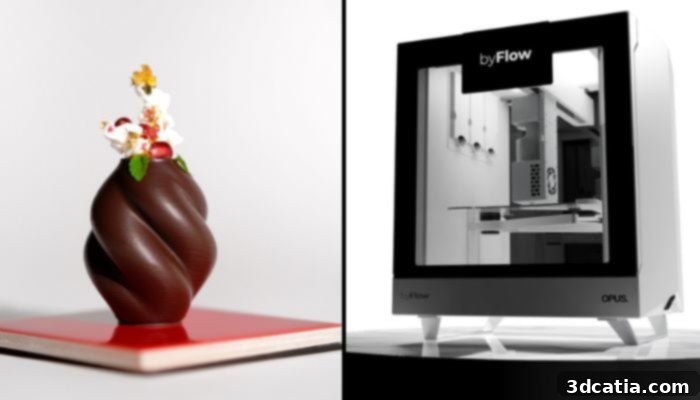
Photo Credits: byFlow
Patiss3, the French Culinary 3D Printer: Mold-Free Creations
Hailing from the innovative French start-up La Pâtisserie Numérique, the Patiss3 is a groundbreaking 3D food printer that introduces a distinctly different approach to edible creation. Unlike most extrusion-based systems, the Patiss3 is built on advanced powder technology, specifically employing a technique called dynamic molding. This revolutionary method allows for the design and creation of virtually any shape without the need for traditional molds, offering an unprecedented level of creative freedom to culinary artists.
The core aim of the Patiss3 is to provide a powerful and versatile working tool for all chefs who wish to express their boundless creativity through their dishes and desserts. By eliminating the constraints of conventional molding, chefs can experiment with complex geometries, intricate textures, and personalized forms previously unimaginable. Currently, the Patiss3 printer excels at designing shortbread cookies, which can be crafted in an infinite array of shapes, whether savory or sweet. This capability allows users to seamlessly integrate various flavors and ingredients, deciding to add spices, rich cocoa powder, or vibrant fruit powder directly into the flour mixture, creating truly bespoke treats. The dedicated teams at La Pâtisserie Numérique are continuously researching and developing new materials and ingredients compatible with the Patiss3’s powder technology. This ongoing innovation promises to broaden the range of possibilities even further, ensuring that the Patiss3 remains at the forefront of culinary 3D printing and continues to inspire revolutionary edible designs for the gastronomic world.
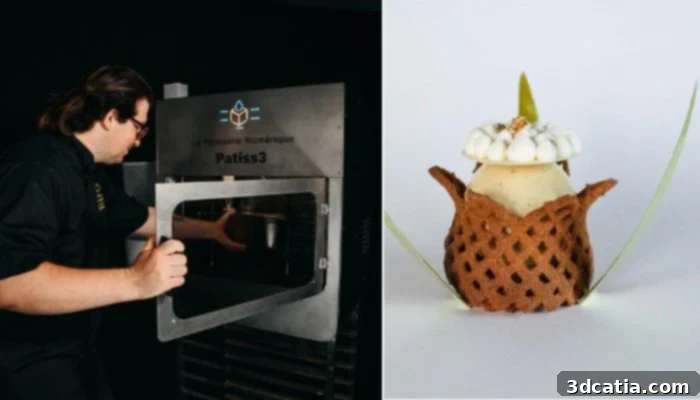
At the left, the Patiss3 machine, at the right, one of the 3D printed creations (Photo Credits: La Pâtisserie Numérique)
The Procusini Research: The Explorer’s Food Printer
The Procusini Research printer is specifically engineered for “those who like to experiment,” positioning itself as an ideal tool for educational institutions, research facilities, and innovative culinary labs. This printer is not just for creation, but for exploration, allowing users to delve deep into the mechanics and possibilities of food 3D printing. To facilitate extensive experimentation, the printer comes equipped with three dosing tips of varying diameters, offering flexibility in extrusion thickness and detail. A crucial feature for research and development is the ability to individually adjust all printing parameters, providing unparalleled control over the printing process. This allows users to meticulously fine-tune settings and observe the effects on different food materials, fostering a deeper understanding of food rheology and additive manufacturing.
The Procusini Research boasts impressive versatility in material compatibility, working seamlessly with a wide array of foods. From creamy cheese and rich chocolate to sweet speculoos and beyond, its adaptable nature encourages boundless creativity and material testing. The expansive printing area of 30 x 50 cm offers ample space for larger projects and multiple simultaneous prints. Designed with hygiene and practicality in mind, the printing area features rounded corners, preventing food particles from getting stuck, and a removable production plate, making cleaning effortless. Connectivity options include both USB and a convenient card reader, while a crisp 3.5-inch touchscreen provides intuitive management and control. As an added bonus, all buyers gain access to an extensive library of up to 1,000 print templates, along with online access to the Procusini Club. Within this community, users can not only find inspiration but also create custom designs, incorporate individual lettering and logos, and even upload their own 3D objects, making the Procusini Research a powerful platform for learning, discovery, and innovation in food science and culinary arts.
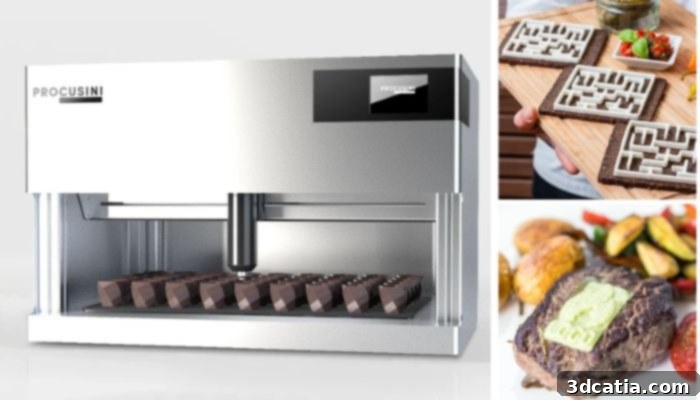
Photo Credits: Procusini
WiibooxSweetin: Versatile Professional Food Printing
The WiibooxSweetin food 3D printer is a robust and versatile machine that embodies a perfect synergy of precision, quality, and creative potential, making it an ideal solution for professional culinary environments. Designed for ease of use, it simplifies the complex process of 3D food printing: users simply download their desired 3D model files onto the machine, and the printing process can commence with minimal fuss. This straightforward approach allows chefs and food businesses to integrate 3D printing into their workflows without requiring extensive technical training.
One of the WiibooxSweetin’s most impressive features is its exceptional material compatibility, offering a broad spectrum of printable foods to cater to diverse culinary needs and creative visions. From rich, velvety chocolate and savory cheese to fluffy mashed potatoes, nutritious beans, sticky caramel, golden honey, fruit jams, and crisp cookies, the possibilities are virtually endless. This wide range of compatible materials allows for unparalleled experimentation and customization in dish design. Crucially for food printing, the WiibooxSweetin includes a sophisticated real-time temperature control device. This ensures that food materials are maintained at their optimal extrusion temperature throughout the printing process, guaranteeing perfect consistency, flow, and, importantly, ensuring that the food is perfectly sealed and structurally sound upon completion.
The printer employs Fused Deposition Modeling (FDM) technology, specifically adapted for food-grade materials. This tried-and-true additive manufacturing method provides flexibility with several types of nozzles, allowing for varying levels of detail and extrusion rates. Furthermore, the WiibooxSweetin is compatible with standard .stl, .obj, and .amr file formats, ensuring seamless integration with most 3D design software. This combination of precision, versatility, and user-friendliness makes the WiibooxSweetin an invaluable asset for restaurants, bakeries, confectioneries, and catering services looking to innovate their menu offerings, enhance food presentation, and streamline customized food production.
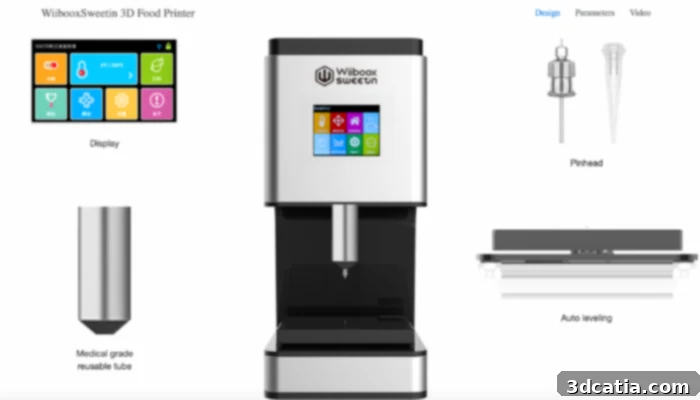
Photo Credits: WiibooxSweetin
The landscape of 3D food printing is rapidly evolving, offering an exciting blend of technological innovation and culinary artistry. From crafting delicate chocolate confections with the Choc Creator V2.0 Plus and mycusini® 2.0, to experimenting with liquid-based vegan foods with nūfood, or designing intricate dishes for professional kitchens with Foodini and the OPUS, these printers are reshaping how we interact with our food. They provide unprecedented opportunities for customization, personalization, and creative expression, while also offering practical benefits like reducing waste and promoting healthier eating habits. Whether you’re a curious home chef, a professional looking to elevate your gastronomic offerings, or a researcher exploring new food science, there’s a 3D food printer on this list designed to meet your needs and spark your imagination. The future of food is being printed, layer by delicious layer, and it’s more accessible than ever before.
What are your thoughts on these incredible food 3D printers? We’d love to hear your opinions and experiences! Let us know in a comment below or join the conversation on our Linkedin, Facebook, and Twitter pages. Don’t forget to sign up for our free weekly Newsletter here to get the latest 3D printing news delivered straight to your inbox! You can also explore all our fascinating videos on our YouTube channel for more insights into the world of additive manufacturing.