
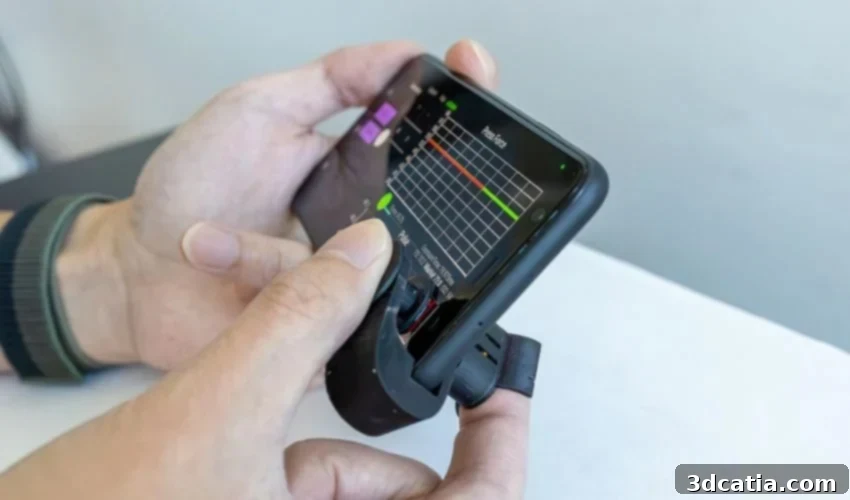
Revolutionizing Blood Pressure Monitoring: Affordable 3D-Printed Smartphone Attachment from UC San Diego
Hypertension, commonly known as high blood pressure, presents a significant global health challenge. According to the Centers for Disease Control and Prevention (CDC), this silent killer was a primary or contributing cause in a staggering 691,095 deaths in the United States in 2021 alone. Furthermore, an alarming nearly half of all adults in the U.S. — approximately 116 million individuals — live with hypertension. Effective management and consistent monitoring are absolutely critical for these patients to prevent serious health complications such as heart attack, stroke, and kidney disease. However, traditional blood pressure monitoring methods often come with barriers: they can be cumbersome, expensive, or require frequent visits to healthcare clinics, making consistent self-monitoring challenging for many.
Addressing these critical issues, researchers at the University of California San Diego (UC San Diego) have made a groundbreaking stride in digital health innovation. They have developed a novel method designed to simplify blood pressure monitoring, making it significantly more accessible and, crucially, more affordable. Leveraging the power of additive manufacturing, often referred to as 3D printing, the innovative team has successfully produced a compact attachment for smartphones. This ingenious device enables users to accurately measure their blood pressure directly from their fingertip, transforming a complex medical procedure into a convenient, at-home task.
How the 3D-Printed Smartphone Attachment Works
The simplicity and elegance of the design are key to its potential widespread adoption. The 3D-printed plastic attachment is ingeniously designed to clip securely over a smartphone’s existing camera and flash module. This setup transforms an everyday device into a powerful medical monitoring tool. When a user presses their fingertip onto the attachment, the smartphone’s flash illuminates the fingertip. The light then travels through a precisely engineered, pinhead-sized channel within the attachment, projecting an image of a red circle onto the smartphone’s camera sensor.
Inside the attachment, a small, calibrated spring plays a crucial role. This spring allows the user to apply varying amounts of force with their fingertip. As the user presses harder on the attachment, the red circle projected onto the camera sensor perceptibly grows larger. This dynamic interaction is precisely what the accompanying, specially developed smartphone application is designed to interpret. The app’s sophisticated algorithm reads two vital pieces of information from the individual red circle image: the size of the circle and its brightness. The size of the circle directly correlates with the amount of pressure exerted by the fingertip, while the brightness of the circle measures the amount of blood flowing through the capillary beds in the fingertip. By combining and analyzing these two data points, the smartphone application’s algorithm is able to convert this real-time information into accurate systolic and diastolic blood pressure values, mirroring the readings typically obtained from a conventional blood pressure cuff.
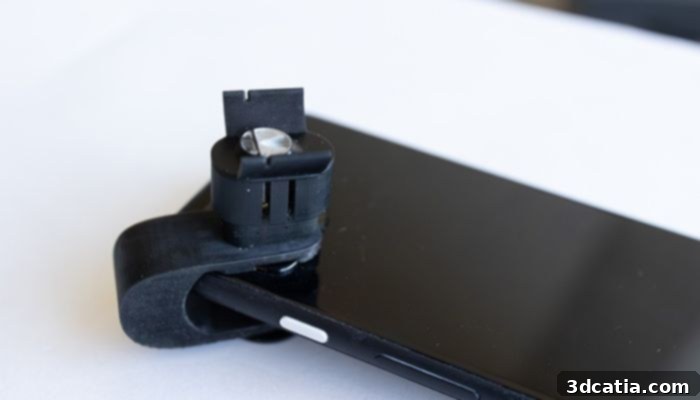
The attachment is attached to the smartphone like a clip, making it easy to use.
Enhancing Accessibility and User Experience for All
One of the most compelling advantages of this innovative smartphone attachment is its potential to significantly improve accessibility and ease of use, particularly for demographics that often face challenges with traditional monitoring devices. Dr. Alison Moore, a study co-author and medical fellow, as well as chief of the UCSD School of Medicine’s Division of Geriatrics, highlighted this benefit, stating, “Using a standard blood pressure cuff can be awkward to put on correctly, and this solution has the potential to make it easier for older adults to self-monitor blood pressure.” This sentiment underscores a common barrier to consistent monitoring: the inconvenience and sometimes physical difficulty associated with correctly positioning and operating a traditional arm cuff. For older adults, or individuals with limited dexterity, this struggle can lead to infrequent readings, compromising effective hypertension management. The fingertip-based, clip-on design removes these hurdles, empowering users to take accurate readings with minimal effort and without assistance.
To validate its effectiveness, the research team rigorously tested the device on 24 volunteers at the UC San Diego Medical Center. The results from these trials were highly encouraging, demonstrating that the readings obtained from the 3D-printed smartphone attachment were comparable to those acquired from a traditional, validated blood pressure cuff. This clinical validation is a crucial step, confirming the device’s reliability and paving the way for its future medical application. The success in these initial trials bolsters confidence in the attachment’s ability to provide trustworthy measurements in a real-world setting, further solidifying its potential as a viable alternative for personal blood pressure monitoring.
A Paradigm Shift: Unprecedented Cost-Effectiveness
Driving Affordability in Healthcare Through Innovation
Perhaps the most transformative aspect of this UC San Diego innovation is its astonishingly low manufacturing cost, which holds the potential to dramatically reshape access to blood pressure monitoring. Currently, each 3D-printed attachment costs an estimated 80 cents to produce. However, the research team projects that this price could plummet to as little as 10 cents per unit if manufactured at scale through mass production techniques. This extreme affordability positions the device as a game-changer, particularly for underserved populations and regions where access to medical equipment and regular clinical visits are significant barriers.
Edward Wang, the study’s lead author, a distinguished professor of electrical and computer engineering at UC San Diego, and director of the Digital Health Lab, eloquently articulated the profound implications of this low cost. He commented, “Because of their low cost, these clips could be handed out to anyone who needs them but cannot go to a clinic regularly.” He further elaborated on this vision, drawing a compelling analogy: “A blood pressure monitoring clip could be given to you at your checkup, much like how you get a pack of floss and toothbrush at your dental visit.” This comparison highlights the potential for the device to become a routine, disposable, and universally distributed tool for preventive health, seamlessly integrated into standard medical care without imposing financial strain on patients or healthcare systems. Such an approach could fundamentally enhance population-level health by making consistent monitoring a pervasive reality rather than a privilege.
In the future, this breakthrough is poised to make vital blood pressure monitoring significantly more affordable and broadly accessible than ever before. Beyond its economic benefits, another distinct advantage of this development is its revolutionary calibration-free system. Traditional blood pressure monitors often require periodic calibration against a reference device, a process that can be inconvenient and, if not done correctly, can lead to inaccurate readings. Wang emphasized this critical distinction, explaining, “Ours is a calibration-free system, meaning you can just use our device without touching another blood pressure monitor to get a trustworthy blood pressure reading. This is what distinguishes our device from other blood pressure monitors.” This ‘plug-and-play’ functionality eliminates a major hurdle, ensuring that users can obtain reliable readings immediately and consistently, fostering greater adherence to monitoring protocols and ultimately improving health outcomes.
The Power of Additive Manufacturing
The choice of additive manufacturing was pivotal to the success and potential of this project. 3D printing offers unparalleled flexibility in design, allowing for the rapid prototyping and iteration of complex geometries that would be difficult or costly to achieve with traditional manufacturing methods. For the UC San Diego team, this meant they could quickly test and refine the attachment’s ergonomic clip design, the precise dimensions of the pinhead channel, and the intricate housing for the spring mechanism. The ability to produce custom, high-precision plastic components on demand was essential for developing a device that integrates seamlessly with various smartphone models while maintaining optimal functionality.
Beyond rapid development, 3D printing is also instrumental in achieving the remarkably low production costs. For initial batches and even for mass production, especially with advances in high-volume additive manufacturing technologies, the process can be highly efficient in material use, minimizing waste. This efficiency, combined with the inherent ability to create intricate designs without expensive tooling, contributes directly to the projected cost of just cents per unit. This technological choice is not merely a convenience; it is a fundamental enabler for the project’s core mission: to make life-saving medical technology universally affordable and accessible.
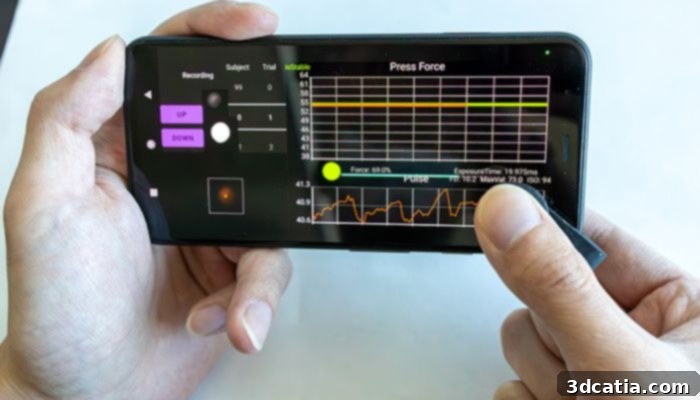
With the help of the app, the user is able to know how hard and for how long it is necessary to hold down on the attachment with the fingertip, ensuring accurate readings.
Future Outlook and Commercialization
The journey for this revolutionary blood pressure monitor is far from over. The dedicated researchers are actively engaged in refining the device, focusing on enhancing the user experience and ensuring broad compatibility with the ever-evolving landscape of different smartphone models. To further advance and commercialize this promising development, the team has founded Billion Labs Inc. This new venture aims to bring this innovative technology from the laboratory to the global market, making a tangible impact on public health. More comprehensive information and detailed scientific findings can be found in their published report HERE, providing in-depth insights into the research methodology and results.
This 3D-printed smartphone attachment represents a significant leap forward in digital health and personalized medicine. By democratizing access to essential health monitoring, it has the potential to empower millions to take proactive control of their cardiovascular health, reduce the burden of hypertension-related diseases, and foster a new era of preventive care. The fusion of additive manufacturing with smartphone technology underscores the boundless possibilities for innovation at the intersection of engineering and medicine, promising a healthier future for all.
What do you think of this innovative 3D-printed attachment for blood pressure monitoring? Would you consider using it to keep track of your blood pressure from the comfort of your home? Share your thoughts and feedback in a comment below, or engage with us on our LinkedIn, Facebook, and Twitter pages! Don’t forget to sign up for our free weekly Newsletter here to receive the very latest 3D printing news straight to your inbox! You can also find all our compelling videos and interviews on our YouTube channel.
*All Photo Credits: UC San Diego