
Dubai’s Deciduous Pavilion: A Landmark in Sustainable 3D Printed Architecture and Digital Fabrication
Dubai continues to solidify its reputation as a global leader in embracing cutting-edge technologies, particularly within the construction sector. The city has become a veritable hub for 3D printing construction projects, arguably hosting more innovative experiments and large-scale applications than any other metropolis worldwide. This ambition is deeply rooted in the “Dubai 3D Printing Strategy” launched in 2016 by His Highness Sheikh Mohammed bin Rashid Al Maktoum, which aims for 25% of new buildings in Dubai to be 3D printed by 2030. This forward-thinking vision positions Dubai at the forefront of sustainable and efficient construction practices, fostering an environment ripe for innovation and groundbreaking architectural achievements in digital fabrication.
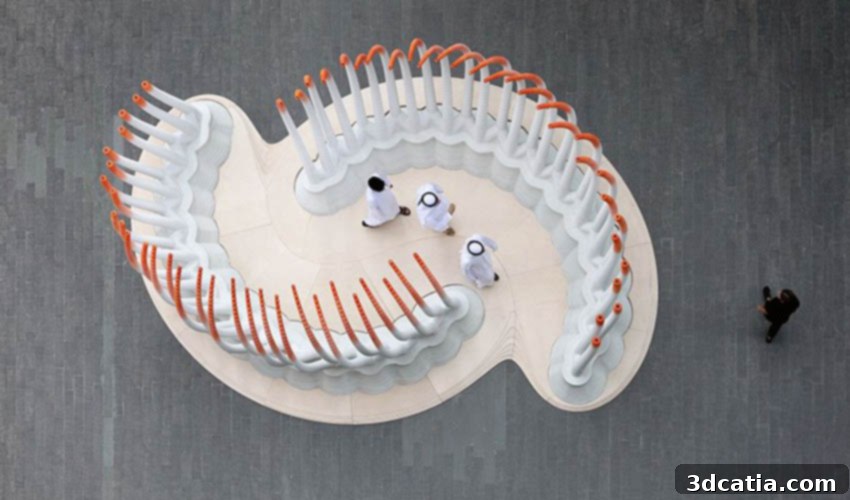
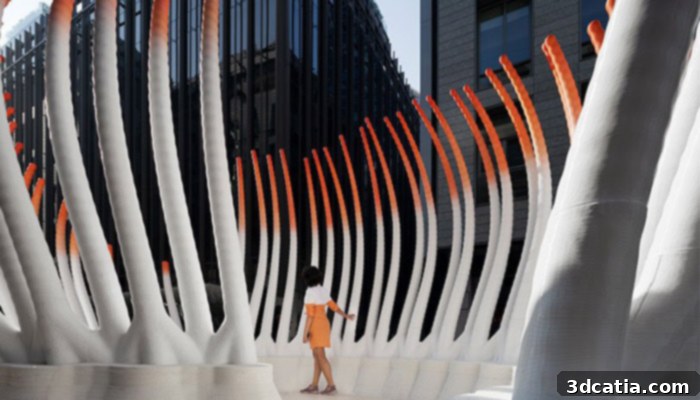
In line with this strategic direction, the Middle East Architectural Network, widely recognized as MEAN*, recently unveiled a remarkable 3D printed pavilion at Dubai’s International Financial Centre (DIFC). This stunning structure, aptly named Deciduous, stands as a testament to the transformative potential of additive manufacturing in architecture. Designed to evoke an abstract botanical form, the pavilion gracefully suggests humanity’s intrinsic connection to nature and the environment, inviting introspection and appreciation for organic shapes within an urban landscape. Standing an impressive 11 feet tall, Deciduous offers visitors an immersive experience, guiding them through its elegantly curved, S-shaped pathway. This intricate design not only creates a sense of flow and discovery but also exemplifies the freedom of form that robotic 3D printing can achieve, transcending the limitations often associated with traditional construction methods and opening new avenues for bespoke architectural elements.
The realization of the Deciduous pavilion was a monumental collaborative undertaking, bringing together the specialized expertise of more than five leading companies. This interdisciplinary approach underscores the complex yet necessary nature of integrating advanced 3D printing technologies into cutting-edge architectural projects. MEAN* emphasized that the project was conceived with Dubai’s strong focus on 3D printing as a sustainable technology in mind. The endeavor was a deliberate and ambitious exploration into the vast possibilities offered by robotic 3D printing, specifically utilizing both plastic and concrete materials. This innovative dual-material approach not only showcases versatility but also pushes the boundaries of what is achievable in contemporary architectural design and construction, highlighting the adaptability of additive manufacturing for diverse structural and aesthetic requirements.
Key players in this collaborative effort included UK-based Ai Build, renowned for its expertise in large-scale polymer 3D printing. Ai Build played a crucial role in bringing the plastic components of the pavilion to life, demonstrating a profound commitment to environmental stewardship by utilizing recycled plastic filament. This innovative material was sourced from an astonishing 30,000 discarded water bottles, supplied by Reflow Filament, highlighting a successful implementation of circular economy principles within a high-profile architectural project. On the other hand, Besix 3D, a regional powerhouse in additive manufacturing, was instrumental for its unparalleled expertise in concrete 3D printing. Their contribution ensured the structural integrity and aesthetic quality of the concrete elements, showcasing the robust and versatile applications of 3D printed concrete in complex designs. This synergy between different material specialists was fundamental to the pavilion’s innovative construction, demonstrating how diverse additive manufacturing techniques can be integrated seamlessly.
The Innovative Construction Process of Deciduous
The design and construction process behind Deciduous, while sophisticated and reliant on advanced computational methods, proved to be significantly less complex and time-consuming than if traditional manufacturing and assembly techniques had been employed. This efficiency is a direct advantage of leveraging digital fabrication tools and additive manufacturing, particularly for projects with intricate geometries. The pavilion was meticulously designed to be assembled from a series of interconnected parts, a strategic decision that facilitated its complete prefabrication off-site. This off-site approach allowed for greater precision, quality control, and the simultaneous production of various components, significantly streamlining the overall project timeline and reducing potential disruptions at the final installation site.
The diverse components of Deciduous included CNC-cut birch plywood elements that formed the essential structural framework, robotically 3D printed concrete sections providing robustness and foundational support, and intricately formed robotically 3D printed polymer parts contributing to its organic and visually compelling aesthetic. Once these various sections were expertly manufactured off-site, leveraging the controlled environments of specialized fabrication facilities, the assembly phase commenced on-site in Dubai’s International Financial Centre. Remarkably, this assembly was accomplished with minimal disruption and without the need for heavy machinery, significantly reducing logistical complexities, on-site disruptions, and the overall environmental footprint of the construction process. This agile assembly process highlights another key benefit of modular 3D printed construction: speed and efficiency.
MEAN* elaborated on their design philosophy, stating: “Computational modeling was used to conceive and quantify the design to a level of detailing optimal within the parameters and constraints of large format robotic 3D printing.” This statement underscores the pivotal role of parametric design and computational tools in modern architectural fabrication. By employing advanced software, designers could explore complex geometries, optimize material usage, simulate structural performance, and ensure the constructability of the intricate botanical forms using the chosen robotic 3D printing technologies. This digital workflow enabled precise control over every detail, from structural integrity to aesthetic finish, ensuring that the final physical structure accurately reflected the ambitious digital model and met exacting standards for both form and function.
The Deciduous pavilion, much like other pioneering projects globally, serves as a powerful showcase of the vast capabilities that additive manufacturing technologies bring to the construction sector. It demonstrates not only the potential for aesthetic innovation and creative freedom but also for enhanced efficiency, reduced waste, and improved sustainability. However, it is crucial to temper enthusiasm with a realistic perspective. While such projects are inspiring, they do not yet signify that 3D printed homes or large-scale commercial buildings will become mainstream any time soon. The construction industry’s adoption of 3D printing is still in its nascent stages, with many significant milestones yet to be achieved across areas such as material science advancements, development of robust regulatory frameworks and building codes, standardization of processes, and scalability to meet mass production demands.
Towards the end of last year, COBOD, one of the foremost manufacturers of advanced 3D printers for construction, offered a vital perspective on the industry’s trajectory. They explicitly pointed out many of the misconceptions surrounding 3D printed buildings and cautioned against the overly idealistic visions sometimes painted by certain industry players. While 3D printing offers immense promise in reducing waste, accelerating build times, and creating unique designs, challenges remain in achieving consistent cost-competitiveness at a mass scale, ensuring long-term structural integrity with novel materials, navigating complex existing building codes, and addressing the current skills gap in the construction workforce. It is imperative for stakeholders, from architects and engineers to policymakers and investors, to maintain a realistic outlook, celebrating innovative projects like Deciduous for their significant contributions to pushing boundaries, without underestimating the substantial research, development, and integration work still required for widespread adoption.
Indeed, projects like the Deciduous pavilion are more than just architectural marvels; they are critical testbeds for future construction methodologies. They provide invaluable data and lessons learned that propel the entire industry forward, offering insights into material performance, robotic precision, and logistical efficiency. By integrating recycled materials and demonstrating efficient off-site fabrication followed by quick, low-impact on-site assembly, MEAN* and its collaborators have not only created an iconic structure that enhances the urban fabric of Dubai but also contributed significantly to the global discourse on sustainable and digitally driven construction. Dubai continues to lead by example, showcasing how strategic investment in research and development, coupled with bold architectural vision, can transform the built environment for a more sustainable, efficient, and innovative future. These achievements pave the way for a deeper understanding of additive manufacturing’s true potential, inspiring further exploration into bespoke architectural elements, affordable housing solutions, and rapid construction in diverse environments worldwide.
What are your thoughts on this groundbreaking 3D printed pavilion and the future of sustainable architecture in urban centers like Dubai? We invite you to share your insights and comments below, or engage with us on our Facebook and Twitter pages! For all the latest news, innovations, and developments in the world of 3D printing, make sure to sign up for our free weekly Newsletter, delivered straight to your inbox.